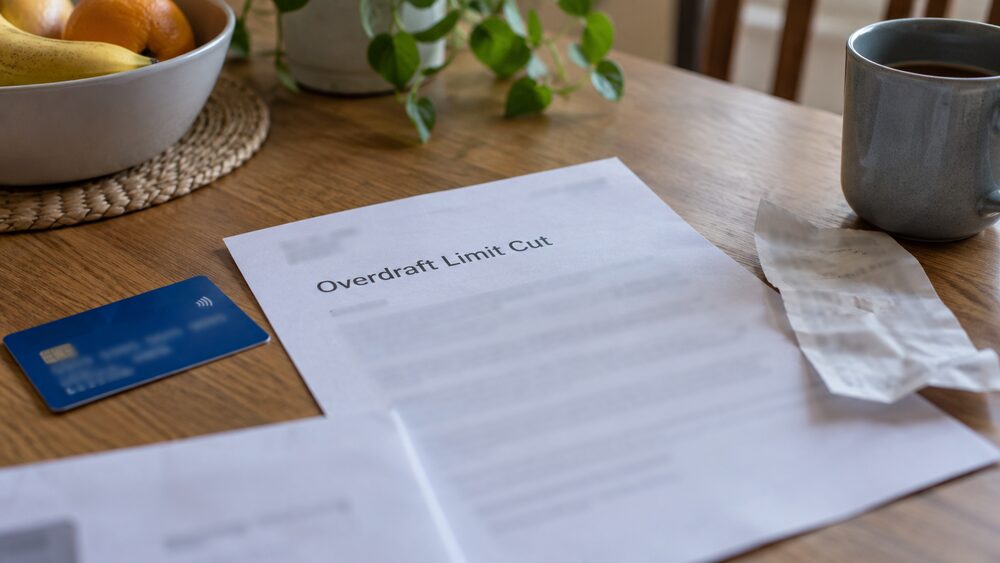
Yes. Your bank can cancel or lower your overdraft limit at any time, and an arranged overdraft is repayable on demand. It is not guaranteed borrowing, and it is not a long-term loan. Experian's guidance is blunt about it: your bank can decide to cancel or lower your limit at any time, and this may be more likely if you keep going over it1. Halifax says the same of arranged overdrafts: your bank or building society could change or cancel your overdraft at any time and it may be repayable on demand2.
Yes. Your bank can cancel or lower your overdraft limit at any time, and an arranged overdraft is repayable on demand. It is not guaranteed borrowing, and it is not a long-term loan. Experian's guidance is blunt about it: your bank can decide to cancel or lower your limit at any time, and this may be more likely if you keep going over it1. Halifax says the same of arranged overdrafts: your bank or building society could change or cancel your overdraft at any time and it may be repayable on demand2.
That matters most to people who use an overdraft as a permanent cushion. MoneyHelper's own explanation of overdrafts says one reason an overdraft is not safe for long-term borrowing is that it is not guaranteed, and the bank could take it away if it thinks you are over-using it and are in financial difficulty3.
The good news is that a cut is not the end of your options. You can ask the bank to reduce or remove the limit yourself, move to a basic bank account with no overdraft, switch current accounts even while overdrawn, or get free debt advice. This page sets out what banks can do, what you can do, and where the rules protect you.
Your bank can withdraw or reduce your overdraft at any time
An arranged overdraft is a credit facility the bank grants you, and the bank keeps control of it. Experian's consumer guide states that your bank can decide to cancel or lower your overdraft limit at any time, and that this may be more likely if you keep going over your limit1. Halifax's explanation of borrowing options says an arranged overdraft could be changed or cancelled at any time and may be repayable on demand2.
Some overdrafts shrink on a schedule rather than by a decision. Graduate account overdrafts are the clearest example: the limit goes down every 12 months, so the interest-free cushion you had in your first year after university is smaller the next year and smaller again after that5. If you have been treating that limit as fixed, the reduction can arrive as a surprise even though it was built into the account.
The "repayable on demand" wording is the part people miss. It means the bank can ask for the money back, not just stop you borrowing more. In practice banks rarely demand the whole balance at once, and MoneyHelper notes that where customers were left worse off after the April 2020 overdraft pricing changes, banks might reduce or waive interest, offer a continuation of overdraft borrowing at the current rate of interest, or agree a repayment programme, possibly including a personal loan3.
What you cannot assume is that the facility will still be there next year. An overdraft is best treated as short-term borrowing that can be withdrawn, not as an income top-up.
Why banks cut or close overdrafts and accounts
Banks cut limits for a mix of commercial and risk reasons. The most common trigger is use: Experian links cancellation or a lower limit to repeatedly going over the limit1. MoneyHelper frames the same point as the bank deciding you are over-using the overdraft and are in financial difficulty3.
Accounts can also be closed outright. A bank is more likely to close an account where there is a form of credit attached, such as an overdraft6. Banks also have to close accounts when they cannot carry out the "know your customer" checks required by money laundering regulations, or where they are concerned an account may be used for financial crime7. Which? has reported other reasons given for frozen accounts, including suspicious transactions outside the normal range for the account, lack of use, suspected fraud, and reputational risk8.
If you are bankrupt, the picture changes sharply. StepChange's guidance says that during bankruptcy your bank is unlikely to let you keep your account if you have an overdraft or other debts with them6. Under the minimal asset process in Scotland, the bank can close your account, usually where there is a credit facility attached such as an overdraft, but banks are required to provide a basic bank account if they fully close your account9.
What to do if your overdraft is removed while you are overdrawn
The first step is to talk to the bank. MoneyHelper's guidance for customers left worse off by the April 2020 changes sets out what banks might do: reduce or waive interest, offer a continuation of overdraft borrowing at the current rate of interest, or agree a repayment programme, possibly including a personal loan3. Those are options to ask about, not entitlements, but they are the outcomes banks have said they will consider.
If you do nothing, the costs stack up. An unauthorised overdraft can mean a penalty charge and a high rate of interest, charges for reminder letters and for direct debits or cheques put through the account, and the bank may freeze the account until the overdraft is paid off11. Banks also charge a monthly fee and a setting up fee on the overdraft, which makes it an expensive way to borrow11. Advice NI notes that if you overdraw, the bank will charge interest on a daily basis and can ask that the overdraft is cleared on demand12.
Switching is still possible. MoneyHelper confirms you can switch using the Current Account Switch Service even if you are overdrawn3. The mechanics matter: if the new account's overdraft covers what you owe, the funds are sent to your old bank and you owe the overdraft balance on the new account instead. If it is a lower amount, or you cannot get one, you need to arrange to pay off the remainder separately before you can switch or close your old account10.
Asking the bank to reduce or remove your overdraft yourself
You do not have to wait for the bank to act. Every major provider lets you manage the limit yourself, and asking for a reduction or removal is a normal request.
| Provider | How to reduce or remove your limit |
|---|---|
| HSBC | Ask to increase, decrease or remove your arranged overdraft in the HSBC Mobile Banking App14 |
| Lloyds Bank | Increase or decrease your overdraft limit, or cancel an arranged overdraft you are not using15 |
| Zempler Bank | Request the reduction or removal of your overdraft at any time by contacting the bank16 |
| Hampden Bank | Clients can request the reduction or removal of an overdraft limit at any time by contacting their banker17 |
One rule applies across all of them: the new limit cannot be less than what you already owe18. If you are £400 overdrawn, you cannot ask for a limit below £400; the lowest you can set is £400, and you clear the rest by paying in. That is why the practical sequence is to stop using the overdraft first, then reduce the limit as the balance falls.
Reducing a limit you are not using is a sensible piece of housekeeping, and it is different from the bank cutting it. You keep control of the timing, and you avoid the position where a facility you rely on disappears at short notice.
A balance transfer moves the debt, not the interest rate
If the overdraft has become a standing debt rather than a short gap, the options are the ones that apply to any non-priority debt. Overdrafts sit in the non-priority group alongside bank loans, credit card or store card bills, and money borrowed from friends and family19. That matters because priority debts, such as rent, mortgage, council tax and energy, come first when you are working out what you can afford.
One option is to separate the overdraft from day-to-day banking by setting up a new account with no overdraft, so the balance stops moving and you can pay it down on a fixed plan20. A basic bank account does this: it will not let you go overdrawn, and because you have no overdraft facility you are not charged interest on the account13. Basic bank accounts must be fee-free for standard operations when provided in sterling and must not have an overdraft facility4. If you are turned down for a standard account, you might be offered a basic bank account instead10.
Another option is to keep the overdraft but treat it as a priority. National Debtline's student money guidance suggests that if the overdraft is interest-free, you could treat debts to the same bank as priorities so that you keep the overdraft, because if the bank starts charging interest the overdraft could increase very quickly22. Business Debtline gives the same reasoning for interest-free overdrafts held with the same bank as other debts23.
Where to get help with overdraft debt
Free, impartial help exists and it does not cost anything to use. MoneyHelper, the government-backed money guidance service, explains how overdrafts work and what banks might offer if you are struggling3. StepChange, National Debtline and Business Debtline all publish free guidance on overdraft debt and the options around it20. Scope has practical and emotional advice for people in debt, including where to turn19.
If your mental health is affected, that is a recognised part of the problem rather than a side issue. Money and Mental Health's research found that nine in ten survey respondents from its Research Community agreed that overdrafts are a form of debt26.
If you are dealing with a formal debt solution, the rules interact with your bank account. Overpayments taken from your benefits should stop when a debt relief order is approved27. Under the minimal asset process in Scotland, banks are required to provide a basic bank account if they fully close your account9.
The regulator's role is worth understanding, because it is not what many people expect. The Financial Conduct Authority does not settle individual complaints and cannot grant redress to consumers who have suffered loss because a term or notice is unfair or insufficiently transparent28. It can apply to court for restitution, or require it, where an unfair term also amounts to a rule breach causing loss to consumers, and it can make rules requiring firms to set up consumer redress schemes28. It has also taken an interest in how banks set overdraft prices, writing to banks to seek clarification about how they determined the new interest rate29. Its high cost credit review work has covered measures such as text message alerts, fee calculators and account switching eligibility tools, and banning the practice of framing an overdraft as part of the available balance30.
For an individual dispute, the route is your bank first, then the Financial Ombudsman Service. MoneyHelper's guidance is that if your bank cancels your overdraft with no warning you might have grounds to complain, and if you are not satisfied with the outcome you can take your complaint to the Financial Ombudsman Service3.
Where the rules protect you, and where they stop
The rules give you alerts and a complaints route. They do not give you a right to keep an overdraft.
Under the FCA's banking conduct rules, a firm must ensure that for each personal current account held by a banking customer, the customer is enrolled to receive arranged overdraft alerts, unarranged overdraft alerts, and alerts for attempts to overdraw without prior arrangement31. A customer can also opt out of arranged overdraft alerts regardless of the other alerts they choose to receive31. In practice this means a bank normally contacts a customer when a payment is about to take them into an unarranged overdraft, which is the moment to act rather than weeks later.
What the rules do not do is guarantee the facility. An overdraft remains repayable on demand, and the bank can withdraw it1. The FCA's own position is that it does not have the power to grant redress to consumers who have suffered loss because a term or notice is unfair or insufficiently transparent, though it can act where an unfair term also breaches a rule and causes loss28.
"Your bank can decide to cancel or lower your overdraft limit at any time. This may be more likely if you keep going over"
If a bank closes your account, access to banking does not disappear entirely. Where a bank fully closes an account, it is required to provide a basic bank account9. The FCA has also set out expectations for firms when implementing branch or ATM closures, including considering the likely impact on customers, communicating changes clearly and in good time, and taking appropriate steps to ensure customers can continue to have appropriate access to banking and cash services32.
Sources32 cited
- What is an overdraft? Experian, 2026
- Loan, credit card or overdraft? Halifax, 2026-09-27
- Overdrafts explained MoneyHelper, 2026-09-25
- Basic bank accounts: July 2023 to June 2024 GOV.UK, 2025-11-05
- Graduate overdrafts StepChange, 2026-09-25
- Bank accounts after bankruptcy StepChange, 2026-09-25
- Access to banking services and cash House of Commons Library, 2026-09-26
- Why banks are freezing accounts and what to do if it happens to you Which?, 2021-09-18
- Minimal asset process bankruptcy StepChange, 2026-09-25
- How to open, switch or close your bank account MoneyHelper, 2026-09-25
- Overdrafts and other bank debts nidirect, 2025-11-07
- Basic bank accounts Advice NI, 2026
- Save money on your social life StepChange, 2026-09-25
- Managing your overdraft HSBC, 2026
- Cost of living FAQs Lloyds Bank, 2022-11
- Managing your credit limit Zempler Bank, 2026-09-26
- Overdrafts Hampden Bank, 2026
- Overdrafts explained HSBC, 2026
- Practical and emotional advice when in debt Scope, 2026-08-05
- How can I stop living in my overdraft? StepChange, 2026-09-25
- Basic bank accounts Advice NI, 2026
- Student money and debt National Debtline, 2026-09-25
- Student money and debt Business Debtline, 2026-09-26
- Debt consolidation Business Debtline, 2026-09-26
- Top tips for borrowing Citizens Advice, 2026-09-25
- Gambling in the red Money and Mental Health, 2026-04-22
- Creditor contact on a DRO StepChange, 2026-09-25
- Unfair contract terms FCA Handbook, 2026
- The FCA high-cost credit review House of Commons Library, 2026-07-08
- FCA high-cost credit review response StepChange, 2026-09-25
- BCOBS 8: overdrafts FCA Handbook, 2026-09-25
- Our response to HMT's call for evidence for the Access to Banking Review Financial Ombudsman Service, 2026-07
 Financial Ombudsman ServiceFree, independent help when a complaint about a firm is not put right
 FSCSProtects your money if a bank, insurer or investment firm fails
 FCA Warning ListCheck whether a firm is authorised before you deal with it
 MoneyHelperFree, impartial money and pensions guidance, set up by government
 Citizens AdviceFree advice on money, consumer and legal problems in England and Wales