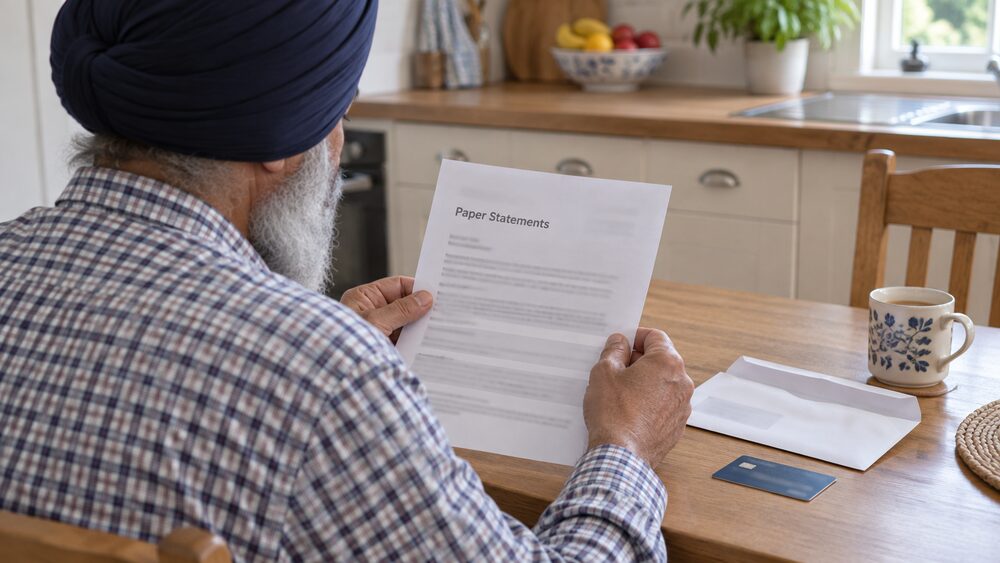
Your bank has to give you regular statements, and in most cases it does not charge for them. The FCA's banking conduct rules say a firm "must provide or make available to a banking customer on paper or in another durable medium such regular statements of account as are appropriate to the type of retail banking service provided"1. Lloyds puts it plainly: "Statements - we will send you regular account statements free of charge"2.
Your bank has to give you regular statements, and in most cases it does not charge for them. The FCA's banking conduct rules say a firm "must provide or make available to a banking customer on paper or in another durable medium such regular statements of account as are appropriate to the type of retail banking service provided"1. Lloyds puts it plainly: "Statements - we will send you regular account statements free of charge"2.
Charges appear at the edges. Ask for a copy of an old statement, or for statements more often than normal, and a fee can apply. Santander offers "free one off, monthly or quarterly paper statements on request" but says "There is a charge for weekly paper statements"3. Halifax says "Getting paper copies of your statements is free"4. AIB NI charges £10 per request per account for a duplicate paper statement5, while Virgin Money charges £5.00 per statement on several accounts6.
The rules also set a ceiling on what you can be charged for extra statements: any charge must reasonably correspond to the firm's actual costs1. And if you spot a payment you did not make, you may have to pay up to £35 of it if it was taken before you told the bank, but nothing after9.
Regular statements are usually free
The starting point is that a statement is part of the account, not an add-on. The FCA rule requires firms to provide or make available regular statements appropriate to the type of retail banking service, on paper or in another durable medium1. Lloyds states that it sends regular account statements free of charge2, and Halifax says paper copies of its statements are free4.
Age UK notes that if you want to, "you'll still receive monthly bank statements in the post", or you can opt to go paperless and receive them by email or download them from your online account13. That choice is yours to make, and switching back is usually possible: Coutts, for example, has a help page on switching paper statements back on, warning customers to "consider your statement frequency when doing so as additional charges could be incurred"14.
Basic bank accounts, which the largest banks must offer, usually carry no fees at all3. If you hold one of those, the statement itself is not a chargeable item.
Where a charge does appear on a regular statement, it is usually something else: a monthly account fee, an overdraft fee, or a payment charge. Lloyds, for instance, says that where a monthly fee applies to a credit card, "it'll be charged to your statement each month"2. That is a product fee shown on the statement, not a fee for the statement.
When a bank can charge for paper statements
A bank can charge when you ask for something beyond the regular statement: a copy of an old one, or statements at a higher frequency than the account normally provides. The FCA rule allows a firm and a banking customer to agree a charge for providing a copy of a statement, or for providing statements more frequently than required, "at the request of the banking customer", and any such charge "must reasonably correspond to the firm's actual costs"1.
In practice the figures vary widely.
| Provider | What triggers the charge | Amount |
|---|---|---|
| AIB NI | Duplicate paper statement, per request per account | £105 |
| Virgin Money (Regular Saver, Current Account Control, Flexible Repay and Rapid Repay) | Duplicate statement, unless you have opted out of paper statements | £5.00 per statement6 |
| Jaja Vanta credit card | Each paper statement issued | £515 |
| Halifax | Paper copies of statements | Free4 |
| Lloyds | Regular account statements | Free2 |
Some providers build the charge into the frequency rather than the copy. FidBank UK says that if you would like more regular statements, "a charge will apply"16. Bank of Ireland UK says charges apply for more frequent statements and points customers to its Schedule of Fees17. Coutts states that "If you receive daily or weekly paper statements, you are charged for this service"12.
If you have opted out of paper statements and then ask for a copy, some providers waive the fee. Virgin Money's terms say no fee is charged for a duplicate statement if you have opted out of receiving paper statements6.
Weekly statements and excessive requests: where fees apply
The clearest line between free and chargeable is frequency. Santander offers free one-off, monthly or quarterly paper statements on request, and charges for weekly paper statements3. Coutts charges for daily or weekly paper statements12. Bank of Ireland UK says charges apply for more frequent statements17. FidBank UK says a charge applies if you want more regular statements16.
The other trigger is volume. Zempler Bank says: "It's free for our Customer Service team to send you your statement(s), but we may charge a fee for excessive requests"18. The provider does not publish a figure for that fee in the material available, so the amount is a matter for its terms.
There is no statutory definition of "excessive". The FCA rule frames it as a matter of agreement between firm and customer, with the charge tied to the firm's actual costs1. In practice, a single request for a copy is unlikely to be treated as excessive; repeated requests in a short period are more likely to be.
If you need statements as evidence, for example for a debt advice appointment, it helps to know what is normally accepted. Age UK's guidance on debt advice lists "bank statements for the past 3 months" among the documents needed19. Asking for three months in one request is a normal ask, not an excessive one.
Your rights under the Payment Services Regulations
The Payment Services Regulations 2017 (S.I. 2017/752) sit alongside the FCA's banking conduct rules and cover how payments are authorised, what you must be told, and who carries the loss when something goes wrong20.
Before you take out a payment service, the provider must give you its name, head office address and contact details, branch or agent details if different, and details of its regulators including any reference or registration number21. Schedule 4 requires details of all charges payable by you, including a breakdown where applicable, details of interest and exchange rates or the method of calculating reference rates, and, where agreed, the immediate application of changes in reference interest or exchange rates21.
That disclosure duty extends to currency conversion. Where a currency conversion service is offered at an ATM, at a point of sale or by the payee, the party offering it must disclose to the payer all charges as well as the exchange rate22. It does not fix the rate: the Financial Ombudsman Service notes that "the rates you see online and in newspapers are just a guide. Each bank sets its own rates"23.
Regulation 94 of the same regulations deals with the liability of a payment service provider for charges and interest24. Where a payment is taken without your authorisation, the Payment Services Regulations and the Banking Conduct of Business rules place obligations on banks and building societies to provide a refund25.
"Banks are expected to process payments a customer authorises it to make, in line with Payment Services Regulations."
Spotting unauthorised payments on your statement: the £35 limit
The statement is where most people first see a payment they did not make. The rules split your liability at the moment you tell the bank.
Before you notify it, you may have to pay up to £35 of any unauthorised payments taken9. Regulation 77 of the Payment Services Regulations 2017 allows a provider to require that the payer is liable up to a maximum of £35 for losses from use of a lost, stolen or misappropriated payment instrument28. Which? reports the same cap, noting that "the Payment Services Regulations allow banks to hold you responsible for the first £35 of any unauthorised card fraud"29.
After you notify the bank, you are not liable for any unauthorised payments taken9. So the timing of your call matters more than almost anything else.
If you claim the use of the card was not authorised by you, it is for your bank to prove otherwise30. The bank may be able to cancel the payment or put the money back into your account25. Where a continuous payment authority is taken after you withdraw consent, your card issuer should give you a refund, including any interest or charges added because the payment was taken31.
If the bank does not resolve it, the Financial Ombudsman Service can look at complaints about cheques and bankers' drafts, including cases where a cheque bounced after being paid in, where the bank did not pay a written cheque or paid after cancellation, where a cheque was lost, stolen or forged, and where a fake or missing banker's draft was not refunded32. For scams where you were tricked into making the payment yourself, the ombudsman has separate guidance23.
Free, impartial help is available if a payment problem has left you short. Age UK's debt advice service and the debt advice charities can help you work through what to do next19.
Sources32 cited
- BCOBS 4.2: Statements of account FCA Handbook, 2026-09-26
- Rates and charges for services Lloyds Bank, 2026-09-27
- Your statements Santander, 2026
- Charges Halifax, 2026-09-27
- Secure messaging FAQs AIB NI, 2026
- Regular Saver account tariff Virgin Money, 2026
- Current Account Control Virgin Money, 2026
- Flexible Repay and Rapid Repay Virgin Money, 2026
- Dealing with fraud Business Debtline, 2026-09-26
- Dealing with fraud National Debtline, 2026-09-25
- Dealing with fraud Business Debtline, 2026-09-26
- Will my statement fee change if I stop receiving paper statements? Coutts, 2026-09-25
- Online banking Age UK, 2026-03-23
- Can I switch my paper statements back on? Coutts, 2026-09-26
- Jaja Vanta summary box Jaja, 2026-05
- Notice Account Key Features FidBank UK, 2026-01
- Statements FAQs Bank of Ireland UK, 2026-09-25
- Close your account Zempler Bank, 2026-09-26
- Debt advice Age UK, 2026-03-09
- The Payment Services Regulations 2017, Part 6 legislation.gov.uk, 2026
- The Payment Services Regulations 2017, Schedule 4 legislation.gov.uk, 2026
- The Payment Services Regulations 2017, Part 6: currency conversion disclosure legislation.gov.uk, 2026
- Sending money abroad Financial Ombudsman Service, 2026-09-26
- Regulation 94: liability of payment service provider for charges and interest legislation.gov.uk, 2026
- Your payment card was used without your permission: distance sales Citizens Advice, 2026-09-25
- How to get your money back after a scam Which?, 2026-09-27
- Consumer complains their bank acted irresponsibly after they made a high volume of gambling transactions Financial Ombudsman Service, 2026-09-26
- Regulation 77: payer or payee's liability for unauthorised payment transactions legislation.gov.uk, 2026
- Contactless £100 cap ending: how to protect yourself from fraud Which?, 2026-03-13
- Your payment card was used without your permission: distance sales Citizens Advice Scotland, 2026-09-28
- Buy now pay later National Debtline, 2026-09-25
- Cheques and bankers' drafts Financial Ombudsman Service, 2026-09-26

 Financial Ombudsman ServiceFree, independent help when a complaint about a firm is not put right
 FSCSProtects your money if a bank, insurer or investment firm fails
 FCA Warning ListCheck whether a firm is authorised before you deal with it
 MoneyHelperFree, impartial money and pensions guidance, set up by government
 Citizens AdviceFree advice on money, consumer and legal problems in England and Wales