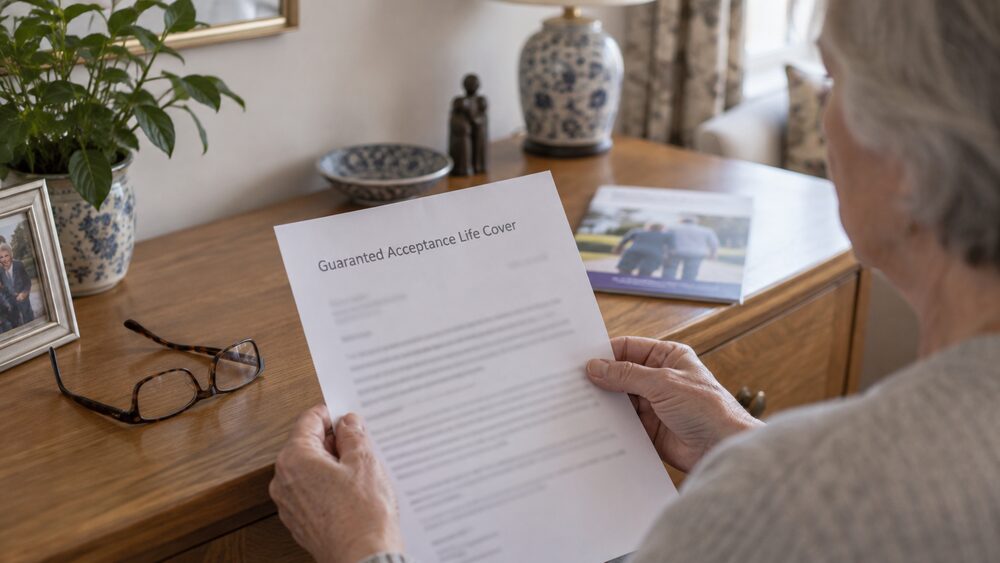
Over 50s life insurance is a whole-of-life policy sold on one promise: a fixed cash sum paid to your family when you die, with guaranteed acceptance and no medical questions for UK residents aged 50 to 801. You choose a monthly premium, the insurer tells you the sum it will pay, and provided you keep up the payments the cover lasts for the rest of your life1. It is typically used to leave money for funeral costs2.
The guarantee of acceptance is the product's whole appeal, and it is also why the sums involved are small. Because the insurer cannot refuse anyone on health grounds, it prices the plan as if every customer could die soon, and it limits its exposure by restricting cover in the first year or two1. Which? notes a key issue with these plans: they often pay out less than you have paid in premiums, and because the payouts are fixed, inflation erodes their value over time1.
That makes over 50s life insurance a product to understand before buying, not just a convenient one. This page explains who can apply, what the plans cost, how the initial waiting period works, what happens if payments stop, and how tax and funeral payments are treated, so you can weigh the plan against alternatives such as term life insurance or a standard life insurance policy.
Who can apply: UK residents aged 50 to 80, no medical questions
The eligibility rules are the same across the market because the product is built around them. Providers including the Post Office, Legal & General, TSB and Shepherds Friendly all offer guaranteed acceptance for UK residents aged 50 to 80, with no medical questions and no health checks5. Aviva describes the product simply as a life insurance policy for people aged 50 and over who are UK residents6. There is no upper health bar to clear: Shepherds Friendly states you are guaranteed to be accepted regardless of your health, with no medical questions asked4.
This is what separates an over 50s plan from ordinary life insurance. Standard policies are medically underwritten: the insurer asks about your health, hobbies and lifestyle, and sets the price, or declines the cover, accordingly. Over 50s plans are not medically underwritten, which means any pre-existing health conditions will not affect the cost1. Macmillan lists these guaranteed plans among the options that may be available to people with cancer, precisely because acceptance does not depend on health, while noting that if you die of natural causes soon after taking out the plan it will not pay out in full, usually in the first one to two years7.
The age window matters at both ends. Below 50, the product is not available, and standard life insurance is usually cheaper per pound of cover. Above 80 at application, the door closes on most plans, although cover already in place continues for life. Bank of Scotland, for comparison, requires applicants for its ordinary life cover to be 18 or over and under 608, so over 50s plans are often the only guaranteed-acceptance option for people applying in their late 70s.
One restriction worth knowing: these plans cannot be taken out on a joint life basis. Legal & General states each individual can take out their own policy instead9. Joint life insurance exists in the wider market, and couples who live together or are in a civil partnership can buy it, but a joint policy pays out on the death of the first policyholder and then ends, leaving the survivor uninsured10. Two single over 50s plans mean two payouts, one on each death. You can also hold a joint policy and a single policy at the same time if your circumstances call for it11.
What it costs: fixed premiums from about £5 a month
Premiums are fixed: the amount you agree at the start does not rise, and the cover is never reduced, regardless of changes in your health4. On the largest plans, from providers such as Legal & General and TSB, you can choose a premium between £5 and £75 a month, depending on your age and smoker status12. Shepherds Friendly's plan runs from £10 to £50 a month4, and the Post Office's premiums also start from £5 a month depending on your age and the cover amount chosen5. Cavendish Online, a broker, lists premiums starting from as low as £7 a month on the plans it sells13.
What the money buys is the catch. Which? compared quotes in December 2025 for a 53-year-old non-smoker in reasonable health: over 50s plans cost £10 to £30 a month, but the starting payout for the lower premiums was just £2,780. The same person could get standard life insurance for £7 a month: a £10,000 term policy running until they turned 901. Legal & General says the average monthly premium its over 50s customers paid over the last six months was £26.9914, which gives a sense of where real customers land in the range.
Because the premium is fixed and the payout is fixed, the relationship between them changes over time. Someone who pays £26.99 a month from age 55 will have paid in more than some of the smaller payout amounts within a decade or two. Which? is blunt about this: over 50s life insurance often pays out less than you have paid in premiums, and Which? does not recommend buying this kind of product1. That is not a reason the plan can never make sense, but it is the reason to compare it against how much life insurance cover you need and against a term policy first, especially if you are in reasonable health.
The waiting period: cover is limited in the first one to two years
Guaranteed acceptance only works for the insurer if it can limit claims in the early years, and it does this through a waiting period, sometimes called a moratorium period. The length varies by provider, and the differences are significant:
| Provider | Full cover for natural causes begins | If you die before then (non-accidental) | Accidental death |
|---|---|---|---|
| Legal & General | After one year | Premiums paid are refunded | Full cover paid within the first year3 |
| Aviva | After 12 months | An amount equal to the premiums paid | Full cover amount paid during the first 12 months15 |
| Post Office | After 12 months | 1.5x the premiums already paid | Covered immediately, at double the cover amount16 |
| Santander | After the first year | An amount equal to the premiums paid | The lump sum paid in the first year17 |
| Shepherds Friendly | After the second anniversary | Cover has not started | Cover begins from the start date4 |
Cavendish Online describes the same mechanism from the broker's side: the plans it sells come with a moratorium period, a waiting period between the policy starting and a potential payout, of two years for example13. Macmillan gives the same range for over-50s plans generally: usually the first one to two years7.
Accidental death is treated differently, and this is where the plans are most generous. The Post Office pays double the standard cover amount for accidental death from day one, with no waiting period2, and Shepherds Friendly's cover for accidental death also begins from the start date4. But the definition of "accident" is narrower than people assume. Accidental death insurance pays a fixed lump sum if you die as a result of an accident, often if you die within 90 days of it, and a death must be caused by the accident itself: if a heart attack kills you, it is not covered, though it may be covered if a non-life-threatening heart attack causes an accident that results in your death and a doctor is clear the accident killed you18.
One further early-years rule applies across life insurance: policies typically exclude suicide claims in the first one or two years after the policy starts19. The dedicated page on the over 50s waiting period and the guide to suicide exclusions cover these rules in more detail.
Missed payments cancel the policy with nothing back
Over 50s plans have no cash-in value at any point, and the consequence of stopping payments is severe. Which? states the position plainly: you must pay the premium until you die, and if you stop paying, your entire policy is cancelled and you get nothing back1. Legal & General uses the same wording for its own plan: if you stop paying premiums when due, your plan will be cancelled and you won't get anything back3.
Providers differ only in how quickly the cancellation happens:
- TSB ends cover 30 days after the first missed premium, with nothing back12.
- Santander ends the policy and cover 60 days after the last payment was due17.
- Shepherds Friendly ends cover after three missed premiums4.
The same rule applies to whole-of-life insurance generally: if you stop paying your premiums your cover will stop, your policy will end, and you will receive no benefit21. Because these plans are often held for decades, the affordability of the premium over the whole of that time matters more than the headline payout. Someone who pays in for fifteen years and then cannot continue loses everything paid, and at that age may not be able to replace the cover. The page on missed premiums and lapsed cover explains the options if you are struggling to keep up payments.
When premiums stop: age 90, 95 or after 30 years
Most over 50s plans do not require payments for the whole of your life; they require them for a long stretch of it, and then stop while cover continues. Legal & General states that with its over 50s life insurance policies, the insured person stops paying premiums at age 90, but the cover continues for life20. Aviva's version stops premiums once you have had the policy for 30 years or from the policy anniversary after your 90th birthday, whichever comes first, again with cover continuing15. Shepherds Friendly uses the same structure: premiums stop after 30 years or when you reach age 90, whichever comes first4. The Post Office plan is the outlier, with premiums stopping at 9516.
This feature is shared with whole-of-life cover generally: it pays out whenever you die, provided you continue to pay premiums, at least until you reach 9022. Which? describes the same rule in its round-up of policy types, noting you must continue to pay the premiums until the end of the term or until you are 90 for whole-of-life cover23.
The practical point is that the stopping age is part of the value of the plan. Premiums stop after 30 years, or when you reach age 90, whichever comes first, and plans can be taken from age 50 up to age 8018. Someone who starts at 50 could therefore pay for the full 30 years, while someone who starts at 80 stops paying at 90 after 10. The earlier you start, the more you pay in total, and the more likely it is that the total paid exceeds the fixed payout. The comparison page on over 50s plans versus term cover works through this trade-off.
Inflation erodes a fixed payout
The payout on an over 50s plan is a fixed number chosen at the start, and it never grows. Which? identifies this as the second structural weakness of the product: because the payouts are fixed, the effect of inflation will erode the value of the payout over time1. Shepherds Friendly makes the same point in its own terms: although the amount paid out on death is fixed, that amount is likely to reduce in value because of inflation4.
The effect compounds over the decades these plans run. A sum fixed at the outset will buy noticeably less in twenty or thirty years' time, and the plan's terms do nothing to offset that. This is the opposite of increasing cover, where the sum insured is designed to rise each year, usually with a premium that rises too. Over 50s plans keep the premium flat by keeping the payout flat, which protects the monthly budget but not the real value of the promise.
For a plan aimed at funeral costs, this matters in a particular way. If the plan is meant to cover a funeral in twenty years' time, the fixed sum needs to be judged against what funerals may cost then, not what they cost today. The comparison of over 50s life insurance and funeral plans sets out the differences, since some funeral plans fix today's prices rather than a cash sum.
Tax, inheritance tax and paying a funeral director directly
The payout itself is not taxed as income. Life insurance payments are not taxed, but they may be added to the value of your estate and become subject to inheritance tax1. Which? makes the same point in its guide to holding multiple policies: life insurance does not incur tax, but it would be added to the value of your estate, so it may then be subject to inheritance tax11. Where inheritance tax applies, it is charged above the estate threshold of £325,00024.
The standard way to keep a payout out of the estate is to write the policy in trust, so the money passes directly to the beneficiaries rather than through the estate. The guide to life insurance in trust and the page on inherit tax on payouts explain how this works. It is worth doing at the outset, because the estate's position can change over the decades an over 50s plan runs.
Two wider changes to inheritance tax are relevant to anyone planning what they leave:
- From 6 April 2027, personal representatives will be liable to report and pay any inheritance tax due on unused pension funds or death benefits, under the government's reforms25. Beneficiaries receiving death benefits will be jointly liable with the personal representatives for paying any tax due24.
- Inheritance tax on an estate, including a life insurance payout that is not in trust, can be paid by the bank directly to HMRC using form IHT423, which can matter when the estate's money is tied up while the funeral has to be paid for26.
Because these plans are typically used to provide money for funeral costs, several routes exist for getting the money to the funeral director. Over 50s plans often have the option to have the policy proceeds paid directly to a specified funeral provider27. Separately, Funeral Support Payment in Scotland can be paid either to the client or to the funeral director directly28. Charities that help with funeral costs will often only consider paying an outstanding funeral bill, and usually pay the funeral director directly rather than paying a family member, though some may help in other cases29. Marie Curie's planning-ahead guidance covers how accounts and bills are handled after a death26.
Making a claim and how long it takes
Claims on over 50s plans are usually straightforward, because there is no medical underwriting to investigate and the sum is fixed. Which? reported in November 2024 on regulator concerns about delays in life insurance payouts generally, and its figures show guaranteed over 50s plans performing well on speed: average claim processing of 20 days, against 53 to 122 days for term insurance30. The guide to claiming after a death and the page on claim documents list what the executor or family needs to send, normally the death certificate and the policy number.
The main reason an over 50s claim pays less than expected is not dispute but the waiting period rules described above: a death from natural causes in the first year or two returns only the premiums, or a small multiple of them. Because acceptance was guaranteed and no health questions were asked, there is no non-disclosure argument for the insurer to raise, which removes the most common cause of declined life insurance claims. The page on how long a claim takes covers the process in more detail.
Gift cards and other sign-up offers
Several providers sweeten the deal with welcome gifts. The Post Office offers new Over 50s Life Cover customers a gift card or experience voucher, subject to minimum premiums and a 180-day qualifying period, with the offer due to end on 30 April 202731. The conditions matter more than the headline: the reward arrives only after around six months of payments, so someone who takes the plan for the gift and then stops paying loses both the reward and the policy.
Treat these offers as marketing, not value. A one-off gift card is small against premiums that may run for decades, and it does nothing to change the three structural features that decide whether the plan is worth having: the size of the payout relative to the premiums, the waiting period, and the effect of inflation. A plan that is right on those counts does not need a gift card to justify it, and a gift card does not rescue a plan that is wrong on them.
Who sells over 50s life insurance in the UK
The market is concentrated among a handful of familiar names, most of them selling very similar plans:
| Provider | Plan | Notes |
|---|---|---|
| Legal & General | Over 50s Fixed Life Insurance | Premiums £5 to £75 a month, stop at age 903 |
| Aviva | Over 50s Life Insurance | Full cover after 12 months, premiums stop at 90 or after 30 years15 |
| Post Office | Over 50s Life Cover | 1.5x premiums returned in the first year, accidental death at double cover16 |
| TSB | Over 50s Fixed Life Insurance | Cover from £5 a month, 30-day lapse rule12 |
| Santander | Over 50s Life Insurance | 60-day lapse rule, first-year premiums returned on natural death17 |
| Shepherds Friendly | Over 50s Life Insurance | Two-year waiting period, premiums £10 to £50 a month4 |
The plans are close enough in structure that the differences that matter are the waiting period, the lapse rules, the age at which premiums stop and the payout offered per pound of premium. Brokers such as Cavendish Online sell over 50s plans alongside the rest of the life insurance market and can quote across providers13. The comparison page on over 50s plans versus term cover and the guide to buying protection insurance cover how to weigh them against fully underwritten alternatives, which are usually cheaper per pound of cover if your health allows it.
What protects you, and where it stops
The protections around an over 50s plan are the same as around any UK life insurance policy, with one addition and one gap. The addition is acceptance itself: because no medical questions are asked and acceptance is guaranteed regardless of health4, there is no health disclosure for the insurer to dispute later, which removes the non-disclosure route by which life insurance claims are most often reduced or refused. The gap is the product's own terms: the waiting period, the fixed payout and the nothing-back lapse rule are all contractual, and no regulator or ombudsman will override them.
On claims, the evidence is reassuring on speed: guaranteed over 50s plans averaged 20 days to process a claim in the figures reported in November 2024, faster than most other types of life insurance30. If a claim is disputed or delayed unreasonably, a complaint can be escalated to the Financial Ombudsman Service, the free independent service that rules on individual insurance disputes. The page on life insurance and FSCS explains what happens if an insurer fails.
The honest summary of where protection stops is the product's economics. Which? does not recommend these plans, because they often pay out less than you have paid in premiums1, and nothing in the rules changes that. What the rules do guarantee is that, provided you survive the waiting period and keep up the payments, the fixed sum will be paid. For someone who cannot get affordable underwritten cover because of their health or age, that guarantee has real value; for someone in reasonable health, it is worth checking the underwritten market first. Free, impartial help with working this out is available from MoneyHelper, and the pages on getting cover with a pre-existing condition and life insurance with no medical questions cover the alternatives in detail.
Sources31 cited
- Over 50s life insurance Which?, December 2025
- Funeral insurance guide Post Office, 2026
- Over 50s Fixed Life Insurance Legal & General, June 2026
- Over 50s Life Insurance Shepherds Friendly, September 2026
- Over 50s Life Insurance Post Office, 2026
- Life insurance glossary Aviva, September 2026
- Types of insurance Macmillan Cancer Support, September 2023
- Life cover Bank of Scotland, September 2026
- Single vs joint life insurance Legal & General, March 2026
- Joint life insurance explained Which?, August 2025
- Multiple life insurance policies explained Which?, November 2025
- Over 50s life insurance TSB, 2026
- Over 50s life insurance Cavendish Online, September 2026
- How much does over 50s life insurance cost? Legal & General, February 2026
- Over 50s Life Insurance Aviva, September 2026
- Over 70s life insurance guide Post Office, 2026
- Over 50s life insurance Santander, 2026
- Accidental death insurance explained Which?, November 2025
- Types of life insurance policy Which?, May 2025
- Premiums and payouts Legal & General, September 2026
- Whole of life insurance Cavendish Online, September 2026
- Term life insurance explained Which?, December 2025
- Types of life insurance policy Which?, May 2025
- Critical illness insurance explained Which?, August 2026
- Reforming Inheritance Tax: unused pension funds and death benefits HM Government, 2027
- Bank accounts and finances after a death Marie Curie, December 2023
- Over 50s jargon buster Shepherds Friendly, December 2014
- Funeral Support Payment Social Security Scotland, September 2026
- Grants for funeral costs Quaker Social Action, 2026
- Regulator flags long delays in life insurance payouts Which?, November 2024
- Over 50s Life Cover gift card Post Office, 2026






 MoneyHelperFree, impartial money and pensions guidance, set up by government
 Financial Ombudsman ServiceFree, independent help when a complaint about a firm is not put right
 FSCSProtects your money if a bank, insurer or investment firm fails
 Citizens AdviceFree advice on money, consumer and legal problems in England and Wales
 Turn2usFree benefits calculator and grants search from a charity