When someone close to you dies, two strands of money often need sorting at the same time: any life insurance they had, and the state benefits the surviving partner may be entitled to. The life insurance claim starts with contacting the insurer, or the person's employer if the cover came through work1. The main state support is Bereavement Support Payment, which for those with dependent children is an initial payment of £3,500 followed by 18 monthly payments of £350, and for those without children is £2,500 followed by 18 monthly payments of £1002.
Neither strand is automatic. The insurer pays out only when someone tells it about the death and makes a claim, and Bereavement Support Payment must be applied for. Timing matters most for the state payment: claim within three months of the death and you get the full run of monthly payments, and you must claim within 12 months to get the initial lump sum at all3.
This page walks through both processes in order: making the insurance claim, finding a policy you did not know about, and then the Bereavement Support Payment rules in full, including who qualifies, the deadlines, how the payment interacts with tax and other benefits, and the special rules for unmarried partners.
Making a life insurance claim: what the insurer will ask for
A life insurance policy pays out only when the insurer is told about the death and a claim is made. The first step is to contact the person's life insurance company to find out about their policy and how to make a claim1. If you do not know whether they had cover, or which company holds it, the insurer cannot begin anything until someone comes forward, so the claim genuinely starts with the family.
Where the cover came through the person's job, the route is different: contact the employer to find out whether they had life insurance and how to make a claim. Workplace cover, sometimes called death in service, is arranged by the employer and the claim is usually made through them rather than directly with an insurance company1. Our page on death in service and workplace protection benefits explains how this kind of cover works.
What the insurer will ask for varies by company, so the practical answer is to let the insurer tell you its own requirements when you first make contact. What you can expect in general terms is proof of death, evidence of your own identity and your relationship to the person who died, and details of the policy. The documents the state asks for when you claim Bereavement Support Payment give a sense of what is typically needed: originals of your marriage or civil partnership certificate and your partner's certificate of registration of death6. Separate guides cover the documents needed for a life insurance payout and how long a claim takes.
The type of policy affects what the claim produces. An over 50s plan promises a lump sum when the policyholder dies, guaranteed to pay out provided premiums were not missed2. Standard life insurance is priced on age, health and lifestyle, and pays the sum assured on death within the policy term2. Some older policies, such as savings endowments, pay out either after a fixed period or on death, whichever comes first7.
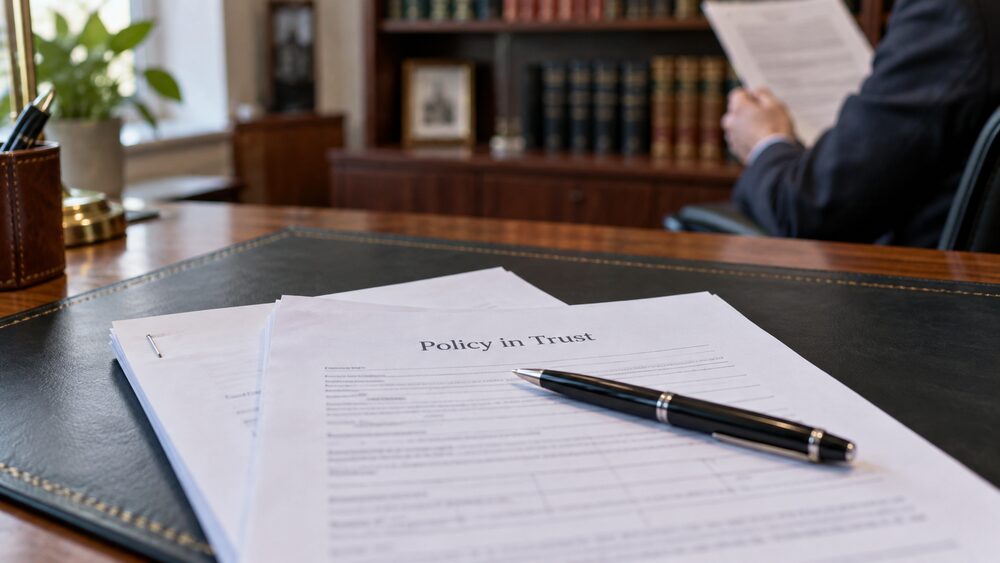
Who receives the money depends on how the policy was set up. If it was written in trust, the payout goes to the named beneficiaries directly, outside the estate. If it was not, the money usually forms part of the estate and is dealt with by the personal representatives. Life insurance payments are not taxed, but they may be added to the value of the estate and become subject to inheritance tax unless the policy was written in trust2. Our page on inheritation tax and life insurance payouts covers this in detail.
How to find a life insurance policy you did not know about
People often die without their family knowing whether they had life insurance, or with whom. There are practical ways to trace a policy. The Association of British Insurers can help you find the company holding a policy, which is the main route when you have no paperwork at all1.
Closer to home, two places usually give the game away. Check the person's bank statements for regular payments to an insurance provider: premiums are typically paid monthly or annually and show up as recurring outgoing payments. Check the person's emails as well, since insurers send policy documents, renewal notices and statements by email1.
If the person was employed, contact their employer to find out whether they had life insurance through work and how to make a claim1. Workplace cover is common and the employer will know whether a scheme existed, even if the family did not.
A few related places to look, based on the same guidance: any documents the person kept about their mortgage, since mortgage life insurance is often arranged alongside the loan, and any over 50s plan paperwork, since these policies are bought directly and frequently by post or online2. If a policy existed and premiums were being paid up to the death, the claim is worth making: an over 50s plan is guaranteed to pay out provided premiums were not missed2.
Bereavement Support Payment: up to £3,500 plus 18 monthly payments
Bereavement Support Payment is the main state benefit for people whose spouse, civil partner or, in some cases, cohabiting partner has died. It replaced the earlier bereavement benefits for people widowed on or after 6 April 20174. The structure is an increased initial payment, followed by up to 18 smaller monthly payments3.
The amounts depend on whether you have children:
| Rate | Initial payment | Monthly payments | Who gets it |
|---|---|---|---|
| Higher rate | £3,500 | 18 payments of £350 | Those entitled to Child Benefit, or pregnant when their partner died3 |
| Standard rate | £2,500 | 18 payments of £100 | Everyone else who qualifies3 |
Those with children receive an initial payment of £3,500 and 18 subsequent payments of £350; people without children get an initial payment of £2,500 and 18 subsequent monthly payments of £1005. The same figures appear in the official benefit rates for 2026/27, which confirm the standard rate lump sum of £2,500 and monthly payments of £100 for deaths on or after 6 April 20178, and in the 2026 regulations, which leave all four figures unchanged9. The government has also confirmed the rates remain the same as in 2025/2610.
The payment is not means-tested: what you earn or how much you have in savings will not affect what you get3. It is paid directly into an account of your choice on a monthly basis3. The 18-month duration was itself an extension: the government lengthened the payment period from 12 to 18 months in response to representations, and the Pensions Act 2014 does not require the amounts to be uprated each year4.
At March 2026 there were 48,000 people receiving Bereavement Support Payment, of whom 37,000 (77.5%) were on the standard rate and 11,000 (22.5%) on the higher rate11.
Who can get Bereavement Support Payment
The entitlement conditions are set in law. A person is entitled to Bereavement Support Payment if their spouse, civil partner or cohabiting partner dies, if they are under pensionable age when the partner dies, if they are ordinarily resident in Great Britain or a specified territory when the partner dies, and if the contribution condition is met12. Independent guidance puts the age test as being under 66 when your partner died13.
The contribution condition is about the deceased partner's National Insurance record, not yours: for at least 25 weeks in one tax year since 6 April 1975 your partner must have paid National Insurance contributions14. The government's guidance on benefits abroad states the same test: at least 25 weeks of National Insurance contributions must have been paid for the surviving partner to receive the payment15.
There is an exception where the contribution condition fails. If your partner died due to a workplace accident or an illness caused by work, you may still be able to claim, even if they had not made the necessary National Insurance contributions16.
Some circumstances rule a claim out. You cannot get Bereavement Support Payment if you were divorced or your civil partnership was dissolved when your husband, wife or civil partner died13. For cohabiting partners, you cannot get it if you were no longer living with your partner, or if you were living with someone else, when your partner died13.
Finally, the benefit is limited to one claim per death. The law states that only one person is entitled to bereavement support payment in respect of one death17, a rule confirmed in the Act itself18. There is no splitting of the payment between, say, a surviving spouse and another relative.
Standard rate or higher rate: which one applies to you
The rate you receive turns on children. The higher rate, £3,500 plus 18 monthly payments of £350, goes to claimants entitled to Child Benefit, and also to women who were pregnant when their partner died3. The standard rate, £2,500 plus 18 monthly payments of £100, applies to everyone else3.
Independent guidance frames the same split by responsibility for a child: if you are responsible for a child under the age of 20 you could get a lump sum of £3,500, and if you are not, £2,50016. The official statistics describe the higher rate as paid to claimants entitled to Child Benefit11.
In practice, most claimants are on the standard rate: 77.5% of the 48,000 people receiving the payment at March 2026 were on the standard rate, and 22.5% on the higher rate11. If your circumstances change during the claim, for example a child leaves full-time education, the rate you were awarded at the start governs the payments, since the award is made when the claim is decided.
Claim within three months to get the full amount
The deadlines are the part of Bereavement Support Payment that catches people out, because the amount you receive depends on when you claim. To be eligible for up to 18 monthly payments, your claim must be made within three months of the death3. The Work and Pensions Committee put the same point plainly when the benefit was designed: it must be claimed within three months of the death to receive monthly payments for the full 18 months19.
The claim period starts on the date your partner died. If you claim within three months of that date, your claim is treated as starting on the date of death and you receive a full 18 months of payments. The claim period finishes 21 months from the day after the date your partner died14.
The lump sum has its own deadline. You must claim within 12 months of your partner's death to get the initial payment; after this time you will only get monthly payments3. Age UK gives the same rule: you qualify for the lump sum as long as you claim within 12 months of the death16.
The three deadlines that decide how much Bereavement Support Payment you receive.
Claims can be backdated for up to 3 months16, which can recover some ground if the claim was delayed, but the safest position is a claim made inside the three-month window. A claim made later than 12 months after the death loses the lump sum entirely, and a claim made late in the 21-month period receives fewer monthly payments, because the claim period still ends 21 months from the death3.
How to apply for Bereavement Support Payment
You can apply for Bereavement Support Payment online, by telephone or by post3. The Northern Ireland version of the service confirms the online route and lists what you need before you start20.
Have the following ready:
- your National Insurance number3
- your bank or building society account details3
- the date your spouse or civil partner died3
- your partner's National Insurance number3
You must send originals of the supporting documents, or show them at your local Jobcentre Plus office: your marriage or civil partnership certificate, and your husband's, wife's, civil partner's or cohabiting partner's certificate of registration of death6.
Where you apply depends on where you live. The benefit was introduced in Great Britain by the Pensions Act 2014, with equivalent provision in Northern Ireland4. In Scotland, the Department for Work and Pensions continues to deliver Bereavement Support Payment to applicants, even though Social Security Scotland now runs several other benefits there21. In Northern Ireland, claims and related funeral payments are handled by the Bereavement Service, which you can contact on 0800 085 2463; you can also fill in a paper SF200 form and post it22.
Tax and other benefits: how the payments are treated
Bereavement Support Payment is tax-free. All payments are exempt from Income Tax4, a position confirmed in the government's Tax Information and Impact Note on the exemption23 and in parliamentary guidance, which states simply that BSP is not taxable19. Age UK gives the same answer for claimants: these payments are not taxable16.
The payment is also deliberately shielded from the benefits system. Bereavement Support Payment will not be taken into account when determining eligibility for means-tested benefits such as Universal Credit, Jobseeker's Allowance, Employment and Support Allowance and Income Support24. The payments do not affect entitlement to other benefits including Universal Credit, and do not count towards the household benefit cap4. During the coronavirus period this treatment was highlighted again: the payment does not affect eligibility for other benefits for one year after the first payment25.
Two boundaries are worth knowing. First, Bereavement Support Payment does not count as a qualifying benefit for a Funeral Expenses Payment in England and Wales, so receiving it does not open the door to that funeral help on its own16. Second, the payments are grants and do not need to be paid back by the person who has made the claim22.
For the life insurance side, the tax position is different in one important way. Life insurance payments are not taxed, but they may be added to the value of the estate and become subject to inheritance tax unless the policy was written in trust2. A policy written in trust pays the beneficiaries directly and keeps the money out of the estate. In Scotland, when Social Security Scotland checks what funds are in the estate of the person who died, a life insurance policy earmarked for something specific, like the mortgage or the children's education, should not be deducted from a Funeral Support Payment award, because it is not available to help pay funeral costs26.
If you were receiving Marriage Allowance, claims can continue after a death: if your partner has died since 5 April 2022 you can still claim by phoning the Income Tax helpline27.
Where Bereavement Support Payment does not apply
The benefit only covers deaths from 6 April 2017 onwards. The law states that a person is not entitled to bereavement support payment if the death occurred before the relevant section came fully into force12. If your partner died before 6 April 2017, you may be able to get Widowed Parent's Allowance instead3.
Widowed Parent's Allowance is payable to bereaved parents whose partner died before 6 April 201716. Turn2us adds that a husband, wife, civil partner or cohabiting partner who died before that date can also open an entitlement, but unmarried partners with children whose partner died before 6 April 2017 should make a new claim rather than rely on the old benefit13.
The benefit's design has been the subject of legal and parliamentary scrutiny. The McLaughlin ruling, a Supreme Court case about bereavement benefits for unmarried parents, did not directly apply to Bereavement Support Payment28, which is why the extension to cohabiting partners came about through changes to the new benefit's rules rather than through the courts.
The 18-month payment period is itself a limit: the payments stop after 18 months regardless of your circumstances, and, unlike some benefits, the amounts are not uprated annually4. The payment also cannot be claimed by anyone other than the one entitled person: only one person is entitled in respect of one death17.
Unmarried partners and backdated claims
The rules for unmarried partners have changed, and claims can now reach back to deaths that happened years ago. From 30 August 2018, "partner" includes cohabiting couples who were not in a legal union when one of the couple dies14. The law was amended so that a person whose spouse, civil partner or cohabiting partner dies can qualify12. Turn2us puts it simply: the law has changed and surviving cohabiting partners with children can get it now13.
Because the change came later than the benefit itself, there are backdating rules for cohabiting parents:
- A bereaved cohabiting parent whose partner died before 9 February 2023 can backdate their claim until 8 February 202414.
- If your cohabiting partner died before 30 August 2018 and you claim before February 2024, your claim can be partially backdated, but you cannot get the initial lump sum6.
- Where the death occurred between 30 August 2018 and 8 February 2023, a claim made before 8 February 2024 could have secured both the lump sum and up to 18 monthly payments; a claim made after 8 February 2024 but on or before 8 November 2024 may still have secured some monthly payments, but not the lump sum6.
The documents on these backdated claims differ in their detail, so if you are a cohabiting parent making a late claim, it is worth checking your exact position with an adviser or with the benefit office before assuming what you will receive. What is consistent across them is the pattern: the later the claim, the less is payable, and the lump sum is the first thing to go.
For claims made in the normal way, the start date rule matters to everyone, married or not. Your claim starts on the date your spouse, civil partner or cohabiting partner died if your claim is received at the benefit office within three months of the bereavement6, which is what secures the full run of payments.
Where to get help
Several organisations offer free help with the money side of a bereavement. Turn2us publishes guidance on eligibility and how to claim Bereavement Support Payment, and runs a benefits calculator13. Age UK covers bereavement benefits for people in later life, including the rules for deaths before April 201716. Marie Curie has practical information on claiming on life insurance after someone dies, including tracing policies1. Entitledto offers guidance on Bereavement Support Payment amounts and deadlines14.
For the claim itself, the Bereavement Service handles applications: in Northern Ireland, contact it on 0800 085 246322. In Scotland, where Social Security Scotland runs separate support, Funeral Support Payment applications can be made online, by phone or by paper form29, and applications can be made for up to six months after the date of the funeral30. Quaker Social Action, which runs the Down to Earth funeral costs service, notes that funeral and bereavement payments are grants and do not need to be paid back22.
If a life insurance claim is disputed or rejected, the Financial Ombudsman Service can look at complaints against insurers, and our page on claiming on protection policies explains the process. For wider money questions after a death, the benefits and life events sections of this site cover what else may change.
Sources30 cited
- Claiming on life insurance after someone dies Marie Curie, 2026-04-14
- Over 50s life insurance guide Which?, 2025-12-03
- Bereavement Support Payment nidirect, 2026-06-24
- Bereavement Support Payment briefing CBP-7887 House of Commons Library, 2026-09-26
- Coronavirus support for widows House of Lords Library, 2026-09-26
- How do I claim Bereavement Support Payment Turn2us, 2025-09-09
- Savings and endowments complaints Financial Ombudsman Service, 2026-09-27
- Benefit and pension rates 2026-2027 HM Government, 2026
- The Social Security (Up-rating) Order 2026 legislation.gov.uk, 2026-03-02
- Social security up-rating regulations 2026 legislation.gov.uk, 2026
- Annual DWP benefits statistics compendium 2026 Department for Work and Pensions, 2026-09-15
- Pensions Act 2014, section 30 legislation.gov.uk, 2014-05-14
- Can I get Bereavement Support Payment Turn2us, 2025-09-09
- Bereavement Support Payment help entitledto, 2026-09-26
- Guidance on social security abroad NI38 HM Government, 2026-07-07
- Bereavement benefits Age UK, 2026-08-26
- Social Security (Claims and Payments) Regulations amendment 2023 legislation.gov.uk, 2023-02-08
- Pensions Act 2014, data legislation.gov.uk, 2014-05-14
- Work and Pensions Committee report on bereavement benefits House of Commons Work and Pensions Committee, 2019-10-22
- Apply for Bereavement Support Payment nidirect, 2026-08-18
- Scottish Welfare Fund statutory guidance Scottish Government, 2026-03
- Government support for funeral costs Quaker Social Action, 2026
- Exemption from Income Tax for the bereavement support payment HM Government, 2014-12-10
- Written evidence on bereavement benefits UK Parliament, 2016-01
- Coronavirus welfare benefits research Senedd Research, 2020-10-22
- Checking what funds are in the estate of the person who died Social Security Scotland, 2026-09-26
- Marriage Allowance HM Government, 2026-09-26
- Work and Pensions Committee report on bereavement damages House of Commons Work and Pensions Committee, 2019-10-22
- Funeral Support Payment Social Security Scotland, 2026-09-26
- Bereaved Parents Day news Social Security Scotland, 2026-07-03


 MoneyHelperFree, impartial money and pensions guidance, set up by government
 Financial Ombudsman ServiceFree, independent help when a complaint about a firm is not put right
 FSCSProtects your money if a bank, insurer or investment firm fails
 Citizens AdviceFree advice on money, consumer and legal problems in England and Wales
 Turn2usFree benefits calculator and grants search from a charity