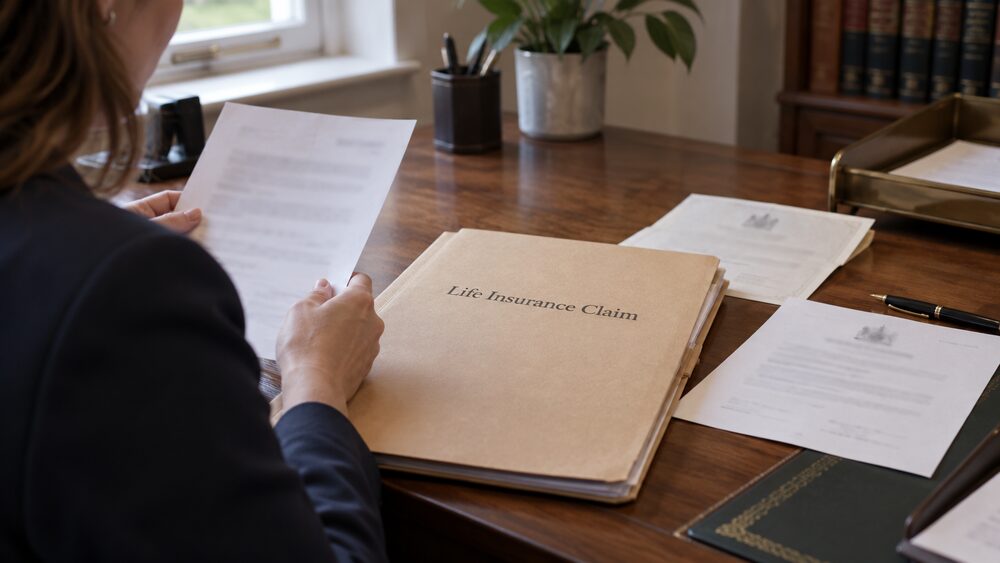
Most life insurance claims come down to a small set of papers: the death certificate, the policy details, and a claim form the insurer sends you. For life insurance claims, you may need a copy of the death certificate and other legal documents, including probate or letters of administration1. Which of those you actually need depends on how the policy was set up and how big the estate is.
Most life insurance claims come down to a small set of papers: the death certificate, the policy details, and a claim form the insurer sends you. For life insurance claims, you may need a copy of the death certificate and other legal documents, including probate or letters of administration1. Which of those you actually need depends on how the policy was set up and how big the estate is.
The single most important document is the death certificate. Some insurers want the original and will not accept a photocopy, while others accept a copy or one certified by a solicitor2. Because several organisations may each want one, it is worth requesting extra copies when you register the death4.
Probate is not always required. Where a policy is written in trust, the family does not need to go through probate to receive the insurance money5. One over 50s provider says that in the majority of cases you do not need to apply for a grant of probate to make a claim6. Where the payout falls into the estate instead, the person dealing with it may need a grant of probate or letters of administration before the money can be released.
Documents needed for a life insurance claim
The starting point is the death certificate, but insurers rarely ask for that alone. A claim usually needs the policy number, the date of the policyholder's death, the claimant's contact details, and a completed claim form6. Some insurers also ask for a will, if one is held, which must be signed and witnessed6.
Where the cover is group life insurance through an employer, the paperwork can differ. If a dependent's pension is included, the insurer may ask for an original marriage certificate from the employee's partner and an original birth certificate from the employee's partner or any dependants8. That is a reminder that workplace schemes often have their own document list, separate from a personal policy.
It helps to gather documents before you contact the insurer, because requests tend to arrive in a bundle rather than one at a time. Useful items include:
- The death certificate, original or certified copy2
- The policy number and any policy paperwork9
- A will, if one is held6
- The claimant's contact details and proof of identity6
- Details of the deceased's estate, such as their will or surviving family9
If you are not sure whether someone had cover at all, their employer is a sensible first call. Contact your family member or friend's employer to find out more about whether they had life insurance and how to make a claim11. For a personal policy, you can contact the person's life insurance company to find out about their life insurance policy and how to make a claim11.
The death certificate: a copy for the insurer
When you register a death, you are issued a certificate for burial or cremation (known as a 'Green Form'), a unique code for Tell Us Once, and a death certificate which you need to pay for12. The death certificate is the document insurers want, and the Green Form is not a substitute.
Whether a copy will do is where insurers differ, and it is worth checking before you send anything. One insurer asks that if you make a claim in writing, you include an original copy of the death certificate with your letter2. Another states plainly that before it can pay a claim it will need the original death certificate, not a photocopy3. A third says it will need to see the original death certificate or a copy certified by a solicitor13. On the other side, some claims simply need a copy of the death certificate6.
Because originals may be needed elsewhere, the practical answer is to order more than one. It is worth requesting as many as 10 original copies when you register the death, even if it costs a bit extra4. Photocopies are not accepted by some organisations, so having several originals avoids a hold-up while one is with a bank and another with an insurer4.
Probate or letters of administration
Probate is the court process that confirms who is entitled to deal with an estate, and it is not automatically part of a life insurance claim. Where a policy is written in trust, the family does not need to go through probate to receive the insurance money5. One over 50s insurer says that in the majority of cases you do not need to apply for a grant of probate to make a claim6.
Where probate is needed, it usually comes up because the payout forms part of the estate rather than passing directly to named people. Before applying for probate, you must value the estate, and you must do this before applying for probate if you need it14. That valuation includes money due from life insurance policies, which is why a claim and a probate application can end up running alongside each other15.
If there is no will, the picture changes. Letters of administration are a legal document from the court giving the legal next of kin permission to deal with the estate when there is no will7. They do the same job as a grant of probate, but for someone who died intestate. If you die without making a will, the law of intestacy sets out who should inherit your estate16.
Banks and insurers may ask for either document before releasing money that forms part of an estate. One bank says that in some cases it may also ask for the grant of probate or letters of administration, or the will17. Another says it may need a copy of the grant of probate or letters of administration18. For a sole mortgage account, one lender asks for an original or photocopy of the grant of probate if there is a will, or the letters of administration if there is not19.
Other legal documents an insurer may ask for
Beyond the death certificate, requests are tailored to the policy and the circumstances of the death. Depending on the type of policy and the circumstances of the death, an insurer may need to request information from the doctor or coroner, and legal documents20. That is most likely where the cause of death is not yet settled or where a coroner is involved.
Identity and address checks are common. One insurer lists proof of identity, a copy of a bank statement, proof of your address, and a police report if one was involved among the things a claimant may be asked for10. These are the same kind of checks a bank runs when someone takes on the affairs of a person who has died, and they are about confirming that the person claiming is entitled to.
Where the estate is being dealt with formally, the insurer may want proof that you are authorised to act. A copy of the grant of probate or grant of letters of administration confirming you are authorised to deal with the financial affairs of the deceased is one example21. Where there is no will, an insurer may ask for confirmation that there is none, alongside a will or a grant of probate or letters of administration22.
Who can make a life insurance claim?
Who signs and who receives the money depends on how the policy is arranged. Where cover is held in trust, the trustees make the claim, and for group life insurance a trustee or someone authorised to sign the form on the trustee's behalf signs it8. Writing a policy in trust is also what keeps the payout outside the probate process5.
For a personal policy not held in trust, the person dealing with the estate, or a named beneficiary, contacts the insurer. The mechanics are straightforward: tell the insurance provider that the policyholder has passed away, provide them with the death certificate and policy information, and fill out any forms the insurer needs for the claim24. One insurer puts it the same way: to make a claim you will need to contact your insurer and then complete the form they send to you25.
If you do not know whether the person had cover, there are two routes. Contact your family member or friend's employer to find out more about whether they had life insurance and how to make a claim11. You can also contact the person's life insurance company to find out about their life insurance policy and how to make a claim11.
If there is no will
Dying without a will does not stop a life insurance payout, but it changes who can deal with the estate and what documents are needed. If you die without making a will, the law of intestacy sets out who should inherit your estate16. The person entitled to deal with it applies for letters of administration rather than a grant of probate7.
Insurers and banks will want confirmation of the position. One savings provider says that where someone is claiming on a deceased person's account, proof and documentation from all executors and administrators is required, such as a grant of probate or letter of administration, a will, or confirmation there is none if the deceased passed away intestate22. In practice that means telling the insurer plainly that there was no will, and providing the letters of administration once they are issued.
Where the estate has no assets at all, the position on debts is different from the position on insurance. If you die but do not have any assets, the debt is not recoverable, and family members should send a copy of the death certificate to creditors23. A copy of the death certificate is usually what a creditor needs to consider writing a debt off26. Where a loved one was in the process of setting up a debt solution, a debt charity says you will not need to provide a copy of the death certificate, though where someone was already in an individual voluntary arrangement it will ask for a copy of the death certificate, a copy of the will if there is one, and the executor's contact details27.
Where to get help
Bereavement paperwork can be handled in stages, and you do not have to work out which documents apply before you make the first call. The insurer's claims team can tell you exactly what it wants for that policy, and asking first avoids sending an original document that then has to be returned.
Free and impartial help is available. Marie Curie offers information on claiming on life insurance, including how to approach an employer or an insurer when you are not sure what cover existed11. Age UK sets out what to do when someone dies, including the documents issued at registration12. If debts are part of the picture, StepChange and National Debtline both publish guidance on bereavement and debt, including what to send creditors27.
If a claim is refused or an insurer asks for something you cannot provide, you can complain to the insurer first and then, if it is not resolved, take the complaint to the Financial Ombudsman Service. The documents an insurer can reasonably ask for are tied to the policy and the circumstances of the death, so a request that seems unrelated to either is worth questioning.
Sources27 cited
- Life insurance claims HSBC, 2026
- How do I notify Phoenix Life about the death of a policyholder? Phoenix Life, 2026
- Life Protection policy conditions LV=, 2026
- Dealing with paperwork Widowed and Young, 2026
- How to write life insurance in trust Which?, 2026
- Over 50s life insurance: premiums and payouts Legal & General, 2026
- What to do when someone dies HSBC, 2026
- Group life insurance claims Canada Life, 2026
- Make a claim Tesco Insurance, 2026
- Claims MetLife, 2026
- Claiming on life insurance Marie Curie, 2026
- What to do when someone dies Age UK, 2026
- Equity release Aviva, 2026
- Valuing the estate of someone who died GOV.UK, 2026
- Funeral Support Payment Social Security Scotland, 2026
- Dementia and managing money nidirect, 2026
- Dealing with bereavement Al Rayan Bank, 2026
- Getting started with bereavement Bank of Ireland UK, 2026
- Help and guidance following bereavement Accord Mortgages, 2026
- Life insurance claim Nationwide, 2026
- Third party data access Experian, 2026
- Are my savings safe? Which?, 2026
- Whose debt is it? Shelter Cymru, 2026
- What is life insurance? Post Office, 2026
- Life and income protection FAQs The Nottingham, 2026
- Write off a debt National Debtline, 2026
- Bereavement and debt StepChange, 2026







 MoneyHelperFree, impartial money and pensions guidance, set up by government
 Financial Ombudsman ServiceFree, independent help when a complaint about a firm is not put right
 FSCSProtects your money if a bank, insurer or investment firm fails
 Citizens AdviceFree advice on money, consumer and legal problems in England and Wales
 Turn2usFree benefits calculator and grants search from a charity