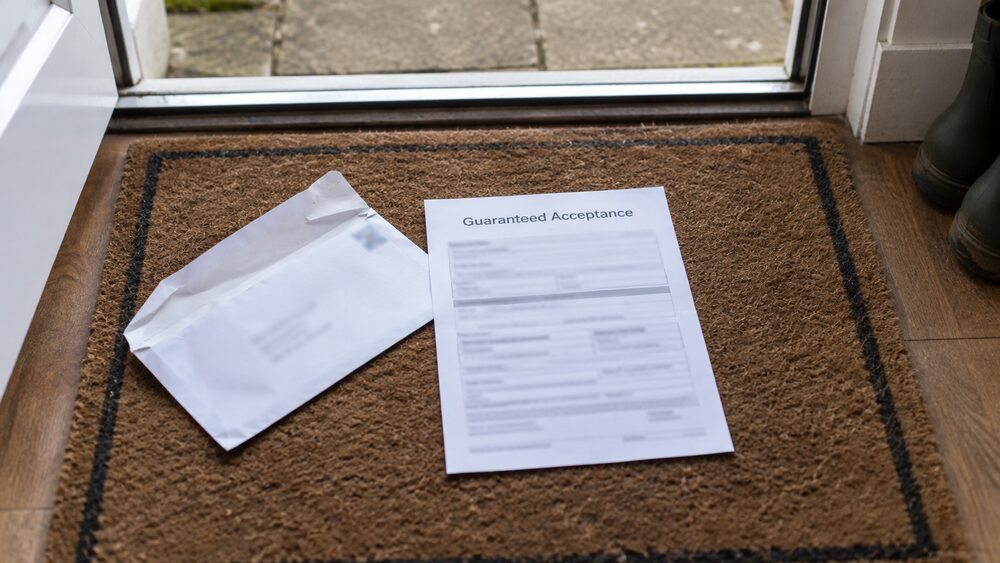
Yes, you can buy life insurance without answering any medical questions. These policies are called guaranteed acceptance plans, and the best known version is over 50s life insurance. The insurer accepts everyone who applies, whatever their health, and pays out when you die. TSB, for example, advertises "Guaranteed acceptance, with no medical questions"1, Santander offers "Guaranteed acceptance with no medical or health questions"2, and Aviva describes the category as "A type of life insurance that you'll be accepted for, regardless of your health"3.
Yes, you can buy life insurance without answering any medical questions. These policies are called guaranteed acceptance plans, and the best known version is over 50s life insurance. The insurer accepts everyone who applies, whatever their health, and pays out when you die. TSB, for example, advertises "Guaranteed acceptance, with no medical questions"1, Santander offers "Guaranteed acceptance with no medical or health questions"2, and Aviva describes the category as "A type of life insurance that you'll be accepted for, regardless of your health"3.
The trade-off is real. Guaranteed acceptance cover is non-medically underwritten, which means it is designed for people who cannot get standard cover, and it is more expensive as a result4. It also tends to pay out a fixed sum rather than the larger amounts standard term cover can provide, and many plans require premiums to be paid until you die.
Standard life insurance works the other way round. You answer about ten questions about your medical history and lifestyle, the insurer checks those answers with your GP, and the price reflects the risk you present4. If you are in good health, that route is usually cheaper for the same amount of cover. If you are not, the questions are where the difficulty starts.
Guaranteed acceptance cover: life insurance with no health questions
Guaranteed acceptance is the only mainstream route to life cover that involves no health questions at all. The insurer does not ask about your medical history, does not ask about your lifestyle, and does not approach your GP. TSB's over 50s plan is "Guaranteed acceptance, with no medical questions"1, Santander's states that cover starts as soon as the application is processed2, Cavendish Online notes that "Over 50s insurance has guaranteed acceptance with no medical information required"9, and Royal London's over 50 plan tells applicants "You won't have to tell us about your health"10.
The reason these plans can accept everyone is that they are priced by age rather than by risk. Which? explains that over 50s cover "isn't medically underwritten, which means any pre-existing health conditions won't affect the cost"4. Everyone of the same age pays broadly the same premium for the same amount of cover, so the insurer is not assessing whether you specifically are likely to claim.
There is a second, narrower category worth knowing about: accident-only cover. MetLife's MortgageSafe Core option is "accident only cover, so we won't ask you any medical history questions"11. That is not life insurance in the ordinary sense, because it pays out only if death results from an accident, but it is a genuine no-questions product. The same provider's extended accident and illness options use "a simplified set of medical questions" instead11.
Guaranteed acceptance is not the same as guaranteed payout on day one. Most over 50s plans apply a waiting period before full cover begins, and the over 50s waiting period page explains how that works. If you are looking at this route because of a health condition rather than your age, the pre-existing conditions guide covers the alternatives.
What a no-medical policy costs and what it leaves out
The price of guaranteed acceptance cover is the price of not being assessed. Because the insurer cannot tell a healthy applicant from an unwell one, everyone pays for the average, and Which? is direct about the consequence: non-medically underwritten cover exists for "those who cannot get standard cover", and it is more expensive4.
What you give up falls into four areas.
- Payout size. Guaranteed acceptance plans typically provide a modest fixed sum, often intended to cover funeral costs rather than replace an income.
- Cash-in value. Term life insurance "has no cash-in value so you get nothing back"12, and the same is true of over 50s plans. Stopping payments means the policy is cancelled and you receive nothing4.
- Payment term. On over 50s cover "you must pay the premium until you die. If you stop paying, your entire policy is cancelled and you get nothing back"4.
- Flexibility. There is no medical underwriting to revisit, so there is usually no route to a lower premium if your health improves.
One point that catches people out: an uncashed life insurance policy is "completely excluded from savings" for means-tested benefit purposes13. It does not count against you in the way a savings account would.
Standard life insurance: the health questions and GP checks
Standard cover begins with a questionnaire. Which? describes it as "a set of about ten questions" covering medical history, with some asking whether you have ever had a condition, some covering the past five years and some the past 12 months, alongside lifestyle questions4. The wording matters: a question beginning "have you ever" reaches back across your whole life.
You then make a declaration. As Which? puts it, "You will need to make an honest declaration about all these issues and your GP will be asked to confirm your medical conditions"14. Insurers "will also check your answers with your GP"5. That is a records check, not an examination, and it is the step people most often worry about unnecessarily.
Not every policy goes that far. MetLife states that its MortgageSafe cover involves "No compulsory GP reports. We won't check your eligibility based on compulsory GP reports, accident reports, or seek any" further medical evidence15. Lloyds Bank says of its life insurance that "You don't need a medical examination, and you'll get an instant decision"16. Post Office over 50s cover offers "No medical questions or health checks"17, and MetLife's EverydayProtect states "You do not need to answer any medical questions to take out the policy"18.
So the practical picture is a spectrum rather than a yes or no. At one end, guaranteed acceptance and accident-only cover ask nothing. In the middle, simplified-question products ask a short set. At the other end, full underwriting asks about ten questions and verifies the answers with your GP. The applying and underwriting guide sets out the process in full, and the GP reports page explains when a full report is actually requested.
Getting cover with a health condition, cancer history or as a smoker
A diagnosis does not automatically close the door, but it changes which door is open.
Cancer. Where the medical prognosis is that you will die during the policy term, insurers are legally entitled to refuse cover, because "Insurers can't cover certainties"6. For people who have had cancer and are in remission, the position depends on the type, the stage and how long ago treatment ended. The life insurance after a cancer diagnosis page deals with that separately. It is also worth knowing that many standard policies include terminal illness cover at no extra cost, paying out early where life expectancy is less than 12 months19, but that applies to cover already in place.
Diabetes. Applying for new cover means providing "full details of when you were first diagnosed with diabetes, your medical history plus the specifics of your treatment and medication"7. Once a policy is running, the position reverses: a later diagnosis does not have to be reported and does not raise the premium6.
Smoking and vaping. Insurers "weight premiums for people who use vapes, gum and patches the same as for those who smoke cigarettes"7, and you "must tell your life insurer if you smoke or vape using nicotine products, even if you do so only occasionally"20. If you have stopped, insurers differ on the qualifying period: "Some insurers only require you to have quit for a year (others for two, five or even 10 years)"6.
Honest disclosure matters: how a claim can be refused
The single biggest risk in this area is not the medical questions. It is answering them carelessly.
If you do not give full and accurate information about your health when applying, "any future claim may not be paid"22. Where an applicant has not been straight about something like smoking, "your family later needs to claim, your policy may be declared void, and any payout refused"7. The same principle runs across insurance generally: a car insurer may "cancel your policy and any claims may be rejected" if it was not told the full picture23, and on travel cover a claim arising from an undisclosed condition will very likely be rejected, leaving you to pay treatment costs yourself24.
The Financial Ombudsman Service takes a more measured approach than outright refusal in some cases. Where a customer did not tell the insurer about a significant change in health, "we'll generally consider it's fair for them to pay your claim, minus any additional premium which would have been charged"25. In other words, if the insurer would have covered the condition for a higher premium, the claim is often paid with that extra premium deducted rather than refused entirely.
The practical rule is to answer every question as it is written, including the ones that reach back over your lifetime, and to check the declaration before submitting. The disclosure duty guide covers what counts as material and what happens when something is missed.
Premiums, missed payments and cancelling a policy
Once a policy is in force, the terms tend to be more protective than applicants expect. Premiums "can't be increased" after a cancer diagnosis, and "as long as you make full and honest disclosures on your application and continue paying the premiums, the policy can't be cancelled"6. That cuts both ways: the insurer cannot raise the price or withdraw, and you cannot usually renegotiate it either.
Missed payments are where cover is lost. On over 50s plans, stopping payment cancels the entire policy and you get nothing back4. On term cover there is no cash-in value at all12. The missed premiums and lapsed cover page explains what happens next and whether a policy can be reinstated, and reinstating lapsed cover covers whether a fresh health declaration is needed.
On tax, payouts "are not subject to income tax or capital gains tax"8. They can, however, "be added to the value of your estate and subject to inheritance tax"4. Writing the policy in trust is the standard way to keep the money out of the estate, and the life insurance in trust guide explains how. The tax on payouts page covers the wider picture.
Two further points that come up often. Holding more than one policy is "perfectly legal and fairly common", with the same company or different providers, and you can hold joint and single policies at the same time26. And on suicide, death by suicide or self-harm "is mostly covered by life insurance policies, except in the first year or two after taking out the policy"27. One insurer states that within the first year there would be no payout if death is due to suicide or intentional and serious self-injury8, and mortgage life insurance generally does not cover suicide within the first 12 months23. The suicide exclusions page has the detail.
If a policy is not right for your circumstances, the life insurance guide sets out the alternatives, and how life insurance premiums are worked out explains what drives the price on standard cover.
Sources27 cited
- Over 50s life insurance TSB, 2026
- Over 50s life insurance Santander, 2026
- Life insurance glossary Aviva, 2026-09-26
- Over 50s life insurance Which?, 2025-12-03
- Types of life insurance policy Which?, 2025-05-16
- Life insurance with cancer explained Which?, 2026-06-25
- Life insurance for pre-existing conditions Which?, 2026-06-25
- Short term life insurance Legal & General, 2025-12-10
- Over 50s life insurance Cavendish Online, 2026-09-26
- Over 50 life insurance policy summary Royal London, 2020
- MortgageSafe brochure MetLife, 2023-11
- Term life insurance explained Which?, 2025-12-03
- Bank or building society savings Entitledto, 2026-09-26
- What is mortgage protection life insurance Which?, 2026-09-25
- Mortgage protection insurance MetLife, 2026-09-26
- Life insurance Lloyds Bank, 2026-09-27
- Over 70s life cover guide Post Office, 2026
- EverydayProtect policy summary MetLife, 2026
- Illness and injury insurance explained Legal & General, 2026-09-26
- Life insurance for people with diabetes Which?, 2026-06-25
- Life insurance Legal & General, 2025
- Pre-existing conditions Legal & General, 2026-03-16
- Mortgage life insurance Cavendish Online, 2026-09-26
- Travel insurance for people with mental health conditions British Insurance Brokers' Association, 2026-09-26
- Change in health Financial Ombudsman Service, 2026-09-26
- Multiple life insurance policies explained Which?, 2025-11-20
- Types of life insurance policy Which?, 2025-05-16











 MoneyHelperFree, impartial money and pensions guidance, set up by government
 Financial Ombudsman ServiceFree, independent help when a complaint about a firm is not put right
 FSCSProtects your money if a bank, insurer or investment firm fails
 Citizens AdviceFree advice on money, consumer and legal problems in England and Wales
 Turn2usFree benefits calculator and grants search from a charity