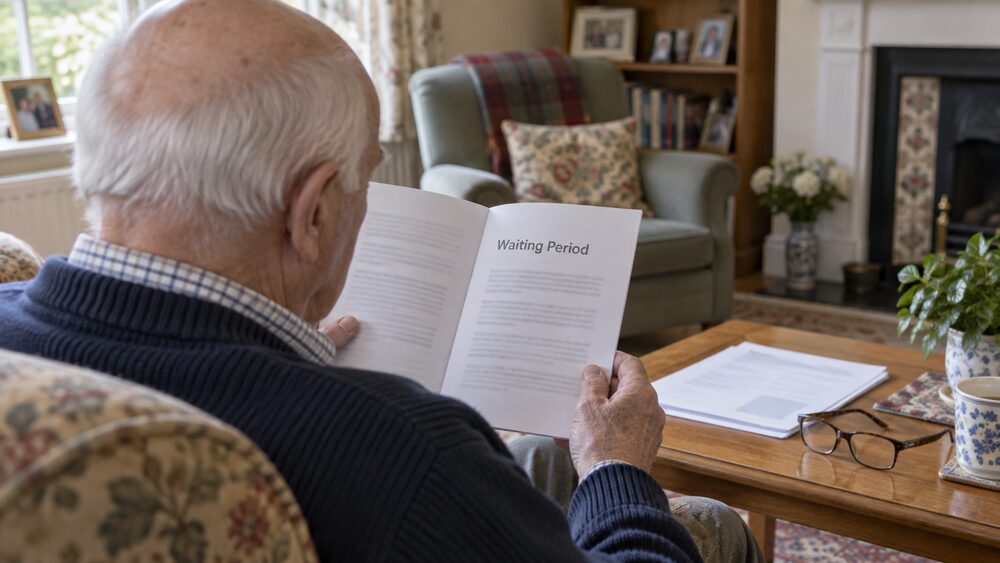
An over 50s plan is a life insurance policy you can take out without answering any health questions. You are accepted whatever your medical history, and you pay a fixed premium until you die. The trade-off is the waiting period: most policies pay the full sum insured only after a set period at the start of the plan, typically 12 to 24 months1.
An over 50s plan is a life insurance policy you can take out without answering any health questions. You are accepted whatever your medical history, and you pay a fixed premium until you die. The trade-off is the waiting period: most policies pay the full sum insured only after a set period at the start of the plan, typically 12 to 24 months1.
If you die during that waiting period, the plan usually does not pay the full amount. Some policies refund the premiums paid instead, and some pay a reduced sum. The waiting period is the single most important term to check before you sign up, because it decides what your family actually receives if the worst happens early on.
This page explains how long the wait lasts, how guaranteed acceptance differs from a policy with health questions, what happens if you miss a payment, and the narrow set of circumstances in which a claim can be refused.
Guaranteed acceptance cover: no health questions, but with limits
The appeal of an over 50s plan is that nothing is asked about your health. TSB describes its over 50s cover as "Guaranteed acceptance, with no medical questions"2, and Santander offers "Guaranteed acceptance with no medical or health questions"7. Aviva defines the category as "A type of life insurance that you'll be accepted for, regardless of your health"8. Ulster Bank describes the same product as "a type of insurance policy designed for people aged between 50 and 80"9.
Because there is no medical underwriting, the price cannot reflect your individual health. Which? explains that the cover is "not medically underwritten, which means any pre-existing health conditions won't affect the cost"1. Instead, premiums are based on your age, whether you smoke, and how much cover you choose1.
That is the limit. Guaranteed acceptance products are often more expensive than medically underwritten cover, and they tend to come with a limited term length or a cap on the total sum insured10. The waiting period is part of the same design: the insurer takes on everyone, so it protects itself against claims arriving immediately after the policy starts.
The eligibility rules are simple but strict. TSB's over 50s plan is open to a UK resident who resides in the UK for at least 183 days a year2. Aviva describes the product as "A life insurance policy for people aged 50 and over who are UK residents"8. If you split your time between the UK and another country, that residency condition is worth checking before you apply.
Health questions or guaranteed acceptance: how each one is assessed
There are two routes to life cover in later life, and they are assessed in completely different ways.
A standard life insurance application asks about your health. Which? describes "a set of about ten questions" covering medical history, with look-backs phrased as "have you ever", the past five years, and the past 12 months1. A separate Which? guide sets out the detail: whether other illnesses have been diagnosed within the past five years, and whether you have received any medical treatment in the past 12 months2. Insurers will also check your answers with your GP3.
A guaranteed acceptance over 50s plan asks none of this. There is no medical information required at all3. The insurer accepts you on age alone, and the waiting period does the work that underwriting would otherwise do.
| Guaranteed acceptance over 50s plan | Standard life insurance | |
|---|---|---|
| Health questions | None3 | About ten, covering medical history and lifestyle1 |
| GP checks | None needed | Insurers check your answers with your GP5 |
| Cost basis | Age, smoking status and level of cover1 | Individual health and circumstances |
| Waiting period | Typically 12 to 24 months1 | None, cover starts immediately |
| Typical age range | 50 to 809 | Varies by insurer |
The practical consequence is that a guaranteed acceptance plan suits people whose health would make standard cover expensive, restricted or unavailable. Specialist, non-medically screened policies "offer guaranteed cover for anyone", but Which? notes they "are often more expensive, with limited term length or total sum insured"10. The waiting period is the price of that certainty.
Suicide exclusion: usually the first one or two years
Life insurance policies commonly exclude death from suicide at the start of the term. Which? states that "death from suicide is likely to be excluded during the first two years after the policy starts"5, and a separate Which? guide says "Policies typically have clauses that exclude these claims in the first one or two years"5.
This runs alongside the waiting period rather than replacing it. On an over 50s plan, the waiting period applies to death from any cause, while the suicide exclusion is a specific clause with its own timescale. Both mean that a claim in the early life of the policy may not pay the full sum insured.
Missed payments: a grace period of around 30 days
Over 50s plans are designed to run for the rest of your life, and the premiums must keep being paid. Which? puts it plainly: "you must pay the premium until you die. If you stop paying, your entire policy is cancelled and you get nothing back"1.
Insurers generally allow a short window to catch up. Many life insurance policies "come with a grace period, usually around 30 days"4. MetLife's terms are specific: "If you miss a premium payment, you have 30 days from your chosen payment date to make the payment or your policy will be cancelled"11.
Legal & General sets out what happens if the plan is cancelled after the cooling-off period or premiums stop: "your cover will end 60 days after the first missed premium and you won't get any money back"12. The exact number of days varies by provider, so the policy summary is the document that matters.
If missed payments have caused wider financial difficulty, StepChange notes that a default notice gives "at least two weeks to make up missed payments"13. That is a different process from an insurance grace period, but it is worth knowing if a missed premium is part of a bigger problem.
Where a claim can be refused
On a guaranteed acceptance plan there are no health questions to answer, so the usual reason for a refused claim, non-disclosure, largely falls away. But claims can still be refused in specific circumstances.
Insurers cannot cover a certainty. Which? explains that "Insurers can't cover certainties, so they're legally entitled to refuse you cover in those circumstances"14. If a medical prognosis is that you will die during the policy term, there is no longer a risk to insure, only a certainty, and an insurer is entitled to decline14.
Dishonesty on an application is the other main route to a refused claim. If you lie about something material, such as your smoking status, "your policy may be declared void, and any payout refused"14. Even on a plan with no health questions, the answers you do give, about age and smoking, need to be accurate.
There are also product-specific eligibility rules. TSB's Free Life Cover, for example, does not accept you "if you are 55 years old or over", and for joint life policies both people need to be under that age15. Post Office Over 50s Life Cover has its own rule: you are "not eligible if you have previously held and cancelled a Post Office Over 50s Life Cover Policy within the last 18 months"16.
What happens if you die during the waiting period
The waiting period is not a gap with no cover at all. Most plans do something if a claim arrives during it, but what they do varies.
Cavendish Online notes that "Some policies, however, may refund premiums if death does occur within the waiting period"3. That means the estate gets back what was paid in, rather than the sum insured. Other policies pay a reduced amount. The policy documents set out which applies.
This is why the waiting period matters most to people taking out a plan in their fifties or sixties, when the chance of a claim in the first year or two is higher than it would be for a younger applicant. A plan with a 24-month wait and a premium refund is a very different proposition from one with a 12-month wait and a reduced payout.
The plan has no cash value at any point
An over 50s plan is not a savings product and cannot be cashed in. Legal & General states that its over 50s plan "has no cash value unless a valid claim is made"6. Which? confirms the same for the category: "you must pay the premium until you die. If you stop paying, your entire policy is cancelled and you get nothing back"1.
There is one window where money does come back. TSB gives "30 days to change your mind" after the application is accepted, and premiums are refunded if the plan is cancelled within that time2. After the cooling-off period, cancelling or stopping payments ends the cover with nothing returned12.
If you want a product with a surrender value, an over 50s plan is not it. Whole of life insurance and other protection products work differently, and the protection section explains how they compare.
Writing the payout in trust
A life insurance payout is not subject to income tax or capital gains tax17. It can, however, be added to the value of your estate and so may then be subject to inheritance tax9. Writing the policy in trust usually keeps the payout outside your estate for inheritance tax purposes18.
There is a second benefit. The payout "can usually be released more quickly because it doesn't normally need to wait for probate"18. That matters if the money is intended to cover funeral costs or other immediate expenses.
A trust does not replace a will. Which? is clear that writing life insurance in trust "can help make sure the policy payout goes to the right people, but it does not deal with everything else you leave behind"18. The life insurance in trust page covers how the arrangement works.
Extra services that come with some plans
Some over 50s plans include access to services beyond the payout. Post Office Over 50s Life Insurance offers "24/7 access to a UK GP online or over the phone", available to the customer, their partner and any children up to the age of 2119. The same provider offers health and wellbeing services including bereavement support20.
These extras are not part of the insurance contract. Post Office states that the GP service "is separate from your contract, so it's not guaranteed for the entirety of your policy"20. They can be withdrawn, and they should not be the reason for choosing one plan over another. The added extras page explains how these services typically work.
Where to get help
If a claim is refused or a plan does not work as expected, the Financial Ombudsman Service can look at a complaint about a protection policy free of charge. MoneyHelper offers free, impartial guidance on protection insurance for anyone weighing up their options.
If missed premiums have led to wider debt problems, StepChange provides free debt advice13. The debt section sets out the full range of help available.
Sources20 cited
- Over 50s life insurance Which?, 2025-12-03
- Over 50s Life Insurance TSB, 2026
- Over 50s Cavendish Online, 2026-09-26
- Types of life insurance policy Which?, 2025-05-16
- Types of life insurance policy Which?, 2025-05-16
- Different types of life insurance Legal & General, 2026-06-19
- Over 50s Life Insurance Santander, 2026
- Life insurance glossary Aviva, 2026-09-26
- Life cover Ulster Bank, 2026-09-25
- Life insurance with cancer explained Which?, 2026-06-25
- MultiProtect terms and conditions MetLife, 2026
- Making a change Legal & General, 2026-09-26
- Default notices and missed payments StepChange, 2026-09-25
- Life insurance for pre-existing conditions Which?, 2026-06-25
- Life insurance and CIC policy summary TSB, 2026-01
- Over 50s terms Post Office, 2026
- How to write life insurance in trust Which?, 2026-04-06
- Is your life insurance set up to pay the right person? Which?, 2026-07-11
- Over 50s Life Insurance Post Office, 2026
- Over 70s life cover guide Post Office, 2026









 MoneyHelperFree, impartial money and pensions guidance, set up by government
 Financial Ombudsman ServiceFree, independent help when a complaint about a firm is not put right
 FSCSProtects your money if a bank, insurer or investment firm fails
 Citizens AdviceFree advice on money, consumer and legal problems in England and Wales
 Turn2usFree benefits calculator and grants search from a charity