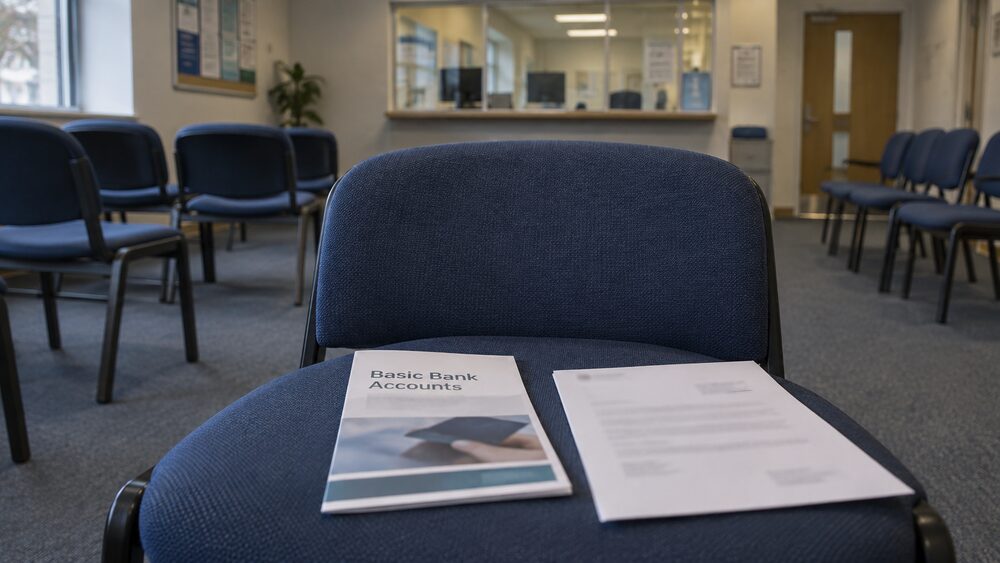
Financial inclusion is the name given to government and regulator work that makes sure people can get and use everyday financial services, whatever their income or credit history. In practice it covers three things that matter directly to you: a right to a fee-free basic bank account from the largest UK banks, a government savings scheme called Help to Save that pays a 50% bonus on savings, and a set of rules that stop banks closing or refusing accounts without good reason.
The government published its Financial Inclusion Strategy in November 2025, and a review of its progress is due in 20271. Alongside it runs the UK Strategy for Financial Wellbeing, a ten-year framework with five priority goals to be met by 20302. This page explains what those plans actually give you, how to use them, and where to go when something goes wrong.
What financial inclusion means for you
Financial inclusion is not a product you buy. It is the policy work that decides whether people on low incomes, with poor credit histories, or without a fixed address can still do the ordinary things a bank account makes possible: receiving wages or benefits, paying bills by direct debit, and putting money aside. When that work succeeds, the results are concrete rules you can rely on, such as the legal duty on the largest banks to offer a basic bank account to individuals8, and the requirement that a refused applicant be told the reason in writing3.
The current framework has two strands. The government's Financial Inclusion Strategy, published in November 2025, sets out its plans for widening access, with a review of progress confirmed for 20271. Separately, the Money and Pensions Service runs the UK Strategy for Financial Wellbeing, a ten-year framework that brings together organisations from a range of sectors around five priority goals to be met by 20302. The two overlap, but the wellbeing strategy is the longer-running of the pair.
Access to cash is part of the same picture. The Payment Systems Regulator has committed to protect the interchange fee for any free-to-use ATM that is currently one kilometre or more away from the next nearest free-to-use ATM, which keeps remote cash machines viable10. You can read more about the wider rules on branches and cash in our guide to the access to cash rules, and about the bodies behind these policies in who regulates what.
Basic bank accounts: a fee-free account without an overdraft
A basic bank account works like any other current account for the everyday things: money can be paid in, you get a debit card, and you can set up direct debits and standing orders. What it does not offer is any way to borrow. There is no overdraft and no cheque book, so you cannot spend more than you have11. Basic bank accounts must be fee-free for standard operations when provided in sterling, and must not have an overdraft facility3.
For most people the account costs nothing to run. There are not usually any fees, and you do not have to have any money to put in the account to open it11. Charges can apply in a few situations, for example using a debit card overseas or in a foreign currency, ordering copies of statements, or making special payments such as same-day CHAPS payments11. One charge to watch: if you set up a direct debit and there is not enough money in the account to pay it, you might be charged for the failed payment13.
You usually need to be at least 16 to open one, or over 18 for some banks, and you can open a basic bank account jointly with someone you trust if you both qualify11. A credit check is normally carried out, but you do not have to pass it to be offered the account: the bank uses it to check your identity, not to judge your creditworthiness11.
Nine banks must offer one
Basic bank accounts are not a favour a bank does you. The largest UK banks are obliged to offer them to retail customers, though not to business customers14. The designated firms are Barclays UK, The Co-operative Bank, HSBC UK, Lloyds Banking Group (including the Halifax and Bank of Scotland brands), Nationwide Building Society, NatWest Group (including the RBS and Ulster brands), Santander UK, TSB and Virgin Money (formerly Clydesdale and Yorkshire Bank)3.
The duty is to offer basic bank accounts to customers who are legally resident in the United Kingdom and who either do not have a bank account or are not eligible for a standard current account3. It applies to individuals only: basic bank accounts are not available to businesses, though charities can find help in the industry body UK Finance's guide to opening a charity bank account14. Large banks have to offer a basic bank account to individuals, and the FCA's rules require a firm that offers one to tell banking customers about it if they meet the firm's eligibility criteria8.
A parliamentary commission once put the principle plainly:
"It should be a right for customers to open a basic bank account irrespective of their financial circumstances"
That right is now written into the Payment Accounts Regulations 2015, which set the grounds on which a bank must or may refuse an account, and the grounds on which it may close one17.
Who can get a basic bank account, including if you are homeless or bankrupt
The starting point is legal residence in the UK and not having, or not qualifying for, a standard account. Beyond that, the rules specifically recognise groups who have historically been shut out. The regulations list consumers with no fixed address, asylum seekers, and consumers who have not been granted a residence permit but whose expulsion is impossible for legal or practical reasons, among those the account is intended to reach17.
If you are homeless, some banks have special schemes for people with no fixed address and will work with a local homeless charity to help confirm your identity11. If you are bankrupt, the position is harder. Citizens Advice notes that if you are bankrupt or have a record of fraud, you will not usually be allowed to open a bank account, but that if you are bankrupt or have a poor credit rating, you may still be able to open a basic bank account13. Among the major UK banks, only Barclays currently provides bank accounts to undischarged bankrupts, according to evidence given to Parliament's Commission on Banking Standards16.
A poor credit history on its own is not a barrier. MoneyHelper's guidance for people managing money with an illness or disability puts it simply: if you have a low income or a poor credit history and think you might have trouble opening a bank account, you could apply for a basic bank account20. The same message appears in guidance for people whose Post Office card account is closing: there are lots of options, including accounts that accept those with a poor credit history21.
One group the rules exclude entirely: a bank or building society is not allowed to open an account for someone who needs leave under the Immigration Rules to enter or stay in the UK but does not have it. Such a person also cannot be a joint account holder, a signatory or a beneficiary, and banks carry out status checks before opening accounts13.
Opening a basic bank account: ID, proof of address and credit checks
When you open an account, you will need to show proof of who you are and your address. If you do not have the right documents, ask the bank what it will accept instead20. Most banks ask for a driving licence or passport to prove your identity, or a photo of these if you are applying online, often with a selfie. Other documents may be accepted, including letters from DWP, HMRC, JobCentre Plus, a local council, a GP, a minister of religion, a social landlord, an armed services officer, a warden, a care home manager, an employer, or a college or training provider11.
For a standard current account, the usual list is similar: you will usually need ID to prove your identity, like a driving licence, passport, recent bills or official documents12. The difference with a basic bank account is that the bank is not using the documents to assess your credit, only to check you are who you say you are. The credit check that banks run is used to verify identity, not to decide whether you are a good risk11.
If you are applying for a benefit such as Universal Credit and need an account for the payments, the same rules apply: a basic bank account usually has all the same features as a current account apart from a cheque book or overdraft, so it can receive benefit payments and run direct debits12.
When a bank can refuse or close a basic bank account
A bank cannot refuse a basic bank account application for any reason it likes. Under the Payment Accounts Regulations, designated institutions must refuse to open a basic bank account for a consumer only where it would be unlawful for it to do so, and regulation 25 sets out the prescribed grounds on which a designated credit institution must or may refuse3. Where an application is refused, the participating institution must, without delay, inform the customer in writing and free of charge of the reason for the refusal, if it may lawfully do so3.
MoneyHelper lists the common reasons a bank gives for refusing a basic bank account: not agreeing to a credit check, failing the ID check, suspected unlawful or fraudulent use of the account, or being threatening, abusive or violent towards staff. The reason for a refusal is given unless the bank suspects fraud or money laundering11.
Closure is restricted in the same way. A basic bank account opened under the regulations may only be closed without the consumer's consent in limited circumstances, for example if the consumer has knowingly used, or attempted to use, the account for illegal purposes, or if there has been no transaction on the account for more than 24 consecutive months3. The full list in the regulations also covers cases where incorrect information was given at application, where the consumer is no longer legally resident, where the consumer has access to another qualifying UK account opened after it, or where conduct towards staff amounts to a listed offence18. An account counts as open even if no transactions have taken place on it, and even if a decision to close has been taken but not yet carried out3.
In June 2025 the government amended the regulations to require firms to provide customers with a sufficiently detailed and specific reason for closing a basic bank account3. MoneyHelper adds that if a bank closes the account for breaking the terms, such as opening another UK bank account, not using the account in over two years, moving abroad, fraudulent use, or abuse towards staff, it will give you at least two months' notice11. Rules for basic bank accounts mean banks are more restricted in the grounds on which a basic account can be closed than a standard one14.
Two situations can leave people shut out of banking altogether, and both have routes to challenge. The first is a fraud marker: the Financial Ombudsman warns that customers may find they cannot open a bank account, their existing account is closed and they cannot open another one, or their mortgage application is rejected23. The second is a frozen account or blocked payment, which typically follows unusual or suspicious activity on the account, or doubts about whether the customer authorised a payment24. Our guide to basic account refusals and fees covers the refusal rules in more detail.
Help to Save: a 50% bonus on up to £2,400 of savings
Help to Save is a government savings account for people on low incomes. It pays a bonus of 50p for every £1 saved over four years25. You can save up to £50 a month, and over the life of the account you can save up to £2,400 and receive government bonuses worth up to £1,20026. The scheme was designed to help working families on low incomes build up a rainy-day fund27.
The bonus is not paid as interest along the way. It is paid at the end of the second and fourth years, based on the highest balance achieved over each period29. The government's own example shows how it works: if you pay in £25 every calendar month for two years with no withdrawals, your first bonus is £300, which is 50% of £600. If your highest balance then grows from £600 to £800 in years three and four, your final bonus is £100, which is 50% of £2004. An evaluation of the scheme describes the same structure: eligible individuals save up to £50 per month for up to four years and receive a bonus of 50p for every £1 saved6, with the bonus paid every 2 years30.
The scheme is being made permanent and expanded. The government confirmed in the Budget that it will make the Help to Save scheme permanent32, and from 6 April 2028 eligibility will be extended to all Universal Credit claimants who receive the child or caring element32. The reformed scheme will be delivered through a multi-provider model, a change that will enable financial institutions to offer Help to Save accounts directly to eligible customers34.
Who qualifies for Help to Save and how to apply
The core test is benefits-based. If you get Working Tax Credit or Universal Credit, a Help to Save account could earn you a 50p bonus for every £1 you save35. Citizens Advice puts it the same way: if you get Universal Credit, you could be eligible to join the scheme and get back an extra 50p for every £1 saved13.
For Universal Credit claimants there is an earnings condition. The legislation sets out that individuals who receive Universal Credit and have minimum household or individual earnings of £1 or more in their most recent assessment period are eligible to open a Help-to-Save account26. The 2025 regulations state the requirement as claimants earning at least £1 in the specified period7, and the earlier 2018 legislation describes the test as minimum weekly household or individual earnings equivalent to 16 hours at the national living wage rate28. In the legislation's own terms, the individual must be in receipt of a current award of Universal Credit, not a nil award, and have earned income in the assessment period immediately preceding the first eligibility reference date equal to or greater than £125.
If you stop getting Universal Credit after opening the account, the account is not closed: eligibility is a condition of opening, not of continuing, so you can keep saving up to £50 a month for the full four years and still receive both bonuses. The extension from April 2028 widens the group further, to all Universal Credit claimants receiving the child or caring element33.
Applying is done through the government's Help to Save service, and the account runs alongside any other savings you have. Because the bonus is worked out on the highest balance, not on the closing balance, money you withdraw reduces the bonus you eventually receive, which is worth knowing before you treat the account as an emergency fund. Our savings accounts guide covers where Help to Save sits among the other options.
The poverty premium: paying more for energy, insurance and credit
The poverty premium is the extra cost of the same goods and services when you are poor: paying by a method that costs more because you cannot get a direct debit, a cheaper tariff or a monthly payment plan. Research from the University of Bristol's Personal Finance Research Centre, published in 2026, measured it across Britain's low-income households36.
Energy is the biggest single element. Overall, 59% of low-income households incurred at least one energy-related poverty premium, with the mean energy-related poverty premium for these households being £145 per year36. The size varies with how you pay and how big your household is. Those paying by prepayment meters pay around £75 more for electricity and £56 more for gas per year under the Energy Price Cap36. Households paying on receipt of the bill on the best fixed rate tariff pay £20 for electricity and £10 for gas, or £30 for dual fuel customers per year, but only £30 if they had switched to a cheaper fixed rate one36. Across all low-income households the average ranges from £65 for the smallest households, with one or two occupants, to £142 for larger households of five or more; among those actually incurring the premium, the range is £112 to £232 per year36.
| Type of poverty premium | How many low-income households pay it | Typical extra cost |
|---|---|---|
| Energy (at least one energy-related premium) | 59% | £145 a year on average36 |
| Higher-cost credit | 27% | £178 a year per household incurring it36 |
| Motor insurance (deprived-area policyholders) | 44% of motor policyholders live in deprived areas | £153 a year on average36 |
| Home contents insurance paid monthly | measured per household | £9 a year36 |
Credit and insurance add their own premiums. Just over a quarter of low-income households, 27%, had incurred a poverty premium on higher-cost credit, with each household incurring it paying £178 annually36. On motor insurance, those in more deprived areas pay around 25 to 30% more for their insurance, and the mean annual poverty premium incurred by the 44% of policyholders who live in a deprived area is £15336. Even paying home contents insurance monthly rather than annually carries a poverty premium of £9 per year36.
The poverty premium is the problem much financial inclusion policy is meant to attack, because a fee-free basic bank account with direct debits is what makes cheaper ways of paying possible. Campaigning bodies such as Fair By Design work on exactly this ground, pressing regulators to remove the charges that fall hardest on low-income households. The Treasury Committee's recent work on the Financial Inclusion Strategy, covered next, is part of the same effort.
Financial Inclusion Strategy: what the government plans and what critics say
The government published its Financial Inclusion Strategy in November 2025, and confirmed that a review into the progress of the strategy will take place in 20271. The commitment to publish it came from HM Treasury, which had earlier stated its intention to publish a Financial Inclusion Strategy alongside a supporting committee37. The government has also said it wants more people to participate in retail investment, a related policy aim38.
The strategy has had a mixed reception. In July 2026 the Treasury Committee published its findings from an inquiry into the strategy, and its verdict was blunt:
"The government's Financial Inclusion Strategy is a welcome first step but it is not a complete plan to tackle financial exclusion in the United Kingdom"
The committee recommended an HM Treasury implementation framework, firm-level inclusion metrics and stronger governance of the Financial Inclusion Committee. Its criticism matters because a strategy without measurable commitments is hard to hold anyone to, and the 2027 review is the first formal checkpoint.
Alongside the government's strategy, the UK Strategy for Financial Wellbeing remains the ten-year framework for the wider effort, with five priority goals to be met by 20302. Its aim is to bring together organisations from a diverse range of sectors to set goals for 20309. For the reader, the practical difference is that the government's strategy covers what ministers and regulators will do, while the wellbeing strategy coordinates what banks, charities, employers and advice services do.
Where to complain and get help if you are shut out
If a bank refuses you a basic bank account and will not give a reason, or closes your account without what you think is a proper explanation, the first step is to complain to the bank itself. It must give you the reason for a refusal in writing and free of charge unless it suspects fraud or money laundering3, and since June 2025 firms must give a sufficiently detailed and specific reason for closing a basic bank account3.
If the bank does not resolve your complaint, take it to the Financial Ombudsman Service. The Ombudsman deals with complaints about frozen accounts and blocked payments, which typically arise from unusual or suspicious activity or doubts about whether a customer authorised a payment24, and with the consequences of fraud markers, where customers may find they cannot open a bank account, their account is closed and they cannot open another one, or their mortgage application is rejected23. Consumer advisers and businesses can contact the Ombudsman's Business Support Hub on 020 7964 1400 for information on how a particular complaint might be looked at, or guidance on the rules and how the Ombudsman works39. Our comparison of the Ombudsman and the courts explains which route suits which dispute.
Free, impartial help is available before things reach a complaint. MoneyHelper, the government-backed money guidance service, publishes the guidance on basic bank accounts, Help to Save and account closures used throughout this page11. Citizens Advice offers free help with banking problems and debt13. In Scotland, the cost of living campaign site signposts debt and money help35. If you are struggling with debt itself, our debt guide sets out the options and the free advice charities that provide them.
Sources39 cited
- Government does not have a complete plan to tackle financial exclusion Treasury Committee, July 2026
- UK Strategy for Financial Wellbeing Money and Pensions Service
- Basic bank accounts July 2023 to June 2024 HM Treasury, 2025
- Help to Save: what you'll get HM Treasury
- The Savings (Government Contributions) Bill HM Treasury, 2016
- Evaluation of Help to Save: executive summary HM Treasury, 2025
- Help-to-Save (No. 2) Regulations 2025 legislation.gov.uk, 2025
- Access to banking services and cash House of Commons Library
- What is financial wellbeing Money and Pensions Service
- The UK's ATM network Payment Systems Regulator
- Basic bank accounts MoneyHelper
- Choosing a bank account for your Universal Credit payment MoneyHelper
- Getting a bank account Citizens Advice
- Access to bank accounts research briefing House of Commons Library
- BCOBS 4.1 information requirements FCA Handbook
- Commission on Banking Standards oral evidence Parliament
- Payment Accounts Regulations 2015, regulation 19 legislation.gov.uk
- Payment Accounts Regulations 2015 legislation.gov.uk, 2015
- Payment Accounts Regulations 2015, regulation 26 legislation.gov.uk
- Make your money easier to manage by yourself MoneyHelper
- What to do now your Post Office card account is closing MoneyHelper
- Payment Accounts Regulations amendment explanatory memorandum 2025 legislation.gov.uk, 2025
- Fraud markers Financial Ombudsman Service
- Frozen accounts and blocked payments Financial Ombudsman Service
- Help-to-Save regulations 2018 legislation.gov.uk, 2018
- Help-to-Save regulations 2025 explanatory memorandum legislation.gov.uk, 2025
- Self Employed Savings Trials HM Treasury, 2018
- Help-to-Save regulations 2018 explanatory memorandum legislation.gov.uk, 2018
- Annual savings statistics 2025: background and methodology HM Treasury, 2025
- Evaluation of Help to Save: synthesis report HM Treasury, 2025
- Help to Save scheme StepChange, 2026-09-25
- Budget 2025: overview of tax legislation and rates HM Treasury, 2025
- Tax-free Savings Newsletter 19, November 2025 HM Treasury, 2025
- Tax-free Savings Newsletter 22, June 2026 HM Treasury, 2026
- Debt and money Scottish Government
- Poverty Premium 2026 University of Bristol Personal Finance Research Centre, 2026
- Treasury Committee report on financial inclusion Parliament
- Retail investment research briefing House of Commons Library
- Electronic money services complaints Financial Ombudsman Service
 Financial Ombudsman ServiceFree, independent help when a complaint about a firm is not put right
 FSCSProtects your money if a bank, insurer or investment firm fails
 FCA Warning ListCheck whether a firm is authorised before you deal with it
 MoneyHelperFree, impartial money and pensions guidance, set up by government
 Citizens AdviceFree advice on money, consumer and legal problems in England and Wales