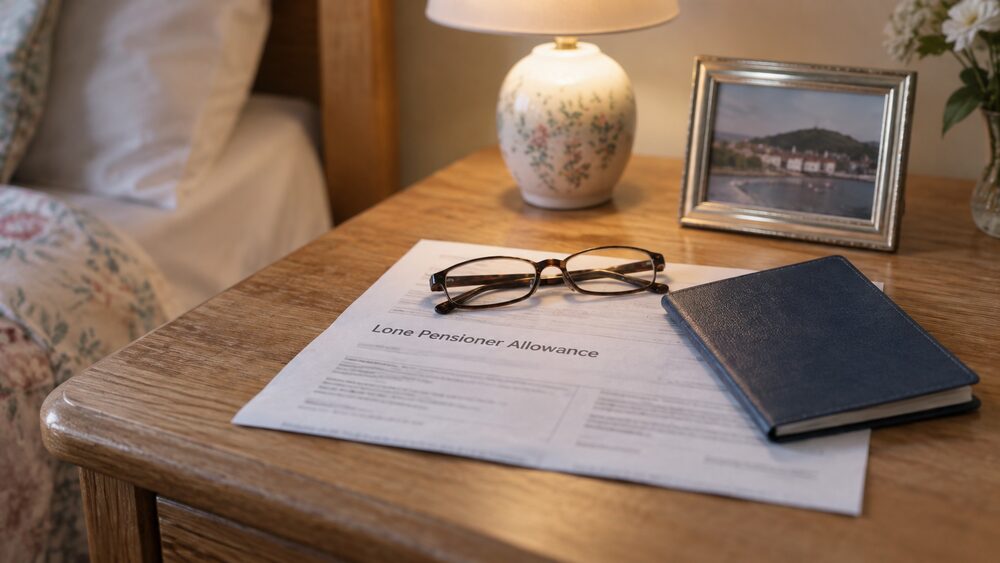
Northern Ireland is the only part of the UK where households pay domestic rates rather than council tax, and the Lone Pensioner Allowance is one of the reductions built into that system. It takes 20 per cent off your rates bill if you are aged 70 or over and live alone1. The same 20 per cent figure is used by the independent advice sector when describing the scheme2.
Northern Ireland is the only part of the UK where households pay domestic rates rather than council tax, and the Lone Pensioner Allowance is one of the reductions built into that system. It takes 20 per cent off your rates bill if you are aged 70 or over and live alone1. The same 20 per cent figure is used by the independent advice sector when describing the scheme2.
The allowance is not means-tested. You do not have to give details of your income or savings, and receiving it does not normally affect any social security benefits you get1. That makes it different from most help with housing costs, which is assessed on what you earn and hold.
Applying is free and can be done at any time during the rating year. Homeowners apply through Land & Property Services, and tenants apply through the Northern Ireland Housing Executive1. The sections below set out who qualifies, the exceptions for people who do not live entirely alone, how to apply, and what happens to the discount if your household changes.
Lone Pensioner Allowance: 20 per cent off your rates bill
The allowance reduces the rates you owe by 20 per cent. It is a discount on the bill itself, not a payment into your bank account, so it shows up as a lower amount to pay rather than as cash1. The independent advice sector describes it in the same terms: a 20 per cent discount for ratepayers aged 70 or over who live alone2.
Because it is a rates discount, it sits alongside the other reductions available to pensioner households in Northern Ireland. Pensioners may be entitled to help with their rates through the Housing Benefit and Rate Relief scheme as well as the Lone Pensioner Allowance, and the two are separate applications4. A different allowance reduces the rates bill by 25 per cent for certain households, which is a distinct scheme with its own rules5.
The practical effect is that a household that qualifies pays a fifth less than the full rate bill for the year. How much that is in pounds depends on the rateable value of the property and the rate poundage set for the year, which is why the saving varies from home to home.
Who qualifies: aged 70 or over and living alone
Two conditions do most of the work. You must be aged 70 or over, and you must live alone1. Both tenants and homeowners can apply, so renting does not rule you out1.
The scheme is aimed at single people aged 70 or over, and independent guidance describes it the same way: if you are single and aged 70 or over you might get a reduction through the Lone Pensioner's Allowance scheme6.
There are exceptions for ratepayers who do not live entirely alone. The official guidance lists them as people who live with a carer who is not their spouse or partner, people who provide care to someone else, households that include someone under 18, and households that include someone with a severe mental impairment1. Those exceptions matter because the headline rule, living alone, would otherwise exclude a carer who lives in the same home.
If you are not sure whether your household fits, the safest step is to ring the number for your situation and describe who lives with you. The decision rests with the office assessing the claim, and the exceptions are set out in the scheme rules rather than left to discretion.
When you can still claim if someone lives with you
Living with another adult normally ends eligibility, but the exceptions above mean some households still qualify. The clearest case is a carer who is not your spouse or partner living in the same home1. Households with a child under 18, or with someone who has a severe mental impairment, are also treated as exceptions1.
Where the other adult is a partner, the position is different, and it connects to the wider rules on pension-age benefits for couples. If you live with a partner, you can only claim Pension Credit now if you have both reached State Pension age7. A single pensioner receiving a pension-age benefit who moves in with a working-age partner faces a change of circumstance that ends pension-age benefit entitlement, and would need to claim a working-age benefit as a mixed-age couple instead8.
There is a protected group. If you qualified before 15 May 2019 with just one partner at pension age, you can continue to receive Pension Credit as long as you continue to meet the other qualifying conditions9. Couples where one partner reached State Pension age before 15 May 2019 and one has been claiming pension-age Housing Benefit since that date as part of the same couple are also treated differently10.
If you are still living with an ex-partner because you cannot afford to move out, you can claim benefits as single people as long as you intend the split to be permanent11. That is a benefits rule rather than a rates rule, but it affects how a household is treated.
Not means-tested: savings and benefits are not affected
The allowance is not means-tested, so it will not affect your social security benefits1. Independent guidance puts it the same way: the allowance is not means-tested and should not impact on other benefits2. You do not have to give income or savings details, and any social security benefits you receive will not normally be affected3.
That is unusual among forms of help with housing costs. Housing Benefit for private tenants, for example, is worked out using Local Housing Allowance rates, which depend on where you live and who is in your household12. Pension-age tenants, or working-age tenants in supported or temporary accommodation, have their help paid through Housing Benefit14. The Lone Pensioner Allowance does not work that way at all.
Because there is no means test, there is no capital limit and no tariff income to calculate. Savings do not reduce the discount, and taking it up does not create a debt or an overpayment elsewhere. If you already receive Pension Credit or another pension-age benefit, claiming the allowance does not put that at risk.
The same principle applies to other non-means-tested payments for older people. Pension Age Disability Payment, for example, is not means-tested, and it does not matter whether the person applying is working or has savings15. Attendance Allowance and Personal Independence Payment work on the same basis, with earnings and savings not affecting eligibility17.
How to apply: homeowners through LPS, tenants through the Housing Executive
The route depends on whether you own or rent. Homeowners apply through Land & Property Services, which administers the scheme for people who own and live in their own home1. To apply you must fill in an application form1. If you own your home, you can ring Land & Property Services on 0300 200 7801 or visit the Land & Property Services website for an application form3.
Tenants apply through the Northern Ireland Housing Executive1. To get an application form if you rent your home, you can ring the Housing Executive on 03448 920 902 or download the form from the Housing Executive website3.
You can make an application at any time during the rating year if you are eligible1. There is no deadline to miss and no annual window.
- Work out whether you own or rent, because that decides who you apply to.
- Get the application form from Land & Property Services or the Housing Executive.
- Fill it in with your National Insurance number and sign it.
- Send it with the supporting documents the form asks for.
- Keep paying your rates while the application is assessed.
The application needs your National Insurance number, and the form must be signed with supporting documents sent with it1. Comparable benefit applications in Northern Ireland ask for a National Insurance number, bank or building society account details, and details of income and savings, so having those to hand is sensible even where the Lone Pensioner Allowance form asks for less19.
Paying rates while your claim is assessed
If you apply for the allowance, you must continue to pay your rate bill until Land & Property Services make a decision about your application1. Stopping payment while you wait is the main thing that goes wrong, because unpaid rates can lead to recovery action regardless of a pending application.
If the application succeeds, any overpayment is refunded or credited to your account1. So the money is not lost by paying in full in the meantime; it comes back or comes off the next bill.
If you fall behind on rates, free and impartial debt advice is available. StepChange, for example, publishes guidance on rates arrears21. MoneyHelper can also be contacted on 0800 011 3797 for pensions and money questions22.
How the discount is paid if you rent
For tenants, the allowance is credited directly to your rent or rates account if you are a Housing Executive or housing association tenant, or to your rates account if you are a private tenant or pay rates charges directly to Land & Property Services3. It is not paid as cash into a bank account.
That matters for how you see it. A Housing Executive or housing association tenant will usually see the reduction reflected in the rent or rates account rather than as a separate payment. A private tenant paying rates directly to Land & Property Services sees it on the rates account.
Benefits and pensions are normally paid into an account, and you can normally only get paid in a different way if you have problems opening or managing an account23. The Lone Pensioner Allowance is not a payment of that kind, so the account rules do not apply to it.
What happens to your allowance if someone moves in
Once awarded, the allowance will only change if someone comes to live with you or you no longer have to pay rates3. Those are the two events that end it.
If someone moves in, tell the office dealing with your claim. The discount stops from that point, and the rates bill returns to the full amount. If the person who moves in is a partner, the change can also affect other pension-age benefits, as set out above8.
Moving into a care home is a different kind of change. Moving into a home may affect your Carer's Allowance or the Carer's Allowance of someone who looks after you, and Carer's Allowance needs to be told about the move24. Residential care also has its own rules on benefits25.
Is Lone Pensioner Allowance available outside Northern Ireland?
No. The allowance applies to domestic rates in Northern Ireland, administered by Land & Property Services and the Northern Ireland Housing Executive1. England, Scotland and Wales use council tax instead, with their own separate discounts and reduction schemes.
The wider Northern Ireland system has its own claim routes. The State Pension claim service for Northern Ireland is for people living there, while people in England, Scotland or Wales claim through GOV.UK26. The service for getting proof of your benefits and State Pension cannot be used by people living outside the UK27.
If you are moving between nations, or you live in Northern Ireland and work in Ireland, the rules on tax, benefits and banking differ on each side of the border. The domestic rates page explains how a Northern Ireland rates bill is worked out, and devolved benefits covers what Northern Ireland pays differently from the rest of the UK.
Sources27 cited
- Lone Pensioner Allowance nidirect, 2026-07-31
- Housing costs Advice NI, 2026
- Lone Pensioners Allowance Entitledto, 2026-09-26
- Help with rates for pensioners nidirect, 2024-03-27
- Help with council tax and rates Contact, 2025-10-02
- Housing Benefit rates Entitledto, 2026-09-26
- Benefits and tax credits you can claim as a carer MoneyHelper, 2026-09-25
- Mixed-age couples Entitledto, 2026-09-26
- Pension Credit Independent Age, 2026-04-08
- Pension Credit Disability Rights UK, 2026-09-26
- Living with a partner and benefits Advicenow, 2026
- What is Housing Benefit? Shelter Cymru, 2026-08-26
- Housing Benefit and council tax reduction Shelter Cymru, 2026-08-26
- Rent Entitledto, 2026-09-26
- Pension Age Disability Payment factsheet Social Security Scotland, 2026-03
- Pension Age Disability Payment Independent Age, 2026-09-26
- Managing money after a dementia diagnosis Which?, 2026-09-20
- Buying a home: things to consider nidirect, 2026-02-25
- Applying for Pension Credit nidirect, 2026-07-06
- Claim New Style Jobseeker's Allowance nidirect, 2026-08-18
- Rates arrears StepChange, 2026-09-25
- Personal pensions MoneyHelper, 2026-09-25
- How benefits and pensions are paid nidirect, 2026-07-15
- Residential care and nursing homes and benefits nidirect, 2026-08-05
- Help with your rent or mortgage Independent Age, 2026-09-26
- Get your State Pension nidirect, 2026-08-18
- Get proof of your benefits and State Pension GOV.UK, 2026-09-26


 Citizens Advice ScotlandFree advice across Scotland
 Citizens AdviceFree advice on money, consumer and legal problems in England and Wales
 MoneyHelperFree, impartial money and pensions guidance, set up by government
 GOV.UKOfficial information on tax, benefits and government services