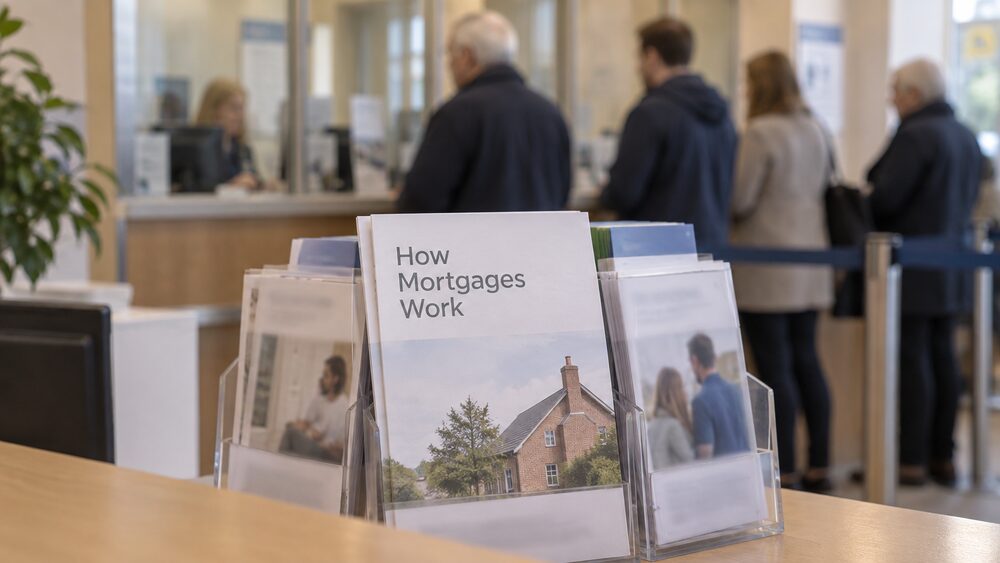
A mortgage is a loan secured on your home. The Bank of England describes a secured loan as one where "you borrow against an asset, such as a house"1, and a mortgage is the loan most people use to buy one. Because the loan is attached to the property, the lender has a claim on it: if you cannot keep up the repayments, your home could be repossessed2.
Most people repay a mortgage in monthly instalments over a term agreed with the lender, paying back both the amount borrowed (the capital) and the interest charged on it. The interest rate you pay depends on the type of deal you take: a fixed rate stays the same for an agreed number of years, while tracker and discounted rates can move. When a deal ends, you are usually moved onto your lender's standard variable rate (SVR) unless you remortgage3.
What a mortgage is: a loan secured on your home
A mortgage is a loan attached to your home or another property you own2. In law, the word "mortgage" includes a charge on the property, and the "mortgagee" is the lender who holds that claim8. What this means in practice is that the lender's right to be repaid is tied to the property itself. If the loan is not repaid, the lender can take steps to take possession of the home and sell it to recover its money.
Because the loan is secured, mortgages are usually the cheapest way to borrow a large amount over a long period, compared with unsecured credit. The trade-off is the risk: the consequence of not paying a secured debt is losing the asset it is secured on, not just a damaged credit record.
More than one loan can be secured on the same property. A second mortgage, also known as a second charge, works like a regular first mortgage except that its claims sit behind the first lender's: if the property is sold, the first mortgage is repaid before the second9. Homeowners use second mortgages to raise finance from the equity in their property, for purposes such as renovations, helping family buy a first home, raising a buy-to-let deposit, consolidating loans or covering unexpected bills9. Mortgages are paid off in the order you took them out, so a second charge waits behind the first10. The dedicated guide to second charge mortgages explains how these work in more detail.
How repayments work: interest, capital and the term
There are two main ways a mortgage can be repaid. With a repayment mortgage, you pay back the capital and the interest together4: each monthly payment covers the interest charged and pays off some of the capital11. This is by far the more common type of deal12. By the end of the term, provided you have kept up the payments, both the capital and the interest have been paid back in full.
With an interest-only mortgage, monthly repayments just cover the interest on the loan13. The capital is paid off at the end of the term in one go, and you can use money from different sources to meet that payment, such as an endowment policy or savings13. Interest-only mortgages carry a distinct risk: if the repayment plan falls short, the full loan is still owed at the end and the home may need to be sold to clear it. The guides to repayment mortgages and interest-only mortgages cover each in full.
The term is the period agreed for repaying the loan. Mortgages do not have to be for 25 years16; the lender agrees a term with you, and a longer term means lower monthly payments but more interest paid over the life of the loan, while a shorter term works the other way. Second mortgages tend to run for shorter periods than first mortgages, for example 5 or 10 years10. A capital repayment mortgage requires monthly repayments for the agreed term until you have paid back both the capital and the interest in full15. If you want to change the term later, the guide to mortgage terms and extensions explains what is involved.
Fixed, tracker or discounted: how each rate type behaves
The interest rate on a mortgage comes in four main forms: fixed rates, tracker rates, discount variable rates, and standard variable rates14.
- Fixed rate: you pay the same interest rate for an agreed number of years, before going back to the lender's SVR or, if you choose, remortgaging17. Your payments stay the same during the fix, which makes budgeting predictable.
- Tracker rate: a variable rate deal that tracks the Bank of England base rate plus a set percentage, for example the base rate plus 1%18. When the base rate moves, your rate and your payments move with it.
- Discount variable rate: a deal charging the lender's SVR minus a fixed margin19. Because it is a variable-rate mortgage, the amount you pay could change from month to month, and the discounted rate tracks the lender's SVR, which can change by any amount and at any time20.
- Standard variable rate (SVR): the lender's default rate, explained in the section below.
The choice is essentially between certainty and flexibility. A fixed rate protects you from rate rises for the deal period but does not benefit you if rates fall, and leaving early can trigger an early repayment charge. Tracker and discount rates can fall as well as rise, so your monthly payments might not be the same each month20. The comparisons of fixed vs tracker and fixed vs discounted rates set out how each behaves side by side, and the guide to types of mortgage covers the full range, including offset mortgages.
Average fixed rates: 4.92% for a two-year fix in August 2026
The average two-year fixed mortgage rate was 4.92% in August 2026, up 0.82 percentage points on a year earlier, according to official statistics6. Earlier independent figures showed the average two-year and five-year fixes at 5.03% and 5.01% respectively at the end of July 202521, and in June 2023 rates on an equivalent two-year fixed-rate mortgage at 75% loan to value were around 5.5%22. Averages move as lenders reprice, so any figure is a snapshot of its period.
Borrowers most commonly take out two-year or five-year fixed-rate mortgages, although three, seven, ten and even fifteen year fixed terms are available12. The rate you are personally offered depends on how much you are borrowing against the property's value, your credit file and your circumstances, not just the market average. The guide to loan to value explains why a smaller deposit usually means a higher rate, and the page on how the APRC is worked out explains how to compare the full cost of different deals.
What happens when your deal ends: the standard variable rate
A standard variable rate mortgage is what you will usually be moved onto when a fixed, tracker or discount deal comes to an end. It is a variable-rate mortgage, which means your payments can go up or down, and each lender sets its own SVR at whatever level it wants3. The interest rates are often higher for SVRs than for other types of mortgage, and average SVRs have been above 7%18.
An SVR is also known as a reversion-rate mortgage3. It is not directly linked to the Bank of England base rate, but is often affected by it: the base rate is only one of several factors a lender takes into account, alongside its own cost of borrowing, risk management and internal targets3. Because SVRs do not change very often, a lender can leave its SVR unchanged even when the base rate falls, or move it when the base rate does not.
At the end of your fixed period, you will need to remortgage. If you do not, you will be moved to your lender's SVR, which is usually much more expensive12. Because average SVRs have been above 7%18, it is important to remortgage to another deal before the end of your fixed term unless you are happy to stay on the SVR. You can move to a new deal with a different lender, or stay with your current lender on a new deal, known as a product transfer21. The guides to SVR mortgages, what to do when your fixed rate ends and remortgaging cover the options, and how far ahead you can lock in a new rate explains the timing.
Fees and charges on a mortgage
A mortgage costs more than the interest. Buying a home brings new and ongoing costs such as paying the mortgage, rates, repairs and service charges24, and the mortgage itself can carry arrangement fees, valuation fees and legal costs, which the guide to mortgage fees and charges sets out.
The charge most often caught out by is the early repayment charge. Your mortgage agreement sets out whether any fees or penalty charges apply, so it is the document to check before making any change to your mortgage16. This applies to overpaying, paying the loan off early, or selling the home: if you sell your home to pay off the mortgage while still in the introductory period, you may incur an early repayment charge12. The dedicated guide to early repayment charges explains how these are worked out and when they apply, and making overpayments covers the allowances many deals include.
Getting a mortgage: what lenders look at
Before offering a mortgage, most lenders will tell you how much money they are willing to lend you, called a mortgage or agreement in principle25. This is an indication based on your circumstances, not a guarantee, and the guide to the agreement in principle explains how it fits into the application process.
A mortgage lender will base your application on several things, including your credit file, the value of your house, and how much you want to borrow26. Lenders typically lend up to four-and-a-half times your salary, and up to six times salary for some borrowers5. How much you can borrow also depends on the deposit: the page on how much you can borrow works through the factors.
On a joint mortgage, lenders will run a credit check on each applicant, and if one party has a poor credit score it could impact the lender's decision12. Taking out a joint mortgage also creates a financial link with the other person12, and a missed mortgage payment will show up on both credit reports, regardless of whose fault it was19. These points matter for anyone buying with a partner, friend or family member, and the guide to joint mortgages, separation and transfer of equity covers what happens if the relationship ends.
A poor credit history does not necessarily close the door. Missed payments, reduced payments, County Court judgments and Decrees on a credit file do not mean you cannot get a mortgage, but you may have to pay more in interest and fees11. The guides to getting a mortgage with bad credit and mortgages for self-employed people cover these situations, and mortgage advice: brokers, advisers and applying direct explains where help fits in.
Properties that are hard to mortgage
The property itself can be as much of an obstacle as the borrower's finances. Some lenders will not accept certain property types, such as timber frames, concrete construction and flat roofs; spray foam insulation is very frequently a problem for providers; and living in a flood area can also cause difficulties27. These features make a property harder to sell or insure, which is why mainstream lenders decline them.
Some property types are more complex to mortgage than others: getting a mortgage on a leasehold property, for example, could be more complex than on a freehold one. The guide to specialist mortgage lenders explains this part of the market, and the pages on leasehold properties, new-build homes and self-build and renovation mortgages cover the property types that most often need specialist treatment. If a lender's valuation comes in below the price you have agreed, that is a separate problem, covered in how to challenge a mortgage down valuation.
Mortgages and borrowing in later life, including equity release
Borrowing against your home does not stop at retirement age. A lifetime mortgage, the most common form of equity release, lets you borrow money against the value of your home28. Some retirement mortgages work more like a standard mortgage: you make monthly repayments, either interest-only or full repayment29. A lifetime mortgage can give you funds in a single lump sum or in smaller amounts over time, with the loan and interest repaid when you die or move into long-term care30.
The most common form of equity release is a lifetime mortgage, a loan secured against the value of your home that is repaid once you die or move into long-term care21. Money freed up via equity release must be initially used to pay off any outstanding mortgage that you have on your property21. Beyond that, the money can be released as a lump sum or through a flexible borrowing facility, and it can be used to help manage debt or to repay a mortgage31. Equity release can also be used to purchase a property, though providers may have restrictions about property type and the process can take longer than raising a standalone equity release mortgage27.
Equity release is a significant commitment and is not right for everyone. The money released can be treated as savings for means-tested benefits such as Universal Credit and Pension Credit, though funds paid directly to a mortgage lender are not usually treated as savings30. The guides to equity release and lifetime mortgages, the downsides of releasing equity, retirement interest-only mortgages and age limits for mortgages cover the options in later life, and equity release and later-life mortgage providers describes who provides them.
Self-build works differently again: an arrears-based mortgage releases money in staged payments as each stage of the build is completed32, which is why standard mortgages do not fit self-build projects.
What can go wrong and where to get help
The first step lenders set out for anyone who thinks they will have difficulty paying their mortgage is to contact the lender as soon as possible33. Mortgages are priority debts: because your lender could repossess your home and sell it to get their money back, they should be paid before non-priority debts7. If you are unable to keep up repayments on your mortgage, your home could be repossessed by your lender3.
Help exists at several levels. If you are having problems with your mortgage you could get help from your lender if they have signed up to the Mortgage Charter34. If you are behind with your mortgage payments, the lender may arrange a forbearance agreement with you, which allows you to repay any missed payments35. Homeowners on certain benefits may be able to get help towards mortgage interest payments, called Support for Mortgage Interest7: it is paid as a loan which must be repaid when your property is sold or transferred36, it covers the interest element only and cannot help pay the amount borrowed, insurance policies or mortgage arrears37. Payments of help with housing costs are made directly to your mortgage lender38, and if you used part of your mortgage for other purposes, such as debt consolidation by remortgaging, you cannot get help with that part of your loan39. The guide to Support for Mortgage Interest explains the scheme.
Other problems can arise even when you are paying. Mortgage underfunding occurs when mortgage payments are not set up on the correct basis, meaning the customer is not paying enough, usually without realising, and then faces paying back more than expected or over a longer period40. The Financial Ombudsman Service can consider complaints about mortgages, including how interest is applied17, and the guide to complaining to the Financial Ombudsman explains the process.
If arrears cannot be resolved, there are schemes of last resort. Under the Mortgage to Rent scheme, your home is sold to a housing association or the local council, and the mortgage and any secured loans are paid off, while you continue living there as a tenant41. In Scotland, Mortgage to Rent allows the local council or a housing association to buy your home42. Negative equity, where the home is worth less than the mortgage, is a separate problem covered in the guide to negative equity. Before any repossession, lenders must follow pre-action rules, explained in what a lender must do before going to court, and the guides to mortgage arrears and repossession set out the process and your rights. Free, independent debt advice is available from charities such as StepChange, National Debtline and Business Debtline, and housing advice from Shelter Cymru and similar bodies10.
Sources42 cited
- What do I need to know about debt Bank of England, 2025-08-19
- Secured loan debt StepChange Debt Charity, 2026-09-25
- Standard variable rate mortgages Which?, 2026-04-02
- Mortgage repayment options Shelter Cymru, 2026-08-28
- Finding the best places to live Which?, 2026-04-09
- Mortgage rates: key statistics House of Commons Library, 2026
- Mortgage arrears or payment difficulties nidirect, 2025-11-07
- Coroners and Justice Act 2010, Section 3 interpretation legislation.gov.uk, 2010-04-08
- Second charge mortgages Finance and Leasing Association, 2026-09-25
- Mortgage arrears guide Business Debtline, 2026-09-26
- Mortgage with bad credit StepChange Debt Charity, 2026-09-25
- Mortgage types explained Which?, 2026-04-02
- Interest-only mortgages Financial Ombudsman Service, 2026-09-26
- Mortgage jargon buster StepChange Debt Charity, 2026-09-25
- Problems paying your mortgage Independent Age, 2026-09-26
- Home buying and selling jargon HomeOwners Alliance, 2026-07-31
- Interest rates applied to mortgages Financial Ombudsman Service, 2026-09-26
- Bank of England base rate and your mortgage Which?, 2026-06-23
- Discount mortgages Which?, 2026-04-02
- Mortgage types explained Which?, 2026-04-02
- Should you consider a product transfer for your next mortgage Which?, 2025-07-31
- Financial Stability Report, July 2023 Bank of England, 2023
- Mortgage checklist StepChange
- Low cost home ownership schemes nidirect, 2026-02-18
- Buying a home: step by step guide nidirect, 2025-08-22
- Remortgaging to pay off debt StepChange Debt Charity, 2026-09-25
- Equity Release Council FAQs: general questions Equity Release Council, 2026-09-26
- Equity release Independent Age, 2026-09-26
- Equity Release Council consumer guide Equity Release Council, 2025-08
- Equity release guide National Debtline, 2026-09-25
- Releasing equity from your home StepChange Debt Charity, 2026-09-25
- Raising money to build your own home nidirect, 2024-09-02
- Get help with housing costs Welsh Government, 2022-11-18
- Rent and mortgage cost of living help Scottish Government, 2026-09-26
- Help to Buy mortgage guarantee scheme nidirect, 2025-08-26
- Support for Mortgage Interest nidirect, 2026-09-01
- Relationship breakdown: things to think about Shelter Cymru, 2026-08-13
- Housing overview: Universal Credit entitledto, 2026-09-26
- Housing costs: more information entitledto, 2026-09-26
- Mortgage underfunding Financial Ombudsman Service, 2026-09-26
- Negative equity Business Debtline, 2026-09-26
- Home Owners' Support Fund: if you're separated from your partner mygov.scot, 2026-07-14






 MoneyHelperFree, impartial money and pensions guidance, set up by government
 StepChangeFree debt advice and solutions from a charity
 Financial Ombudsman ServiceFree, independent help when a complaint about a firm is not put right
 Citizens AdviceFree advice on money, consumer and legal problems in England and Wales
 ShelterFree housing advice from a charity