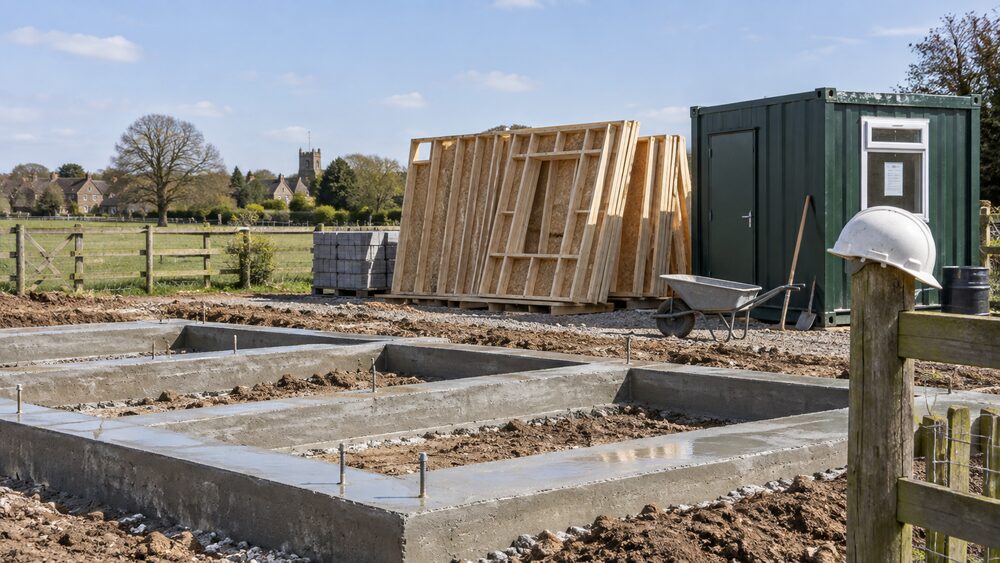
A self-build or renovation mortgage is a home loan designed for a property that does not exist yet, or does not yet look the way you want it to. The main difference from an ordinary mortgage is how the money arrives: instead of one lump sum on completion, the lender releases funds in stages as the building work progresses1.
That staged structure is what makes these loans work, and also what makes them harder to get. Bath Building Society says you can expect to need a deposit of at least 25% of the total project cost unless you own the land already2. Ecology Building Society asks for a 20% minimum deposit to buy the land plus a further 15% to 20% of total build costs to start the build3. By contrast, a standard mortgage usually needs at least 5% of the property's value4.
The trade-off is control. You are not buying a finished home with a known value; you are funding a project whose final cost and final value are both estimates until the work is done. Lenders price and structure for that uncertainty, which is why the deposit is larger, the paperwork is heavier and the choice of providers is narrower.
What a self-build or renovation mortgage is
A renovation mortgage is a type of additional borrowing used specifically for home improvements, secured against the projected property value5. A self-build mortgage does the same job for a plot and a build. Both are secured loans against the home you will end up with, not against the home you have now.
The mechanics differ from a standard purchase in one important way. With a normal mortgage the lender values a finished property and hands over the money. With a self-build, the lender is advancing money against something that is being created, so it needs a way to check progress and limit its exposure at each point. That is what the staged release schedule is for.
The Financial Conduct Authority's rules recognise this. Its mortgage conduct rules cover the release of tranches of money to the customer in relation to a self-build mortgage or other instalment mortgage6. In other words, staged lending is a recognised, regulated product type rather than an informal arrangement.
Most self-build mortgages are offered on a repayment basis, where each monthly payment covers some of the loan and some interest7. Some lenders also offer interest-only during the build, switching to repayment on completion8. Interest-only means you pay only the interest each month and still owe the full amount at the end, so it needs a separate plan to clear the debt9.
Projects these mortgages can cover: new builds, conversions, renovations and knock-downs
The range of projects is wider than the name suggests. Suffolk Building Society lists new projects from scratch, conversions, renovations, knock down and rebuilds, and mid or partially built projects among the build types its self-build mortgages cover10. That last category matters: if you have already started and run out of money, some lenders will still consider taking it on.
Conversions are a recognised niche. Bath Building Society describes barn conversions as a niche area of lending but something it can consider2. Beverley Building Society says its self-build and custom-build mortgages could suit you if you are planning to build your own home, join a custom build project, or convert an existing property such as a barn8. Ecology Building Society lends for conversions on the same planning terms as self-builds3.
Renovation lending covers a similar spread. NatWest says a renovation or remodel mortgage may cover extensions, structural changes and other refurbishments5. Skipton describes a new build mortgage as helping you buy a home that has been newly constructed, significantly modernised, or refurbished in the past two years11. Hampden Bank offers loans to significantly refurbish an existing residential property12.
| Project type | What it involves | Lenders that state they cover it |
|---|---|---|
| New build from scratch | Buying a plot and building a home | Suffolk, Bath, Ecology, Beverley10 |
| Conversion | Barn or other existing building turned into a home | Bath, Beverley, Ecology2 |
| Renovation | Extensions, structural changes, refurbishment | NatWest, Hampden, Ecology5 |
| Knock down and rebuild | Demolishing and starting again | Suffolk10 |
| Partially built | Taking over a project already under way | Suffolk10 |
One thing these mortgages do not cover is a mobile home. Banks and building societies do not offer mortgages for buying mobile homes14.
Staged payments: how the money is released as the build progresses
The staged release is the defining feature. Northern Ireland's official guidance puts it plainly: the lender releases money to the borrower in stages, not as a single amount, as the build progresses15.
There are two timing models, and the difference matters for your cash flow. An advance self-build mortgage releases payments at the beginning of each stage, so the money is available to pay trades as the work starts2. An arrears self-build mortgage releases payments after each stage is complete, which suits people who have cash to pay for the work up front and want to be reimbursed2. Northern Ireland's guidance describes the same split, with an arrears-based mortgage releasing money in staged payments as each stage is completed15.
The stages themselves follow the build. Bath Building Society sets out a typical schedule: the first payment when you buy the land; the second when the foundations are laid and again once the property is built up to eaves level; further payments when the roof is watertight and when the interior walls are plastered; and the final instalment on completion2. Beverley Building Society releases funds in six stages: land, foundations, wall plate, wind and watertight, first fix, and second fix or completion8.
Not every lender uses fixed milestones. Ecology Building Society releases funds as and when the build progresses, up to a percentage of the increased value of the property3. Its Self-build 65% mortgage releases staged payments of up to 65% of your increased property value as the build progresses, with no set construction milestone stages16.
Suffolk Building Society releases funds in arrears for new purchases; for self-build remortgages it can depend on your circumstances whether funds are received in advance or in arrears17. If you are remortgaging to fund a build rather than buying a plot, ask which model applies before you commit.
Who can get one and what lenders look for
The first filter is the project itself. Suffolk Building Society states that its self-build mortgages are only for personal use, so borrowers must live in the property themselves once it has been completed17. These are not investment products.
The second is planning. Ecology Building Society needs at least outline planning permission to start the application process and detailed planning permission before the mortgage is released3. Its Renovation Large Loan requires planning permission or listed building consent to be in place before funds are lent13. Its off-site build mortgage works the same way18. Where a project needs formal planning permission from the local authority, that permission has to be obtained3.
The third is costings. Suffolk Building Society requires full costings to be provided, and offers a self-build budget planner to help10. A lender needs to see what the build will cost, stage by stage, before it can agree a schedule of releases.
The fourth is income and affordability. Lenders must check if you can afford mortgage repayments and may refuse a new mortgage19. That check is harder on a self-build because you may be paying rent or an existing mortgage at the same time.
Self-employment is not a bar. Family Building Society offers a range of mortgages for landlords and the self employed20, and lenders will usually require a deposit of at least 10% of the purchase price if you are self-employed21. Some lenders work only through intermediaries: Bath Building Society's self-build and custom-build options are available exclusively through BuildStore22.
Applying for a self-build or renovation mortgage
Applying for a mortgage usually involves four main stages23. You can apply direct to a building society or other lender, or use a regulated mortgage broker24. The Building Societies Association suggests contacting the building society directly, or speaking to an independent mortgage adviser, to see what is most suitable for your needs7.
Leeds Building Society sets out the situations it handles: an existing mortgage customer, buying a new home, remortgaging, or a buy to let mortgage25. A self-build application will sit alongside those, with the extra documentation the project needs.
- Get planning permission in principle. At least outline permission is needed to start an application with some lenders, and detailed permission before funds are released3.
- Prepare full costings. Lenders require a stage-by-stage budget, and some provide a planner to build it10.
- Arrange the mortgage. Apply direct or through a regulated broker24.
- Have the land valued and the plans assessed. A surveyor may also provide a minimum reinstatement value, the amount you would need to rebuild the property from the ground up, which is useful when arranging buildings insurance26.
- Agree the release schedule. Confirm whether payments come in advance of each stage or in arrears after it2.
- Draw down stage by stage as the work is certified.
If you are buying a newly built home in Scotland, official guidance says to arrange a loan and take legal advice before accepting the builder's offer27. If your home has a Help to Buy equity loan and you plan structural alterations, permission is required from the scheme administrator for anything that needs planning permission, changes to the layout, loft or basement conversions, specially adapted kitchen units, extensions or conservatories, and changes to access28. Internal redecoration, painting, carpeting, built-in furniture, refitting an existing kitchen or bathroom, and garden landscaping do not need permission28.
Can I live in my current home while the new one is being built?
Often yes, but it has to be arranged. Northern Ireland's official guidance says that if you want to stay in your current home while you build your new home, you need to discuss any unpaid mortgage with the lender, and you need to make sure you have enough income to cover both mortgages15.
Let to buy is one structure for this. It involves having two mortgages at the same time: a buy-to-let mortgage on the existing home and a standard residential mortgage on the new home29. Lenders will usually want proof that you are buying a new home at the same time as switching your mortgage, typically a copy of your mortgage offer for the new home29.
A lifetime mortgage can be transferred to a new property, subject to the lender agreeing that the new house is suitable30, and you can remain in your home as long as the property is in good repair and you do not go bankrupt31. That is a later-life option rather than a build route, but it matters if you are funding a build in retirement.
What can go wrong during a build and where to get help
The most common problem is a gap between what the lender will release and what the work costs. Because each stage is released only when the previous one is done, an overrun has to be covered from your own funds. Lenders must check affordability and may refuse a new mortgage19.
Insurance is a separate risk. Renovation insurance covers renovations, extensions, conversions, new builds, self-builds, restorations and contract works32. Standard home insurance often will not cover a property while major work is going on, so this needs arranging before work starts.
If you fall behind on payments, help exists. If you are having problems with your mortgage you could get help from your lender if they have signed up to the Mortgage Charter33. A mortgage company may give a repayment break for short-term problems34. Support for Mortgage Interest can help with the cost of interest on a mortgage or remortgage, a loan taken out to pay a service charge for essential repairs or improvements, or a loan taken out to pay for certain essential repairs or improvements directly35. It is paid as a loan which must be repaid when your property is sold or transferred36.
There are limits. If you used part of your mortgage for other purposes, such as debt consolidation by remortgaging, you cannot get help with that part of your loan37. Loans must be for repairs needed to keep the property fit to live in, such as providing a bath, shower or toilet, repairing structural defects, or adaptations for a disabled person37. Loans to meet the cost of essential repairs and improvements can qualify for help with the interest on that loan39.
If a complaint about your lender cannot be resolved, the Financial Ombudsman Service handles disputes about mortgage contracts, including first and second charge mortgages and bridging loans, equity release products, home purchase plans and sale and rent back agreements40. Free, impartial help is available from MoneyHelper and from debt advice charities such as StepChange, which can advise on mortgage problems41.
Once the build is finished, the picture usually improves. In most cases it is possible to remortgage once your self build is complete and certified by a surveyor2, which is the point at which the property can be valued as a finished home and moved onto standard mortgage terms.
Sources41 cited
- Self and custom build Building Societies Association, 2020-10-29
- Frequently asked questions about self-build mortgages Bath Building Society, 2026-08-11
- Mortgages FAQs Ecology Building Society, 2026-03-12
- Applying for a mortgage Which?, 2026-05-20
- Remortgage to renovate NatWest, 2026-09-25
- MCOB 7.6 Financial Conduct Authority, 2004
- About mortgages Building Societies Association, 2023-01-19
- Self-Build & Custom-Build mortgages Beverley Building Society, 2025-12-17
- Interest-only mortgages Coventry Building Society, 2026
- Self-build criteria Suffolk Building Society, 2024-09-27
- New builds Skipton Building Society, 2026-09-26
- Self-build mortgages Hampden Bank, 2026
- Renovation 90% Large Loan Ecology Building Society, 2026-08-21
- Buying a mobile home Shelter Cymru, 2026-08-24
- Raising money to build your own home nidirect, 2024-09-02
- Self-build 65% mortgage Ecology Building Society, 2026-08-21
- Self-build mortgages Suffolk Building Society, 2026-05-21
- Off-site build mortgage (advanced payment) Ecology Building Society, 2026-08-21
- Mortgage worries Macmillan Cancer Support, 2022-01-11
- Mortgages Family Building Society, 2026-09-26
- Mortgages for self-employed buyers Which?, 2025-12-18
- Self-build mortgages Bath Building Society, 2026-08-04
- Understanding your mortgage Macmillan Cancer Support, 2022-11-01
- How to get a mortgage Building Societies Association, 2023-01-19
- How to apply Leeds Building Society, 2026-09-26
- Mortgage valuations explained Which?, 2025-12-18
- Buying a newly built home mygov.scot, 2020-08-12
- How to make structural alterations to your Help to Buy home GOV.UK, 2021-05-05
- Let to buy explained Which?, 2026-06-23
- 5 common equity release myths Which?, 2024-06-15
- Equity release StepChange, 2026-09-25
- Home renovation insurance guide British Insurance Brokers' Association, 2026-02-11
- Rent and mortgage Scottish Government, 2026-09-26
- How to survive an income shock Debt Advice Foundation, 2016-03-23
- Help with mortgage costs entitledto, 2026-09-26
- Things to think about Shelter Cymru, 2026-08-13
- Housing costs: more information entitledto, 2026-09-26
- Housing costs rules under 60 entitledto, 2026-09-26
- Charges, ground rent and other housing costs entitledto, 2026-09-26
- Mortgage arrears charges Financial Ombudsman Service, 2026-09-26
- Mortgages StepChange, 2026-09-25




 MoneyHelperFree, impartial money and pensions guidance, set up by government
 StepChangeFree debt advice and solutions from a charity
 Financial Ombudsman ServiceFree, independent help when a complaint about a firm is not put right
 Citizens AdviceFree advice on money, consumer and legal problems in England and Wales
 ShelterFree housing advice from a charity