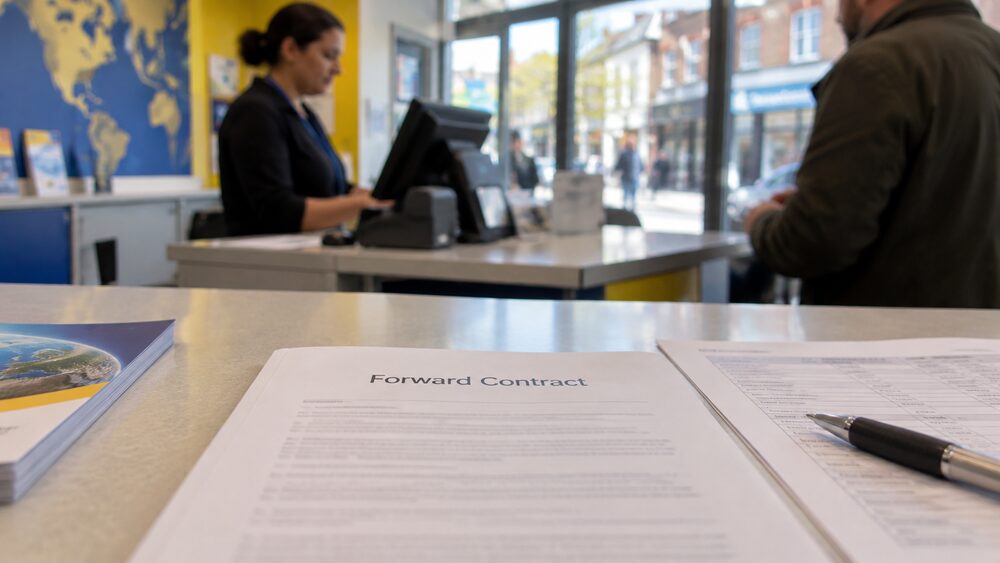
When you have to pay someone in another currency, the exchange rate you get is part of the price of the payment. If you pay today, you take whatever the market rate is at the moment you deal. If the payment is weeks or months away, a house deposit abroad, a wedding, an invoice from a foreign supplier, you can instead fix the rate now and pay later. That is what a forward contract does, and it is the main way individuals and small businesses protect themselves from currency movements on international payments.
The alternative is to wait and hope, or to set a target rate and let a provider buy automatically if the market reaches it, which is called a limit order. Each approach has a cost and a risk. A 2023 report by the House of Commons Treasury Committee put the scale of the problem plainly: for cross-border transfers, "It takes three to five days. Up to 6% is chewed up in fees"1. Fixing a rate in advance does not remove those fees, but it does remove the uncertainty about what the currency itself will cost.
Spot transfers: the live rate, often paid the same day
A spot transfer is the simplest kind of currency payment: you agree a rate now, send your pounds, and the provider sends the foreign currency to your recipient. The rate you are quoted reflects the live market at the moment of the deal, with the provider's margin and fees on top. How those margins work is covered in the guide to exchange rates on international payments.
Speed is the main advantage. For payments within the UK in pounds, money sent using Faster Payments through online banking or a smartphone app "will reach the recipient's account within 2 hours, and sometimes it's received immediately"3. Cross-border payments are slower, typically three to five days end to end1, and the guide to how long an international payment takes explains the cut-off times and holidays that cause the delays.
The cost of a spot transfer comes in two parts: the margin inside the rate, and any explicit fees. For comparison, everyday foreign exchange fees give a sense of the range. Using a debit card abroad typically carries "a foreign exchange fee, often around 3% of the transaction amount"4, while investment platforms charging for currency conversion on international shares and funds were found to range "from 0.45% to 1.5% on amounts up to £5,000"5. Specialist transfer firms generally sit well below card rates, which is why the guide to banks versus specialist providers is worth reading before choosing who to deal with.
A spot transfer suits a payment you need to make now, or one where you are content to accept the market rate on the day. Its weakness is that it gives no protection at all for a payment due in the future: the provider quotes the rate from the live market at the moment you deal1, and exchange rates can change daily, even hourly3, so the price in pounds of a future payment is unknown until the day you transact.
How long a currency transfer takes
Timing matters more when a rate is fixed, because a forward contract settles on a specific date. Three figures frame what to expect. Domestic Faster Payments arrive within two hours and sometimes immediately3. Cross-border transfers take three to five days, with up to 6% lost in fees1. And the working-day rhythm of banking means a payment confirmed just after a provider's daily cut-off time, or on a Friday before a holiday weekend in the receiving country, can arrive noticeably later than one confirmed mid-morning on a Tuesday.
For a spot transfer this is an inconvenience. For a forward contract it is a planning issue: if the currency must reach a notary or a supplier by a contract deadline, the maturity date you agree needs to allow for the transfer time on top. The guides to Swift payments and details needed to pay someone abroad cover what affects the final leg of the journey.
Forward contracts fix today's rate for a later payment
A forward contract is an agreement with a currency provider to buy a set amount of foreign currency at a rate fixed today, on a date in the future. The amount, the rate and the maturity date are all agreed at the outset. You normally pay a deposit when the contract is struck, often a small percentage of the total, and the balance by the maturity date. On that date you pay the agreed amount in pounds and the provider delivers the agreed amount of currency.
The point of the arrangement is certainty. Between the day you strike the deal and the day it settles, the market rate will move, sometimes daily or even hourly, but none of that changes what you pay. If you are buying a property abroad, budgeting for a purchase in another currency, or paying a foreign invoice with a known due date, a forward contract turns an unknown future cost into a known one.
The deposit exists because the contract binds both sides. The provider is committed to delivering the currency at the agreed rate even if the market moves against it, and the deposit is its security against you not completing. The Financial Conduct Authority's banking conduct rules treat initiating "a payment in a currency other than a currency of the United Kingdom to a payee outside the United Kingdom" as a distinct, regulated action that firms must handle under set standards10, so the deal is not an informal promise but a contractual commitment on both sides.
The trade-off is symmetrical. If the market moves in your favour, the rate you fixed still applies and you get no benefit. If it moves against you, you are protected. Some providers offer flexible or window forwards that let you draw down the currency within a period rather than on a single date, which can suit a payment schedule that is not pinned to one day, but the terms vary by firm and should be checked before committing.
Spot or forward: how each one behaves
| Spot transfer | Forward contract | |
|---|---|---|
| Rate | Live market rate when quoted | Fixed when you strike the deal |
| When money moves | In many cases the same day | On the agreed maturity date |
| Money up front | The full amount | Usually a deposit, balance later |
| Exposure to rate moves | None once sent | None, in either direction |
| Suits | Payments needed now | Payments due on a known future date |
A limit order sits between the two. You tell the provider a target rate, and if the market reaches it, the provider buys the currency automatically. You get the rate you wanted without watching the market, but there is no guarantee the market will ever reach your target, so it does not suit a payment with a hard deadline. If the rate is never hit, you are left deciding at the last minute whether to take the spot rate after all.
How the exchange rate and charges are worked out
Whatever type of transfer you choose, the rules on disclosure are the same. Under the Payment Services Regulations 2017, "the party offering the currency conversion service to the payer must disclose to the payer all charges as well as the exchange rate to be used"2. The same rules allow that "changes in the interest or exchange rates may be applied immediately and without notice" where that right is agreed in the framework contract and based on agreed reference rates, though more favourable changes to the customer may always be applied without notice2. In practice this means a quoted rate is a quote, not a guarantee, until you confirm the deal.
For online transfers, the rules go further. Where a payment provider offers currency conversion for an online credit transfer, it "shall inform the payer prior to the initiation of the payment transaction, in a clear, neutral and comprehensible manner" of the estimated conversion charges, the estimated total amount in the payer's account currency including fees, and the estimated amount the recipient will receive11. In practice this means the information shown before a transfer is sent covers the whole picture: what leaves the sender's account, what the recipient gets, and what the provider keeps.
Where a conversion service is offered at a cash machine or a card terminal abroad, "it should be possible for the payer to refuse that service and to pay in the currency used by the payee instead"11. Refusing the terminal's conversion and letting your own provider do it is often the cheaper of the two, though the only way to know is to compare the two rates shown on the screen.
How a rate is fixed, and by whom, varies with the context, and official rules show how much conversion conventions differ. For Scottish land and buildings transaction tax, chargeable consideration in foreign currency is calculated "by translating the foreign currency into sterling using the London closing exchange rate on the effective date of the transaction"12. For stamp duty on shares, amounts in overseas currencies "must be converted to pounds sterling using the exchange rate, either on the date of the transfer or agreed between the buyer and seller"13. And in Scottish sequestration, a claim stated in foreign currency is converted "at a single exchange rate for that currency determined by the trustee with reference to the exchange rates prevailing at the close of business on the date of sequestration"14. A currency provider's quote is none of these: it is the provider's own rate, which is why comparing quotes from more than one firm, covered in ways to send money abroad, matters.
One further cost belongs to tax rather than the transfer itself. Where the overseas transfer charge arises on certain transfers of pension funds overseas, "the charge is 25% of the transferred value"15. This does not apply to ordinary payments abroad, but anyone moving pension rights overseas should take advice on it first.
How to arrange a currency transfer
Transfers can be arranged in several ways. The Payment Systems Regulator notes that a payment "can be done over the phone, via online banking, or in person"18. Specialist currency firms commonly deal by phone or through an app; high street banks offer the service through their branches, online banking and telephone banking. The steps are broadly the same whichever route you take:
- Gather the recipient's details: the account number or IBAN, the bank identifier, the currency and the country. The guide to recipient details lists what each destination needs.
- Get a quote: the provider must show the exchange rate and all charges before you agree2, and for online transfers the estimated amounts on both sides11.
- Choose spot, forward or limit order: depending on whether you are paying now, on a known future date, or waiting for a target rate.
- Confirm the deal: this is the moment the rate is fixed. A Financial Ombudsman Service case study describes a customer who, after a phone call with his bank, had in fact "agreed to the transfer going out the next day at the bank's exchange rate, which was fixed at the time of the phone call"17. Once confirmed, you are bound.
- Fund the transfer: send your pounds before the provider's cut-off time if the payment needs to be processed that day.
Expect identity and security checks, especially for a first payment or a large sum. The guides to identity checks and sending large sums explain what firms ask for and why payments can be held while checks are completed.
Where fixing a rate can go wrong
The main risk of a forward contract is the one you accept knowingly: the market may move in your favour and you will not benefit. The rules allow exchange rate changes to be applied immediately and without notice in some circumstances2, but a contractually fixed rate cuts both ways, and neither side can reopen it because the market has shifted.
The second risk is that your plans change. A forward contract is a commitment to buy the agreed currency on the agreed date. If the property purchase falls through or the invoice is cancelled, you still owe the provider the contract, and firms typically require you to settle it, sometimes at a loss if the market has moved against the position. Some providers allow the contract to be extended or the date moved, but this is at their terms, not yours, and may carry a cost. Before striking a forward, it is worth asking the provider directly what happens if the underlying payment does not go ahead.
The third risk is misunderstanding what you have agreed. The ombudsman case study of Felix is a warning about phone dealing: a conversation about a future transfer became a binding deal at the bank's rate, fixed at the time of the call, and the customer lost thousands through the confusion17. The lesson is not to avoid phone dealing but to be clear, before you confirm, whether you are asking for a quote or making a deal, and to ask for the confirmation in writing.
A limit order carries its own risks: the target rate may never be reached, leaving you to deal at the last minute at whatever the market offers, and some providers charge for the order or cancel it after a set period. Ask what happens to the order if it is never triggered.
Exchange rate risk is taken seriously enough elsewhere in UK financial services that regulators force firms to spell it out in capital letters. For mortgages secured on land and repayable in a currency other than sterling, firms must include the statement:
"THE STERLING EQUIVALENT OF YOUR LIABILITY UNDER A FOREIGN CURRENCY MORTGAGE MAY BE INCREASED BY EXCHANGE RATE MOVEMENT."
The mortgage rules make the same point in the standard information given to borrowers: "Changes in the exchange rate may increase the sterling equivalent of your debt"20. The European standardised information sheet for foreign currency loans spells out the mechanics with a worked example: "For example, if the value of sterling fell by 20% relative to [credit currency], the value of your loan would increase to [insert amount in sterling]. However, it could be more than this if the value of sterling falls by more than 20%"21. And the underlying legislation sets a threshold at which extra warnings must be given: where the amount payable varies "by more than 20% from what it would be if the exchange rate between the currency of the contract and sterling" applied at conclusion22. EU rules in the same field require that consumers are made aware of exchange rate risk and given ways to limit their exposure, "through conversion rights, caps or warnings"23.
These rules are about foreign currency borrowing rather than transfers, but the arithmetic is the same for anyone fixing a rate: a 20% currency move is a large, realistic swing, and it is the size of move that fixing a rate is designed to protect against.
What protects you, and where to get help
Currency firms operating in the UK must be authorised or registered with the Financial Conduct Authority, and the conduct rules for banks cover the specific act of initiating a payment in a foreign currency to a payee outside the UK10. The disclosure rules described above, showing all charges and the exchange rate before you agree2, are your main practical protection at the point of dealing. How your money is held while a payment firm processes it, and what happens if a firm fails, are covered in the guides to safeguarding and the FSCS and when a payment firm fails.
If something goes wrong, complain to the provider first, giving it the chance to put things right. If it does not, the Financial Ombudsman Service can look at complaints about currency transfers, and its published case study on a misheard phone deal shows it will unpick what was actually agreed17. Your rights when a payment goes astray, is delayed or is charged incorrectly are set out in the guide to your rights under the Payment Services Regulations, and if you believe you have been scammed, the guides to scams involving payments abroad and to tracing, cancelling or recalling a payment explain the immediate steps and the limits on getting money back.
Free, impartial help is available: MoneyHelper, the government-backed money guidance service, covers everyday banking and payments, and Citizens Advice can help with complaints and consumer rights. For tax questions, such as whether the 25% overseas transfer charge could apply to a pension transfer15, speak to a qualified adviser or HMRC before moving the money.
Sources23 cited
- Cross-border payments report House of Commons Treasury Committee, 2023
- Payment Services Regulations 2017, Part 6 legislation.gov.uk, 2026
- Online money transfers guide Age UK, 2026
- How to open, switch or close your bank account MoneyHelper, 2026
- How investment platforms work Which?, 2026
- Ways to convert currency Hargreaves Lansdown, 2026-09-26
- How do exchange rates work Post Office, 2026-09-14
- Travel Savings Plan terms and conditions Caxton, 2026
- International payments terms and conditions Caxton, 2026
- BCOBS 7.5.4R Financial Conduct Authority, 2018
- Regulation (EC) No 924/2009, Article 3b legislation.gov.uk, 2019
- LBTT chargeable consideration guidance Revenue Scotland, 2026
- Stamp duty on shares HMRC, 2014
- Bankruptcy (Scotland) Act rules on foreign currency claims legislation.gov.uk, 2016
- Overseas transfer charge legislation.gov.uk, 2024
- Payment Services Regulations 2017, Part 6 legislation.gov.uk
- Felix loses thousands in international money transfer confusion Financial Ombudsman Service, 2026
- Which? authorised push payment super-complaint response Payment Systems Regulator, 2026
- CONC 4.1.3R Financial Conduct Authority, 2014
- MCOB 5 Annex 1R Financial Conduct Authority, 2016
- MCOB 5A Annex 1, European Standardised Information Sheet Financial Conduct Authority, 2026
- Mortgage Credit Directive Order 2015, Schedule 2 legislation.gov.uk, 2015
- Directive 2014/17/EU legislation.gov.uk, 2014




 MoneyHelperFree, impartial money and pensions guidance, set up by government
 Financial Ombudsman ServiceFree, independent help when a complaint about a firm is not put right
 FCA Warning ListCheck whether a firm is authorised before you deal with it
 Citizens AdviceFree advice on money, consumer and legal problems in England and Wales