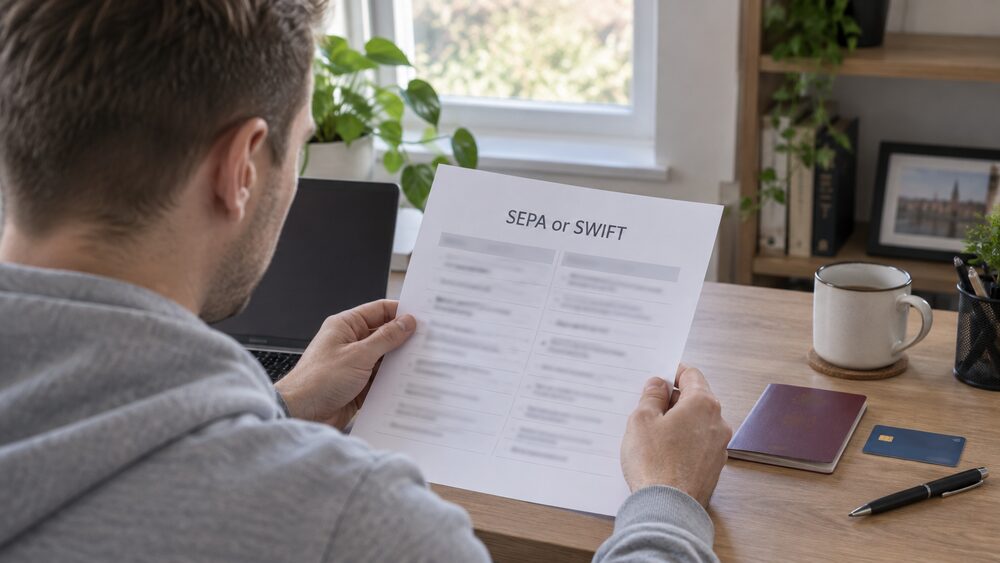
Sending money from a UK account to someone abroad runs down one of two tracks. SEPA is the European scheme for euro payments: it moves euros between accounts in the participating countries, and it is the cheaper and faster route when it fits. SWIFT is the global messaging network that banks use for everything else, and it allows for payments in any currency1.
The practical difference for a consumer is cost and reach. A SEPA payment avoids the costs of SWIFT, as one bank puts it2, while a SWIFT payment can carry a flat fee, a currency conversion charge, or both. Barclays, for example, charges no Barclays fee for payments made in its app or Online Banking, but applies a currency conversion charge of no greater than 2.75% for personal and Premier customers3. A Virgin Money M Access ISA tariff lists an international payment by SWIFT at £254.
Which one you get is not usually a choice you make at the screen. If you are sending euros to a euro account in a SEPA country, the payment travels as a SEPA credit transfer. If you are sending pounds, dollars or any other currency, or sending to a country outside the scheme, it goes by SWIFT.
SEPA or SWIFT: how a payment from a UK account travels abroad
SEPA is a set of European payment rules, not a company. It covers credit transfers and direct debits in euros, and it exists so that a euro payment between participating countries clears on the same terms as a domestic one. HSBC sets out the two shapes a SEPA payment can take: a recurring Direct Debit or a single payment1. The scheme's limit is currency, not geography in the everyday sense: SEPA transactions are limited to payments sent in euros, while SWIFT allows for payments in any currency1.
SWIFT is the messaging layer underneath most cross-border banking. When a payment cannot travel as a euro SEPA transfer, it is routed through correspondent banks, which is why it can pick up charges at more than one point in the chain and why timing depends on cut-off times and public holidays in each country involved. Our guide to how international payments work sets out that chain in detail, and Swift payments and wire transfers covers when a SWIFT payment is the only option.
For a UK consumer, the choice usually comes down to the currency and the destination. Sending euros to a euro account in a SEPA country is the case SEPA was built for. Sending sterling, dollars or anything else, or sending to a country outside the scheme, means SWIFT or a specialist provider. If euros are what you are sending, sending euros covers SEPA credit transfers and direct debits from a UK account specifically.
Fees and charges on international payments
International payment charges come in three parts, and they are not all labelled as fees.
The first is the provider's own charge. Barclays states plainly that it does not charge a Barclays fee for payments made in its app or Online Banking3. Virgin Money's M Access ISA tariff lists an international payment by SWIFT at £254, and an incoming SWIFT payment of £7.00 for all remaining currencies including sterling over £100 or equivalent4. Handelsbanken describes its SEPA service as a way to make single one-off euro payments without the costs of Swift2.
The second is the currency conversion charge, which is usually the larger of the two and is covered in the next section.
The third is what the receiving bank or an intermediary bank deducts along the way. This is the part UK providers do not control and often cannot quote in advance, and it is why the amount that lands can be less than the amount sent.
Some charges are waived by individual banks in specific circumstances. Lloyds refunded its fee for payments made to Ukraine on and since 21 February 2022, done automatically within a few days, and stopped charging non sterling transaction fees on Lloyds Bank credit card payments to non-UK based charities from 24 February 2022. Those are bank decisions rather than a general entitlement, and they apply to the bank's own customers.
Exchange rates: conversion charges of up to 2.75%
The exchange rate is where most of the cost of an international payment sits. Barclays applies a currency conversion charge of no greater than 2.75% for personal and Premier customers3. The charge is worked out as a percentage of the amount sent, so it rises with the size of the payment, and the recipient receives the converted amount after that deduction.
Government payments follow the same logic. The State Pension paid into an overseas account carries a conversion charge of 0.39% before payment5. That is a much lower margin than a high street bank's, and it shows how widely conversion charges vary between providers and between products.
The rate a provider applies is not the rate you see on a news site. Providers buy currency at one rate and sell it to you at another, and the gap between the two is the margin. A conversion charge expressed as a percentage is the visible part of that margin; the rate itself may already include a further mark-up. Our guide to exchange rates on international payments explains the mid-market rate and how to read a quote.
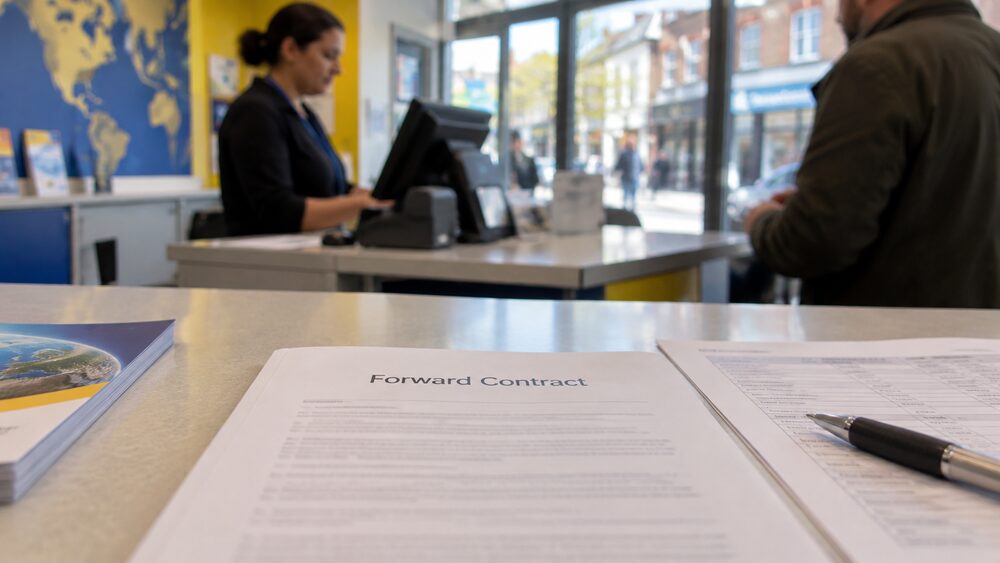
Two things follow for anyone comparing options. First, ask what the recipient will receive, in their currency, after all charges. Second, check whether the conversion happens at your bank or at the receiving end, because a payment sent in sterling to be converted abroad may be converted at a rate you never see. If you are sending a large amount, sending a large sum overseas covers limits and source of funds checks, and fixing an exchange rate covers forward contracts for locking a rate in advance.
Sending an international payment in the app or online
Most international payments are now made digitally. Barclays says most foreign currency payments are now digital and the alternatives are more secure6, and it offers online sending and receiving to more than 130 countries3. For payments to India, the bank asks for the SWIFT BIC or IFSC code of the bank you are sending to7.
Handelsbanken sets out the channels available for its SEPA payments: online banking, the app, your branch or over the phone2. That range is typical, though branch and phone access is thinning as networks shrink.
Before you send, you will normally need the recipient's name and address, their account number or IBAN, and the receiving bank's BIC or SWIFT code. Our guide to details needed to pay someone abroad lists what each country requires, including IBAN, BIC, routing numbers and payment purpose. Some destinations also require a payment purpose, and restricted currencies and country rules covers India, China, the UAE and others.
Timing depends on the route. A SEPA Direct Debit is collected on the date given for payment unless that is a public holiday in the other bank's country, in which case it moves to the next working day8. SWIFT payments take longer because they pass through correspondent banks. How long an international payment takes covers cut-off times, holidays and delays, and payment limits covers daily and per-payment caps.
Cheques and banker's drafts are giving way to digital payments
Paying in a sterling cheque at a bank outside the UK is largely over. Barclays stopped accepting sterling cheques and banker's drafts deposited outside the UK from 14 May 2026, so recipients overseas can no longer pay in sterling cheques or banker's drafts sent from the UK9. The bank's stated reason is that most foreign currency payments are now digital and the alternatives are more secure6.
Some institutions never accepted them in the first place. A credit union's current account terms state: "We cannot accept a foreign currency cheque or a sterling cheque where the paying bank is not in the UK."10
The wider trend is the same. The number of bank branches and cash machines has been falling over the past decade, as consumers increasingly use online banking and digital payments11. More and more people are using digital payments to transfer funds directly from one bank account to another using interbank payment systems, particularly the Faster Payments Service12. In the person-to-person front, cash payments are being replaced by Faster Payments13.
If you still hold a foreign cheque, foreign cheques covers paying one in or sending a sterling cheque abroad, and travellers cheques covers what happened to that format and how to cash old ones.
Scams that target money sent abroad
International payments are attractive to fraudsters because they are fast, hard to reverse and cross borders. Several patterns recur.
Impersonation is the most common. Phishing (email scams) and smishing (texting scams) are the most common kinds of scams14, and scammers pose as named banks: messages have been sent by scammers posing as Santander, Royal Bank of Scotland (RBS) and HSBC15. The rule that defeats the safe account version is simple and absolute: "your bank, the police and regulators will never ask you to move money to a 'safe' account"16.
Other patterns to recognise:
- A friend or family member messaging to say they need money transferred urgently. Speak to them directly first to check it is them18.
- A seller asking for payment by bank transfer instead of a secure payment method, common in ticket scams19.
- A caller asking for your PIN and telling you to hand your bank card to a courier20.
- Scam mail promising fake lotteries and prize draws, get-rich-quick schemes, bogus health cures, investment scams and pyramid selling21. Scams are only sent to take personal details or money from you22.
- Skimming devices attached to cash machines to record card details from the magnetic strip while a miniature camera captures the PIN, with a fake magnetic stripe card then used with the genuine PIN at overseas machines not upgraded to Chip and PIN23.
- Recovery scams, where someone who contacted a previous victim claims they can get the money back. One case involved a contact claiming to work for the NCA (National Crime Agency) who said they could recoup funds paid using cryptocurrency, contacted the victim on Telegram, and requested payment via PayPal personal account names, with the "official" company PayPal account said to be unavailable due to maintenance24.
- Pension transfers into "international self-invested personal pensions (SIPPs)" that look to facilitate investment overseas but run through a UK-registered SIPP, a trend the Pensions Regulator has flagged25.
Barclays customers have specific tools. You can ask callers claiming to be from the bank to send a secure notification to your Barclays app to make sure they are genuine26, and the bank's own guidance is to ask for a secure notification via app ID showing the colleague's name in the app17. Barclays states it will never send a link in an SMS message, and never contacts customers by phone, text or email to ask them to move money to another account, help with an "internal investigation", give device access, or reveal a PIN, PINsentry or other membership details17. It has partnered with Get Safe Online on a tool to check whether a website is known to be problematic17.
Where to report a problem and get help
Where you report a fraudulent international payment depends on where you live. Report Fraud handles fraud in England, Wales and Northern Ireland; if you live in Scotland or the fraud happened there, contact Police Scotland on 10127. Scams should also be reported to Report Fraud, or by calling the police on 101 if you live in Scotland28. In Scotland you can also contact Advice Direct Scotland on 0808 164 600029. Computer software service fraud can be reported online to Report Fraud or by phoning 0300 123 2040, or by calling police on the non-emergency number 10130.
If you have sent money to the wrong account, how to get money back that you have sent to the wrong account covers what your bank can and cannot do. Our guide to tracing, cancelling or recalling a payment sent abroad covers the process for cross-border payments, and your rights under the Payment Services Regulations sets out the legal framework.
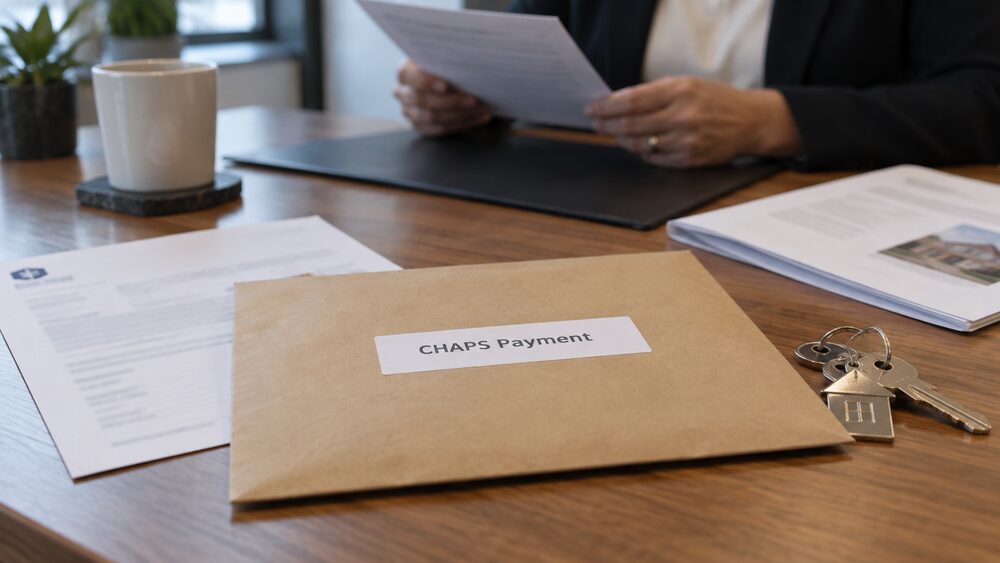
On the reimbursement rules, the picture is narrower than many people assume. The CHAPS APP scams reimbursement requirement only applies to payment service providers who are not already required to register, or who are not already registered, with Pay.UK as required by SD20, which applies to directed providers in relation to Faster Payments31. In other words, the reimbursement regime does not automatically cover every international payment route.
If a provider will not resolve a complaint, the Financial Ombudsman Service can look at it. Its quarterly complaints data for Q1 2026/27 records 59 complaints opened about defined benefit transfers to a SIPP32. Free, impartial help is available from MoneyHelper on the types of scam16, and debt advice charities can help where a scam has left someone in financial difficulty.
Sources32 cited
- What is SEPA? HSBC, 2026
- SEPA payments Handelsbanken, 2026
- Send and receive money online to 130+ countries Barclays, 2026
- M Access ISA tariff Virgin Money, 2026
- State Pension if you retire abroad GOV.UK, 2026-09-26
- Where can I deposit foreign cash? Which?, 2025-09-22
- International bank transfers Barclays, 2026
- Send an international payment Lloyds Bank, 2026-09-27
- Changes to sterling cheques paid overseas Barclays, 2026-05-14
- Current account terms and conditions Credit Union, 2025-08
- Access to banking services and cash House of Commons Library, 2026-09-26
- Consumer protection in interbank payments Payment Systems Regulator, 2026-09-26
- UK cash and cash machines 2025 UK Finance, 2026
- Top 5 financial scams FSCS, 2019-09-06
- Scam alert: fraudsters exploit new online security checks Which?, 2019-09-03
- Types of scam MoneyHelper, 2026-09-25
- Phone number checker Barclays, 2026
- Impersonation fraud Take Five, 2026-09-26
- Ticket scams Take Five, 2026-09-26
- Phone scams Age UK, 2026-08-19
- Scams by post nidirect, 2025-10-24
- Postal scams Consumer Council, 2026
- Cash machine fraud Take Five, 2026-09-26
- What is a recovery scam? Which?, 2026-09-10
- Pension scams threat assessment The Pensions Regulator, 2022-06-15
- Santander's new app blur feature Which?, 2025-08-28
- Credit Information Commissioner's Office, 2026-09-25
- My tips for reporting scams Which?, 2026-06-17
- How to spot, avoid and report scams StepChange, 2026-09-25
- Computer software service fraud nidirect, 2026-07-27
- PS24/5 CHAPS APP scams reimbursement requirement Payment Systems Regulator, 2026-09-26
- Quarterly complaints data Q1 2026/27 Financial Ombudsman Service, 2026

 MoneyHelperFree, impartial money and pensions guidance, set up by government
 Financial Ombudsman ServiceFree, independent help when a complaint about a firm is not put right
 FCA Warning ListCheck whether a firm is authorised before you deal with it
 Citizens AdviceFree advice on money, consumer and legal problems in England and Wales