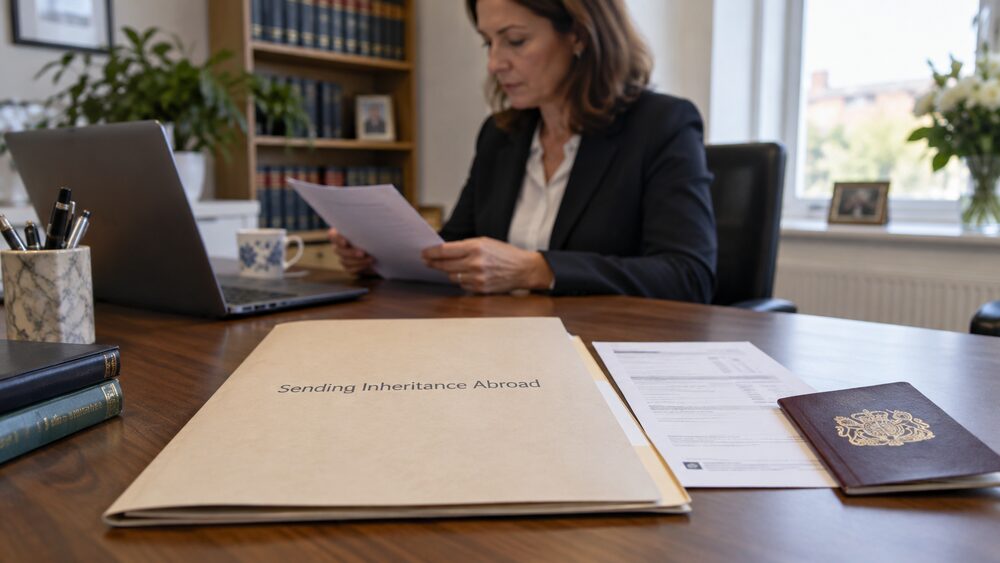
When someone dies leaving money to a person who lives abroad, the inheritance can be sent to them, but only after the estate has been properly settled in the UK. The personal representative, meaning the executor named in the will or the administrator appointed when there is no will, values the estate, pays any debts and Inheritance Tax, obtains the legal authority to deal with the estate, and only then distributes money to the beneficiaries. A beneficiary abroad has the same entitlement as one in the UK; the distance changes the payment mechanics, not the entitlement1.
The good news for the recipient is that UK tax usually falls on the estate, not on them. HMRC's guidance states plainly: "You do not usually owe any tax on an inheritance at the time you inherit it", and the personal representative normally pays any Inheritance Tax due before passing on the inheritance1. The main exceptions are gifts made before death that exceed the nil rate band, where the tax can fall on the recipient, and any tax the beneficiary's own country imposes on money received from abroad1.
An international money transfer, in the Financial Ombudsman Service's definition, "allows people to send funds from a UK account to another account in different country"2. The Ombudsman, which handles complaints about transfers gone wrong, counts high street banks, specialist money transfer and remittance businesses, online payment services and foreign exchange specialists among the firms it can look at2. This page explains the whole journey: the tax and probate steps that come first, the checks a provider will make on a large sum, the costs of converting it, and what to do if something goes wrong.
How sending an inheritance abroad works
Inheritance Tax is "a tax on an estate (the property, money and possessions) of someone who's died"7. The estate is everything the person owned, and it is the personal representative's job to gather it in, settle what is owed, and hand out what remains. Where there is a will, the executor named in it applies for a grant of probate; where there is no will, a relative applies for a grant of letters of administration, which "makes them the 'administrator' of the estate and allows them to value the estate, pay any debts and distribute the estate according to the intestacy rules"8. More than half of UK adults do not have a will, so the intestacy route is common9.
Once the grant is in hand and the debts and tax are settled, the representative can pay each beneficiary. Nothing in the process requires a beneficiary to have a UK account: the money can be transferred to an account abroad in the beneficiary's own name. What changes is the paperwork and the checks. A large payment to an overseas account will attract more scrutiny than a domestic one, because the sending bank or transfer service has to satisfy itself about who is being paid and where the money came from. The beneficiary will need to prove their identity to the representative as well as to their own bank.
The timing is set by the estate, not the transfer. Estates with property to sell, foreign assets to value or a trust in the background take longer, and Inheritance Tax on assets that take time to sell can be paid by annual instalments, with the representative able to apply for probate once the first instalment is paid10. Only when the estate is ready does the international payment itself happen, and it is usually measured in days rather than months.
The rules also differ slightly across the UK nations. In Scotland the court document is called confirmation rather than probate, and in Northern Ireland the estate summary form is sent to HMRC as part of the probate application8. These differences affect the paperwork the representative gathers, but not the beneficiary's right to be paid abroad.
Paying tax before the money leaves: inheritance tax and probate
Inheritance Tax comes first, and it comes before the legal authority to distribute. HMRC's guidance is that "you'll normally have to start paying Inheritance Tax before probate is granted", with the deadline at "the end of the sixth month after the person dies to avoid paying interest"3. The IHT400 notes state the rule in full: "You must pay any Inheritance Tax and interest that's due before you can get a grant"11. In Scotland the position is the same in substance: any Inheritance Tax due "will usually be paid before you receive the inheritance"7.
The starting point for the bill is the nil rate band. Inheritance tax is only payable if the value of the estate is over the threshold of £325,0004, and a further allowance, the residence nil rate band, can be claimed where a home is left to direct descendants, using form IHT43512. Assets passed to a spouse or civil partner on death, and gifts to a registered UK charity, are exempt1. Gifts made in the seven years before death count towards the estate's value for tax purposes4.
Several reliefs exist for estates that cannot easily raise cash. Where the tax relates to certain assets that may take time to sell, it can be paid by annual instalments, and the representative must say on form IHT400 that they want to pay this way10. The full tax and interest can be paid off at any time by writing to HMRC asking for a final assessment10. In certain circumstances HMRC can allow a grant on credit, postponing payment until after probate has been granted5. Cash held within a share or investment portfolio can sometimes be released directly to HMRC by the stockbroker or fund manager5.
From April 2027 the reporting duty widens: before probate can be obtained, the full value of the estate including any pensions must be reported to HMRC and any tax owed paid14. The government is also setting up a scheme through which beneficiaries can direct pension providers to pay the Inheritance Tax on their behalf directly to HMRC15. For smaller estates the excepted estate rules apply, with specified transfers made within seven years of death not exceeding £250,000, and for foreign domiciliaries or non long-term UK residents a £150,000 gross value of UK assets limit11.
Executors who get this wrong carry personal risk. Citizens Advice Scotland warns that "if you make a mistake and miss out some details about the property, money and belongings owned by the person who died, you could be held liable and have to pay a financial penalty"16. In Scotland, estates worth more than £36,000 need specific forms, including the confirmation form C1 and form IHT400 where tax is due or the estate does not qualify as an excepted estate16. Northern Ireland has its own estate summary form, the NIPF7, whose details are sent to HMRC after the probate application8.
Tax in the recipient's country
The UK side is usually settled before the money moves, but the beneficiary's own country may have its own rules on receiving money from abroad, and those rules are outside UK control. What UK rules do determine is whether the beneficiary owes anything here.
A beneficiary does not usually owe UK tax on an inheritance when they receive it1. HMRC will contact a beneficiary if they have to pay any Inheritance Tax themselves1. The main case is where the person who died made lifetime gifts above the nil rate band: "if the gifts total more than the nil rate band for Inheritance Tax, then the tax is due on the gifts themselves and is paid by the recipients of the gifts"17. The tax on such chargeable transfers is set at one-half of the death rate under section 7 of the Inheritance Tax Act 198418, and taper relief reduces the bill by how long the donor survived: 16% for gifts made five to six years before death and 8% for six to seven years19. A beneficiary whose inheritance is put into a trust that does not or cannot pay can also be landed with the tax1.
Residence matters for income the inheritance generates later, though not for the inheritance itself. If you are UK resident, you will normally pay UK tax on your foreign income; if you are not UK resident, you will not pay UK tax on your foreign income20. Someone living abroad usually still pays UK tax on their UK income, and may need to send a Self Assessment return if, for example, they rent out property in the UK or have taxable UK savings interest22. People who have lived in the UK before may owe UK tax on UK income or gains made while abroad21, and those returning to the UK pay UK tax on UK and foreign income and gains, though Foreign Income and Gains relief may apply23. HMRC's detailed guidance covers the residence and domicile rules that decide these outcomes, including the position of people who are resident but not domiciled in the UK24.
The rules of the country where the beneficiary lives are worth checking before the payment arrives. Many countries tax inheritances or gifts directly, some with their own allowances and rates, and some have forced heirship laws dictating who inherits property25. UK Inheritance Tax on overseas property generally still applies because overseas property counts as part of the estate19, but that is the deceased's estate's bill, not the beneficiary's.
Bank transfer or money transfer service: how each one handles large sums
An international money transfer "allows people to send funds from a UK account to another account in different country"2, and the market offers several ways to arrange one. The Financial Ombudsman Service lists the types of firm it covers: a high street bank, a specialist money transfer and remittance business, an online payment service, or a foreign exchange specialist2. The differences between them matter most on a large sum, where the exchange rate and the fee structure decide how much actually arrives.
A high street bank is the default route for many executors because the estate's money is already sitting there. The bank knows the customer and the account history, which can make source-of-funds checks smoother, but banks are not always the cheapest route for converting a large amount, and their transfer fees and exchange margins vary. A specialist transfer or foreign exchange firm exists to move money across borders, and on large sums it will often quote a rate and fee up front; the trade-off is that the executor is dealing with a firm that has no prior relationship with the estate, so identity and source-of-funds checks start from scratch.
The choice is not one-directional. Some executors send pounds and let the beneficiary's bank convert them; others convert in the UK and send the beneficiary's currency. The guide to ways to send abroad sets out the options side by side, and banks vs specialist providers compares how each handles cost and service. Whichever route is used, the firm must be authorised to send money, and the Ombudsman can look at complaints about all of the firm types listed above2. The guide to safeguarding and the FSCS explains how money is protected with a payment firm while it is in transit.
Exchange rates and fees: where the cost of a transfer hides
On a large inheritance, the exchange rate matters more than any fixed fee. A small difference in the rate applied to a six-figure sum can be worth more than the entire fee, and the rate is where costs are least visible. The mid-market rate, the margins providers add and how to read a quote are explained in the guide to exchange rates on international payments.
Fees come in several forms. There can be a fixed transfer charge, a percentage foreign exchange fee, and charges from intermediary or receiving banks along the way. For comparison, MoneyHelper notes that using a debit card abroad typically attracts "a foreign exchange fee, often around 3% of the transaction amount"6, which gives a sense of how percentage-based currency charges are scaled: the same principle applies to transfers, where a percentage fee on a large sum is far more costly than the same percentage on a holiday purchase.
Timing is the other hidden factor. Exchange rates move constantly, and an estate that takes months to settle may see the rate move between the day the amount is calculated and the day it is sent. Some providers offer ways to manage this, such as fixing a rate in advance, covered in the guide to forward contracts and limit orders. It also matters who pays the charges: some arrangements deduct them from the amount sent, so the beneficiary receives less than expected, while others charge the sender separately.
Identity and source-of-funds checks on large transfers
Banks and transfer firms are required to check who is sending money, who is receiving it and where the money came from. On an inheritance this is usually straightforward to evidence, but the checks can still hold a payment up, so having the documents ready before starting avoids delays.
The identity side works at both ends. The sending firm will verify the personal representative's identity and their authority to act, and will want the beneficiary's full name, address and account details abroad, in the format the guide to recipient details explains. The beneficiary will separately be verified by their own bank when a large sum lands. The direction of travel is visible in the government's own arrangements for pension death benefits, where the pension provider "will supply the beneficiary's identity details (including name, address, date of birth and National Insurance number if appropriate) to the PR and confirm the benefit value or values for each beneficiary"15. Executors collecting beneficiary details for a transfer are doing the same kind of job.
Source-of-funds checks ask where the money came from. The parallel in everyday conveyancing is instructive: when a family member gifts a house deposit, "your child's conveyancer might request bank statements as proof of the gift or loan as part of their money-laundering checks"26. For an inheritance, the equivalent evidence is the grant of probate or confirmation, the death certificate, the estate's bank statements and the Inheritance Tax paperwork. A provider that cannot satisfy itself may hold the payment, which is frustrating but is a legal requirement rather than a fault with the transfer. The guide to identity and security checks when sending covers what firms ask for and why payments get held.
How to send the money step by step
The process falls into two phases: settling the estate, then moving the money. In Scotland, Citizens Advice sets out four steps to sorting out an estate: valuing the property and possessions, paying debts due from the estate, paying inheritance tax and filling in tax forms, and applying for confirmation16. The same sequence applies in England, Wales and Northern Ireland with probate in place of confirmation. Once the grant is issued and the estate's debts are paid, the international payment can be arranged.
- Value the estate and report it. List the property, money and possessions, work out whether Inheritance Tax is due, and file the required forms, including form IHT400 where tax is payable or the estate is not an excepted estate16. HMRC's grossing up calculator helps where gifts are involved, with the results printed and posted with the IHT40027.
- Pay the Inheritance Tax. Pay by the end of the sixth month after the death to avoid interest3, using an Inheritance Tax reference obtained in advance. If paying at a bank branch by cheque, write the name of the deceased and the payment reference number on the back of the cheque28.
- Obtain the grant. Probate, confirmation or letters of administration give the legal authority to distribute8. Tax must be paid first11.
- Settle the estate's debts. Funeral costs, utility bills, loans and other liabilities are paid before beneficiaries16.
- Collect the beneficiary's details. Get the beneficiary's full name, address, overseas account number and any identifiers such as an IBAN, in writing, and confirm their identity documents15.
- Choose the transfer route and compare costs. Decide between the estate's bank and a specialist provider, compare the exchange rate and total fees, and confirm who pays the charges2.
- Pass the provider's checks. Supply the grant, death certificate, tax paperwork and proof of the source of funds when asked26.
- Send the payment and keep evidence. Record the reference, amount, date and confirmation, and share them with the beneficiary so they can watch for the arrival.
The beneficiary's own bank may apply charges or ask questions when the money lands, so a beneficiary who expects the payment and has their own proof of the inheritance ready will face fewer delays. The guide to receiving a payment from abroad covers that side of the transaction.
Scams and mistakes that can cost an inheritance
Large sums attract criminals, and bereavement makes people easier targets. The classic patterns are an impersonator contacting the executor claiming to be the beneficiary with "new" account details, a fake provider offering an unbeatable rate on the transfer, or a fraudulent invoice for fees that must be paid before the money can be released. The guide to scams involving payments abroad covers these in detail. The core defence is verification of any change of account details through a known channel, never one supplied in the message that announces the change.
Mistakes are as costly as fraud. A payment sent with the wrong reference can go astray: HMRC warns that "if you use the wrong reference number your payment may be delayed or used to pay a different tax bill that you owe"28. The same principle applies to beneficiary account details, where a single wrong digit can send a life-changing sum to the wrong account. Confirming details in writing before sending is the main protection, and if a payment does go missing, the guide to tracing, cancelling or recalling a payment explains what can be done, because international payments are far harder to recall than domestic ones.
Some mistakes are made earlier, in the estate itself. Gifts made before death can carry tax consequences for the recipient17, and executors who miss assets or details face personal liability and possible penalties16. Trusts carry their own tax charges, arising on certain chargeable events29, and arrangements used to disguise income can trigger charges every 10 years after money is put into the trust, when a loan is written off, and when the trust ends30. The wider lesson from guidance on giving assets away applies to any estate planning: gifts are permanent, and "there's no going back"31.
Pension transfers show how regulated checks try to stop scams. Under the transfer regulations, if an amber flag is identified, "the transfer can only proceed if the member takes specified scams guidance from MoneyHelper and provides specified evidence confirming they have taken it"32. An inheritance payment is not a pension transfer, but the same principle of independent verification before a large sum moves is the right habit.
Where to get help if a transfer goes wrong
If a payment is delayed, missing or sent to the wrong account, the first call is to the sending bank or transfer service, followed by the beneficiary's bank abroad. Keep the reference and confirmation details. If the firm cannot resolve the complaint, the Financial Ombudsman Service can look at complaints about money sent abroad, covering banks, specialist transfer businesses, online payment services and foreign exchange specialists2. The Ombudsman's service is free to consumers.
For the estate side, HMRC runs a Bereavement Helpline, and if you cannot call it, you must fill in form P1000 to tell HMRC who is dealing with the money, property and possessions of the person who died33. MoneyHelper offers free, impartial guidance on banking and transfers, and Citizens Advice can help with the estate process itself16. For the transfer itself, the guides to how international payments work, how long payments take and your rights under the Payment Services Regulations cover the mechanics, the timescales and the protections that apply from start to finish.
Sources33 cited
- Tax on property, money and shares you inherit HM Revenue and Customs, 2026-09-26
- Complaints we can help with: sending money abroad Financial Ombudsman Service, 2026-09-26
- Valuing the estate of someone who died HM Revenue and Customs, 2026-09-26
- FAQs about inheritance tax Remember A Charity, 2026-09-26
- Applying for a grant on credit for Inheritance Tax HM Revenue and Customs, 2024-04-01
- How to open, switch or close your bank account MoneyHelper, 2026-09-25
- Inheritance tax support mygov.scot, 2026-08-18
- Inheritance tax reporting rules if person died after 1 January 2022 nidirect, 2025-07-31
- Over half of UK adults don't have a will Remember A Charity, 2025
- Paying Inheritance Tax in yearly instalments HM Revenue and Customs, 2026-09-28
- Inheritance Tax account form IHT400 notes HM Revenue and Customs, 2026
- Claim the residence nil rate band HM Revenue and Customs, 2023-07-31
- Debts after death Business Debtline
- Inheritance tax on pensions: how the new rules will work in practice Which?, 2026-05-23
- Inheritance tax on pensions: liability, reporting and payment, summary of responses HM Government, 2025-07-21
- After a death: dealing with an estate Citizens Advice Scotland, 2026-09-26
- Inheritance Tax account form IHT400 notes, 2021 edition HM Revenue and Customs, 2021
- Inheritance Tax Act 1984, Section 7 legislation.gov.uk, 2026
- Inheritance tax and property changes Which?, 2026-04-06
- Tax on foreign income HM Revenue and Customs, 2026-09-26
- Tax when you come to the UK HM Revenue and Customs, 2026-09-26
- Tax on your UK income if you live abroad HM Revenue and Customs, 2026-09-26
- Sending a tax return if you come back to the UK HM Revenue and Customs, 2026-09-27
- Foreign Income and Gains relief legislation legislation.gov.uk, 2024-04-06
- Tax on overseas property Which?, 2026-04-06
- How parents can help first-time buyers Which?, 2025-12-16
- Inheritance Tax grossing up calculator HM Revenue and Customs, 2025-03-05
- Pay Inheritance Tax from a bank or building society account HM Revenue and Customs, 2026-09-28
- Work out the number of quarters when Inheritance Tax is charged on a trust HM Revenue and Customs, 2024-03-28
- The loan charge settlement scheme HM Revenue and Customs, 2026-07-17
- Can I give away my property or assets to avoid care fees? Which?, 2026-09-09
- Occupational and Personal Pension Schemes (Conditions for Transfers) Regulations 2021 legislation.gov.uk, 2022
- Report a death and tell government services (Tell Us Once) HM Revenue and Customs, 2026-09-28


 MoneyHelperFree, impartial money and pensions guidance, set up by government
 Financial Ombudsman ServiceFree, independent help when a complaint about a firm is not put right
 FCA Warning ListCheck whether a firm is authorised before you deal with it
 Citizens AdviceFree advice on money, consumer and legal problems in England and Wales