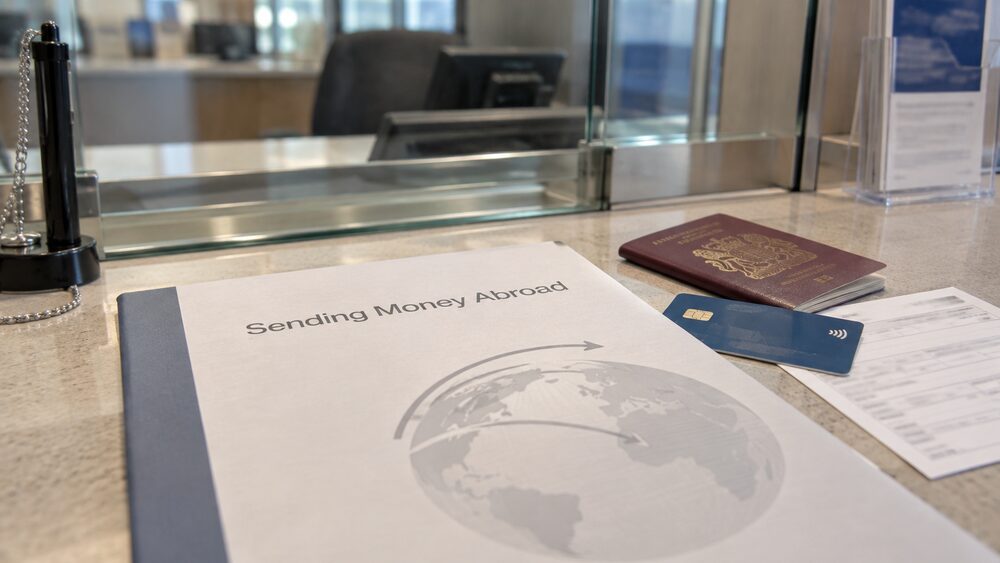
When someone abroad pays money into your UK account, the payment travels through the international banking system and lands in your account as a credit, usually in pounds. Receiving money from outside the UK simply means money sent to your account from an account outside the UK1. To make that happen, the sender needs a small set of details from you: your name and address as they appear on the account, your IBAN, and your bank's SWIFT/BIC code2. Your bank may charge a fee for receiving the payment, and if the money arrives in a foreign currency your bank will convert it into pounds at its own rate.
The two questions people ask most are what exactly to give the sender, and why the amount that arrives can be smaller than the amount sent. The answers are connected: the details determine whether the payment arrives at all, and the fees and the exchange rate determine how much of it is left when it does. Under rules set by the Financial Conduct Authority, banks must give you clear information about the charges that apply to your account and to individual payments3, so the cost of receiving is something you can check in advance rather than discover afterwards. Fees range from no charge for some payments to several pounds for others, and a payment sent in the wrong currency or with the wrong details can be delayed, returned, or reduced by charges taken along the way.
If a payment has not arrived, it can usually be traced. The sender's bank and your bank can follow the payment through the system, and the Financial Ombudsman Service, which handles complaints about banking and payments including international transfers, can look at a case where a bank has not dealt with a problem properly4.
What happens when money is sent to you from abroad
An international money transfer allows people to send funds from an account in one country to an account in another. From your side of the transaction, receiving money from outside the UK means money is sent to your account from an account outside the UK1. You do not need to do anything to "accept" the payment in advance: as long as the sender has the right details, the payment is routed to your bank and credited to your account.
The sender's bank begins the process using the details you supplied: your name and address, your bank's code (normally the BIC), your IBAN or account number, the country of your bank, and the amount of the payment8. The payment then moves through the international banking system, sometimes directly if the two banks have a relationship, and sometimes through one or more intermediary banks. How this chain works, and why it affects the amount that arrives, is covered in how international payments work.
When the payment reaches your bank, two things can happen to the amount. Your bank may apply a receiving fee, and if the money arrives in a foreign currency rather than pounds, your bank converts it into pounds at its own inbound exchange rate before crediting your account. Both reduce what finally lands in your balance, and both vary between banks, which is why the amount received can differ from the amount sent even when nothing has gone wrong.
The time a payment takes depends on the route and the currencies involved. Santander's guidance on international payments indicates that a payment sent outside the UK in pounds is expected to arrive the next working day, while a payment sent in a currency other than pounds, euros or US dollars may take up to 4 working days12. Payments into the UK follow similar routes, and cut-off times, weekends and public holidays in either country all affect the timing, as covered in how long an international payment takes.
Details to give the sender: IBAN and SWIFT/BIC
To receive money from outside the UK, you need to know your own IBAN and your BIC or SWIFT code2. These are not extra accounts or special arrangements: they are standard identifiers for your existing account, formatted so that a bank abroad can route the payment to it. Anyone who wants to transfer money internationally usually needs to use an IBAN and SWIFT/BIC code to do so13. UK regulations on payment accounts require your bank to give you your account details, including your IBAN, when you ask for them14, so this is information your bank must supply, not a favour.
The full set of details a sender typically needs from you is:
- your full name, exactly as it appears on your account
- your address, as held by your bank
- your IBAN
- your bank's SWIFT/BIC code
- the country of your bank, and the amount and currency of the payment8
Barclays sets out the same list for its own customers: to make sure the payment gets through, you give the sender your IBAN, Barclays UK's SWIFTBIC code, your sort code and account number unless the IBAN is provided, your full name as shown on the account, your address, and the amount and currency9. Halifax and Lloyds both tell customers sending money to the EEA and the UK that they need the recipient's full name and address, the recipient's IBAN, and the recipient's SWIFT/BIC15, which is the same information seen from the other end of the transfer. AIB in Northern Ireland likewise requires the IBAN and Bank Identifier Code, which the receiver can obtain from their bank, together with the receiver's full address details17.
Your IBAN is not a secret in the way a password is, and giving it to a payer is the normal way to receive money. It includes a country code and a bank and account number in a standard format, which helps to reduce errors in international payments5. UK IBANs in official use show the pattern clearly: HMRC publishes an IBAN of GB54 BARC 2026 4853 8367 97 for overseas payments of Child Benefit overpayments18, and Revenue Scotland publishes GB93NWBK60708010019456 with the SWIFT code NWBKGB2L for payments by BACS, CHAPS and Faster Payments19. Skipton Building Society gives savers an IBAN of GB03BARC20789170798924 for sending money from overseas20. In each case the IBAN begins with GB, followed by check digits, then the sort code and account number.
If you do not know your IBAN or SWIFT code, there are several ways to find them: check any paper or digital banking statements, call your bank or visit a branch, or use a SWIFT/BIC search tool2. Many banking apps also display them in the account details section. The dedicated guide to details needed to pay someone abroad covers each identifier in more depth.
SWIFT/BIC codes: 8 or 11 characters that identify your bank
A BIC, sometimes referred to as a SWIFT code, is a unique set of characters, either 8 or 11 numbers and letters2. It identifies your bank, and you need it if you want to send or receive money from outside the UK; HSBC customers can find theirs on their bank statement21. A bank's SWIFT code is unique and can contain eight or 11 characters, which all convey specific details of the bank13.
The structure is fixed, and knowing it helps you check that what you have been given is plausible:
| Part | Characters | What it identifies |
|---|---|---|
| Bank code | 4 letters | The bank itself5 |
| Country code | 2 letters | The country where the bank is located, like GB for the United Kingdom5 |
| Location code | 2 characters | Usually the bank's head office5 |
| Branch code | 3 digits or letters | A unique branch, with XXX typically representing the head office5 |
An 8-character code is simply one without the final branch section. Real examples show the pattern: HMRC publishes the BIC BARCGB22 for overseas payments22, and Barclays UK gives its customers the SWIFTBIC code BUKBGB229. Both are 8 characters: four letters identifying the bank, GB for the United Kingdom, and a two-character location code.
Whether a bank uses one SWIFT code for all its branches or a separate code for each depends on the bank: some use the same SWIFT code for all their branches, while others have unique codes for each one5. If your bank operates a single code across its network, that is the one to give. Where a branch-specific code exists, the bank's main code ending in XXX will still route a payment correctly when the account number or IBAN is also supplied.
When the sender's bank asks for something other than an IBAN
Not every country uses IBANs, and payments from those places are made using different identifiers. When money is being sent from outside the IBAN system, the sender's bank asks for a different set of details. Halifax's guidance for sending money to the rest of the world, outside the EEA, requires the recipient's IBAN where one exists, the name and address of the recipient's bank, a clearing code, and the reason for the payment15. The clearing code is that country's own equivalent of a sort code, such as the routing number used in the United States.
From the receiving end, this means a sender from a non-IBAN country may ask you for your sort code and account number rather than an IBAN. Barclays tells customers receiving international payments to give their sort code and account number unless the IBAN is provided9, and Barclays' international payments guidance confirms the sender may use either the account number or the IBAN, which is 15 to 33 characters long23. A UK sort code and account number can always be turned into an IBAN, so if in doubt, giving the sender your IBAN covers both cases.
The reason for the payment is sometimes requested as well, particularly for payments from outside Europe15. This is a regulatory requirement on the sender's side, part of the checks banks make on cross-border money flows, and it does not usually affect what you receive. If a payment is being held up, it is sometimes because information of this kind was missing at the sender's end, and identity and security checks when sending explains what banks look for.
Receiving euros by SEPA: an IBAN is required
If the sender is paying you in euros from a country in the Single Euro Payments Area, the payment can travel as a SEPA credit transfer, and for that route an IBAN is required. Barclays states plainly that if you want to receive a SEPA credit transfer, you need to provide the sender with an IBAN9. The SEPA scheme is built around the IBAN as the account identifier, so there is no alternative format to give.
The other details for a SEPA payment are the sender's to supply, but the receiving side is the same as any international payment: your full name as shown on your account, your bank's address, and your IBAN23. SEPA payments in euros are typically cheaper and faster than full SWIFT payments between the same countries, which is why a euro sender may ask which route to use. The comparison is set out in SEPA vs SWIFT payments, and sending euros from a UK account covers the scheme from the sending side.
Note that receiving a SEPA payment does not require you to hold a euro account. The payment arrives in euros and, if your account is in pounds, your bank converts it and may charge a receiving fee, in the same way as any other incoming foreign currency payment.
Fees for receiving money from abroad
The rules here come from the regulator rather than from any one bank. Financial Conduct Authority rules on banking conduct require firms to make information about charges available to customers, including the charges that apply to individual payment services, and to notify you of the charges for a payment3. That means the receiving fee is not a hidden deduction: it must be published in your bank's tariff, and you can check it before giving the sender your details.
There may be a cost for sending or receiving money from abroad, depending on your bank and the bank the money is being transferred from. The clearest way to see the range is to look at what different banks publish:
| Bank or provider | Payment received | Fee |
|---|---|---|
| Cater Allen | Pounds from outside the UK, electronically | £225 |
| Cater Allen | Currencies other than pounds, any country | £225 |
| Cater Allen | Pounds from within the UK | No charge25 |
| first direct | Money from outside the UK in pounds sterling | £57 |
| first direct | Money from outside the UK in a foreign currency | £57 |
| first direct | Money in euro from outside the EEA | £526 |
| Royal Bank of Scotland | Non-euro payments received under £100 | £16 |
| Royal Bank of Scotland | Payments received over £100 | £76 |
Two things stand out from this range. First, fees are not proportional to the amount: Royal Bank of Scotland charges £1 for a small non-euro payment and £7 for one over £1006, so a modest payment can lose a noticeable share to the fee. Second, some banks charge the same whether the money arrives in pounds or in a foreign currency, while others distinguish between them, so the currency the sender chooses can change what you are charged.
Fees can also be taken before the money reaches you. Where a payment passes through intermediary banks, charges may be deducted from the amount in transit, which is one reason the sum credited can be less than the sum sent. The sender can sometimes choose who bears the charges, and this is worth clarifying before the payment is made. Foreign cheques carry a separate set of charges: Cater Allen's tariff lists collection and negotiation of foreign cheques at £7.50 or €8.50 depending on the currency of the account into which the cheque is paid25, and foreign cheques covers that route in full.
Your bank's tariff of fees is the definitive list for your own account, and the regulator's rules mean it must be made available to you3. If a fee has been taken that you did not expect, ask the bank to explain it, and complain if the explanation is not satisfactory.
Payments in pounds or in a foreign currency
The sender usually has a choice of which currency to send, and that choice decides who does the conversion into pounds. If the sender pays in pounds, the conversion happens at the sender's end and your account is simply credited with sterling. If the sender pays in their own currency, your bank converts it at its own inbound rate when it arrives7. The exchange rate your bank applies is its own, not a mid-market rate, and the margin between the two is effectively a further cost. How rates and margins work is covered in exchange rates on international payments.
The receiving fee and the conversion are separate. first direct, for example, charges £5 for receiving money from outside the UK in pounds sterling and £5 for receiving money in a foreign currency7, so the fee is the same either way, but the exchange outcome is not. A payment sent in pounds arrives as a known amount; a payment sent in a foreign currency arrives as whatever the inbound rate produces.
There are circumstances where the currency of arrival matters beyond the rate. The Financial Services Compensation Scheme pays compensation in pound sterling, not in any other currency27, so a person holding a foreign currency account who needed to claim FSCS protection would be compensated in pounds. And where a UK payment such as a State Pension is paid to an overseas account, it is paid in the local currency, so the amount received changes with the exchange rate28; the same principle works in reverse for payments into the UK.
For most people receiving money into an ordinary sterling current account, the practical choice is the sender's: paying in pounds gives certainty about the amount that will arrive, at the cost of the sender bearing the conversion. The wider options for sending, including specialist providers that may offer better rates than banks, are compared in banks vs specialist providers.
Accounts that do not accept money from abroad
Not every UK account can receive money from abroad, and it is worth checking before you give a sender your details. NS&I states for its Direct Saver that it does not accept credit cards or money from non-UK financial institutions29, so an international transfer from a bank abroad cannot be paid directly into that account. Some savings accounts and niche products have similar restrictions, and the account terms are the place to check.
Restrictions can also follow the account holder rather than the account. Under the rules governing the Help-to-Save scheme, an individual who is absent from the UK, apart from temporary absences, is not able to pay any amount into an account, and no bonus accrues on any amount paid in during such a period30. Someone living abroad who expects regular payments into a UK account therefore needs to check both the account's terms and their own residence position.
Where an account cannot accept an international payment directly, the usual workaround is for the money to be paid into a current account that can, and moved on from there. Free, impartial guidance on choosing, opening and switching a bank account is available from MoneyHelper, the government-backed money guidance service31.
When a payment from abroad has not arrived or disappears
Two things go wrong most often: a payment that never appears, and a payment that appears and then vanishes again.
The second is the more alarming, but it has a known cause. Banks sometimes credit an incoming international payment to your account before the funds have fully settled through the system behind it. first direct's terms state that if the actual funds from outside the UK are not received 10 working days after the payment appeared in your account, the bank will take the money back out7. If that happens, the payment has not been lost: it has been unwound while still in transit, and the sender may need to check that it was sent correctly or resend it.
A payment that never arrives can be stuck at several points: rejected for wrong details, held for a check, or sitting with an intermediary bank. The steps to take are:
- Confirm with the sender exactly what details they used, the amount, the currency and the date of the payment.
- Ask your bank to trace the incoming payment, giving it the sender's reference if there is one.
- Ask the sender to ask their bank to trace the payment from the sending end, which is often faster.
- If the bank will not help or will not respond, make a formal complaint to the bank.
- If the complaint is not resolved, take it to the Financial Ombudsman Service, which handles complaints about banking and payments, including international transfers4.
The full process, including how recalls work, is covered in tracing, cancelling or recalling a payment. In genuinely exceptional circumstances, such as a country with no functioning transfer system, the Foreign, Commonwealth and Development Office operates a money deposit service, but it will only consider this if no other transfer service is available, it usually takes longer than other options, it requires visiting the nearest British embassy, high commission or consulate in person, and a fee is charged32.
Tax on money received from abroad
Receiving money from abroad is not automatically taxable, and most payments people receive, gifts from family, money for a property sale, a transfer of your own savings, are not income at all. Tax becomes relevant when the money is income or gains. UK residents pay UK tax on their UK income and gains and on foreign income and gains, although relief may be available in some cases33. So if the payment from abroad is, for example, rent from a property you own overseas or dividends from foreign investments, it falls within UK tax even though it arrives in a UK account from abroad.
The payment itself is not the taxable thing: the underlying income is. A gift from a relative abroad, or a repayment of a loan, is not income and does not need to be declared as such. Where the money does represent foreign income, it is reported through a Self Assessment tax return, and the personal tax guide covers when a return is needed. If the amount is large, a bank may also ask about the source of the funds as part of its checks, which is a money laundering requirement rather than a tax one; sending a large sum explains what to expect.
Where protection applies, and where it stops
Money in a UK bank account is protected by the Financial Services Compensation Scheme up to its normal limit, and that protection does not depend on where the money came from. But FSCS compensation is paid in pound sterling, not in any other currency27, which matters for anyone holding a foreign currency account. The rules around payment firms are different again: money held with a payment or money transfer firm is protected by safeguarding requirements rather than bank deposit insurance, and safeguarding and the FSCS explains the distinction.
For the payment itself, your rights come from the Payment Services Regulations. These cover how quickly a bank must act, what it must tell you about charges, and its duty to investigate. The Payment Services (Amendment) Regulations 2024, which strengthened protections around authorised push payment scams, apply only to outbound authorised push payments wholly executed in the UK in sterling34, so they do not extend to an incoming payment from abroad. Your rights when things go wrong with an international payment are set out in your rights under the Payment Services Regulations.
If something does go wrong, the complaint route is fixed: complain to the bank first, then to the Financial Ombudsman Service, which can look at complaints about international money transfers4. The ombudsman is free to use and independent, and MoneyHelper offers free, impartial guidance on banking problems more generally31. Because receiving a payment from abroad is often the mirror image of sending one, the wider rules, costs and options on the sending side are covered across the money transfers guide.
Sources34 cited
- Glossary of terms, current account Kroo, 2026
- What is an IBAN, a BIC and a SWIFT code? HSBC, 2026
- Banking Conduct of Business sourcebook 7.1 Financial Conduct Authority
- Sending money abroad: complaints the ombudsman can help with Financial Ombudsman Service
- SWIFT codes explained OFX, 2026
- How to send money abroad Royal Bank of Scotland, 2026
- first direct Personal Account terms and conditions first direct, 2026
- Sending money to the UK HSBC, 2026
- Receiving international payments Barclays, 2026
- How to make payments Royal Bank of Scotland
- Personal account schedule and rates Starling Bank, 2026-05-31
- Making international payments Santander, 2026
- Guide to IBAN, SWIFT and BIC Starling Bank, 2026
- The Payment Accounts Regulations 2015, Part 4 legislation.gov.uk, 2015
- International payments: send money guide Halifax, 2026
- Send an international payment Lloyds Bank, 2026
- Foreign exchange AIB (NI), 2026
- Repay Child Benefit overpayments HMRC, 2026
- How to pay a Land and Buildings Transaction Tax penalty Revenue Scotland, 2024
- Paying in to your savings Skipton Building Society, 2026
- Banking terms HSBC, 2026
- Pay Stamp Duty HMRC
- International bank transfers Barclays, 2026
- Banking Conduct of Business sourcebook 7.5 Financial Conduct Authority
- Banking tariff Cater Allen, 2026
- International payments first direct, 2026
- FSCS podcast episode 46 transcript Financial Services Compensation Scheme, 2025
- Six things to know about your State Pension if you want to retire abroad Which?, 2022
- Direct Saver brochure NS&I, 2024
- The Savings (Government Contributions) Act 2017 Regulations legislation.gov.uk, 2018
- How to open, switch or close your bank account MoneyHelper
- Your finances when travelling abroad FCDO, 2022
- Tax return for non-UK residents and those moving abroad HMRC, 2026
- The Payment Services (Amendment) Regulations 2024 legislation.gov.uk, 2024

 MoneyHelperFree, impartial money and pensions guidance, set up by government
 Financial Ombudsman ServiceFree, independent help when a complaint about a firm is not put right
 FCA Warning ListCheck whether a firm is authorised before you deal with it
 Citizens AdviceFree advice on money, consumer and legal problems in England and Wales