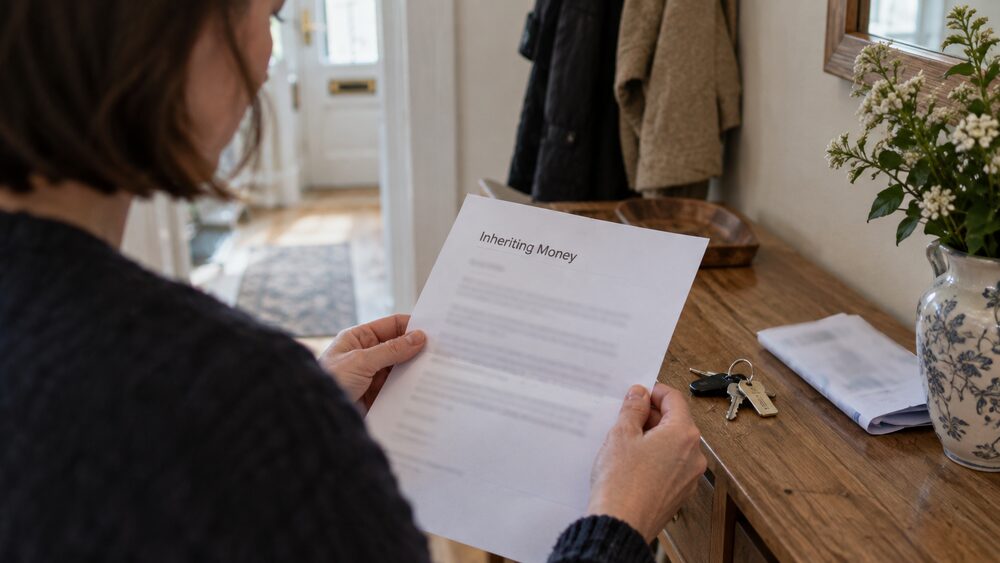
Receiving an inheritance usually means waiting while someone else sorts out the estate, then finding out what tax, if any, applies to what you receive. In most cases the tax due is Inheritance Tax, and it is charged on the estate of the person who died rather than on you as the recipient: any Inheritance Tax due will usually be paid before you receive the inheritance1. What can affect you directly are the taxes that follow, such as Income Tax on profits the inherited assets generate and Capital Gains Tax when you sell them2.
If the person who died was your spouse or civil partner, there is one further thing that is easy to miss: an extra ISA allowance, known as an Additional Permitted Subscription, equal to the value of their ISA when they died. It is yours even if the ISA itself was left to somebody else, and it sits on top of your normal annual ISA allowance3.
When an inheritance is paid out
An inheritance is not paid on the day someone dies. The personal representatives of the estate have to value everything the person owned, settle any debts, deal with the tax forms and obtain the legal authority (a grant of probate, or confirmation in Scotland) to hand out what is left. In Scotland, guidance sets out four steps to sorting out an estate: valuing the property and possessions, paying debts due from the estate, paying Inheritance Tax and filling in tax forms, and applying for confirmation6.
The tax comes first in practice. You will normally have to start paying Inheritance Tax before probate is granted7, and the rules state plainly that you must pay any Inheritance Tax and interest that is due before you can get a grant8. Where the estate includes hard-to-sell assets, such as a house, the representatives can pay in yearly instalments instead, provided at least 20% of the total Inheritance Tax owed is on qualifying assets, or paying in one lump sum would cause financial difficulties. The request is made on the Inheritance Tax account form IHT400, the tax must be paid in full once the deceased's assets are sold, and the remaining tax and interest can be paid off at any time by writing to HMRC for a final assessment9.
If the estate's money is locked up until the grant is issued, there is a route called a grant on credit: the representatives send HMRC a signed form IHT400 with a letter, headed "Grants on credit", stating the maximum amount they can pay towards the tax before the grant is issued10.
Not every estate goes through the full process. An excepted estate is one where no Inheritance Tax is due and a full Inheritance Tax account on form IHT400 is not needed11, and there may be no Inheritance Tax to pay where the value of the estate is below the threshold, although HMRC forms may still need to be completed6. In Scotland, certain payments can also come back out of the estate: Funeral Support Payments are recovered from the estates of people who died aged 18 or over with money or assets, once those assets become available, and this can happen before any inheritance is paid12.
The window for claiming runs from death itself. The period of administration starts on the day following the date of death and ends when the personal representatives have taken all the steps necessary to complete the administration of the estate13.
The practical guides on probate, confirmation in Scotland and being an executor cover each stage in detail.
Tax on an inheritance you receive
Inheritance Tax itself is a tax on the estate: the property, money and possessions of someone who has died1. It is charged at 40% above the threshold, and the rate falls to 36% where 10% or more of the net value of the estate is left to charity14. The main allowance, the nil-rate band, has been set at £325,000 since 20104, and when a surviving partner inherits unused allowances, a couple could pass on up to £1m before Inheritance Tax is due5. Gifts of property or money made in the seven years before death also count towards the estate's value14.
For the estate's valuation, the law requires all assets to be valued as if each item had been sold on the date the deceased died, at open market value, with asset values rounded down to the nearest pound and liabilities rounded up8. Where tax is charged on transfers made before the death, legislation sets it at half the death rate15.
As the person receiving the inheritance, the taxes that can affect you are different ones. You may have to pay Income Tax on any profit you earn from what you have inherited, for example dividends on shares or rental income from a property, and Capital Gains Tax when you sell anything you inherited2. Scottish guidance confirms the same two taxes are the ones to watch on what you receive1.
Inherited pensions follow their own rules. Money left in a pension is outside the estate in the usual way, but beneficiaries might pay Income Tax to receive the money, depending on how old the holder was when they died16. Where death occurred before age 75 and the money is taken as adjustable income, no tax is charged provided the money is paid to the nominated beneficiaries within two years of the pension provider becoming aware of the death17.
ISAs are a special case. They can be handed to a spouse or civil partner tax-free, but if they are inherited by anyone else, the ISA will be included as part of that person's estate for Inheritance Tax calculations18. The page on tax after a death covers the estate's own Income Tax position.
Inheritance and benefits
An inheritance can change what benefits you receive, though not always in the way people expect. Some payments are simply not counted: if your occupational pension is an inherited pension, it is not taken into account when New Style Jobseeker's Allowance is worked out19. Similarly, when claiming, you do not need to report a private pension or annuity statement for a pension you inherited from someone who died20.
Some payments pass to a surviving partner automatically. You might still be able to inherit Additional State Pension from your partner, which matters for people who do not qualify for it in their own right21. In Northern Ireland, if you inherit a lump sum payment from a deferred State Pension, the Department for Communities will write to you about it22.
Residence-based conditions apply to some benefits. Carer's Allowance in Scotland can continue if you live in the EU, Iceland, Norway, Liechtenstein, Switzerland or Gibraltar and have a genuine and sufficient link to Scotland23. For Maternity Allowance, you do not have to be a UK citizen, and the UK has arrangements with certain other countries to help claimants who have been outside the UK; where a spouse is a serving member of the Armed Forces and the claimant lives outside the EEA in a country with no reciprocal agreement, an ex-gratia payment from the Ministry of Defence may be available instead24. UK legislation also provides for benefits from outside the UK that are substantially similar to a listed UK benefit and payable to a person resident in the United Kingdom25.
The page on what happens to benefits when someone dies covers the wider picture, and free bereavement support lists sources of help.
Inheriting a spouse's or civil partner's ISA: the extra allowance
When a spouse or civil partner dies, the survivor is entitled to a one-off additional ISA allowance, equivalent to the value of the deceased partner's ISA when they died3. ISAs can be handed to a spouse or civil partner tax-free, and the survivor gets this extra allowance equivalent to the value of the ISA inherited18. NS&I, for example, states that you can now inherit an additional ISA allowance if your spouse or civil partner dies, up to the value of their ISA at the date of death26.
The allowance exists because the ISA itself loses its tax-free status on death. The extra allowance is the compensation: it lets the surviving partner put an equivalent amount back into a tax-free wrapper, so the family does not lose the ISA's tax advantage simply because one partner died. The rules that govern the current version, including the more generous valuation basis, came into force in 20183.
Who can claim the Additional Permitted Subscription
The Additional Permitted Subscription (APS) belongs to the spouse or civil partner of the person who died, regardless of what the deceased person stated in their will3. That has a surprising consequence: even if the ISA money itself was left to someone else, the surviving partner is still entitled to the increased allowance and can fund it with their own money. Which? gives the example of someone who left £50,000 of ISA assets to their child: the partner would still be entitled to an increased ISA allowance3.
Nobody else qualifies. Children, siblings and other relatives who inherit ISA assets do not receive any extra allowance, and the ISA holdings they inherit are simply part of what they receive from the estate18. The rules also treat Junior ISAs differently: if a child dies before 18, the money is paid to whoever inherits their estate and the tax-free ISA inheritance rules do not apply. If the child was over 16 and married, which is possible in Scotland and Northern Ireland, the money goes to their spouse and the ISA inheritance rules stand3.
How much you can add: the higher of two values
The size of the allowance is worked out generously. It is equal to the value of the money passed on, or the value of the ISA at death, whichever is higher3. This rule change means that if the investments inside the ISA grew between the date of death and the moment they were passed to you, the allowance is based on the larger figure. It also means that if the holdings fell in value after death, your allowance is not reduced: the date-of-death value still stands.
For Lifetime ISAs there is a specific rule: the spouse or civil partner of a deceased Lifetime ISA holder has an Additional Permitted Subscription equal to the amount held in all their Lifetime ISAs at death, including any government bonus, and no government charge applies on those withdrawals27.
The date-of-death value is the same figure the estate uses elsewhere: for Inheritance Tax, assets are valued at their open market value as if sold on the date of death8.
The extra allowance sits on top of your own annual ISA allowance
The Additional Permitted Subscription is additional to your normal annual ISA subscription limit: it is a one-off allowance, equal to the value of the deceased's ISA holdings, that sits on top of the usual allowance rather than using any of it up28. You can pay in your full annual allowance in the same tax year as you use the extra allowance, and the extra allowance does not depend on your own earnings or age.
The parallel with Inheritance Tax allowances is helpful for understanding how these additions work: the residence nil-rate band is layered on top of the £325,000 nil-rate band4, and a surviving partner can inherit unused allowances so that a couple could pass on up to £1m5. The ISA rule works the same way in principle: an allowance that belonged to the deceased partner is preserved and added to the survivor's own.
Keeping inherited investments or paying in cash
You do not have to keep the investments that were in your partner's ISA. You can sell the holdings and pay cash into your own ISA up to the allowance, keep the investments as they are within an ISA, or a combination. The choice matters for tax: once the assets are inside your ISA, future growth and income are tax-free, whereas the same assets held outside an ISA could generate taxable dividends or capital gains2.
Cash held within a stocks and shares or Innovative Finance ISA is treated under its own rules: under regulations introduced in 2026, the account manager must pay HMRC an amount representing income tax at the savings basic rate in force for the year on interest or alternative finance returns on cash held under those components29.
Similar inheritance conveniences exist outside ISAs. NS&I states that if you inherit money held in a Direct Saver or Investment Account, you can hold it in a Direct Saver in your own name even if it takes you over the personal holding limit30. And if the inheritance includes property, be aware that inherited dwellings count towards the dwellings a buyer owns for the purposes of Scotland's Additional Dwelling Supplement on later purchases13. Where the person who died held a shared ownership home under the Older Persons Shared Ownership scheme, whoever inherits the home must continue to pay the service charges and rent until the property is sold31.
Using the allowance with a different ISA provider
You are not tied to the provider your partner used. The allowance can be claimed with a different ISA manager, but there is a structural limit: an APS allowance can only be transferred once, so if there is more than one ISA to inherit, you will have an allowance with each provider, and moving an allowance between providers can only happen one time3.
Providers are not obliged to take the money. ISA providers do not have to accept APS payments, so you may not be able to deposit inherited savings with the provider of your choosing3. Before making plans, check with the provider you want to use, and if it declines, ask another. The Building Societies Association describes the allowance as a one-off ISA allowance equal to the value of the deceased's ISA holdings28, and providers that accept it will have their own application route.
How to apply for the extra allowance
The increased ISA allowance is claimed by filling out an application form, which you get from the ISA provider3. The process runs directly with the provider, not with HMRC: the provider checks your entitlement, confirms the value of the deceased's ISA, and then opens the additional subscription facility for you.
In practice you will need the death certificate and evidence of the ISA's value at the date of death, and the provider may ask for documents from the estate's administration. NS&I, for one, confirms its Direct ISA accepts the inherited allowance up to the value of the deceased's ISA at the date of death26. If your partner had ISAs with more than one provider, you claim a separate allowance with each3.
Deadlines: three years from death or 180 days after the estate is settled
The allowance is available for three years after the date of death. If administering the estate takes longer than three years, the deadline is extended: it becomes 180 days after the estate has been administered3. The clock on "administered" runs from the period of administration, which starts on the day following the date of death and ends when the personal representatives have taken all the steps necessary to complete the administration of the estate13.
The deadline is the reason not to leave the claim until the estate is fully wound up. Because the allowance is yours even while the estate is still being administered, you can apply as soon as you have the death certificate and the provider's valuation, rather than waiting for probate or confirmation to finish.
Where the extra allowance does not apply
The allowance is limited to spouses and civil partners. It does not pass to children, friends or other relatives, whatever the will says, and ISA assets inherited by anyone other than a spouse or civil partner form part of that beneficiary's estate for Inheritance Tax purposes18. The Junior ISA exception is narrower still: if a child dies before 18, the money goes to whoever inherits their estate and the tax-free ISA inheritance rules do not apply, unless the child was over 16 and married, which is possible in Scotland and Northern Ireland3.
The allowance also depends on a provider being willing to take it. Since providers do not have to accept APS payments, an allowance can in practice be unusable with a particular firm, and because it can only be transferred once, a wrong first move cannot be undone3. For Lifetime ISAs, the surviving partner's allowance includes the government bonus held in the account at death, and withdrawals under it carry no government charge27.
Changing or redirecting what you inherit
What you inherit is set by the will, or by the intestacy rules if there is no will, and the APS is the one element that cannot be redirected: it belongs to the surviving spouse or civil partner regardless of what the will states3. If the family wants to change who receives what after a death, a deed of variation is the usual instrument, and it is a decision that needs care because of the tax rules around gifts.
Those rules bite in both directions. If someone gave away property or money in the seven years before they died, those gifts still count towards the estate's valuation for Inheritance Tax14. And if someone gave something away but continued to benefit from it, it still counts towards the value of their estate5. For the recipient of a gift with reservation, the Capital Gains Tax position is measured from the date the property was given, not the date of death: the CGT owed on a sale is based on the increase in value between the date the property was given and the date it is sold32.
Living abroad
If you live outside the UK when you receive an inheritance, your UK tax position depends on where your income and the inherited assets sit. If you are eligible for a Personal Allowance, you pay Income Tax on your UK income above that amount; otherwise you pay tax on all your UK income. You usually have to send a Self Assessment tax return if you live abroad and you rent out property in the UK, have taxable savings interest from UK banks or building societies, have a pension outside the UK and were UK resident in one of the five previous tax years, or have any other untaxed UK income33.
People who have lived in the UK before may have to pay tax on UK income or gains made while they were living abroad, and Self Assessment applies to those who have to pay UK tax on foreign income, such as an overseas pension, savings interest in an overseas bank account or rental income34. UK students who work abroad in the holidays remain liable for UK tax on anything they earn above the personal allowance35. If you have a student loan, you are expected to keep repaying it while overseas unless you can give proof, such as a recent bank statement, that your overseas income is below the threshold36. Note also that the online service for getting proof of your benefits and State Pension cannot be used if you live outside the UK37.
On the estate side, property owned overseas generally counts as part of the estate and is subject to the normal Inheritance Tax rules4. The guides on money abroad and personal tax cover the wider rules.
Where to get help
Free, impartial help is available at every stage. Citizens Advice publishes guidance on dealing with an estate after a death, including the steps involved and when Inheritance Tax forms are needed6. In Scotland, mygov.scot sets out Inheritance Tax support and confirms that the tax is usually paid before you receive your inheritance1. nidirect provides the equivalent guidance for Northern Ireland, including on inherited State Pension payments22, and Social Security Scotland publishes the rules on recovering Funeral Support Payments from estates12.
For the estate itself, the site's guides cover paying Inheritance Tax, valuing an estate, probate and what to do when someone dies. For the ISA allowance, the first stop is the ISA provider itself, since it runs the application and decides whether to accept the subscription3. The ISAs section explains the wrappers themselves, and free bereavement support lists helplines if the admin is piling on top of grief.
Sources37 cited
- Inheritance Tax support mygov.scot, 2026-08-18
- Tax on property, money and shares you inherit GOV.UK, 2026-09-26
- Can you inherit an ISA? Which?, 2026-04-06
- Inheritance tax and property: rule changes Which?, 2026-04-06
- 5 inheritance tax planning mistakes to avoid Which?, 2026-04-22
- After a death: dealing with an estate Citizens Advice Scotland, 2026-09-26
- Valuing the estate of someone who died GOV.UK, 2026-09-26
- Inheritance Tax account form IHT400 notes HM Revenue and Customs, 2026
- Pay Inheritance Tax in yearly instalments GOV.UK, 2026-09-28
- Applying for a grant on credit for Inheritance Tax GOV.UK, 2024-04-01
- Inheritance Tax account form IHT400 notes, 2021 edition HM Revenue and Customs, 2021
- Recovery of funeral costs from a person's estate Social Security Scotland, 2026-09-26
- Additional Dwelling Supplement technical guidance Revenue Scotland, 2026-09-26
- FAQs about wills and inheritance tax Remember A Charity, 2026-09-26
- Inheritance Tax Act 1984, Section 7 legislation.gov.uk, 2026
- Take your whole pension pot in one go Pension Wise, 2026-09-28
- Adjustable income from your pension pot Pension Wise, 2026-09-28
- Lifetime ISA vs pension Which?, 2026-03-23
- New Style Jobseeker's Allowance nidirect, 2026-09-10
- Claim New Style Jobseeker's Allowance nidirect, 2026-08-18
- Additional State Pension GOV.UK, 2026-09-25
- Claiming or inheriting a deferred State Pension nidirect, 2026-06-26
- Carer's Allowance changes in Scotland mygov.scot, 2025-11-06
- Maternity Allowance claim form notes nidirect, 2026-01
- Pensions Act 2004, Part 10, Section 678 legislation.gov.uk, 2026
- NS&I Direct ISA NS&I, 2026-09-04
- Lifetime ISA technical note HM Treasury, 2016-09
- Obtaining additional ISA allowances Building Societies Association, 2019-02-05
- The Individual Savings Account (Amendment) Regulations 2026, draft legislation GOV.UK, 2026-07-16
- NS&I Direct Saver brochure NS&I, 2024-07-01
- Older Persons Shared Ownership scheme GOV.UK, 2025-12-03
- Capital gains tax on property Which?, 2026-04-06
- Tax on UK income if you live abroad GOV.UK, 2026-09-26
- Tax if you come to the UK GOV.UK, 2026-09-26
- Working while you study: paying tax nidirect, 2025-09-10
- Repaying your student loan GOV.UK, 2026-09-25
- Get proof of your benefits and State Pension GOV.UK, 2026-09-26



 MoneyHelperFree, impartial money and pensions guidance, set up by government
 Citizens AdviceFree advice on money, consumer and legal problems in England and Wales
 Turn2usFree benefits calculator and grants search from a charity
 GOV.UKOfficial information on tax, benefits and government services