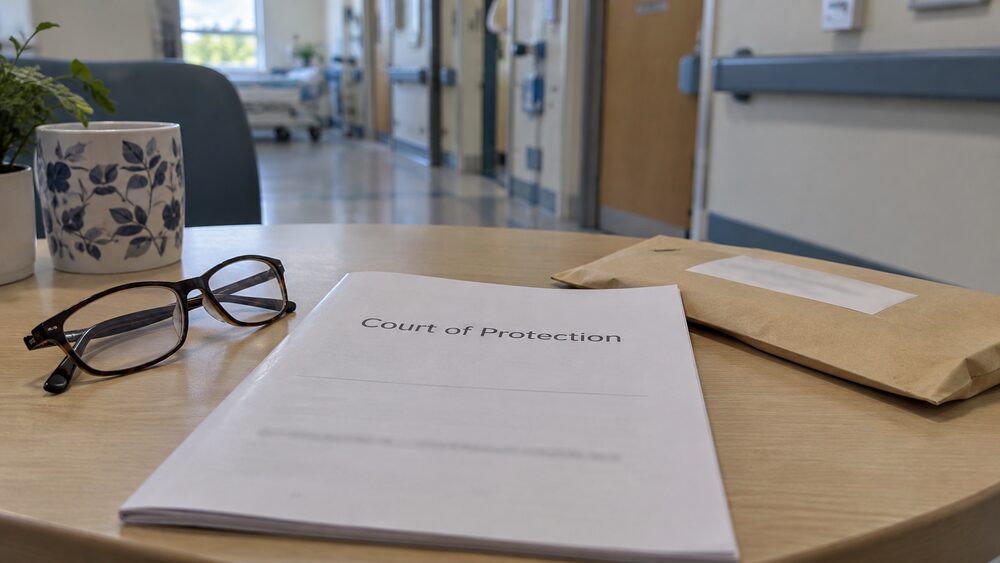
If someone loses mental capacity and there is no power of attorney in place, nobody can simply step in. Being a spouse, a son or a daughter, or the next of kin does not give anyone the legal right to operate another adult's bank account, sell their home or manage their savings. The bank will normally freeze the account or restrict it to essential transactions only, and the person's cards, chequebooks and online banking access may be cancelled1.
If someone loses mental capacity and there is no power of attorney in place, nobody can simply step in. Being a spouse, a son or a daughter, or the next of kin does not give anyone the legal right to operate another adult's bank account, sell their home or manage their savings. The bank will normally freeze the account or restrict it to essential transactions only, and the person's cards, chequebooks and online banking access may be cancelled1.
The route forward is an application to the Court of Protection. The court can give someone the right to make decisions for a person who does not have mental capacity, and that person becomes a deputy3. It is a formal, supervised process, and it is generally described as long and costly4. There is no way to set up a power of attorney after capacity has been lost: a lasting power of attorney has to be made while the person still has capacity, although it stays valid afterwards5.
This page explains what happens to money and accounts when capacity is lost without a power of attorney, why a lasting power of attorney can no longer be made at that point, how deputyship works, what it costs, and the other routes that exist, including DWP appointees and joint accounts.
What happens to your finances if you lose capacity without a power of attorney
The first thing that changes is access. If the account holder loses mental capacity, they no longer have access to their accounts: instructions are not accepted, access to banking apps, online banking and telephone banking is removed, and cards in their name are cancelled2. Banks may also cancel debit cards, chequebooks and online banking access, and can arrange for statements to be sent to an attorney instead of the account holder, depending on the terms of the document12.
An ordinary power of attorney, sometimes called a general power of attorney, does not help here. It automatically becomes invalid once the donor loses capacity13. The same applies to a power of attorney that ceases if you become mentally incapable of managing your affairs, although an enduring power of attorney will continue15. This is the trap many families fall into: a document that worked perfectly well while the person could still make decisions stops working at exactly the moment it is needed most.
Without a valid lasting or enduring power of attorney, the Court of Protection may need to become involved1. Until a deputy is appointed, the money is effectively locked. Bills may go unpaid, direct debits may fail, and debts can build up. A joint account does not solve the problem either: if a partner loses mental capacity, the joint account could be frozen unless there is a power of attorney in place, and the bank might freeze it completely or allow only essential payments7. If you lose mental capacity and do not have a power of attorney, the bank may restrict the account to essential transactions8.
Why a lasting power of attorney can no longer be made
A lasting power of attorney is still valid after you lose mental capacity, but you still need to set it up while you have mental capacity5. That is the rule that closes the door. Once capacity has gone, the document cannot be created, because the person making it must understand what they are signing.
You cannot set up a new power of attorney if you lose mental capacity. Instead, relatives or a trusted person need to apply for a Court of Protection order for a deputy to be appointed4. The court then decides who should act.
There is one older route that still works in some cases. An enduring power of attorney is the older form of power of attorney, now replaced by the lasting power of attorney, and it is not possible to make a new one16. If an enduring power of attorney was signed and witnessed before October 2007, it can either continue to be used, or be cancelled and replaced with a property and financial affairs lasting power of attorney17. If you lose mental capacity, the attorney must register the enduring power of attorney to start or continue using it17. In Northern Ireland, the attorney must register an enduring power of attorney with the Office of Care and Protection once the donor lacks capacity10.
A lasting power of attorney does not expire, though it can be cancelled by the attorney, or by the donor if they still have mental capacity18. It can also be cancelled at any time while the donor has mental capacity by sending the original document and a deed of revocation to the Office of the Public Guardian5.
Deputyship: applying to the Court of Protection
A deputyship is used when someone has already lost capacity and there is no valid power of attorney in place9. An application is made to the Court of Protection, which decides who to appoint to act for the person; the person appointed is known as the deputy, previously called a receiver14. A deputy is someone the court appoints to make decisions for someone who cannot make decisions for themselves, which is called mental capacity19.
The court does not rubber-stamp the application. It will consider whether it is necessary for ongoing decisions to be made on the person's behalf, and whether the person applying is suitable1. You can apply to become someone's deputy if they do not have mental capacity20. A friend, relation or someone who knows the person who has lost mental capacity can apply to the Court of Protection10. An attorney for financial decisions cannot be bankrupt5.
The process can take a while, because the court has to make sure it is safeguarding people who can no longer manage or look after their own affairs6. It is also described as time-consuming and costly21. There is no fixed timescale in the guidance, but the comparison with lasting power of attorney registration, which can take up to 20 weeks, gives a sense of the scale10.
Costs, fees and supervision of a deputy
Deputyship is not free. In all cases, the deputy will need to pay an application fee, any court or legal fees associated with the application (a fixed amount set by the court), and a supervision fee every year11. These costs do not include solicitors' fees if one is used18. The annual supervision fee is a continuing cost, not a one-off, which is why deputyship is generally more expensive than setting up a lasting power of attorney in advance.
The deputy's role is tightly controlled. A deputy does not have any legal claim to the money they manage11. They act under the court's supervision and must account for what they do. That is the trade-off: the court's oversight protects the person who has lost capacity, but it also means the deputy cannot simply do whatever the family thinks best.
Where the person's affairs are simple, the cost may not be justified. If the person only has income from benefits and no other income or capital, a deputyship application may not be needed1. In that situation, a DWP appointee arrangement is usually the more proportionate route.
Other routes: DWP appointees, joint accounts and bank arrangements
Deputyship is not the only option, and for some people it is not the right one.
DWP appointee. Someone can apply to the Department for Work and Pensions to become an appointee for a person receiving benefits who has lost capacity and has no attorney1. An appointee deals with benefits and state pension payments. They cannot manage savings, investments or property. If you do not know anyone who can act as an appointee, the DWP can arrange for the local authority to act22. The DWP will remove an appointee if the person can manage their own benefits, or if the appointee is not suitable22. A person who already has the legal right to act for someone does not need to apply to become an appointee; that includes a power of attorney, a guardianship order, a deputy order in England and Wales, a controller order in Northern Ireland, or another court order23.
Joint accounts. These are not a workaround. A joint account could be frozen unless there is a power of attorney in place, and the bank might freeze it completely or allow only essential payments7. If you lose mental capacity and do not have a power of attorney, the bank may restrict the account to essential transactions8. Joint accounts can help with day-to-day management while both people have capacity, but they do not give anyone authority once capacity is lost.
Bank arrangements. Some banks will accept a registered power of attorney and can, depending on its terms, cancel the donor's cards and chequebooks and send statements to the attorney instead12. These arrangements depend on a valid power of attorney existing. Without one, the bank has no authority to follow a family member's instructions.
Where to get help and how to raise concerns
If a power of attorney is in place and the donor has lost capacity, only the attorney can make a complaint on their behalf to the Financial Ombudsman Service24. That is a practical consequence of the rules: family members who are not the attorney cannot take up a complaint for the person.
For free, impartial help, Age UK publishes guidance on what happens if you do not have a power of attorney, covering deputyship, DWP appointees and independent mental capacity advocates1. Scope covers managing money for someone else and becoming an appointee3. MoneyHelper explains how joint accounts work7.
Where the rules differ across the UK, it matters. In Northern Ireland, applications in this area need to be made to the Office of Care and Protection25. Enduring powers of attorney in Northern Ireland must be registered with the Office of Care and Protection once the donor lacks capacity10. In Scotland, powers of attorney executed before 2 April 2001 do not need to be registered with the Office of the Public Guardian in Scotland and continue even if capacity is lost, unless the power states it will lapse10.
If you are considering the options side by side, the comparison between a Court of Protection deputy and a lasting power of attorney sets out how the two routes differ. For the wider context of money decisions at this stage of life, see Money Through Life's Big Changes.
Sources25 cited
- What happens if you don't have a power of attorney Age UK, 2026-01-09
- Power of attorney Barclays, 2026
- Managing money for someone else Scope, 2025-11-27
- Court of Protection FAQs HSBC, 2026-09-26
- Power of attorney Age UK, 2026-03-23
- Third party access Metro Bank, 2026-09-25
- Joint accounts MoneyHelper, 2026-09-25
- Dementia and managing money nidirect, 2026-09-03
- Register a legal authority Tesco Bank, 2026-09-25
- Manage saving for an adult NS&I, 2026-04-02
- Guide to Court of Protection orders Nationwide, 2026
- Using a power of attorney Nationwide, 2026
- Ordinary power of attorney Age UK, 2026-03-23
- Power of attorney Leeds Building Society, 2026-09-26
- Help collect your benefits or pension nidirect, 2026-06-26
- Enduring power of attorney Age UK, 2026-01-09
- Use or cancel an enduring power of attorney GOV.UK, 2026-09-26
- Power of attorney Standard Life, 2026
- Leaving money to a disabled person in a will or trust Scope, 2026-04-09
- Becoming an appointee Scope, 2025-08-11
- Banking with dementia Which?, 2025-04-13
- Removing an appointee Scope, 2025-08-04
- Supporting clients moving to Scotland from the rest of the UK Social Security Scotland, 2026-01-27
- Complaints about power of attorney Financial Ombudsman Service, 2026-09-26
- Manage an account GOV.UK, 2026-09-28






 MoneyHelperFree, impartial money and pensions guidance, set up by government
 Citizens AdviceFree advice on money, consumer and legal problems in England and Wales
 Turn2usFree benefits calculator and grants search from a charity
 GOV.UKOfficial information on tax, benefits and government services