
In Northern Ireland, care is not arranged through a local council as it is in England, Wales and Scotland. It is arranged through your local Health and Social Care Trust (HSC Trust), the body that delivers both health and social care in the region. The Trust assesses what care you need, arranges it, and decides how much, if anything, you are asked to contribute towards the cost1.
The broad split is this: care delivered in your own home is generally not charged for by Trusts, while a move into a residential or nursing home triggers a financial assessment of your income, savings and assets. Health care provided by the NHS remains free at the point of use for people who reside in the UK, and that principle sits underneath everything else: nursing and health services arranged through the health service are not means-tested in the way social care can be1.
Care in Northern Ireland also rests heavily on unpaid carers. Official survey figures for 2024/25 show that 15% of adult carers provided care for 50 or more hours per week, and many households combine informal care from family with paid services arranged by the Trust2. Around 228,520 Personal Independence Payment claims were in payment in Northern Ireland at the end of November 2025, an increase of 5% on a year earlier, reflecting how many people live with long-term illness or disability and may one day need paid care3.
How care is paid for in Northern Ireland
The starting point is always the same: contact your HSC Trust and ask for a care needs assessment. The Trust is the single route into both health and social care in Northern Ireland, because the two are run together rather than split between an NHS body and a council as they are elsewhere in the UK. The needs assessment decides what care you need, and it is the needs assessment that comes first: the question of who pays follows on from it, never the other way round1.
Once the Trust knows what care is needed, the funding route depends on where that care is delivered. If the care can be provided in your own home, Trusts generally do not charge for it, which makes Northern Ireland different from most of England, where home care charges are routine. If the care has to be provided in a residential or nursing home, the Trust carries out a financial assessment, and your contribution is worked out from your income, savings and assets.
Some payments are protected at the assessment stage. Payments made under the Infected Blood Payment Scheme Northern Ireland should be disregarded by authorities when making assessments for social care, so money received through that scheme does not push up what you are asked to pay9. This is one example of a wider principle: the financial assessment looks at particular kinds of income and assets, not everything you have.
The scale of need behind these arrangements is large. As well as the Personal Independence Payment claims noted above3, there were 77,290 Carer's Allowance claimants in Northern Ireland at the end of August 2025, an increase of 1% on a year earlier10. Many families are already providing substantial care before any paid services begin, with 15% of adult carers providing 50 or more hours of care each week2. The Trust's role is often to top up and formalise care that families have started, and the funding rules recognise that by keeping home care generally free of charge.
What the Health and Social Care Trust provides free
Health care in Northern Ireland, as across the UK, is provided by the NHS free at the point of use for people who reside in the UK. The official guidance is blunt about the limits of that entitlement: if you move abroad, you are not automatically entitled to use the NHS free of charge, even if you have paid National Insurance contributions and taxes in the UK1. For people living in Northern Ireland, though, health services arranged through the Trust, including nursing care arranged on health service grounds, are not subject to a means test.
Because health and social care are integrated in Northern Ireland, the line between what is free and what is means-tested is drawn by the nature of the service rather than by which organisation provides it. Care that meets health needs is free; social care in a residential setting is subject to the financial assessment described below. Care delivered in your own home by the Trust is generally not charged for.
There are specific protections on top of this general picture. Payments under the Infected Blood Payment Scheme Northern Ireland should be disregarded by authorities in making assessments for social care, so they do not count against you either in the needs assessment or the financial one9. If you receive compensation through that scheme, tell the Trust so the disregard is applied.
Care at home: what you may be asked to pay
Domiciliary care, meaning help with things like washing, dressing and meals delivered in your own home, is generally not charged for by Health and Social Care Trusts in Northern Ireland. This is one of the most significant differences from England, where councils routinely charge for home care after a financial assessment, and it means many people in Northern Ireland receive substantial weekly care at home without a bill.
The care itself still has to be arranged properly. It starts with a needs assessment from your Trust, which looks at what you can do for yourself, what family or friends provide, and what paid support is needed. If you have a disability or long-term condition, benefits that help with the extra costs, such as Personal Independence Payment, may form part of the picture: a claim for Personal Independence Payment in Northern Ireland must be made in writing on a form authorised by the Department, by telephone, or by a telephone call from the Department, and must be made on the first day of the period the claim covers11.
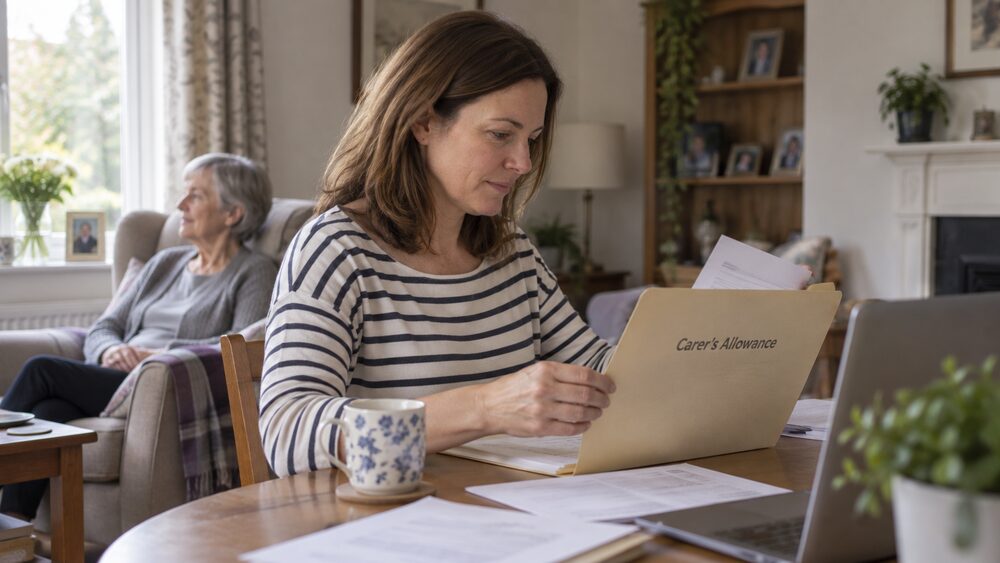
Much of the care at home in Northern Ireland is provided by family members rather than paid staff. Official statistics show 77,290 people were receiving Carer's Allowance at the end of August 202510, and 15% of adult carers provided 50 or more hours of care per week in 2024/252. Carers themselves can get support: the rules around Carer Support Payment, the Scottish replacement for Carer's Allowance, treat a person as satisfying residence conditions across borders for a 13-week period, and amounts of Carer Support Payment above what carer's allowance would have paid are disregarded in income calculations for benefits12. A person moving from England or Wales to Scotland has their Carer's Allowance stopped 13 weeks after the move, and needs to apply for Carer Support Payment as soon as possible after moving13. If you care for someone, see money help for unpaid carers.
Residential and nursing home fees and the financial assessment
When a move into a residential or nursing home is being considered, the Trust carries out a financial assessment alongside the needs assessment. Your contribution to the fees is worked out from your eligible income, your savings and your assets, and the Trust pays the rest of its usual rate for a home that meets your assessed needs. The assessment is not optional: it is how the Trust decides the split between what you pay and what it pays.
Income from benefits is squarely within the assessment. Official guidance states that Pension Credit "will count as income when your contribution to your residential care or nursing home fees is assessed"4. The same guidance explains that what happens to your benefits depends on who pays for the care home: if the NHS or another body funds your place, different rules apply to your benefits than if you are paying for yourself14. Some benefits stop or reduce once the state is funding your care home place, so it is worth telling the Northern Ireland Pension Centre about any move into care, since you need to report changes in circumstances to receive all the benefits you are entitled to15.
A few payments are protected. Winter Fuel Payments continue for people living permanently in residential care, at £100 for those aged between State Pension age and 79, and £150 for those aged 80 or over, which is lower than the £200 and £300 paid to households in the community16. Universal Credit includes a support element of £217.26 per assessment period for a claimant with limited capability for work and work-related activity, effective from 6 April 202617, and income of that kind feeds into what the assessment sees.
For comparison, in Wales the residential charge is worked out from eligible income such as pensions or welfare benefits18, and the same principle of assessing eligible income applies in Northern Ireland's financial assessment. The detailed mechanics of needs and financial assessments are covered in care needs assessments and financial assessments.
How savings, income and your home are counted
The financial assessment looks at three things: your income, your savings and your assets, with your home treated differently depending on your circumstances. Income means eligible income, such as pensions and welfare benefits: guidance for Wales, which follows the same principle, states that "how much you pay towards this care will be calculated from your eligible income, such as pensions or welfare benefits"18. Pension Credit counts as income for the residential care assessment4, and so do State Pension and private pension payments.
To put that in context, household income in Northern Ireland is heavily reliant on earnings and state support. Official statistics for 2022/23 show the majority of household income, 71%, comes from earnings, with 17% from state support19; the year before, the split was 72% from earnings and 16% from state support20. For someone whose working life is behind them, the state support share is much larger, which is why pensions and benefits dominate most care home financial assessments.
Your home is the asset that usually matters most. The average house price in Northern Ireland was £202,000 in Quarter 2 (April to June) 2026, up by 9.2% (£17,000) from the same quarter a year earlier6. Whether the home counts towards your assessment depends on who lives in it and whether your move into care is permanent, a question covered in does your home count towards care home fees?. Housing costs themselves also bear on what income you have left: in 2024, 25.3% of private-renting household income in Northern Ireland went on rent, at £751 rent against £2,974 income21.
Certain payments are disregarded, meaning they are left out of the calculation. Infected Blood Payment Scheme Northern Ireland payments should be disregarded in social care assessments9, and amounts of Carer Support Payment above the equivalent carer's allowance figure are disregarded in income calculations for benefits including the Northern Ireland equivalents of income support, jobseeker's allowance, employment and support allowance, housing benefit and state pension credit12. If you receive payments you believe should be disregarded, raise it with the Trust carrying out the assessment.
Deferring payment or selling your home to pay for care
For many people, the home is the main asset available to pay for a care home place, and the average Northern Ireland home was worth £202,000 in Quarter 2 20266. Affordability context matters here: official statistics note that in Northern Ireland an average home was affordable with an average or higher income in the year to March 202422, so the home often represents a substantial share of a family's wealth.
If selling is not the right step, there are other routes to consider. Social tenants may be able to buy through the House Sales Scheme offered by the Northern Ireland Housing Executive and registered housing associations, and people who cannot afford to buy a home outright may be helped by the Northern Ireland Co-ownership scheme23. These schemes are about buying rather than paying for care, but they show the range of housing options that exist alongside outright ownership, and a home that is not sold may be rented out to produce income instead.
One option people sometimes consider is deferring a State Pension to build up a higher amount later. The process for claiming a deferred State Pension is different if you live outside Northern Ireland24, and claiming by post takes more time than claiming online or by calling the Northern Ireland Pension Centre25. You can check what a deferral would mean for you through a State Pension forecast, contacting the Northern Ireland Pension Centre if you are in Northern Ireland26. Deferring a pension increases income later, but it is not a care-funding solution in itself, and any State Pension received still counts as income in a financial assessment.
Top-up fees and choosing a more expensive home
The Trust pays its usual rate for a home that meets your assessed needs. If you or your family prefer a more expensive home, someone can pay the difference, and that difference is the top-up fee. Independent guidance defines it as the gap between the fees and the cost of your care, paid so you can live in a more expensive home5.
The rules around who pays are strict. You cannot usually pay your own top-up fees: they are generally paid by a third party, such as a friend, relative or charity5. Before asking for a top-up at all, the Trust must be able to show that there is another care home within the cost of your care that can meet your needs and that a place is currently available5. In other words, a top-up should be a genuine choice, not something demanded because nothing cheaper was offered.
Whoever agrees to pay will be asked to sign a contract, usually with the body that then pays the care home, and the contract must explain the important points: how much the top-up payments will be, how often they need to be paid, what might happen if the person paying can no longer afford the top-up, how any annual increase in costs will be shared, and what will happen if care needs change5. Two protections are worth knowing. If the person paying the top-up can no longer afford it, the Trust has to carry out a new care needs assessment before deciding what to do, and in the meantime the Trust is responsible for covering the fees5. And if there is no cheaper care home available that can meet your care needs, the Trust will have to increase its contribution to cover a fee increase5. More detail is in care home top-up fees.
Benefits that can help with care costs
Several benefits interact with care costs, both before and after a move into a home. Pension Credit tops up pension income for the lowest-income pensioners: 60,310 claimants and 69,390 beneficiaries were receiving it in Northern Ireland at the end of November 2025, an increase of 620 claimants (1%) on a year earlier3. You can still get Pension Credit if you are living with your family, because the Northern Ireland Pension Centre looks at your income, not theirs27. To apply by phone, call the Northern Ireland Pension Centre application line; calls are free, and the Centre can also help you apply for help with housing costs at the same time as your Pension Credit application28.
Personal Independence Payment helps with the extra costs of long-term illness or disability, and 228,520 claims were in payment in Northern Ireland at the end of November 20253. A claim must be made in writing on an authorised form, by telephone, or through a call from the Department, on the first day of the period it covers11. For carers, Carer's Allowance was going to 77,290 claimants at the end of August 202510, and Housing Benefit rules in Northern Ireland add a carer premium where the cared-for person remains in receipt of benefits including the daily living component of Personal Independence Payment29.
Winter Fuel Payments continue in residential care at the reduced rates of £100 or £150 depending on age16. If someone is paying for care and dies, bereavement support follows: Funeral Support Payment eligibility in Scotland is a separate matter, but people in Northern Ireland can find out about funeral payments through nidirect.gov.uk30. For an overview of the whole benefits system, see benefits in the UK.
Where the rules differ from the rest of the UK
Northern Ireland's care funding sits apart from the rest of the UK in several ways. The most important is structural: health and social care are integrated and delivered by HSC Trusts, rather than split between the NHS and local councils. That is why care at home is generally not charged for, while in England councils commonly charge for home care, and why the Trust rather than a council arranges everything.
The differences run through the benefits and legal systems too. Winter Fuel Payment regulations made in 2025 provide in relation to Northern Ireland only for provision corresponding to Great Britain regulations32, so the two systems run in parallel rather than as one. Consumer law differs: in Northern Ireland the law does not generally prohibit providers of goods, facilities and services from discriminating on the grounds of age, which is slightly different from Great Britain law but has a similar effect33. Carer benefits also cross borders: Carer's Allowance stops 13 weeks after a move from England or Wales to Scotland, when Carer Support Payment takes over13, and the consequential legislation extending those arrangements extends to Northern Ireland only in Part 412.
For how the other nations handle care costs, see paying for care in England, paying for care in Scotland and paying for care in Wales, and the wider guide to how money rules differ across the nations.
Challenging a decision and where to get help
If you disagree with a needs assessment, a financial assessment or a contribution the Trust has worked out, ask the Trust to look again at the decision first. Keep the paperwork: the assessment letter, the calculation of your income and assets, and any contract you or a relative have signed, including a top-up contract. If you believe a payment should have been disregarded, such as an Infected Blood Payment Scheme payment9, say so in writing.
Some disputes involve other bodies. Housing Benefit overpayment disputes are dealt with by contacting the Northern Ireland Housing Executive34. If debts built up while paying for care become unmanageable, Northern Ireland has a Debt Relief scheme in which an individual applies to the Official Receiver for an Order, and for a payment of £90 the individual obtains protection against enforcement action by their creditors for a one-year period35. Free debt advice is available through the routes set out in debt: a complete guide.
If the person needing care can no longer manage their own money, Northern Ireland has its own system: the Office of Care and Protection can appoint a controller to manage someone's affairs36, and applications of that kind in Northern Ireland need to be made to the Office of Care and Protection37. This is the Northern Ireland equivalent of the Court of Protection route in England and Wales, and it is covered in losing mental capacity without a power of attorney. The Financial Ombudsman Service can consider complaints involving attorneys and controllers, including how a controller manages money36.
For benefits questions and changes of circumstances, the Northern Ireland Pension Centre provides information on State Pension and other benefits you may be eligible for on retirement38, and you need to report any changes in circumstances to it to receive all the benefits you are entitled to15. If you are unhappy with a Trust's final decision, free independent advice is available from charities such as Independent Age, which publishes guidance on care funding disputes and top-up fees5, and MoneyHelper offers free, impartial pensions and benefits guidance.
Sources38 cited
- Guidance on Social Security Abroad NI38 GOV.UK, 2026-07-07
- Family Resources Survey: Northern Ireland 2024/25 NISRA, 2024
- Benefits Statistics Summary November 2025 NISRA, 2025-11-30
- Residential care and nursing homes and benefits nidirect, 2026-08-05
- Care home top-up fees Independent Age, 2026-09-26
- Private rent and house prices, UK: August 2026 ONS, 2026
- Help with health costs Macmillan Cancer Support, 2025-06-01
- Paying for adult care services Contact, 2026-05-08
- Infected Blood Payment Scheme: financial advice and support nidirect, 2026-09-01
- Benefits Statistics Summary August 2025 NISRA, 2025-08-31
- Personal Independence Payment Regulations (Northern Ireland) 2016 Legislation.gov.uk, 2016-05-04
- Carer's Assistance (Carer Support Payment) (Scotland) Regulations 2023 (Consequential Amendments) Order 2023 Legislation.gov.uk, 2023-11-16
- Carer's Allowance GOV.UK, 2026-09-25
- Going into a care home: benefits GOV.UK, 2026-09-27
- State Pension: report a change in your circumstances nidirect, 2026-09-01
- The Social Fund Winter Fuel Payment Regulations (Northern Ireland) 2025 explanatory memorandum Legislation.gov.uk, 2025
- Pensions Act 2025 Legislation.gov.uk, 2026-04-06
- Charging for social care Welsh Government, 2026
- Poverty and Income Inequality Report 2022/23 NISRA, 2022
- Poverty and Income Inequality Report 2021/22 NISRA, 2021
- Private rental affordability, England, Wales and Northern Ireland: 2024 ONS, 2024
- Housing purchase affordability, Great Britain: 2024 ONS, 2024
- Low cost home ownership schemes nidirect, 2026-02-18
- Claiming or inheriting a deferred State Pension nidirect, 2026-06-26
- Get your State Pension nidirect, 2026-08-18
- Check your State Pension forecast nidirect, 2026-09-01
- Income, benefits and Pension Credit nidirect, 2026-06-26
- Applying for Pension Credit nidirect, 2026-07-06
- Housing Benefit (Persons who have attained the qualifying age for state pension credit) Regulations (Northern Ireland) 2006 Legislation.gov.uk, 2016-05-03
- Funeral Support Payment eligibility Social Security Scotland, 2026-09-26
- Paying for care services at home Independent Age, 2026-09-26
- The Social Fund Winter Fuel Payment Regulations (Northern Ireland) 2025 Legislation.gov.uk, 2025-08-22
- Insurance for older customers: age discrimination House of Commons Library, 2026-07-08
- Who to talk to about deductions from your Universal Credit nidirect, 2026-06-30
- Proposed increases to the Monetary Eligibility Limits for Debt Relief Orders in Northern Ireland Department for the Economy, 2024-05-17
- Complaints about a power of attorney or deputy Financial Ombudsman Service, 2026-09-26
- Manage a Junior ISA GOV.UK, 2026-09-28
- Getting information and help with pensions nidirect, 2026-06-26



 MoneyHelperFree, impartial money and pensions guidance, set up by government
 Citizens AdviceFree advice on money, consumer and legal problems in England and Wales
 Turn2usFree benefits calculator and grants search from a charity
 GOV.UKOfficial information on tax, benefits and government services