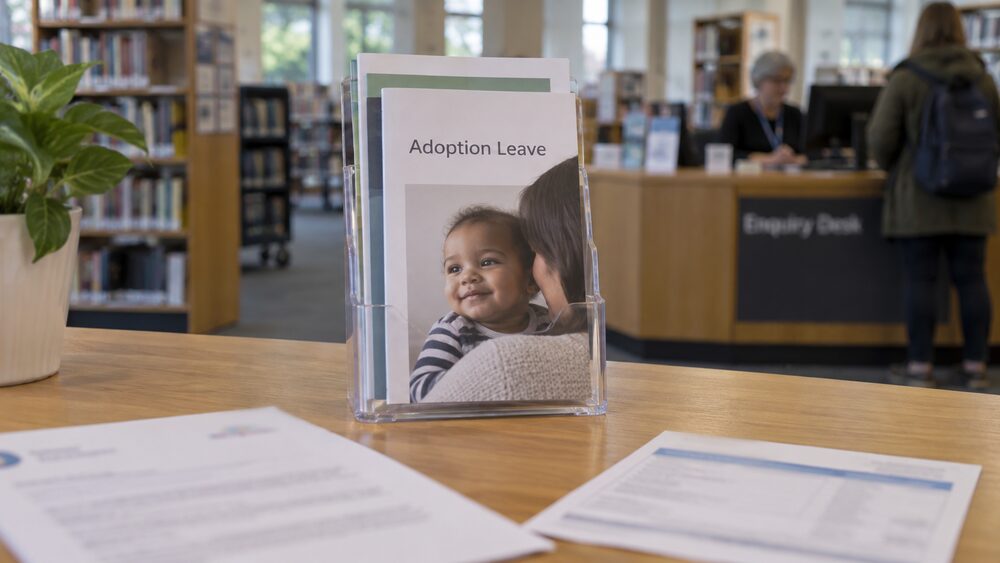
If you are adopting a child, adoption leave gives you up to 52 weeks off work, and Statutory Adoption Pay covers up to 39 weeks of it. The first six weeks are paid at 90% of your normal weekly pay before deductions. For the remaining 33 weeks the rate is £194.32 a week, or 90% of your average weekly earnings if that is less1.
If you are adopting a child, adoption leave gives you up to 52 weeks off work, and Statutory Adoption Pay covers up to 39 weeks of it. The first six weeks are paid at 90% of your normal weekly pay before deductions. For the remaining 33 weeks the rate is £194.32 a week, or 90% of your average weekly earnings if that is less1.
To qualify you need to have worked for your employer continuously for at least 26 weeks by the week you are matched with a child by an adoption agency, and to earn an average of at least £123 a week before tax3. Where a couple adopts, only one parent can take adoption leave and claim Statutory Adoption Pay. The other parent may be able to take paternity leave and pay for adoption, or take over what is left of the adopter's leave through shared parental leave4.
This page sets out what each type of leave and pay is worth, who qualifies, how to claim it from your employer, and how the pay interacts with tax, Universal Credit and other benefits.
Adoption leave: up to 52 weeks off work
Adoption leave lasts for 52 weeks1. Statutory Adoption Leave allows you to take up to 52 weeks off work when you adopt a child2. The leave is made up of ordinary adoption leave followed immediately by additional adoption leave, and the two together give the full year.
The leave is available to the person the adoption agency matches with the child. Where a couple adopts, only one parent in a couple can take Statutory Adoption Leave and Pay2. The other parent is not left without options: partners, including same-sex partners and civil partners, may be entitled to up to two weeks of paternity leave and statutory paternity pay, taken as separate weeks or together, at any time up to a year from the adoption4.
Paternity leave for adoption runs from the date of the child's placement, but must be completed within 56 days of the date of placement7. That is a tighter window than the adopter's own leave, and it is the deadline most often missed.
There is a separate right to shared parental leave and pay, which lets the couple share the leave between them. To use it, either you or your partner must qualify for Statutory Adoption Pay, and one of you must have qualified for statutory adoption leave or statutory adoption pay for the child8. The partner may be able to take the remainder of the adopter's unused leave if the adopter returns to work, paid at the remainder of the statutory pay the adopter would have been entitled to4.
Statutory Adoption Pay: 90% for six weeks, then up to £194.32 a week
Statutory Adoption Pay is paid in two stages. During the first six weeks, you get 90% of your normal weekly pay before deductions1. For the next 33 weeks, you get £194.32 a week, or 90% of your average weekly earnings if that is less1. The £194.32 figure is the statutory rate set for April 2026 to April 20273.
The pay can be paid for up to a maximum of 39 weeks5. That is shorter than the 52 weeks of leave, so the final 13 weeks of adoption leave are normally unpaid unless your employer offers more under its own scheme.
One point of confusion is worth clearing up. Some guidance still quotes £184.03 a week for the later weeks of Statutory Adoption Pay9. That was the rate in an earlier year. The current rate, and the one that applies to adoptions in the 2026 to 2027 year, is £194.321. If you are checking what you will be paid, use the current figure.
The same £194.32 rate applies to Statutory Paternity Pay, paid for one or two consecutive weeks at £194.32 or 90 per cent of your average weekly earnings if this is less7. So a partner taking paternity leave for adoption is on the same flat rate as the adopter's later weeks.
Who qualifies: 26 weeks with your employer and earnings of at least £123 a week
Two conditions decide whether Statutory Adoption Pay is payable. The first is service: you must have worked for your employer continuously for at least 26 weeks by the week you are matched with a child for adoption by an adoption agency3. The second is earnings: you must earn an average of at least £123 a week before tax3.
The £123 figure is the threshold for April 2026 to April 2027, measured on average over the eight weeks before the matching week if you are paid weekly, or the two months before it if you are paid monthly1. The matching week is the week in which you are notified about being matched with a child for adoption purposes10.
The same shape of test applies across the family of statutory payments. Statutory Paternity Pay requires 26 weeks of continuous employment into the fifteenth week before the expected week of childbirth, or into the matching week for adoption, with average earnings at least equal to the lower earnings limit for National Insurance contributions5. Statutory Maternity Pay uses 26 weeks by the fifteenth week before the baby is due and earnings above £123 a week before tax11.
If you do not qualify for Statutory Adoption Pay, that is not necessarily the end of the matter. Your employer should still pay you Statutory Maternity, Paternity or Adoption pay if you are eligible, even where you are not entitled to anything under the firm's own scheme12. Occupational schemes sit on top of the statutory minimum rather than replacing it.
Only one adopter can claim, but a partner may take what is left
Where a couple adopts a child, only one parent is entitled to take adoption leave and claim Statutory Adoption Pay4. That rule applies to same-sex couples as well as different-sex couples4. It does not mean the second parent has no rights; it means the couple has to decide which of them takes the adoption leave, and the other uses a different route.
The main routes for the second parent are:
- Paternity leave and pay for adoption: up to two weeks, taken as separate weeks or together, at any time up to a year from the adoption4.
- Shared parental leave and pay: available where either you or your partner qualifies for Statutory Adoption Pay, and one of you qualified for statutory adoption leave or pay for the child8.
- Taking over unused leave: if the adopter does not use up all their adoption leave and goes back to work, the partner may be able to take the remainder, paid at the remainder of the statutory pay the adopter would have been entitled to4.
Shared parental pay has its own limits. The number of weeks payable is 39 weeks less the weeks of Statutory Adoption Pay payable and the weeks notified by the other partner13. There is also a cap on working during a statutory pay week: work on any day under a contract of service during a statutory pay week must not exceed 20 days including previous days so worked13.
The "only one" pattern recurs across family payments. Only one member of a couple can receive the LCWRA element in Universal Credit, with the other getting the Carer element instead14. Only one of two people caring for the same person can get Carer's Allowance or Carer Support Payment15. It is a common design in the benefits system, not a penalty aimed at adopters.
How to claim Statutory Adoption Pay from your employer
The claim runs through your employer's payroll. Your employer pays Statutory Adoption Pay through PAYE and claims it back from HMRC3. You will need to provide evidence, such as a letter from the adoption agency or a matching certificate3.
The steps are:
- Tell your employer you are adopting and when you want your pay to start, giving at least 28 days' notice6.
- Give your employer the evidence of the match or placement, such as the letter from the adoption agency or the matching certificate3.
- Your employer writes to you within 28 days of receiving your notice, stating the date on which your additional adoption leave will end3.
- Your employer pays Statutory Adoption Pay to you in the same way and at the same time as your normal wages16.
If you are claiming paternity pay for adoption rather than adoption pay, the process is similar but the form differs: you can complete an online form, download it and send a copy to your employer17. Statutory Maternity, Paternity or Adoption Pay can also be applied for on the HMRC website18.
If something goes wrong, there is a route to challenge it. If you disagree with a Statutory Adoption Pay decision made by your employer, you can contact HM Revenue and Customs Statutory Payments Disputes Team19. If your employer refuses to pay or has gone into liquidation, you can claim any unpaid Statutory Adoption Pay from the HMRC Statutory Payment Disputes Team on 0300 322 9422; HMRC can make a formal decision and fine employers for failure to pay3. For paternity pay, if you cannot get it, your employer must complete and give you form SPP1 telling you why it has not been paid7.
When can Statutory Adoption Pay start?
Statutory Adoption Pay can start from the date of the child's placement or up to 14 days before the expected date of the placement6. You must give your employer at least 28 days' notice of when you want to start getting it6.
The flexibility is narrower than it looks. You cannot choose an arbitrary start date; it has to sit within that window around the placement. If you want pay to begin before the placement, the earliest point is 14 days ahead of the expected date.
For the partner taking paternity leave for adoption, the timing rules are different. That leave runs from the date of the child's placement, but must be completed within 56 days of the date of placement7. The two week entitlement can be taken as separate weeks or together, at any time up to a year from the adoption4, but the 56 day completion rule for the placement period is the one that catches people out.
Tax, Universal Credit and other benefits
Statutory Adoption Pay is taxable. You will pay tax and National Insurance on your Statutory Adoption Pay2. It is treated as normal pay, so tax and National Insurance are taken off in the usual way7. It is charged to tax under the normal rules rather than being treated as a taxable social security benefit20.
For Universal Credit, Statutory Adoption Pay counts as earnings. The statutory payments counted as earnings include Statutory Maternity Pay, Statutory Paternity Pay, Statutory Shared Parental Pay, Statutory Parental Bereavement Pay, Statutory Adoption Pay and Statutory Sick Pay21. You must report these in the assessment period in which you received them, unless Universal Credit has told you that your employer reports through the Real Time Information system22.
Statutory Adoption Pay is not included in the benefit cap, which limits the total amount in some benefits that working-age people can receive16. It does, however, count in full as earnings when calculating your entitlement to other means-tested benefits16. So it can reduce a means-tested award even though it sits outside the cap.
The treatment differs by benefit:
| Benefit | How Statutory Adoption Pay is treated |
|---|---|
| Universal Credit | Counted as earnings21 |
| Housing Benefit, Council Tax Benefit, Pension Credit | Treated as earnings, attracting whatever earnings disregard applies23 |
| Income Support, income-based Jobseeker's Allowance, income-based Employment and Support Allowance | Treated as income other than earnings, with no earnings disregard23 |
| Benefit cap | Not included16 |
Universal Credit's unearned income rules do not capture statutory payments: unearned income does not include statutory payments like Statutory Sick Pay or Statutory Maternity Pay24. Statutory Adoption Pay is also excluded from Statutory Sick Pay, so the two cannot be claimed for the same period25.
The rules have been extended in recent years to cover more family situations. Statutory neonatal care pay is defined as a payment under Part 12ZE of the Contributions and Benefits Act and has been added to the work condition and to employed earnings in the Universal Credit Regulations26. It is available to a child's adopter, overseas adopter, prospective adopter, the partner of the adopter or prospective adopter, or the partner of the overseas adopter27. If your child needs neonatal care after placement, that is a separate entitlement worth checking.
Where to get help
If you are unsure whether you qualify, or your employer disputes your entitlement, free and impartial help is available. The HMRC Statutory Payments Disputes Team handles disagreements with an employer's decision and unpaid pay where an employer refuses or has gone into liquidation3. For benefit calculations, the Turn2us and Entitledto benefit calculators let you model how Statutory Adoption Pay affects Universal Credit and other awards16.
For broader advice on your rights at work during an adoption, Maternity Action publishes guidance on adoption leave and pay rights for parents3, and Gingerbread covers time off when a new baby arrives9. If you are also considering how adoption leave fits with your pension and long-term planning, the pensions guide sets out how contributions and State Pension credits work during periods away from work.
Sources27 cited
- Adoption leave and pay Maternity Action, 2026-03
- Adoption leave and pay PensionBee, 2026-05-15
- Adoption leave and pay rights for parents Maternity Action, 2026-02
- Can I get Statutory Paternity Pay? Turn2us, 2026-05-14
- The Additional Statutory Paternity Pay (General) Regulations 2010 legislation.gov.uk, 2010-03-25
- How do I claim Statutory Adoption Pay? Turn2us, 2026-05-14
- Statutory Paternity Pay nidirect, 2026-04-06
- Shared Parental Leave and Pay nidirect, 2026-04-03
- Time off when you have a new baby Gingerbread, 2026-06-08
- Expecting a child Turn2us, 2026-04-06
- The impact on mothers and families of low maternity payments Maternity Action, 2023
- Occupational Maternity Pay Entitledto, 2026-09-26
- The Statutory Shared Parental Pay (Adoption) Regulations (Northern Ireland) 2015 legislation.gov.uk, 2015-03-02
- Carers with limited capability for work and Universal Credit Entitledto, 2026-09-26
- Carer's Allowance Marie Curie, 2026-04-05
- How much Statutory Adoption Pay will I get? Turn2us, 2026-09-26
- How do I claim Statutory Paternity Pay? Turn2us, 2026-05-14
- National Insurance credits Which?, 2026
- How do I challenge a Statutory Adoption Pay decision? Turn2us, 2026-05-14
- Income Tax (Earnings and Pensions) Act 2003, Part 10 legislation.gov.uk, 2026
- What will affect your Universal Credit payments nidirect, 2026-06-30
- Other payments from employment and Universal Credit Entitledto, 2026-09-26
- Maternity and Paternity Pay Allowance Entitledto, 2026-09-26
- Surplus earnings rule Turn2us, 2026-09-26
- Statutory Sick Pay Mental Health and Money Advice, 2025-07-21
- The Universal Credit (Amendment) Regulations 2025 legislation.gov.uk, 2025-02-24
- The Statutory Neonatal Care Pay (General) Regulations 2025 legislation.gov.uk, 2025-03-20






 MoneyHelperFree, impartial money and pensions guidance, set up by government
 Citizens AdviceFree advice on money, consumer and legal problems in England and Wales
 Turn2usFree benefits calculator and grants search from a charity
 GOV.UKOfficial information on tax, benefits and government services