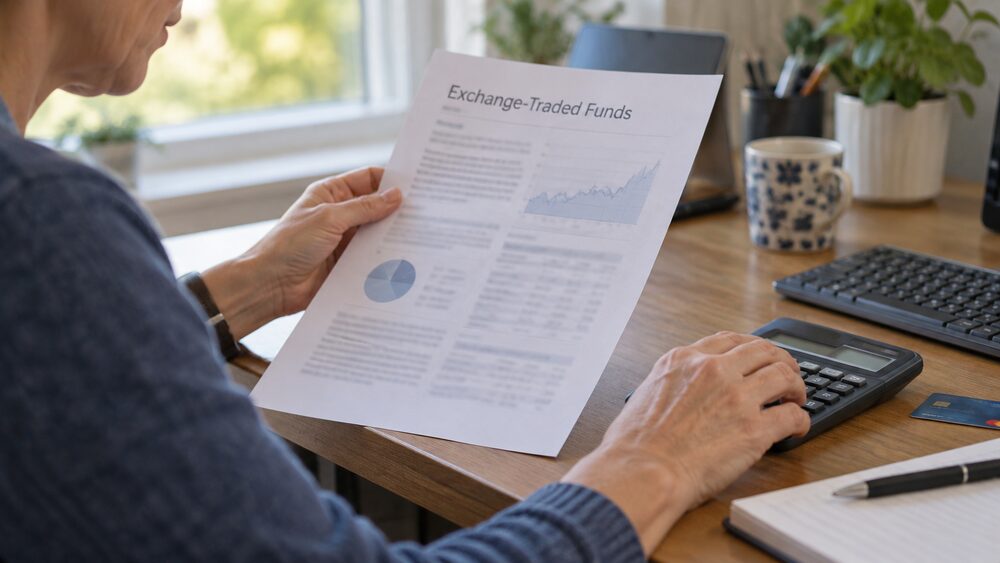
An exchange-traded fund, or ETF, is a collective investment fund that is traded on a stock exchange in the same way as an individual company's shares1. Instead of picking shares yourself, you buy one holding that usually invests across an entire index, such as the FTSE 100, and ETFs are usually cheaper than other funds known as mutual funds1. Because they trade on the stock market, you can buy and sell them throughout the trading day, just like shares1.
Most ETFs aim to track the performance of a specific index, such as the FTSE 100 or the S&P 5001. They are bought and sold through a stockbroker or an investment platform, in the same way you would buy shares2, and no stamp duty is payable when you buy them3. This page explains what ETFs invest in, how they are priced, what they cost, how much you need to start, and how to hold them in an ISA or pension.
What an ETF is: a fund that trades like a share
An ETF is a basket of investments, usually made up of shares and/or bonds1. Like other collective investments, it pools money from many investors and spreads it across a range of holdings, so one purchase gives you a slice of dozens or hundreds of companies. Where it differs from an ordinary fund is how you buy and sell it: ETFs are traded on a stock market and can be bought and sold throughout the day like shares1, whereas ordinary funds are usually priced and dealt once a day.
The mechanics sit behind the scenes but are worth a sentence. ETFs are listed on the stock market, but they are open-ended: authorised participants trade directly with the fund manager to create and redeem shares, which keeps the number of shares in line with demand6. For you as an investor, the practical effect is that an ETF behaves like a share on the outside and like a fund on the inside.
You deal in ETFs through a stockbroker, a platform offering brokerage services, or a market maker, either on an exchange or over the counter2. That is the same route as buying shares, and the process of placing an order, choosing an order type and paying a dealing charge is covered in how to buy and sell shares. If you are weighing an ETF against an ordinary tracker fund, the dedicated comparison page on ETFs vs index funds goes into the differences in detail.
What ETFs invest in: shares, bonds, commodities and more
There is a wide variety of ETFs available, covering different asset types including shares, bonds, property and commodities1. Common examples include equity (stock) ETFs, bond ETFs, commodity ETFs, index ETFs, active ETFs and thematic ETFs built around themes such as artificial intelligence or clean energy1. Most ETFs track an index such as the FTSE 100, but others can track a specific stock sector, a currency or a commodity1, and thematic funds built around environmental or social screens are one of the main ways people invest ethically7.
In practice that means the range runs from broad market trackers holding hundreds of companies, to narrow funds holding a single commodity or one industry. A commodity or currency ETF is a very different animal from a FTSE 100 tracker, and the risks differ accordingly: a broad equity ETF spreads the risk of any one company failing, while a single-commodity ETF concentrates it in the price of one thing.
If you want to read more about the underlying assets, the site has core pages on bonds, gilts, money market funds and diversification and asset allocation. ETFs sit alongside investment trusts and unit trusts as one of the main types of fund available to UK investors8.
Tracker or active: how ETFs follow the market
ETFs are usually passive products: they track an index1. Most ETFs are passively managed, which means the manager only makes trades to ensure the fund matches the market it is tracking1. Passive funds, also known as tracker funds, are designed to follow the performance of a market index such as the FTSE 100 or the Dow Jones9. The manager is not trying to beat the market, only to mirror it, which is why the ongoing charges tend to be low.
Not every ETF is passive, though. It is possible to invest in "active ETFs", which are tracker funds that track a custom-made index of suitable firms10. An active ETF still follows an index, but the index itself is built by the manager to reflect a particular approach, such as an ethical screen, rather than being a standard market benchmark. The line between passive and active is explained more fully in active vs passive investing.
A separate category sits at the riskier end: short and leveraged ETFs. These are bought and sold on recognised investment exchanges like shares, but they are designed to move a multiple of, or in the opposite direction to, an index on a daily basis11. They are trading instruments rather than long-term investments, and they are covered in the site's page on FCA rules on high-risk investments.
Income or accumulation: what happens to dividends
ETFs are normally set up as either income (also known as distributing) or accumulation1. Like investment funds, ETFs are either income or accumulation funds: income ETFs pay the dividends out to investors, while accumulation ETFs reinvest the dividends back into the fund1.
The choice is about how you receive returns, not how much the fund earns. An income ETF pays dividends out, typically as cash into your account, which suits people who want an income from their investments; the mechanics of dividend payments are covered in how dividends work. An accumulation ETF keeps the dividends inside the fund, so its price rises to reflect them, which suits people who want growth without needing to act. If you hold outside an ISA or pension, the tax treatment differs: dividends from an income ETF are taxable income in the usual way, while the reinvested dividends in an accumulation ETF still count as income for tax purposes even though you never see the cash. How investments are taxed is covered in tax on investments, and the mechanics of reinvestment in dividend reinvestment.
One point worth knowing for anyone holding investments they have inherited: Income Tax applies to any profit you earn from an inheritance, for example dividends on shares13. Dividends from inherited ETFs are treated the same way.
ETF costs: ongoing charges, dealing fees and spreads
ETFs generally tend to have cheaper ongoing charges than ordinary funds, though they may incur extra trading fees from investment platforms14. The ongoing charge figure (OCF) is an annual percentage of your investment paid to the fund manager, and it is the headline cost of holding the fund14. To give a sense of the level: one large US equity ETF has an ongoing charge of 0.09%, and another has 0.15%15. Charges vary widely between ETFs, and the dedicated page on fund charges and the ongoing charges figure explains what the OCF includes and how to read it.
The full cost of owning an ETF is more than the OCF. The main components are:
- Ongoing charges (OCF): the annual percentage taken by the fund manager14
- Dealing fees: brokerage commissions and bid-ask spreads on each purchase and sale2
- Platform fees: what your investment platform charges to hold the account14
- Stamp duty: none on ETFs, unlike UK shares and UK investment trust shares3
The dealing side matters more for ETFs than for ordinary funds, because every purchase and sale is a trade. With ETFs there are brokerage commissions and bid-ask spreads on each direct purchase and sale2. A platform's dealing charges are explained in dealing charges for buying and selling investments, and the account-level costs in investment platform fees and charges.
For comparison, when you buy shares in UK-based investment trusts you pay stamp duty of 0.5% of the purchase amount, and it is paid only when you buy, not when you sell16. ETFs are exempt from stamp duty3. The detail is on stamp duty on shares.
How ETF prices work: bid, offer and trading through the day
ETFs have two prices at any given moment: the ask price, which is what you buy the ETF for, and the bid price, which is what you sell it for17. The difference between the two is called the bid-ask spread17. You can buy and sell ETFs at any time of the trading day at a known price17, and the price changes throughout the day as they are bought and sold17.
This is the sharpest practical difference from ordinary funds. An ordinary fund is priced once a day, after the market closes, and everyone who deals that day gets the same price. An ETF is traded throughout the day when stock markets are open, and the price continually changes in line with the forces of supply and demand17. Orders to buy or sell ETF shares are executed throughout the trading day at market-determined prices that change continually18. ETFs can also be traded at the day's calculated net asset value, or NAV, as it is commonly known18.
The spread is a real cost, though usually a small one. If the ask price is slightly higher than the bid price, you pay the spread every time you buy and then sell. Spreads tend to be tighter on large, heavily traded ETFs and wider on small or specialised ones. Because prices move through the day, the price you get depends on when your order executes; if you want control over that, limit orders, stop losses and other order types let you set the price at which you will trade.
Settlement is the step after the trade. The settlement date represents when ownership of the investment is transferred, and is two working days after a trade is placed4. Some platforms say it could take one to two working days for the deal to settle after a trade4. Until settlement completes, the trade is done but the ownership transfer is still being processed.
How much you need to start
You can buy as little as one share of an ETF20. The minimum you need is enough money to buy at least one share, plus enough to cover fees or commission from the provider20. Because ETF prices vary widely, from a few pounds to hundreds, the practical minimum depends on the ETF you choose and the charges your platform applies.
Regular investing is also possible. You can invest in investment trusts from as little as £50 a month21, and small amounts starting from around £50 a month are a common entry point for funds generally8. Some managed services set higher minimums: one provider's income investing service, which invests in ETFs likely to pay dividends, asks for a starting amount of £10,000 or more22. That is a feature of that particular managed service, not of ETFs themselves.
Before choosing what to buy, it is worth knowing your risk appetite, because investment funds and ETFs have a risk rating on a 1 to 7 scale23. The page on investment risk and your attitude to risk explains the scale, and what is the minimum amount I can invest? covers starting amounts across account types.
Holding ETFs in an ISA or pension
Most ETFs can be held within a stocks and shares ISA, a tax-efficient account that shields any returns you make from UK income tax and capital gains tax5. A stocks and shares ISA is a tax-free investment account that lets you put money into a range of different investments5, and that range includes funds, shares, ETFs and investment trusts5.
The rules behind this say only authorised or recognised funds may be held in a stocks and shares ISA24. ETFs qualify because they are listed on a stock exchange, so you can buy and sell them at any time the exchange is open5. The exclusions are things like unlisted shares, including shares in private companies, which cannot be held in a stocks and shares ISA5. The full picture of what can and cannot go in is on where investments can be held.
ETFs can also be held for children: a stocks and shares Junior ISA holds investments in funds, shares, bonds, ETFs and investment trusts25. See investing for children for how Junior ISAs and Junior SIPPs work.
Outside an ISA, a pension is the other main tax-sheltered route. A self-invested personal pension (SIPP) is a form of defined-contribution personal pension that allows you to choose and manage your own investments, such as shares, funds and ETFs26. The trade-offs between the two wrappers, including access rules and allowances, are set out in where investments can be held.
Where protection stops
Tax shelter is not investor protection. An ETF held in an ISA or a general account can fall in value, and poor performance is not something the compensation scheme covers. The rules on what the FSCS does and does not protect are on what happens if an investment platform or pension provider fails and does FSCS cover poor investment performance?.
Some ETF-adjacent products carry extra risks that a plain index tracker does not. A physical ETF actually owns the underlying securities of the index, while an exchange-traded note (ETN) works like a bond issued by a financial organisation that pays out the return of the index over a period of time27. With an ETN you are relying on the issuer staying solvent as well as the index performing; the difference is explained in crypto exchange-traded notes and the wider ETP family. Short and leveraged ETFs, mentioned above, add their own layer of risk and are designed for short-term trading rather than buy-and-hold investing11.
Before buying, read the fund's own documents. The page on fund documents: KIDs, KIIDs, factsheets and prospectuses shows where to find the risk rating, the ongoing charge and what the fund is allowed to invest in. If something goes wrong with how an investment was sold or administered, complaints about ISAs and investments can be taken to the Financial Ombudsman Service28, and the route is described in mis-sold investments and bad investment advice. Free, impartial guidance is available from MoneyHelper, and the site's investing section covers the surrounding ground: how investment platforms work, general investment accounts and how investing works.
Sources28 cited
- Investment funds explained Which?, 2026
- How investment platforms work Which?, 2026
- Pay Stamp Duty HMRC, 2026
- How can I place a deal? AJ Bell, 2026
- The investments you can hold in a stocks and shares ISA Which?, 2025
- Why investment trusts are a solid basis for building wealth MoneyWeek, 2026
- Ethical investing explained Which?, 2026
- New to investing The Association of Investment Companies, 2026
- 5 key investing questions answered Which?, 2025
- ETF jargon buster AJ Bell, 2026
- Short and leveraged ETFs interactive investor, 2026
- ETF ISA investing interactive investor
- Tax on property, money and shares you inherit HMRC, 2026
- Are fund charges eating into your returns? Which?, 2026
- How to invest ethically without harming your returns Which?, 2025
- Investment company costs The Association of Investment Companies, 2026
- What are ETFs? Vanguard Investor, 2026
- How do ETFs compare with mutual funds? Vanguard, 2026
- What is an ETF Hargreaves Lansdown
- ETFs Bestinvest, 2026
- Risk vs rewards The Association of Investment Companies, 2026
- Investment styles Nutmeg, 2026
- Are you ready to invest? Which?, 2026
- Individual Savings Account Amendment Regulation 2026 HM Treasury, 2026
- What is a Junior ISA? AJ Bell, 2026
- 6 ways to save for retirement without a workplace pension Which?, 2025
- What is an ETN? Hargreaves Lansdown, 2026
- Complaints we can help with: ISAs Financial Ombudsman Service, 2026



 MoneyHelperFree, impartial money and pensions guidance, set up by government
 FSCSProtects your money if a bank, insurer or investment firm fails
 FCA Warning ListCheck whether a firm is authorised before you deal with it
 Financial Ombudsman ServiceFree, independent help when a complaint about a firm is not put right
 Citizens AdviceFree advice on money, consumer and legal problems in England and Wales