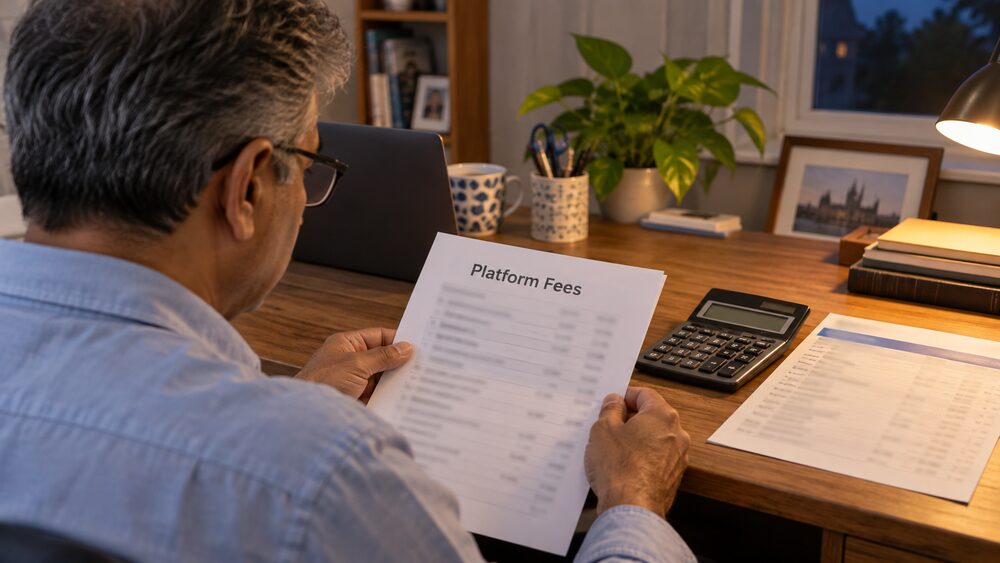
An investment platform fee is the charge you pay for the service that holds your investments, administers your account and lets you buy and sell. Platforms charge either a percentage annual fee or a fixed amount each year1. Typical percentage fees on funds run from about 0.25% to 0.45% of your holdings, often uncapped2, while flat fees can be as little as £4.99 a month at some providers3. On top of the platform fee you may pay dealing charges each time you trade, foreign exchange fees on overseas investments, and the funds' own ongoing charges.
The platform fee is only one layer of cost, and it is not always the biggest. A ready-made fund with a 0.45% ongoing charge held on a platform charging 0.25% gives a combined cost of 0.7% a year3. Because the platform fee is charged on the value of your pot, its weight grows with your money, which is why the choice between a percentage fee and a flat fee matters more as your investments grow.
What a platform fee pays for, and what it leaves out
The platform fee covers the running of your account: holding your investments, valuing them, producing statements and tax documents, and administering the account types you hold, such as a general investment account, a stocks and shares ISA or a SIPP. Most investment platforms do not charge extra for an ISA, although different platforms may have different funds and assets available7.
What the platform fee does not cover is the cost of the investments themselves. Funds levy their own charges, typically an initial fee of up to 5.5% on some funds and an ongoing charge of around 1%8, and these are deducted inside the fund rather than billed to you separately. The ongoing charges figure is the standard number to look at for a fund's own costs.
Dealing is usually charged separately too. You might be charged each time you buy and sell a share, investment trust or exchange-traded fund, while fees for buying and selling traditional funds are less common6. Investment trusts are treated by platforms in a similar way to shares, so you will likely pay one-off fees when you buy and sell them even if fund trading is free9. A few platforms do not offer investment trusts at all10. The separate guide to dealing charges covers these costs in detail.
Percentage or flat fee: how each one is charged
A percentage fee is worked out on the value of your holdings and taken as a slice of them each year. NatWest, for example, charges 0.15% on investments up to £1m, and a minimum platform fee of 0.05% on anything over £5m4. Hargreaves Lansdown states its platform fee is up to 0.35% per year8. Triodos charges 0.40% per annum on balances up to and including £250,000 in its Impact Investment Account or Stocks and Shares ISA, and 0.20% on balances above that11, a tiered structure where the rate falls as the pot grows.
A flat fee is a fixed amount regardless of how much you hold. Some providers charge a flat monthly or annual fee, for example £4.99 per month3. A third structure is a percentage fee with a cap: Moneyfarm charges 0.25% per annum on eligible assets in its portfolios, calculated and accrued daily and charged monthly in arrears12, while its Share Investing Stocks and Shares ISA carries a custody and platform services fee of 0.35%, capped at £45 per year12. A cap turns a percentage fee into something closer to a flat fee for larger pots.
Some platforms combine structures or charge different rates for different asset types. Freetrade describes typical platform fund fees on mutual funds of 0.25% to 0.45% on holdings, uncapped, while its charges on exchange-traded funds range from 0% to 0.45% of holdings and are capped2. The same platform can therefore be cheap for one kind of holding and expensive for another, which is why the asset mix of your portfolio matters when comparing platforms.
Flat fee or percentage: which costs less depends on the pot
The rule of thumb from independent guidance is that the cheaper structure depends on the size of your portfolio. Which? states that if you have a portfolio worth around £50,000 or less, a percentage-based charge will generally work out cheaper, while larger portfolios fare better with a flat fee1. The same guidance says fixed fees are usually better suited to investors with £50,000 or more, and that percentage fee structures best suit investors with £25,000 or less, though it is worth checking because some platforms cap their percentage fees6.
The reason is arithmetic. A flat fee of £4.99 a month is about £60 a year, which beats a 0.45% fee only while the pot is small; as the pot grows, the percentage fee grows with it while the flat fee stays put. A cap changes the picture again: Moneyfarm's 0.35% ISA fee capped at £45 a year12 means the charge stops rising once the pot passes the point where 0.35% exceeds £45.
Providers' own published terms show how the numbers work out in practice. Triodos Bank's Impact Investment Account and Stocks and Shares ISA charges an annual service charge of 0.40% on holdings up to and including £250,000, and 0.20% on any balance above that13. The charge is expressed as an annual percentage but calculated and paid quarterly, based on the average value of the holding across the previous quarter, so the effective cost falls as a pot grows beyond the £250,000 threshold.
Zero-fee and low-fee platforms
Some platforms advertise no platform fee or no transaction fees at all. Which? notes that some platforms do not charge transaction fees at all14, and Freetrade's own guidance shows ETF platform charges ranging from 0% to 0.45% of holdings, capped, with no charge on its own service for those holdings2.
A zero headline fee does not mean the service costs nothing to run. Platforms that charge no fee make their money in other ways, such as foreign exchange fees or keeping the interest paid on cash you hold with them, or by upgrading customers to paid products such as managed portfolios or premium tiers6. The guide to cash held on investment platforms explains how interest on uninvested cash is treated, and commission-free trading looks at what "free" dealing really costs.
The wider lesson is to compare total cost, not the headline. A platform with no platform fee but a 1.5% foreign exchange fee on overseas deals6 can cost more than one with a small percentage fee and cheaper dealing, if you buy international shares regularly. The guide to buying US and overseas shares covers where those charges arise.
Exit and transfer fees
You might be charged if you transfer investments from one platform to another. Many platforms have scrapped these fees, while others will offer to cover switching fees as an incentive to join them6. Where exit fees do exist on stocks and shares ISA transfers, they have been found ranging from £15 to £30 per holding, and most providers charge nothing5.
Because exit fees are charged per holding, the total cost of leaving rises with the number of different investments you own. A portfolio of 15 holdings at £30 each would cost £450 to move in full, against nothing at a provider that has scrapped the charge. This is one reason to check the exit terms before opening an account, not only when you want to leave.
Transfers between platforms can also have tax consequences if investments are sold rather than moved as they are. The narrow guide to whether you pay capital gains tax when selling investments to transfer them covers that question, and how investment platforms work explains the transfer process itself.
When fees are taken: monthly, quarterly or twice a year
Platforms differ in when they collect their fee, and the timetable affects how the charge appears on your account. Moneyfarm accrues its platform fee daily and charges it monthly in arrears12. Triodos expresses its Annual Service Charge as an annual percentage but calculates and pays it quarterly, based on the average value of your holding across the previous quarter11. Santander's Investment Hub calculates its platform service fee daily and charges it twice yearly, just after 1 May and 1 November each year13.
The frequency does not change the annual rate, but it does change how visible the cost is. A monthly charge of a few pounds is easy to track; a twice-yearly charge calculated daily can arrive as a larger single deduction, which matters if you need to budget for it or if the platform will sell investments to cover it.
Where the fee is charged on the average value across a period, as Triodos does11, a pot that fell during the quarter is charged on more than its final value, and one that rose is charged on less. This is a detail, but it explains why two people with the same year-end balance can pay slightly different amounts on the same headline rate.
When there is not enough cash to pay the fee
Platforms collect their fees from the money in your account, and if there is not enough cash they can sell investments to cover the charge. Triodos states that its Annual Service Charge is paid from money in the linked Cash Account, or by selling shares if there is not enough cash available, and that it will instruct the sale of shares in your investments to cover the whole amount, with no charge to pay the Annual Service Charge in that way11.
Some platforms offer an alternative. NatWest states you can pay its platform fee directly from your investment, or from your NatWest bank account4. Paying from a bank account avoids the sale of investments altogether, which matters for two reasons: it keeps your holdings intact, and it avoids a taxable disposal outside a shelter like an ISA.
If investments are sold, the proceeds of the sale are what covers the fee, so the number of units or shares you hold falls. Over years, repeated sales to cover fees can noticeably reduce a holding, which is one argument for keeping a cash balance in the account or paying by Direct Debit where the platform allows it.
Selling shares to pay fees can count for Capital Gains Tax
Where shares are held outside a stocks and shares ISA or Junior stocks and shares ISA, a sale to cover a platform fee is classified as a disposal for Capital Gains Tax purposes and may need to be declared to HMRC. Triodos states this expressly for its Annual Service Charge11. In general, you pay Capital Gains Tax if you made a profit on selling or disposing of certain assets, such as shares16.
Whether tax is actually due depends on the gain, your annual exempt amount and your other disposals in the tax year, not on the reason for the sale. A sale to pay a fee is treated like any other sale. The cost basis follows the normal rules: for shares acquired through employee share schemes, for example, the capital gains cost is what you pay for them together with any amount charged to Income Tax on exercise17, and for shares taken in a stock dividend instead of cash, the net amount already included in your Income Tax counts as an allowable cost18.
Inside a stocks and shares ISA, none of this arises, because ISA holdings are not subject to Capital Gains Tax on disposal. ISA account managers also have their own reporting duties to HMRC concerning listed securities19, separate from anything you declare. The guides to how investments are taxed and where to hold investments cover the shelters available.
Fee changes coming to some platforms
Platforms change their pricing, and several well-known brands have changes taking effect in December 2026. Halifax is moving its Ready-Made Investments account fee from a flat £3 monthly fee to a percentage-based fee, with terms and conditions and key features documents updating from 10 December 2026, and one-off payments into the service dropping from a £500 minimum to £1, with monthly payments starting from £2020. Lloyds is making the same move for its Ready-Made Investments, changing to a percentage-based fee of 0.3% a year charged monthly, capped at £25 a month and charged only on the first £100,000 of investments, with one-off payments starting from £1 and monthly payments from £2021.
A change from a flat fee to a percentage fee redistributes cost between customers: smaller pots pay less under a percentage, larger pots pay more, subject to the cap. Lloyds' cap of £25 a month means the charge stops rising once the charged balance reaches the point where 0.3% a year exceeds that amount21.
A separate change affects cash inside investment ISAs. From April 2027, any interest earned on cash in investment ISAs will incur a government charge, and the investment platform or the asset managers will remove that charge on your behalf22. This is deducted rather than billed, so it reduces what you receive rather than appearing as a separate fee.
On notice, the rules for payment services require that notice of proposed changes to framework contract terms be provided no later than two months before the date on which they take effect23. Platforms also publish their updated terms and key features documents when pricing changes, as Halifax and Lloyds are doing for December 202620.
Comparing the total cost of a platform
A fair comparison adds up every layer for your own circumstances, not just the headline platform fee. The components to check are:
- The platform fee itself: percentage, flat, tiered or capped, and on which assets4
- Dealing charges: per trade on shares, investment trusts and ETFs, with fund dealing often free6
- Foreign exchange fees: ranging from 0.45% to 1.5% on amounts up to £5,000 for international shares and funds6
- Exit fees: £15 to £30 per holding where charged, nothing at most providers5
- The funds' own charges: typically around 1% ongoing, plus initial fees of up to 5.5% on some funds8
- Advice, if you want it: one-off advice sessions on some platforms cost from around £500 to £1,00024
The size and shape of your pot drives which platform works out cheapest. Percentage fees on pension platforms typically range from around 0.3% to 0.8% depending on the provider and the size of the pension25, and some pension products carry low platform charges of 0.15%26. Do-it-for-me platforms, which choose and manage investments for you, tend to charge a little more than DIY platforms7, and exchange-traded funds generally have cheaper ongoing charges than funds, though they may incur extra trading fees from investment platforms7.
FCA rules also constrain how platforms take money from funds. A platform service provider may receive a share of a fund's annual management charge only if it passes that share on to the retail client in the form of additional units or cash, provided that cash does not offset or appear to offset any adviser charges or platform charges27. This is the rule that ended hidden fund rebates to platforms, so the platform fee you see is meant to be the platform fee you pay.
What protects you, and where to get help
Platform fees themselves are a commercial matter: no regulator caps them, and the protection comes from disclosure and competition rather than a limit. What the rules require is that charges are disclosed clearly before you invest, in documents such as the key features document and terms and conditions, and that changes to contract terms are notified in advance, with payment services required to give no less than two months' notice of proposed changes23.
If a platform gets a fee wrong, or takes a charge you were not told about, you can complain to the platform first and then to the Financial Ombudsman Service if you are not satisfied. The guide to what happens if an investment platform fails covers the FSCS protection that applies to investments held on a platform, which is separate from anything the fee structure tells you.
For free, impartial help with working out what a platform costs you, MoneyHelper, the government-backed money guidance service, is available at no cost, and the guide to how much a financial adviser costs explains when paid advice is worth considering, with one-off sessions on some platforms costing from around £500 to £1,00024. For the underlying investments, the guides to investment funds, investment trusts and ETFs explain what each type costs to hold and trade.
Sources27 cited
- Are fund charges eating into your returns? Which?, 2026
- Mutual funds explained Freetrade, 2026
- Understanding investment fees and costs Chip, 2026
- Investment fees NatWest, 2026
- Stocks and shares ISA transfers Which?, 2026
- How investment platforms work Which?, 2026
- Investment funds explained Which?, 2026
- Fund FAQs Hargreaves Lansdown, 2026
- Investment trusts explained Which?, 2025
- Ways to invest The Association of Investment Companies, 2026
- Impact investments Triodos Bank, 2026
- Consolidated Terms and Conditions, US shares Moneyfarm, 2025
- Fees, charges and key documents Santander, 2026
- How to tax-proof your investment portfolio Which?, 2024
- Managing your investments online Santander, 2026
- Tax when you come to the UK GOV.UK, 2026
- HS287 Capital Gains Tax and employee share schemes GOV.UK, 2026
- Capital Gains Tax: share reorganisation, takeover or merger GOV.UK, 2014
- Individual Savings Account Regulations 2015 legislation.gov.uk, 2015
- Ready-Made Investments price changes Halifax, 2026
- Ready-Made Investments price changes Lloyds Bank, 2026
- Why is the government going to tax your ISA? Which?, 2026
- Payment Services Regulations 2017, Part 6 legislation.gov.uk, 2017
- How much financial advice costs Which?, 2026
- Lost pensions: the tracing services that could help you find them Which?, 2026
- Watch out for high charges when accessing your pension Which?, 2024
- FCA Handbook COBS 6.15 Financial Conduct Authority, 2014




 MoneyHelperFree, impartial money and pensions guidance, set up by government
 FSCSProtects your money if a bank, insurer or investment firm fails
 FCA Warning ListCheck whether a firm is authorised before you deal with it
 Financial Ombudsman ServiceFree, independent help when a complaint about a firm is not put right
 Citizens AdviceFree advice on money, consumer and legal problems in England and Wales