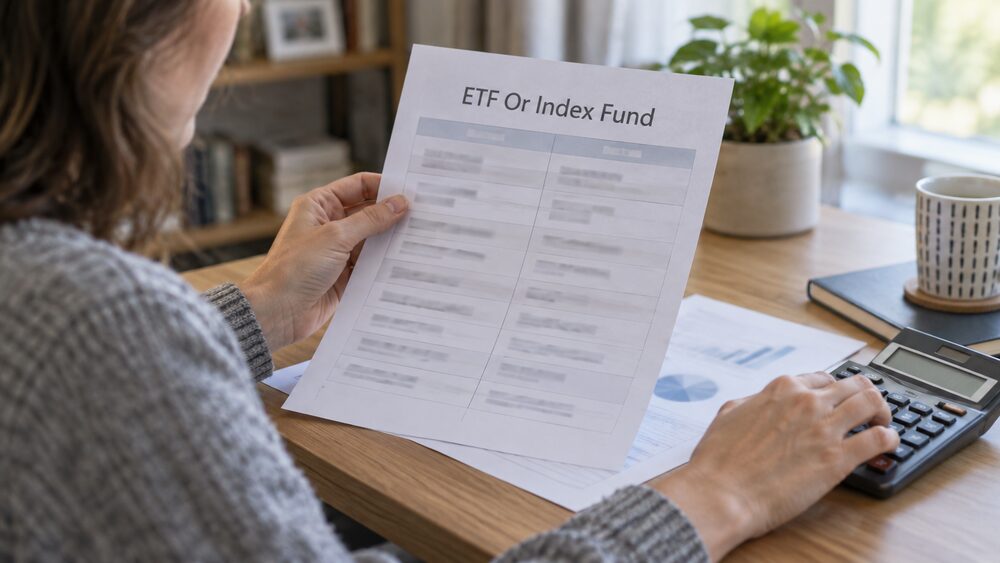
An exchange-traded fund and an index fund are both ways of tracking a market rather than paying someone to pick shares. The practical difference is how you buy and sell them. An ETF is listed on a stock exchange, so you can buy and sell it at any time the exchange is open, and its price moves through the day like a share1. A tracker fund built as a unit trust or OEIC is priced once a day, at its daily valuation point2.
That single difference drives most of the rest. Because ETFs trade on an exchange, you may pay a dealing charge each time you buy or sell, plus the gap between the buying and selling price. Because tracker funds are bought directly from the fund, you may avoid dealing charges but you cannot trade mid-afternoon.
On cost, ETFs generally tend to have cheaper ongoing charges, though they may incur extra trading fees from investment platforms1. Whether that works out cheaper for you depends on how often you trade and what your platform charges for each type of investment.
What each one actually is
A fund is a collection of lots of different people's money, managed by a professional fund manager who invests it across a range of assets, such as shares or property, depending on the fund's aims. Funds come in three main types: investment trusts, unit trusts and exchange-traded funds. An index fund is not a fourth type. It describes what the fund does, tracking an index rather than trying to beat it, and it can be built in any of those structures.
ETFs are the most popular type of exchange-traded product3. They are listed on the stock market but are open-ended, with authorised participants trading directly with the manager to create and redeem shares6. That mechanism is what keeps an ETF's market price close to the value of the assets it holds. Units are created by a group known as Authorised Participants, authorised by the ETF issuer3.
Most ETFs are passively managed, which means the manager only makes trades to ensure the fund matches the market it is tracking7. Passively tracking an index is less expensive than active fund management8. That is the core of the appeal: you are buying the market, not a manager's judgement.
Index ETFs and index mutual funds are extremely transparent compared with actively managed funds, because investors generally know what the holdings are and in what proportion, based on the target index8. Many ETFs go further and provide daily visibility as to what securities the fund holds, how it is performing and its Total Expense Ratio costs8.
Fees, charges and eligibility
Fund costs come in several parts: the ongoing charge figure, performance fees, trading fees and stamp duty reserve tax, exit fees and platform fees1. The ongoing charge figure is an annual percentage of your investments paid to the fund manager1. On some funds, providers levy an initial fee of up to 5.5% when you invest, plus an ongoing charge typically around 1%4. Those are the charges on the fund itself, before anything your platform adds.
ETFs sit differently. Their fees are deducted from the fund assets, which means ETF investors do not directly pay these fees to the fund manager9. Management fees vary: they can be as low as 0.03% for a passive ETF, or 0.63% for an actively managed one10. Platform fund fees range from 0% to 0.45% of holdings, capped, depending on the provider10. Some ETFs also carry an ongoing charge that varies depending on the fund you choose11.
The trading costs are where the two diverge most. With ETFs, there are brokerage commissions and bid-ask spreads on each direct purchase and sale8. ETFs have different buy and sell prices, known as the offer and bid respectively3. A tracker fund bought through a platform may carry no dealing charge, but you can only buy or sell it at its daily valuation point2.
| ETF | Tracker fund (unit trust or OEIC) | |
|---|---|---|
| Ongoing charges | Generally cheaper1 | Typically around 1% on some funds4 |
| Initial charge | Not typically levied on the fund | Up to 5.5% on some funds4 |
| Dealing cost | Brokerage commission and bid-ask spread on each trade8 | Platform dealing charge may not apply2 |
| Stamp duty | Exempt5 | Depends on the underlying holdings |
| Pricing | Through the day, at market prices8 | Once a day, at the valuation point2 |
Eligibility is broad. Exchange-traded funds can be held in a stocks and shares ISA5. Most UK ETFs can be bought and held within a provider's ISA, Lifetime ISA, fund and share account or self-invested personal pension3. On some platforms there is no minimum order size for ETFs, shares, investment trusts and bonds, and you just need enough to buy one share in that investment12. Funds generally allow smaller regular amounts: you can invest small amounts starting from around £50 a month, and investment trusts can be bought from as little as £50 a month13.
Before investing, read the Key Investor Information Document or Product Summary to understand the charges you will pay14. That document is where the ongoing charge figure for a specific fund is set out.
Opening an account or switching
Most people reach both ETFs and tracker funds through an investment platform. Platforms offer investment funds, shares, investment trusts, exchange-traded funds, bonds and other investments, though some only offer investment funds2. That distinction matters: if your platform only offers funds, you cannot buy an ETF there at all.
You might be charged each time you buy and sell a share, investment trust or exchange-traded fund, while fees for buying and selling traditional funds are less common2. So the platform you choose shapes which of the two is cheaper for you, before any fund charge is considered.
If you already hold investments elsewhere, transfers are possible but not instant. One provider gives a guide of 6 to 8 weeks for transferring funds out17. The process usually involves the receiving platform asking for the transfer, and your existing holdings either moving across or being sold and the cash reinvested.
There is a separate set of rules for money held in court funds on behalf of a child. When the child turns 18, the investments can be sold and the proceeds paid into a bank account, transferred into their name, or part sold and part transferred, and the choice is made on the form18. That is a narrow case, but it is one of the few situations where an index tracker holding is dealt with by an official process rather than a platform instruction.
Service and complaints
Complaints about investments and pensions are handled by the Financial Ombudsman Service. In the three months to December 2025, it recorded 24 new complaints about exchange-traded funds19. That is a small number against the size of the market, and it sits inside a much larger flow of complaints about the sector as a whole.
The most complained-about issue in investments and pensions in 2021/22 was administration or customer service, with 6,340 new complaints20. In 2020/21 the ombudsman saw 50% more complaints about pension and investment providers' administration or customer service, and 20,854 new complaints in the sector overall21. Those figures are about service rather than investment performance, which is where most friction actually arises.
Where a complaint is about advice rather than administration, the ombudsman looks at what a comparable alternative would have produced. In one case about a personal pension plan, it told the business to compare the actual return the consumer had achieved with a benchmark return comprised of lower risk investments22. In a case about pension transfer advice, it found that none of the guaranteed annuity rates on the original policies were competitive with the wider annuity market at the time of the advice, and that the consumer would have preferred to transfer out for better returns23.
If you are unhappy with a platform or fund provider, complain to the firm first. If it does not resolve the issue, the ombudsman can look at it. Complaints about the Pension Protection Fund or the Financial Assistance Scheme follow different rules about what can be investigated and decided24.
Protection for your money
The investments themselves are held as fund assets, separate from the firm's own money. That is the first layer of protection, and it applies whether you hold an ETF or a tracker fund.
Cash is different. Money sitting uninvested on a platform is not the same as money invested in a fund, and the protection that applies to it depends on how the firm holds it. E-money firms, for example, must ring-fence customer funds with an authorised credit institution, invest them in low-risk liquid assets held with an authorised custodian, or ensure funds are covered by an insurance policy or comparable guarantee25. Even then, FSCS protection does not apply to e-money balances, and customers are told their money is safeguarded rather than covered25.
For investments, the value can go up as well as down and you may get back less than you invest8. That is a market risk, not a failure risk, and no compensation scheme covers poor performance. What the schemes cover is the failure of a firm, and the rules differ between the investments themselves and any cash held alongside them.
Fixed or tracker: how each one behaves
The choice between an ETF and a tracker fund is not a choice between active and passive. Both are usually passive. It is a choice about dealing.
An ETF gives you intraday pricing and the ability to trade whenever the exchange it is listed on is open8. That suits someone who wants to place an order at a moment of their choosing, or who wants to hold the same investment across several accounts. It also means you see a bid-ask spread on every trade, and you may pay commission each time8.
A tracker fund gives you a single daily price and no intraday dealing. There is no minimum period for holding a tracker fund, but you can only buy or sell it at its daily valuation point2. That suits someone investing a regular monthly amount, where the timing of the deal within the day makes little difference.
On dividends, both come in two forms. ETFs are normally set up as either income, also known as distributing, or accumulation3. Income ETFs pay dividends out to investors, while accumulation ETFs reinvest the dividends7. Distributing ETFs pay dividends out as cash, and accumulating ETFs automatically reinvest them back into the fund11. Tracker funds work the same way, so the choice is about whether you want the income paid out or rolled up.
On transparency, ETFs have an edge in the detail available. Many provide daily visibility of holdings, performance and costs8. Index funds more broadly are also extremely transparent compared with actively managed funds, because the holdings follow the target index8.
Where the two overlap, and where they do not
Both are funds, both pool money with other investors, and both can be held in the same accounts. A fund pools your money with other people's money to buy a range of assets27. The benefits are the same for either structure: access to a wider range of investments than you could buy yourself, management by a professional fund manager, diversification across a number of holdings, economies of scale as costs are spread across investors, and the ability to invest in specific markets or in line with your values13.
The differences are practical. ETFs trade like ordinary shares, so the price changes throughout the day as they are bought and sold28. They are exempt from stamp duty5 and can be used in an ISA29. Tracker funds are usually structured as unit trusts or open-ended investment companies30, and a single fund typically holds 40 to 60 underlying assets30.
One thing to watch is that an ETF is not the only exchange-traded product. An exchange-traded note works differently: a physical ETF actually owns the underlying securities of the index, while an ETN works like a bond issued by a financial organisation that pays out the return of the index over a period of time31. If you are comparing products, check which one you are looking at.
Most ETFs will not follow an index perfectly, and the gap between performance and the returns from an index is called tracking difference8. That gap is where charges and practical tracking costs show up, and it is the number to compare between two funds tracking the same market.
Sources31 cited
- Investment funds explained Which?, 2026-07-23
- How investment platforms work Which?, 2026-03-16
- What are exchange-traded products Hargreaves Lansdown, 2026-09-26
- Fund FAQs Hargreaves Lansdown, 2026-09-26
- Your investment options Halifax, 2026-09-27
- Why investment trusts are a solid basis for building wealth MoneyWeek, 2026-09-25
- ETF ISA investing Interactive Investor, 2026-09-26
- About ETFs Fidelity, 2026-09-26
- What is a mutual fund HSBC, 2026
- Mutual funds explained Freetrade, 2026
- ETFs Aviva, 2026-09-26
- ETFs AJ Bell, 2026
- Risk vs rewards The Association of Investment Companies, 2026
- Investment risks AJ Bell, 2026
- About funds Fidelity, 2026-09-26
- Aegon customer support Aegon, 2026
- Transfer from another provider AJ Bell, 2026
- Get court funds money when you turn 18 GOV.UK, 2026-09-27
- Quarterly complaints data Q3 2025/26 Financial Ombudsman Service, 2025
- Annual complaints data insight 2021/22 Financial Ombudsman Service, 2021-04-01
- Annual complaints data insight 2020/21 Financial Ombudsman Service, 2020
- Consumer complains investment funds within personal pension plan represented high risk Financial Ombudsman Service, 2026-09-26
- Unhappy consumer because of advice to change pension type Financial Ombudsman Service, 2026-09-27
- What we can and cannot do The Pensions Ombudsman, 2026
- Is your money safe with Revolut Which?, 2024-06-13
- Investment types Bestinvest, 2026
- Types of investment Standard Life, 2026
- Your investment options Scottish Widows, 2026-09-26
- Exchange-traded funds Lloyds Bank, 2026-09-27
- Funds Interactive Investor, 2026-09-26
- What is an ETN Hargreaves Lansdown, 2026-09-26




 MoneyHelperFree, impartial money and pensions guidance, set up by government
 FSCSProtects your money if a bank, insurer or investment firm fails
 FCA Warning ListCheck whether a firm is authorised before you deal with it
 Financial Ombudsman ServiceFree, independent help when a complaint about a firm is not put right
 Citizens AdviceFree advice on money, consumer and legal problems in England and Wales