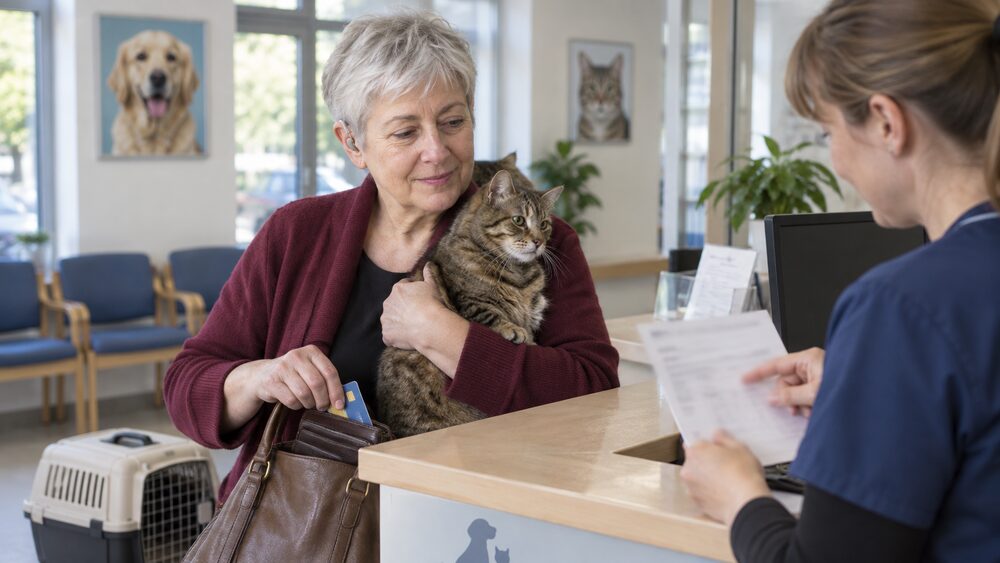
Pet insurance does not pay every vet bill in full. Every policy has an excess, which Tesco Pet Insurance's policy document defines as "the amount you pay towards each vet fees claim", and that amount may be a fixed sum, a percentage of the bill, or both1. Many policies carry an excess of around £120, according to Which? reporting from August 2025, so on a typical claim the owner pays the first part and the insurer pays the rest2.
The percentage part is where pet insurance differs from most other covers you will have bought. Post Office guidance explains that excess for pet insurance "can work in two ways: a fixed amount per claim or a percentage of the vet bill", and that the percentage version, known as a co-payment, usually applies to older pets3. A co-payment is charged on top of the fixed excess, not instead of it, and it can turn a bill you expected the insurer to pay into one you share in substantially.
This page explains what the excess is, how the two parts work together, when and to whom you pay it, how it changes as your pet ages, and what it means for the cost of a claim. The general principles of excesses across all insurance are covered in the guide to insurance excess, and the wider workings of pet cover in how pet insurance works.
What pet insurance excess is
The excess is your share of a claim. Tesco Pet Insurance's terms define it as "the amount you pay towards each vet fees claim", and state that it "may be a fixed amount (for example £100) and/or a percentage contribution (for example 20%)"1. The exact excess that applies to you is set out in your certificate of insurance, which is the document you receive when the policy starts or renews.
The purpose is the same as in any insurance: the insurer pays claims above a threshold, and you pay the first part. Which? reporting on puppy and kitten cover puts it plainly: "expect to pay an excess when you make a claim"7. The size of the excess is one of the things that shapes the premium, alongside the pet's age, breed and the level of vet fee cover chosen, and the two move in opposite directions, which the section on choosing an excess level below covers.
In practice the excess is the number to check before you assume a bill is covered. Vet fee cover itself can range from £1,000 to as much as £25,000 depending on the policy5, but whatever the limit, the excess comes off the claim first. On a small bill the excess can take a large share of the cost; on a large one it matters much less. Which? reported in August 2025 that with many policies carrying an excess of around £120, most owners still received more than £250 back after the excess was deducted from the average claim2.
Fixed excess or co-payment: the two ways you share the cost
Pet insurance splits your share of a claim in two ways, and a single policy can use both. Post Office guidance sets out the structure: "Excess for pet insurance can work in two ways: a fixed amount per claim or a percentage of the vet bill. This is known as a co-payment", and notes that the percentage version usually applies to older pets3.
A fixed excess is a set pound amount, deducted from each eligible claim. Tesco's terms give £100 as an example of a fixed excess1. Some insurers offer a choice of fixed excess when you set up the policy: Lloyds Bank pet insurance offers dog insurance customers a choice of a £175 or a £125 fixed excess, and cat insurance customers the same £175 or £125 choice8.
A co-payment, or percentage excess, is a share of the bill rather than a set amount. Tesco's terms give 20% as an example1. Because it is a percentage, it grows with the size of the claim: 20% of a £500 bill is £100, but 20% of a £4,000 bill is £800. Agria's cat policies state that "in addition to a fixed excess a percentage excess may also apply"10, which is the arrangement most older-pet policies use.
Which type you face matters most on large claims. A fixed excess is predictable: you know the most you will pay towards any one claim before the insurer contributes. A co-payment is open-ended in cash terms, because it scales with the bill. Which? notes that if you have a co-payment policy, "you'll have to pay this along with the excess"7, so the two are additive rather than alternatives.
Co-payment is paid on top of the fixed excess
The point that catches most people out is that a co-payment does not replace the fixed excess. Both apply, and the order in which they are taken affects what you end up paying. Which? states it directly: "If you have a co-payment policy, where you pay a percentage of each claim, you'll have to pay this along with the excess"7.
Agria's worked example shows the mechanics. Based on a fixed excess of £170 and a percentage excess of 10%, if you submitted a claim for £1,000, you would pay the first £170, which would leave £830. You would then pay 10% of the remaining bill, which is £83, and Agria would pay the £747 that is left11. The percentage is applied to what remains after the fixed excess, not to the whole bill.
Waggel's co-payment guidance gives a second example, on a policy with a £2,000 annual limit, a £250 excess and a 20% co-payment. On a £1,000 vet bill, the owner pays a £150 excess and £600 in co-payment, leaving the insurer to pay the remainder within the annual limit12. On that policy the co-payment is the larger of the two deductions by some distance, which is typical wherever the percentage is 20% and the bill is more than a few hundred pounds.
The percentages themselves are set by each insurer and shown in your documents. Animal Friends applies a co-payment of 20% of any vet fee claim, in addition to the excess, if your cat reaches the age of 104. Its dog policies apply 20% of each vet fee claim once your dog reaches the age of 813. Which? found a 20% co-payment on the cheapest lifetime policy it examined when weighing up self-insurance14, and notes that for older animals co-payments "can be as much as 25%"5.
How the excess is paid when you claim
There are two ways the excess leaves your pocket, and your insurer's claims process determines which. The more common is that you pay the vet directly. NFU Mutual's pet and equine claims guide states: "The excess on your policy is the amount you pay per claim and needs to be paid to your vet", and adds that if the insurer is paying the vet directly, the excess is taken off the first payment made to you for that claim15. Animal Friends says the same for all its policies: "You'll need to pay that excess amount directly to your vet"16.
The other route is deduction from the payout. Lloyds Bank pet insurance tells customers: "To keep things simple, we'll deduct the excess from any amounts we pay you"17. Either way the amount is the same; only the mechanics differ. If your insurer pays your vet directly, Lloyds notes that claims "can be paid directly to your vet, if they agree"9, and in that arrangement the vet will normally ask you for the excess at the time of treatment or settlement.
Knowing which applies to you matters for cash flow. If the insurer deducts the excess, the money arriving in your account is already net, and you still owe the vet the balance of the bill. If you pay the vet the excess yourself, the insurer's payment should cover the rest. Tesco Pet Insurance tells customers that the excesses they pay can be found in the Tesco Pet Portal and on their Certificate of Insurance, for policies renewed after 1 January 2025 or taken out on or after 21 January 20256. Checking the excess before you authorise treatment avoids a surprise when the settlement arrives.
Per claim, per condition or per year
The second question after "how much" is "how often". The answer depends on the type of policy, and the differences are material for a pet with a long-running illness.
| Policy type | How the excess is charged | Source |
|---|---|---|
| Time limited | Per condition | Post Office18 |
| Max benefit | Per condition | Post Office18 |
| Lifetime | Per condition, per year | Post Office19 |
| Maximum benefit and time limited (Sainsbury's) | Per condition | Sainsbury's Bank20 |
| Lifetime (Sainsbury's) | Per condition, per year | Sainsbury's Bank20 |
Post Office Pet Insurance states plainly: "Yes, an excess is payable per condition. It'll be payable per condition, per year, for Lifetime Pet Insurance"19. Its support pages break this down by product: the Max Benefit excess and the Time Limited excess are each payable per condition, while the Lifetime excess is payable per condition, per year18. Sainsbury's Bank charges the same way: per condition for maximum benefit and time limited policies, and per condition, per year for lifetime policies20.
The per-condition rule means two unrelated illnesses in one year mean two excesses. Lloyds Bank pet insurance explains its fixed excess as "the amount you pay towards each condition each policy year", paid only for the first claim on the same condition in a year, and payable again for each year if treatment lasts more than a year17. Pet Protect's terms state that an excess is payable "for each unrelated condition treated during each period of insurance", and again for each period of insurance if treatment dates span more than one period21.
That last point matters for long treatments. Agria states that "when your pet's treatment falls into two or more periods of insurance, you must pay the fixed excess for each period of insurance and also for each separate illness or injury"22, and its cat policies carry the same rule10. So a condition treated across a renewal date can trigger the excess twice even though it is one illness. Which?'s review of lifetime cover explains the underlying structure: per condition per year cover "has a maximum limit for each condition you'd need to claim for, which resets each year"23, and the excess resets with it.
Why excess and co-payment rise as your pet gets older
Age is the biggest single driver of what you pay towards claims. Which? explains that "insurance companies typically treat cats and dogs over the age of eight as 'older pets'"5, and that for older animals co-payments "can be as much as 25%"5. The trigger ages vary by insurer and species: Animal Friends applies its 20% co-payment to cats from age 104 and to dogs from age 813.
Several insurers state the escalation openly. Pet Protect's lifetime cover states that "the amount you will have to pay towards each claim (the Policy Excess) and the percentage of vet bills that you will have to pay towards each claim (the Vet Fee Contribution) will increase as your pet gets older"24. Its rabbit insurance pages describe the same premium factors: "your pet's age, breed & gender and the increasing costs of veterinary treatment"25.
Post Office Pet Insurance sets out what happens at renewal: "When your pet reaches the upper ages of their policy, their excess will change to a percentage of the claim or the set excess, whichever is more"18. It lists the change points as the 8th birthday for most dog breeds and the 10th birthday for cats18. So the answer for most owners is yes: the excess changes as the pet ages, and it changes in the direction that costs you more.
Premiums move the same way. Which? notes that "as pets age, insurance premiums typically rise"7, and Lloyds Bank tells customers: "Your price won't go up if you make a claim. It might go up for other reasons, like your pet's age"27. The combined effect is that an older pet costs more to insure twice over: a higher premium each month and a bigger share of each claim. The guide to insuring older pets covers the options that remain at that point, and how insurance premiums are worked out explains the pricing behind it.
What a claim costs you: worked examples from insurers
The clearest way to see what an excess structure means is to run a real claim through it. Lloyds Bank pet insurance gives an example based on a claim cost of £3,000: the customer pays a £125 fixed excess, chosen when setting up the policy, and also pays £287.50, a 10% variable excess, also chosen at set-up17. On that policy the two deductions together come to £412.50 out of a £3,000 bill, with the insurer paying the balance.
Agria's example, shown in the diagram above, works the same way on a smaller bill: a £1,000 claim with a £170 fixed excess and a 10% percentage excess leaves the owner paying £170 plus £83, and Agria paying £74711.
Waggel gives a simpler example for a policy with only a fixed excess. For a first vet bill of £1,000 for a new condition, "Mrs. Smith will pay her Excess of £100 and we will pay the remaining £900"28. That is the shape of a claim where no co-payment applies: one deduction, known in advance.
Which?'s analysis of self-insurance shows what the deductions look like on a serious claim. In one scenario it modelled, a dog owner's cover "would only have contributed £3,920 towards this claim after caps, excesses and co-payments are accounted for", with the owner also paying "an extra £300 they'd have paid in excesses"29. The lesson is that the excess is not the only deduction: the cover limit and any co-payment reduce the payout too, and the three compound on large claims.
Choosing an excess level for your policy
Where an insurer offers a choice, the trade-off is between the monthly premium and your share of each claim. The principle is the same across insurance: as the British Insurance Brokers' Association puts it, "if you agree to pay a higher excess in the event of a claim your premium will be lower"30. Which? makes the same point about voluntary excess generally: "the higher this is, the lower your premium will be", while cautioning that policies almost always have compulsory excesses beneath the voluntary one31.
In pet insurance the choice usually appears at the quote stage. Tesco Pet Insurance tells customers: "When you get a quote, you can choose to increase the excess, which will help reduce your monthly payments"6. Lloyds Bank pet insurance offers dog insurance customers a choice of a £175 or £125 fixed excess8, and a variable excess choice of 0%, 10% or 20%8. Cat customers choose between the £175 and £125 fixed excesses9.
How to weigh the choice depends on the bills you can absorb. A higher fixed excess or a higher percentage saves on the premium every month but costs more on every claim, and a percentage co-payment scales with the bill in a way a fixed excess does not. A 20% co-payment on a £4,000 claim is £800 before the fixed excess is counted. Against that, a lower premium over years with no claims can outweigh the extra cost of one claim. The decision is personal: it turns on what savings you hold and how you would manage a large vet bill, not on any universal answer.
Where the excess is not the only thing you pay
The excess is the most visible deduction, but three other things reduce what a claim pays out. The first is the cover limit. Vet fee cover ranges from £1,000 to as much as £25,000 depending on the policy5, and on max benefit policies the insurer "stops covering" a condition once its limit is reached5. Which?'s self-insurance scenario, where cover contributed £3,920 to a claim after "caps, excesses and co-payments", shows all three deductions working together29.
The second is exclusions. Which? reported in January 2024 that only a small proportion of policies potentially cover pre-existing conditions: 29% for dogs and 21% for cats33. A condition excluded from the policy is not helped by any excess arrangement, because nothing is paid at all. What counts as excluded, and what must be declared, is covered in the guide to pet cover exclusions.
The third is the co-payment itself, which is a deduction from the claim rather than a fee on top of it. Animal Friends' dog policies state a co-payment of "20% of each vet fee claim if a co-payment applies to your policy or once your dog reaches the age of 8"13, and its cat policies apply the same 20% from age 1034. On a large bill that is a substantial sum, and it is charged after the fixed excess has already been taken.
If a claim is disputed or the deduction does not match your documents, you can complain to the insurer and then to the Financial Ombudsman Service, which the guide to complaining about an insurer sets out step by step, and the page on rejected claims covers the common reasons and remedies.
Sources34 cited
- Tesco Pet Insurance Pinnacle policy document Tesco Pet Insurance, 2024
- How to avoid the summer hazard behind costly dog insurance claims Which?, 2025-08-05
- What is excess Post Office, 2025-05-14
- Animal Friends cat insurance Animal Friends, 2026-09-26
- Pet insurance explained Which?, 2025-12-04
- Making a claim, Tesco Pet Insurance Tesco Pet Insurance, 2026-09-26
- Do you need pet insurance for puppies and kittens? Which?, 2024-05-19
- Lloyds Bank dog insurance Lloyds Bank, 2026-09-27
- Lloyds Bank cat insurance Lloyds Bank, 2026-09-27
- Agria cat insurance Agria Pet Insurance, 2026-09-26
- How to claim, Agria Pet Insurance Agria Pet Insurance, 2026-09-26
- Waggel co-payment Waggel, 2026-09-26
- Animal Friends Max Benefit dog insurance Animal Friends, 2026-09-26
- Is self-insurance ever a good idea? Which?, 2026-02-25
- NFU Mutual pet and equine claims guide NFU Mutual, 2026-09-26
- Animal Friends claims FAQ Animal Friends, 2026-09-26
- Lloyds Bank pet insurance support Lloyds Bank, 2026-09-27
- Post Office Pet Insurance help and support Post Office, 2026
- Post Office Pet Insurance Post Office, 2026
- Sainsbury's Bank pet insurance Sainsbury's Bank, 2026-09-25
- Pet Protect, make a claim Pet Protect, 2025-06-30
- Agria dog insurance Agria Pet Insurance, 2026-09-26
- Petplan pet insurance review Which?, 2025-12-04
- Pet Protect lifetime pet insurance Pet Protect, 2026-04-16
- Pet Protect rabbit insurance Pet Protect, 2025-12-03
- Post Office Lifetime Pet Insurance Post Office, 2026
- Lloyds Bank pet insurance Lloyds Bank, 2026-09-27
- Waggel claim contribution Waggel, 2026-09-26
- Is cutting insurance to save money ever a good idea? Which?, 2022-11-02
- Cost of home insurance, BIBA British Insurance Brokers' Association, 2022-11-18
- How black box car insurance works Which?, 2026-01-22
- Lloyds Bank pet insurance claims support Lloyds Bank, 2026-09-27
- Six traps to avoid when taking out pet insurance Which?, 2024-01-31
- Animal Friends time limited cat insurance Animal Friends, 2026-09-26



 MoneyHelperFree, impartial money and pensions guidance, set up by government
 Financial Ombudsman ServiceFree, independent help when a complaint about a firm is not put right
 FSCSProtects your money if a bank, insurer or investment firm fails
 Citizens AdviceFree advice on money, consumer and legal problems in England and Wales
 GOV.UKOfficial information on tax, benefits and government services