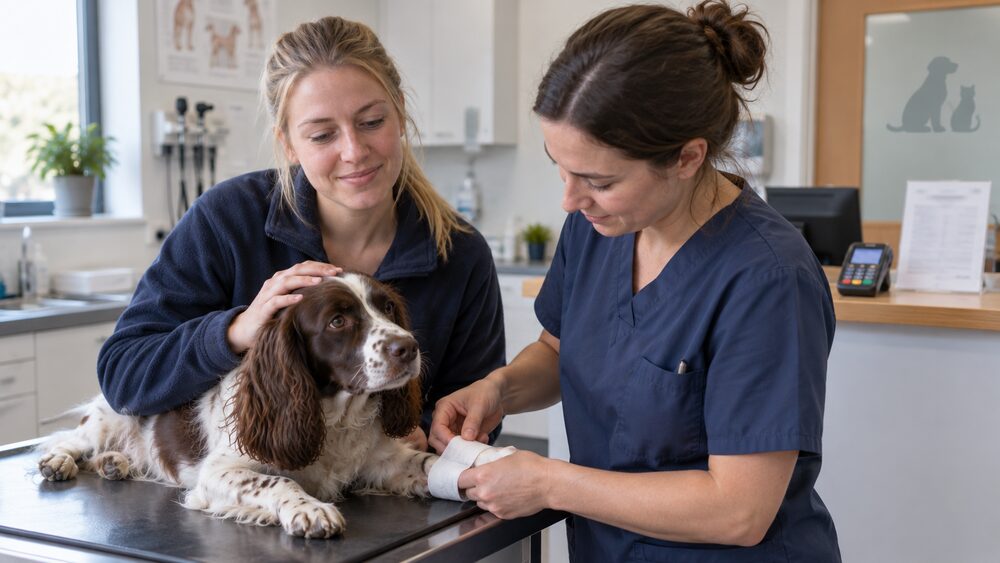
Pet insurance pays towards vet bills if your cat, dog or other pet is injured or becomes ill. Policies vary widely in what they pay and for how long, and the differences between them are mostly about two things: how much vet fee cover you get, and what happens to that cover after a claim. Vet fee cover across the market ranges from £1,000 to as much as £25,0001.
The other thing that shapes every claim is the excess: the part of the bill you pay yourself before the insurer contributes. Waggel's example policies show how this works: a £100 claim contribution is selected, and it is paid for each new condition claimed for during the policy period, but not again for repeat visits to the vet for the same condition in that period2. On top of a fixed excess like this, some policies, particularly for older pets, add a percentage co-payment, so you pay a slice of the remaining bill as well.
This page explains how the pieces fit together: the main types of policy, how the excess works claim by claim, how the cover limit is used up or reinstated, and what happens when a pet has more than one condition or reaches the ages at which insurers change the terms.
The main types of pet insurance
Pet insurance comes in four broad shapes, and the shape determines both the price and what happens when your pet needs treatment that drags on.
Accident only is the cheapest and most basic type: it pays out a fixed amount for each accidental injury and does not cover illnesses at all1. Time-limited cover pays for the treatment of a condition for up to 12 months, after which the insurer stops paying for that condition regardless of whether it has cleared up7. Max benefit, or per-condition, cover pays a limited amount for each condition, and once that limit has been reached the insurer stops covering it1. Lifetime cover is the most comprehensive form: it offers vet fees cover up to a maximum amount, which is reinstated each year, so ongoing conditions keep being funded as long as you keep renewing4.
Within lifetime cover there are two variants. Annual cover has a maximum overall limit that includes all conditions your pet may experience, which resets each year. Per-condition-per-year cover has a maximum limit for each condition you claim for, which also resets each year7.
| Type | What it pays | What happens over time |
|---|---|---|
| Accident only | A fixed amount per accidental injury | Illnesses are excluded entirely1 |
| Time limited | Treatment for a condition for up to 12 months | Cover for that condition then stops7 |
| Max benefit (per condition) | A limited amount for each condition | Insurer stops covering it once the limit is reached1 |
| Lifetime | Vet fees up to a maximum, reinstated each year | Ongoing conditions covered year after year if you renew4 |
The choice matters most for pets that develop lasting conditions such as arthritis or diabetes, where a time-limited policy runs out after 12 months but a lifetime policy keeps paying. The trade-off is price: lifetime cover costs more because the insurer takes on more risk. The dedicated comparison of lifetime or time-limited pet insurance works through this in detail.
What the excess is and how it works in pet insurance
The excess is the first slice of a claim that you pay yourself. In pet insurance it can work in two ways: a fixed amount per claim, or a percentage of the vet bill, known as a co-payment, which usually applies to older pets8. Some insurers combine the two, so a fixed excess applies first and then a percentage of what remains2.
The size of the fixed excess is often your choice at the outset. Tesco Pet Insurance, for example, lets customers increase the excess when quoting in order to reduce monthly payments9. Lloyds Bank pet insurance offers a variable excess of 0%, 10% or 20% chosen when the policy is set up10. A higher excess means a cheaper premium but a bigger share of each bill falling on you.
The size of the excess matters when judging value, and it is not always a fixed amount. Pet insurance excesses can work in two ways: a fixed amount per claim, or a percentage of the vet bill, known as a co-payment, which usually applies to older pets4. Where it is a fixed amount, it varies by policy: Waggel's example policy shows a £100 claim contribution per condition2. Because the excess is deducted from every eligible claim, a small vet bill can leave relatively little to claim back, which is worth weighing against any saving on the premium. The general rules on how excesses work, including the difference between compulsory and voluntary excess, are explained in the guide to insurance excess.
Claims below the excess are not paid
If a vet bill is smaller than the excess, the insurer pays nothing. Waggel's policy wording is typical of how this works: any claim made under £100 will not be paid, and the owner pays for any vet fees below that level11. The same principle applies to every policy, whatever the excess level.
This has a practical consequence for everyday vet costs. Vaccinations, small infections, minor cuts and routine appointments often come in below the excess, so they are always the owner's responsibility. Pet insurance is designed for the bills that would otherwise be hard or impossible to absorb, not for the small ones.
It also means a policy with a very high excess can be close to useless for moderate claims. Which? found the cheapest lifetime policy in one analysis carried an excess of £249 per condition per year, plus a 20% co-payment12. On a £300 bill, that policy would pay nothing at all. When comparing policies, the excess is as important a number as the cover limit.
A worked example: £1,000 vet bill, £100 excess, £900 paid
The clearest way to see how an excess works is a worked example. Waggel gives one: if a pet's first vet bill for a new condition is £1,000, the owner pays the excess of £100 and the insurer pays the remaining £90011.
Where a percentage excess also applies, the owner's share is larger. Agria gives this example, based on a fixed excess of £170 and a percentage excess of 10%: on a £1,000 claim, you pay the first £170, leaving £830. You then pay 10% of the remaining bill, which is £83, and Agria pays the £747 that is left13.
Lloyds Bank gives a similar illustration on a larger claim. On a claim cost of £3,000, a customer with a £125 fixed excess and a 10% variable excess pays the £125 plus £287.50, the 10% variable share14. The fixed excess is chosen by the customer when the policy is set up, and so is the percentage.
The pattern to notice is that the percentage share is usually worked out after the fixed excess has been deducted, so the two do not simply add up. A 10% co-payment on a £1,000 bill is not £100 on top of the fixed excess; it is 10% of whatever remains once the fixed amount has come off.
Vet fee cover limit: how each claim reduces it
Every policy has a vet fee limit, and every claim eats into it. What happens next depends on the type of policy.
On Waggel's example policy, the owner selected £4,000 of medical coverage. After the £1,000 claim, the remaining coverage for vet fees is £3,000 for the rest of the policy period15. That is how a fixed-period policy behaves: the pot shrinks and does not refill until renewal, if it refills at all.
On lifetime policies, the limit reinstates. Agria's terms state that vet fees cover is reinstated each year, provided the policy is renewed each year without a break in cover16. Post Office lifetime policies work the same way, offering vet fees cover up to a maximum amount which is reinstated each year4. NFU Mutual's permanent health cover for dogs and cats resets the vet's fees cover limit for a particular illness, injury or condition once the first claim has reached 52 weeks17.
The reinstatement is the single biggest reason lifetime policies cost more, and the single biggest reason they matter for pets with ongoing conditions. A break in cover can undo it: if a policy lapses and is restarted, conditions treated under the old policy can count as pre-existing under the new one. The rules on pet cover exclusions and mid-term changes cover this risk.
One excess per condition in each policy period
The excess is not charged per visit. It is charged per condition, and the timing rules follow the type of policy.
Post Office states it plainly: an excess is payable per condition, and per condition, per year, for lifetime pet insurance3. Its help pages give the same breakdown by product: the excess on Max Benefit cover is payable per condition, the excess on time-limited cover is payable per condition, and the excess on Lifetime cover is payable per condition, per year4. Sainsbury's Bank applies the same structure, with the excess payable per condition on maximum benefit and time-limited policies and per condition, per year on lifetime policies18.
Lloyds Bank explains what this means for a long-running condition: the fixed excess of £125 is the amount you pay towards each condition per policy year, paid only for the first claim on the same condition in a year, and payable again for each year if treatment lasts more than a year19.
Some insurers add a further rule when treatment spans a renewal. Agria's lifetime cat policies require the fixed excess to be paid for each period of insurance and also for each separate illness or injury when treatment falls into two or more periods of insurance20. So a condition diagnosed in one policy year and still being treated in the next attracts the excess again, even though it is the same condition.
New, unrelated conditions: a fresh excess each time
While the same condition does not trigger a repeat excess within a policy period, a different condition does. Waggel's example continues: if the owner has to take the pet back to the vet for the same condition, the excess is not payable again during the current policy period, but a £100 excess is payable for any new, unrelated condition15.
This is the mirror image of the per-condition rule. The insurer treats each illness or injury as a separate event, with its own excess and, on per-condition policies, its own share of the cover limit. Two unrelated illnesses in the same year means two excesses, and on a max benefit policy it also means two separate limits being drawn down.
The practical point is to expect the excess on each genuinely new problem, and to keep records of what each vet visit was for. Where two conditions could be related, for example two separate skin infections, the insurer's view of whether they are one condition or two determines whether one excess is due or two, and that judgement can be worth querying if it goes against you.
Older pets: rising excess and co-payments
Pet insurance is priced for the pet's age, and the terms change as the pet gets older. Which? notes that as pets age, insurance premiums typically rise22.
The excess can change too. Post Office states that when a pet reaches the upper ages of its policy, the excess changes to a percentage of the claim or the set excess, whichever is more. For cats, that age threshold is 10 years3. Other insurers apply similar rules at their own age thresholds, so the small print at renewal matters more, not less, as a pet gets older.
The percentage element is the co-payment. On a co-payment policy, you pay a percentage of each claim along with the excess22. Which? found a lifetime policy with a 20% co-payment alongside its £249 excess12. On a £2,000 claim, that combination would leave the owner paying a substantial share before the insurer's contribution begins.
For pets already past the age thresholds, cover options narrow. The page on insuring an older cat or dog sets out what tends to be available and what it costs in excesses and co-payments. Which? has also examined whether self-insurance, saving monthly instead of paying premiums, ever works out, and found that after three uncomplicated vet bills spread over 10 years one owner was left with £2,167 in the bank, but a single serious claim could have consumed far more than that, with insurance contributing £3,920 towards one example claim after caps, excesses and co-payments23.
Pre-existing conditions and other exclusions
Only a small proportion of policies potentially cover pre-existing conditions: around 29% for dogs and 21% for cats5, which means most policies exclude them, so anything that showed symptoms before the policy started is unlikely to be paid for.
This exclusion is the reason insurers care so much about your pet's medical history when you apply, and why giving incomplete answers can lead to a rejected claim later. The rules on what counts as misrepresentation, and what an insurer can do about it, are explained in the guide to giving wrong information to an insurer.
Beyond pre-existing conditions, exclusions vary by policy type and by product. Accident only policies exclude illnesses entirely1. Cover for other risks is patchy: 78% of dog policies and 87% of cat policies offer holiday cancellation cover5. Some owners assume their home insurance picks up pet-related costs, but damage caused by pets was included in only 33% of home policies in one Which? analysis, so the two covers are not substitutes.
Which? has identified common traps when taking out pet insurance, including assuming a condition is covered when the policy wording excludes it5. Reading the exclusions before buying, rather than at claim time, is the one step that prevents most disputes. The full detail is in pet cover exclusions and mid-term changes.
How claims and vet payments work
The claims process is usually straightforward. Your vet can often do much of the work: Agria notes that your vet can fill out the claims form on your behalf, and the insurer can pay your vet directly13. NFU Mutual's claims guide describes the same arrangement, with the excess paid to your vet, or taken off the first payment made to you if the vet is being paid directly17.
How the excess reaches the insurer varies. Lloyds Bank deducts the excess from any amounts it pays the customer, so the payout arrives already reduced14. Where the insurer pays the vet directly, you settle the excess with the vet yourself. Post Office reviews each claim and pays back the cost as long as the condition is covered on the policy, with the policy excess applying24.
There are deadlines. Lloyds Bank requires claims to be received by the later of the policy end date or six months after the date the pet's treatment started19. Missing the deadline is a common reason claims fail, and the time limits are covered in detail in how long you have to claim on pet insurance.
If a claim is refused, the first step is the insurer's own complaints process, and after that the Financial Ombudsman Service. The guide to why insurance claims are rejected explains the common grounds and what to do about them.
Who provides pet insurance in the UK
Pet insurance is sold by specialist pet insurers, high street banks, supermarkets and general insurers, often under brand names that differ from the firm actually underwriting the policy.
Agria Pet Insurance sells lifetime dog and cat cover with annual vet fee limits that reset each year, plus multi-pet policies covering several cats and dogs on one policy, and cover for horses, rabbits and working dogs2. Post Office sells lifetime, time-limited and max benefit cover for cats and dogs, and separate rabbit insurance3. Lloyds Bank offers dog and cat insurance with vet fees cover up to £12,000 each year, and a choice of variable excess levels10. Sainsbury's Bank sells three types of pet insurance with vet fee cover up to £10,00018. Tesco Bank pet insurance lets customers adjust the excess at quote stage9.
NFU Mutual, aimed at rural customers, offers permanent health cover for dogs and cats with per-condition limits that reset after 52 weeks of claims17. Aviva sells pet cover alongside its other insurance products25. M&S Bank's Premier policy includes overseas vet fee cover of £2,000 per policy period in EU countries within its travel scheme26. Waggel is an app-based insurer that charges its excess, which it calls a claim contribution, per condition11. Petplan, one of the best-known specialist names, provides lifetime policies with annual limits for vet fees as well as time-limited cover for dogs and cats7.
Prices, cover limits and terms differ widely between them, and the excess structure differs too, so comparing the policy wording matters more than comparing brand names. The guide to how insurance premiums are worked out explains what drives the price.
Complaints and protection if things go wrong
Pet insurance generates a significant volume of complaints. In 2025/26 the Financial Ombudsman Service received 2,065 complaints about pet insurance and upheld 41% of those it resolved27. In the first quarter of 2026/27 alone, 593 new pet insurance complaints were opened28. An uphold rate of 41% means a substantial minority of disputed decisions go the customer's way, so it is worth pursuing a complaint you believe in.
The route is fixed. Complain to the insurer first, giving it the chance to respond, and then to the Financial Ombudsman Service if you are not satisfied. The process and time limits are set out in the guide to complaining about an insurer.
If the insurer itself fails, the Financial Services Compensation Scheme steps in. Pet insurance claims are protected at 90%, lower than the 100% that applies to some long-term insurance such as whole of life assurance6. What that means in practice, and what happens to cover for ongoing conditions when an insurer goes bust, is explained in what happens if your insurer goes bust.
Sources28 cited
- Pet insurance explained Which?, 2025-12-04
- Agria dog insurance Agria Pet Insurance, 2026-09-26
- Pet insurance Post Office, 2026
- Pet insurance help and support Post Office, 2026
- Six traps to avoid when taking out pet insurance Which?, 2024-01-31
- What is the Financial Services Compensation Scheme Bank of England, 2025-12-01
- Petplan pet insurance review Which?, 2025-12-04
- What is excess Post Office, 2025-05-14
- Making a claim Tesco Insurance, 2026-09-26
- Dog insurance Lloyds Bank, 2026-09-27
- Excess Waggel, 2026-09-26
- Is self-insurance ever a good idea Which?, 2026-02-25
- How to claim Agria Pet Insurance, 2026-09-26
- Pet insurance support Lloyds Bank, 2026-09-27
- Claim contribution Waggel, 2026-09-26
- Terms and conditions Agria Pet Insurance, 2026-09-26
- Pet and equine claims guide NFU Mutual, 2026-09-26
- Pet insurance Sainsbury's Bank, 2026-09-25
- Make a claim Lloyds Bank, 2026-09-27
- Agria cat insurance Agria Pet Insurance, 2026-09-26
- Claims FAQs Animal Friends, 2026-09-26
- Do you need pet insurance for puppies and kittens Which?, 2024-05-19
- Is cutting insurance to save money ever a good idea Which?, 2022-11-02
- Pet medication claim Post Office, 2026
- Pet insurance Aviva, 2026
- M&S Pet Insurance M&S Bank, 2026
- Annual complaints data and insight 2025/26 Financial Ombudsman Service, 2025
- Quarterly complaints data Q1 2026/27 Financial Ombudsman Service, 2026





 MoneyHelperFree, impartial money and pensions guidance, set up by government
 Financial Ombudsman ServiceFree, independent help when a complaint about a firm is not put right
 FSCSProtects your money if a bank, insurer or investment firm fails
 Citizens AdviceFree advice on money, consumer and legal problems in England and Wales
 GOV.UKOfficial information on tax, benefits and government services