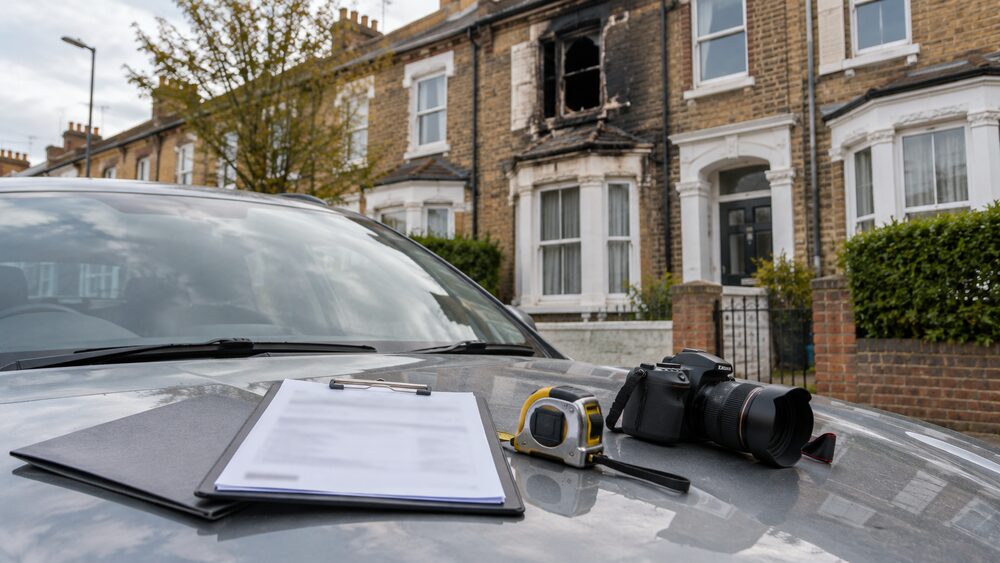
If your home is badly damaged, your insurer may send a loss adjuster to look at it. A loss adjuster investigates and assesses claims on behalf of insurers, and their fees are invariably paid by the insurers1. A loss assessor is a different animal: a person who, in return for a fee, usually a percentage of the amount claimed, acts for the claimant in negotiating the claim1. One works for the insurer, the other works for you.
That single difference explains almost everything else. The adjuster's job is to assess the financial loss, identify the work needed to reinstate the property and record damaged contents2. The assessor's job is to argue your case for a bigger or faster settlement, and you pay for that service out of the money you eventually receive.
This page sets out who each one works for, what happens when an adjuster arrives, how insurers are allowed to settle a claim, why claims get reduced or turned down, what to check before you claim, and where to go if you disagree with the outcome.
Loss adjuster or loss assessor: who each one works for
The two roles sit on opposite sides of the same claim. A loss adjuster is one who investigates and assesses claims on behalf of insurers, sometimes called a claims adjuster1. Insurers use independent qualified loss adjusters for detailed investigations of complex and large losses, and although the adjuster's fees are invariably paid by the insurers, the industry describes them as impartial professionals who make their own judgements1.
A loss assessor is defined as a person who, in return for a fee, usually a percentage of the amount claimed, acts for the claimant in negotiating the claim1. In motor insurance the same word describes an engineer, but in home and property claims it means someone you hire to represent you.
The practical consequences follow from that. Because the adjuster is paid by the insurer, you do not receive a bill for their visit, and you cannot instruct them. Because the assessor is paid by you, you choose whether to hire one, and the fee comes out of whatever settlement you receive. If a stranger contacts you after a flood or fire offering to handle your claim for a fee, they are not your insurer's adjuster, whatever they call themselves.
Loss adjusters are appointed and paid by the insurer
Your insurance company will send a loss adjuster to assess the damage to your home6. You do not appoint them, you do not pay them, and you cannot choose which firm attends. The adjuster reports back to the insurer, which then decides how the claim is handled.
The visit does not always happen quickly. The loss adjuster might not come immediately if there has been a lot of flooding in your area6, because the same small number of firms are handling many claims at once. While you wait, there are things worth finding out: how long it will be before the loss adjuster is able to come and survey the damage, whether the company will organise and pay for cleaning and redecorating your home, and who will look after your insurance claim6.
If you bought your policy through a broker, the broker may take some of this on. A broker might speak to loss adjusters and claims departments and do as much as possible for you7, and using one can reduce the chances of your claim being rejected7. That support at the time of a claim is one of the things a broker is paid for8.
What happens when your insurer sends a loss adjuster
The adjuster's task is to establish what happened, what it will cost to put right, and whether the policy responds. That means assessing the financial loss, identifying the work needed to reinstate the property, and recording damaged contents2. For a large or complex loss, such as a fire or widespread flooding, the adjuster may recommend specialists, agree a schedule of works, or value the rebuild.
The adjuster's assessment is not the final word, but it carries weight. In one case the ombudsman looked at, a homeowner's insurer told her it would actually cost £600,000 to rebuild her home, based on a loss adjuster's valuation, and it declined her claim9. In another, the ombudsman found that the loss adjuster had not factored in that the house was built with a timber kit, so the insurer had not shown the homeowner's own estimate was unreasonable10. That second case shows the value of challenging an assessment with evidence the adjuster missed.
Adjusters also handle straightforward claims without visiting. Where a claim is small or the cause is obvious, the insurer may settle on photographs and receipts alone. The adjuster tends to appear where the sums are large, the cause is disputed, or the insurer suspects the policy does not respond.
How your insurer can settle a claim: repair, replace or pay cash
Home insurance claims are usually settled in one of three ways: repairing the damage, replacing something lost or damaged, or paying cash to cover the cost of repair or replacement3. Policies commonly reserve the choice to the insurer, with wording such as: "We will decide whether to repair, replace, pay cash or reinstate the damaged part of the building."3
That matters if you would rather have the money. If the customer insists on cash when the insurer is willing to repair or replace, the insurer will only pay the amount it would cost them, and as insurers get discounts from the suppliers and contractors they use, that figure is usually less than market rates4. So a cash settlement can leave you short of what a builder would charge you directly.
The same principle runs through other types of cover. On mobile phone and gadget insurance, a cash settlement is generally the cost of replacing the phone or gadget with one of the same age and condition before the insured event, from a reputable source11. On motor claims, if the vehicle is not worth repairing the insurer offers a lump sum for it, known as a write-off or total-loss, and the damaged vehicle then belongs to them12. When your vehicle is written off, your insurance company pays you the current value of the vehicle, instead of the cost of repairing it12.
| Settlement method | What it means in practice |
|---|---|
| Repair | The insurer arranges or approves the work, often through its own contractors3 |
| Replace | A lost or damaged item is replaced rather than paid for in cash3 |
| Cash | You receive money to cover the cost of repair or replacement3 |
| Reinstate | The damaged part of the building is rebuilt or restored3 |
Why claims get reduced or turned down
Most disputed home claims come down to one of a few causes: the damage is excluded, the sum insured was too low, or the information on the policy was wrong.
Underinsurance is the most common. If you insured something for less than its replacement value, you may have to pay a proportion of any loss or damage, and the insurer has a formula for working this out, known as applying average5. How fair that is depends on what the insurer told you. Where the insurer's questions or guidance were unclear, reducing the claim payment, voiding the policy or adjusting the claim in other ways may not be considered fair13. If the insurer would still have insured you at the same premium, the ombudsman is unlikely to find it fair for the insurer to reduce or decline the claim13. If it would have charged a higher premium, it is likely to be fair for the insurer to reduce the claim in line with the proportion of the premium paid: for example, if you paid £400 but should have paid £500, you receive 80% of the claim value13. If the insurer would not have insured you at all, it is likely to be fair to reduce or decline the claim, and the insurer may also void the policy13.
Exclusions do the rest. Standard home insurance will not usually cover damage caused by wear and tear14, and you might not be covered if the damage results from general wear and tear, such as water entering through a poorly maintained roof15. Groundwater flooding is often excluded14, and your standard policy may not pay out if the loss or damage was caused while the home was unoccupied14.
Sometimes the insurer is simply wrong. In one case the insurer declined a claim saying the damage was caused by gradual deterioration and wear and tear, not storm conditions, and the ombudsman's investigation showed wind was indeed the cause16. In another, the insurer declined a claim altogether17. Where a claim is declined because of something you did not disclose, the rules on misrepresentation allow the insurer to charge more for the policy, retrospectively apply a restriction, settle a claim proportionately, or avoid the policy18.
Checking your cover before you claim
A few minutes with your policy documents before damage happens is worth more than any argument afterwards.
- Check the sum insured against rebuild cost, not market value. Underinsurance is the single biggest cause of reduced home claims5.
- Read the exclusions list. Wear and tear, groundwater flooding and unoccupied properties are common ones14.
- Check what garden cover you have. Some policies include cover for garden furniture, trees, hedges, lawns and fences, while others do not19.
- Check your excess. A higher voluntary excess lowers the premium but increases what you pay towards every claim.
- Tell your insurer about changes. If something changes after the policy has started, you will not usually have to tell the insurer about it until the policy is renewed18, but check the terms for anything the policy asks you to report immediately.
If you do not have insurance, you will not be able to make a claim for damage to your property19. Home insurance is not a legal requirement in the UK, but mortgage lenders normally insist on buildings cover, and without it the cost of repairs falls entirely on you.
Will my insurer pay for somewhere to stay if my home cannot be lived in?
Most home insurance policies will also provide alternative accommodation where a property has been damaged and is no longer safe to live in19. Buildings cover generally pays for cleaning up and repairing your property, as well as temporary accommodation if your home has been made uninhabitable15. Home emergency policies may also provide alternative accommodation while the problem is being fixed if your home is unsafe or uninhabitable20.
There is a limit to this. If you are evacuated as a precaution and your property has not been damaged, temporary accommodation is typically arranged through the local authority rather than your insurer19. So a flood warning that empties a street, without water reaching the homes, is a council matter, not a claim.
Where to get help if you disagree with a claim decision
Start with your insurer's formal complaints process. If that does not resolve it, the Financial Ombudsman Service is free to consumers and looks at home insurance claims, including how a claim was settled4. The ombudsman can tell the insurer to change how a claim was recorded, recalculate a premium, refund money paid and, in some cases, pay compensation for distress or inconvenience caused by poor customer service21. Where a complaint is about a claim, the ombudsman may ask the insurer to make necessary repairs, replace the item, offer a cash settlement, or compensate for distress or inconvenience11.
The ombudsman also handles disputes about underinsurance5, vehicle theft claims turned down for reasons such as the key being left in the vehicle or an exclusion applying22, and cases where claims information given at renewal was not accurate23. It is not a guarantee of a payout: in one case the ombudsman found the insurer had done something wrong but did not need to do anything to put things right financially, because the customer would not have done anything differently24.
If you are dealing with a declined claim and want to understand the wider rules, our guide to why insurance claims are rejected sets out the common grounds and the complaint route, and complaining about an insurer explains how the ombudsman process works step by step. For claims specifically about storm and flood damage, see storm, flood and escape of water claims.
Sources24 cited
- Jargon buster British Insurance Brokers' Association, 2025-02-11
- After a flood National Flood Forum, 2026-09-26
- Settling home insurance claims Financial Ombudsman Service, 2026-09-26
- Home insurance complaints Financial Ombudsman Service, 2026-09-26
- Underinsurance Financial Ombudsman Service, 2026-09-26
- After a flood: making an insurance claim nidirect, 2024-08-29
- When to use an insurance broker MoneyHelper, 2026-09-25
- Why use a broker? British Insurance Brokers' Association, 2025-04-02
- Insurer didn't provide guidance on rebuild cost Financial Ombudsman Service, 2026-09-27
- Consumer questions loss adjuster's valuation after fire Financial Ombudsman Service, 2026-09-26
- Mobile phone and gadget insurance Financial Ombudsman Service, 2026-09-27
- Accident checklist British Insurance Brokers' Association, 2026-09-26
- Underinsurance in home insurance complaints Financial Ombudsman Service, 2026-09-26
- 5 winter risks your home insurance might not cover Which?, 2026-09-26
- Does your insurance cover damage caused by bad weather? Which?, 2025-12-08
- Insurer refuses storm damage claim Financial Ombudsman Service, 2026-09-27
- Insurer declined a private health insurance claim Financial Ombudsman Service, 2026-09-27
- Misrepresentation and non-disclosure Financial Ombudsman Service, 2026-09-26
- ABI offers advice to anyone affected by wildfires Association of British Insurers, 2026-07-31
- Home emergency insurance Financial Ombudsman Service, 2026-09-26
- Fault claims and no claims bonuses Financial Ombudsman Service, 2026-09-16
- Vehicle theft Financial Ombudsman Service, 2026-09-16
- Consumer complains about misleading information at renewal Financial Ombudsman Service, 2026-09-26
- Mis-sold travel insurance Financial Ombudsman Service, 2026-09-26



 MoneyHelperFree, impartial money and pensions guidance, set up by government
 Financial Ombudsman ServiceFree, independent help when a complaint about a firm is not put right
 FSCSProtects your money if a bank, insurer or investment firm fails
 Citizens AdviceFree advice on money, consumer and legal problems in England and Wales
 GOV.UKOfficial information on tax, benefits and government services