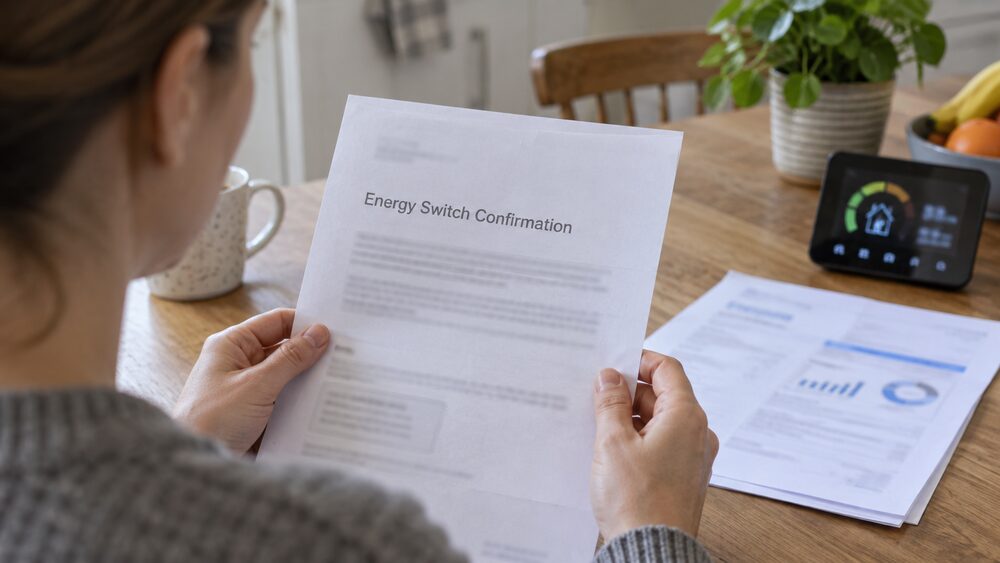
Switching energy supplier means moving the account that bills you for gas and electricity from one company to another. The energy itself keeps arriving through exactly the same pipes and wires, because only the billing changes hands: you will not experience any interruption to your electricity or gas supply during a switch1. You might be able to save some money by switching, particularly if you currently have gas and electricity from different suppliers and move both to one company2.
The process is faster than many people expect. Since 1 April 2024, energy suppliers have five working days to move you from your old supplier to your new one, and that five-day deadline only starts after a 14-day cooling-off period in which you can cancel without penalty3. If the new supplier misses the deadline, you are entitled to £40 compensation3.
What switching energy supplier involves
A switch changes who bills you, not how energy reaches your home. The wires, pipes and meter stay as they are, and the supply is not interrupted at any point1. What changes is the company that sets your unit rates and standing charge, sends your bills and takes your payments.
There are three separate things you can switch, and it is worth knowing which one you are doing. You can switch supplier, switch billing method (for example from paying on receipt of a bill to Direct Debit), or switch tariff with your existing supplier. All three can save money, and switching tariff or payment method does not require changing company at all8.
If you owe money to your energy supplier, you may not be accepted by a new supplier, though there are rules that protect your right to switch in many debt situations, covered later on this page2. If you are struggling with bills rather than shopping for a better deal, suppliers have obligations that may help more than a switch would: they must offer payment plans you can afford, can give you more time to pay, and many run hardship funds or grants9. Charities advise contacting your supplier about these options before assuming a switch is the answer.
Price cap or fixed deal: what you are choosing between
If you do not fix an energy deal, you will typically pay your provider's default variable rate, which is determined by the energy price cap5. The cap was introduced by Ofgem in 2019 to ensure fair prices for customers who do not actively switch energy provider, and it only affects standard variable tariffs, also known as standard, default or out-of-contract tariffs10. It sets the maximum amount energy suppliers can charge you for each unit of energy and the standing charge if you are on a standard variable tariff11.
The cap changes every three months, so a variable rate moves up and down through the year4. The level varies by energy supply region, payment method and type of electric meter, for example standard or economy 7, so two households on the same tariff type can pay different amounts12. Official figures show the cap increased slightly by 0.2% in January 202613.
A fixed tariff works differently. It fixes the amount you pay for each unit of gas and electricity you use, and your daily standing charge, usually for a term of 12 to 24 months5. One thing a fixed tariff does not do is fix your bills: your bills or Direct Debit payments still depend on how much energy you use14. The amount you are charged is set by the amount of energy you use, the unit cost and the daily fee15.
| Standard variable (price cap) | Fixed tariff | |
|---|---|---|
| Unit rates | Can change, capped, reviewed every three months5 | Set for the term, usually 12 to 24 months5 |
| Standing charge | Capped, can change11 | Fixed for the term14 |
| Contract length | No fixed term | Fixed term, exit fees may apply4 |
| What happens at the end | Continues | You roll onto the supplier's standard variable rate16 |
Guidance published in 2026 notes that, due to the recent rise in the energy price cap, it is unlikely you will find any cheaper deals at the moment, and if you have a fixed deal the guidance is to check the market before your agreement ends rather than assuming a switch will save money17. Whether a fixed deal beats the capped variable rate depends on the rates on offer when you weigh them up, and on how much energy you use.
Discounts for dual fuel and Direct Debit
Two discounts shape what a switch is worth alongside the headline rates. Most companies offer a discount for paying by Direct Debit18, and MoneyHelper confirms many companies, councils and organisations give a discount for people paying by Direct Debit, including money off your bills with most energy companies19. Usually paying by Direct Debit also allows you to be on your supplier's cheapest tariff, so your bill may increase a little if you cancel the Direct Debit15.
The second is the dual fuel discount. If you currently get gas and electricity from different suppliers, you could switch if one of them offers a dual fuel discount for taking both18. Whether the combined saving beats two separate cheap tariffs is a matter of weighing up the total cost of each arrangement, not just the discount label.
A further payment that depends on your supplier is the Warm Home Discount. Participating suppliers are obligated to provide a direct discount of £150 for those eligible, paid into their electricity or gas account20. Your supplier must be part of the scheme, and the bill must be in your name or your partner's name21. If you rely on this discount, checking a new supplier participates in the scheme matters before switching.
Some tariffs also require one month's payment, or even two in some cases, before they start supplying your gas and electricity, so the first cost of a switch can be higher than the later ones4.
How to switch: what you need from your bill
An accurate comparison needs two things from a recent bill: how much energy you use and the name of your current tariff5. Guidance suggests checking you are still on a competitive tariff about once a year, since fixed deals usually last one or two years and the market moves3.
With those details, the practical steps are:
- Find a recent bill or your annual statement and note your tariff name, your usage and how you pay.
- Check what each tariff would cost using your actual usage, not average figures.
- Look at whether the tariff has exit fees, and whether it requires a payment upfront4.
- Agree the new contract, which starts the 14-day cooling-off period4.
- Take a meter reading on the day of the switch so neither supplier bills you on estimates.
If you rent, you do not need your landlord's permission to switch supplier if you pay the bills yourself22. The exception is where bills are included in your rent or the landlord pays the energy company themselves, in which case they choose the supplier5. You also do not need your landlord's permission to switch your meter type, though you may have to pay to change the meter back when you leave23. A landlord cannot take money from your deposit for changing suppliers, except for small administrative costs to change the supplier back, which must be agreed and shown in your contract18.
The switch takes about 5 working days after a 14-day cooling-off period
The timetable has two stages. First comes the 14-day cooling-off period, which the supplier must allow from the day after you agree to the new contract; during this period you can cancel the switch without penalty3. Only once that period has passed does the five working day deadline begin, within which the supplier must complete your switch3. Before 1 April 2024, suppliers had 15 working days to complete a switch, and only those signed up to the Energy Switch Guarantee were bound to the shorter timescale4.
Guidance in Wales describes the whole transfer as taking about 21 days in total, which is consistent with a 14-day cooling-off period followed by five working days for the switch itself1. If your new supplier takes longer than five working days to switch you, you are entitled to £40 compensation3.
If you are moving home rather than switching at the same address, tell your energy supplier at least 48 hours in advance, ideally more4. After a switch, you have 15 working days to choose a new contract with the new supplier, your old supplier, or a different supplier, if you change your mind about the deal you agreed25.
Exit fees and the end of a fixed tariff
Most suppliers charge an exit fee if you leave a fixed term contract early18. Exit fees are typically £100 or more, often £100 per fuel if you want to leave before the end of your contract, so a dual fuel household leaving early could face two charges4. Exit fees only apply to fixed-term deals, including some tracker tariffs4.
The important limit is at the end of the term. Exit fees cannot be charged in the last 49 days of your tariff, so in that window you can switch freely without being charged4. Your supplier is required to contact you 42 to 49 days before the end date of your fixed-term tariff, informing you it is ending and that you can switch without a fee6. If a supplier tries to charge you a fee to switch when your contract ends in the next 7 weeks, that is a reason to complain15.
If your fixed deal ends and you have not arranged anything else, your supplier will automatically move you onto its default tariff, the standard variable rate15. With a fixed rate, you roll onto your provider's standard variable rate when the tariff ends, so doing nothing does not mean bills stop, it means they move onto the capped rate16. Your supplier must also give you 30 days' notice if a change to a variable tariff will make you worse off5.
The dedicated page on fixed tariff exit fees covers the charges in more detail, and how long switching takes breaks down the timetable.
Switching when you owe your supplier money
Debt changes the rules, but it does not always block a switch. The key threshold is 28 days. You have the right to switch supplier if you have been in debt to your current supplier for less than 28 days, and your supplier will add the amount you owe to your final bill6. If you have owed money for more than 28 days, you will need to repay the money before you can switch18. Fuel suppliers can reject a change of supplier if you have a debt balance owing3. One exception: if it is your supplier's fault that you are in debt, it cannot stop you from switching6.
For prepayment meter customers the rule is different. You can switch if you have a prepayment meter and owe £500 or less, and the limit applies per meter: you pay by topping up and have less than £500 debt for each meter, which you then repay to your new supplier instead7. Which? notes smaller providers may have their own approaches, but the £500 rule is the general entitlement14. If you cannot afford to top up your prepayment meter, contact your energy supplier to check if they have grants available26.
| Your situation | Can you switch? |
|---|---|
| Credit meter, in debt less than 28 days | Yes, debt added to your final bill6 |
| Credit meter, in debt 28 days or more | You must repay the debt first18 |
| Prepayment meter, under £500 debt per meter | Yes, debt moves to the new supplier7 |
| In debt through your supplier's fault | The supplier cannot block the switch6 |
If debt is the underlying problem rather than the tariff, suppliers must offer payment plans you can afford and should not try to get you to clear arrears any faster than you can afford6. Free debt advice charities can help you sort arrears before or alongside a switch, and the page on switching with prepayment debt covers that route in full.
Credit balances: refunds within 10 working days of the final bill
If you pay by Direct Debit you will often have built up credit on your account, especially after winter. When you switch, your old supplier must send you a final bill and refund a credit balance within 10 working days of it3. Citizens Advice puts the same rule plainly: they have to pay back anything they owe you within 10 working days of sending your final bill24.
You might also be due a refund from accounts you have already closed. You could be owed money if you closed old energy accounts when you moved home or switched suppliers during the past five years, and unclaimed credit from old suppliers can still be traced and claimed24. The page on dormant bank accounts explains a similar principle for forgotten money elsewhere.
If a supplier drags its feet, the compensation rules bite: not being refunded credit within 10 days of receiving a final bill is one of the situations that triggers £40 compensation, alongside not receiving your final bill within six weeks of switching27. And if the Energy Ombudsman later decides you are entitled to a refund, the supplier must pay it within 28 days28.
When a switch goes wrong: complaints and the Energy Ombudsman
Most switches complete without incident, but two things go wrong often enough to have their own rules: switches that are delayed, and switches that happen by mistake. If you are switched without your permission or by mistake, you are owed £40, and both your original and new supplier share equal responsibility for resolving the problem, so you can contact either4. After reporting it, you will receive written confirmation within five days explaining what action the supplier will take, and within 20 working days confirmation that you are being returned to your original supplier6.
The compensation rules cover the main failures27:
| What went wrong | Compensation |
|---|---|
| Switch not completed within five working days after cooling-off | £40 from the new supplier3 |
| Switched without permission or by mistake | £404 |
| Final bill not received within six weeks | £4027 |
| Credit not refunded within 10 days of the final bill | £4027 |
| Supplier fails to send compensation within 10 working days | An extra £404 |
| No reply within 20 working days of reporting a mistake | An extra £404 |
| Old and new suppliers take more than 20 working days to decide if the switch was correct | £40 from each supplier4 |
| Supply not re-registered within 21 working days of a confirmed mistake | An extra £405 |
If compensation is not paid or a dispute is not resolved, complain to your supplier first29. You can complain to the Energy Ombudsman about a billing or transfer problem, but only after you have given the supplier the chance to respond: you can escalate after eight weeks, or earlier if the supplier sends a deadlock letter with its final response6. You must send your complaint to the ombudsman within 12 months of receiving the deadlock letter or final response6. If the ombudsman takes up your case, you will get its decision within 6 to 8 weeks, and if it decides you are entitled to a refund the supplier must pay within 28 days28.
The Energy Ombudsman is independent and free to use, and it has the power to force an energy supplier to take action, which could be practical steps, an apology or compensation6. You can register a dispute online on the Energy Ombudsman website or by phone28. Citizens Advice offers free and impartial help with making a complaint to your energy company or the Energy Ombudsman29, and our page on when you can take a complaint to the Energy Ombudsman sets out the process step by step. For a delayed switch or late final bill specifically, see compensation for a delayed energy switch, and for writing the complaint itself, how to write an effective complaint.
Sources29 cited
- Newid cyflenwr ynni (Switching energy supplier) Shelter Cymru, 2026-09-17
- Your business and household budget Business Debtline, 2026-09-26
- Getting the best energy deal Age UK, 2026-09-10
- Guide to switching supplier Which?, 2026-05-15
- How to switch energy supplier Which?, 2026-05-15
- Gas and electricity arrears National Debtline, 2026-09-25
- Prepayment meters Shelter Cymru, 2026-08-28
- Save energy and money Consumer Council Northern Ireland, 2026
- Struggling to pay energy bills Christians Against Poverty, 2026-08-20
- What is the energy price cap? Which?, 2026-08-27
- Energy saving tips Scope, 2026-09-01
- Fuel poverty scenario modelling based on Ofgem energy price caps Scottish Government, 2026-09-02
- Scottish Economic Bulletin, December 2025 Scottish Government, 2025-12
- Energy tariffs explained Which?, 2026-03-31
- Your gas or electricity supplier has put up its prices Citizens Advice, 2026-09-26
- Understanding energy bills StepChange Debt Charity, 2026-09-25
- Making the most of your money Business Debtline, 2026-09-26
- Switching utility providers StepChange Debt Charity, 2026-09-25
- Make your money easier to manage yourself MoneyHelper, 2026-09-25
- Help with gas and electric bills Shelter England, 2025-07-25
- Managing energy and heating costs Macmillan Cancer Support, 2022-11-01
- Switching energy supplier Scope, 2026-08-17
- Utility bills and your rights Shelter England, 2026-05-01
- Check if a previous energy supplier owes you money Citizens Advice, 2026-09-25
- Five energy switching myths busted Which?, 2021-07-07
- Energy grants if you cannot afford to top up your prepayment meter mygov.scot, 2026-02-04
- Energy switching problems: are you entitled to compensation? Which?, 2020-08-27
- Energy complaints Age UK, 2026-08-26
- How to complain about your electricity, gas or energy bill Which?, 2026-07-30


 Citizens AdviceFree advice on money, consumer and legal problems in England and Wales
 MoneyHelperFree, impartial money and pensions guidance, set up by government
 Financial Ombudsman ServiceFree, independent help when a complaint about a firm is not put right
 GOV.UKOfficial information on tax, benefits and government services
 StepChangeFree debt advice and solutions from a charity