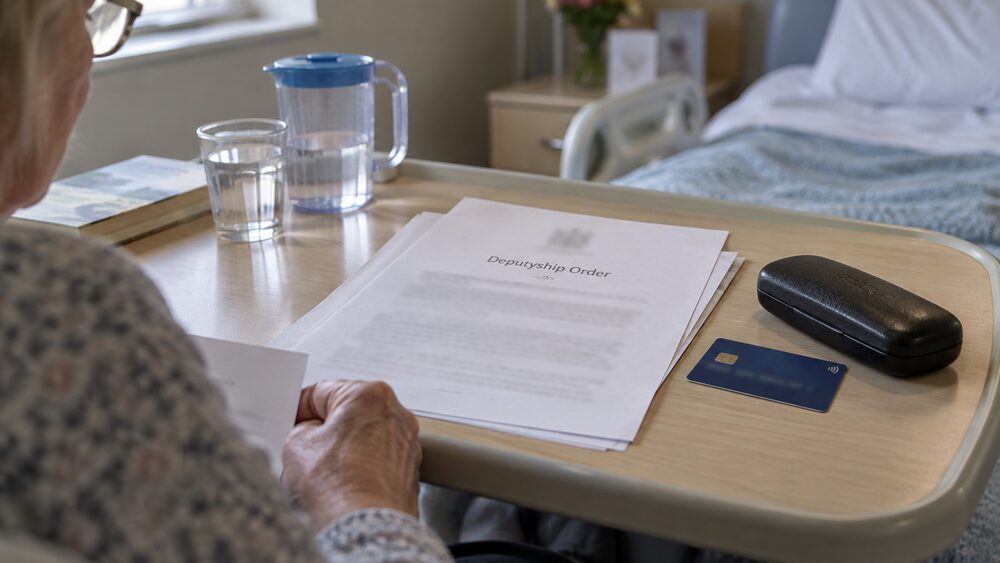
A deputy is someone the Court of Protection appoints to manage another person's money when that person has lost mental capacity and has not set up a power of attorney. Once the court order is granted, the deputy must register it with each bank or building society before they can touch the account. The bank then adds the deputy to the account, and the deputy can manage it in much the same way the account holder could: paying bills, moving money, opening and closing accounts, and dealing with statements and Direct Debits1.
A deputy is someone the Court of Protection appoints to manage another person's money when that person has lost mental capacity and has not set up a power of attorney. Once the court order is granted, the deputy must register it with each bank or building society before they can touch the account. The bank then adds the deputy to the account, and the deputy can manage it in much the same way the account holder could: paying bills, moving money, opening and closing accounts, and dealing with statements and Direct Debits1.
The order is the key document. Without it, a bank has no authority to let anyone else operate the account, and if the account holder has lost capacity and there is no power of attorney, the bank may restrict the account to essential transactions only3. A deputyship is the route that exists precisely for that situation.
How long registration takes varies by bank. One building society says it usually takes up to 11 working days to register someone as a deputy5. Another bank says that once it receives the documents it can take up to a month6. The practical work is in gathering the paperwork, not in the registration itself.
What a deputy can do on someone else's bank account
A deputy's powers are wide but not unlimited. Banks describe the deputy as able to manage the account in the same way the account holder could, just like a power of attorney, including withdrawals, opening and closing accounts, making payments in and making amendments2. In practice that covers having statements sent to the deputy's address, updating address details, and adding, removing or cancelling standing orders and Direct Debits7.
At one high street bank the list of permitted actions includes holding a debit card, obtaining information about the account holder's accounts, opening or closing accounts in the account holder's name, issuing cheques, making payments such as bills, withdrawing cash, depositing cash and cheques, retrieving items from safekeeping, applying for ISAs, accessing online and mobile banking, accessing phone banking, holding a cheque or pay-in book, managing the account if the account holder becomes mentally incapacitated, and signing a mortgage loan agreement. All of those are subject to any restrictions or special instructions in the court order8.
That last point matters. The court order can limit what the deputy does, and the bank will follow the order rather than the general rule. A deputy who wants to transfer money into someone else's account needs to go back to court for approval9.
When a deputy can be added: the Court of Protection order
A deputy can be added to an account following a Court of Protection order, when the account holder has lost mental capacity and has not set up a power of attorney2. The application goes to the Court of Protection, which considers whether it is necessary for ongoing decisions to be made on the person's behalf, and whether the applicant is suitable3.
In England and Wales, the Court of Protection can appoint a deputy or an appointee10. The court can appoint someone as a deputy to make decisions on someone's behalf, and a person can apply to the court for an order to be appointed11. Once appointed, the deputy has complete control of the person's bank accounts11. More than one deputy can be appointed for the same person11.
The same route applies to specific products. For a Junior ISA, where the account holder has lost capacity, a close friend or relative needs to apply to the Court of Protection for a financial deputyship order12.
The order is not self-executing at the bank. Once a Court of Protection order is granted, the deputy must register it with the bank before they can manage the account6. Until that happens, the bank has no instruction to act on.
How to add a deputy to a bank account
The process is the same shape at most banks, though the detail differs. Contact the bank, send the order and identification, wait for registration, then ask for the access you need.
- Get the Court of Protection order. The court appoints the deputy and issues the order11.
- Contact each bank and building society where the person holds an account. Most account providers will allow a helper to access an account, and each has its own instructions13.
- Send the Court of Protection document and two forms of identification. For savings accounts, some banks also want a savings application form; for mortgages, a completed "keep us up to date" form2.
- Wait for registration. One building society says up to 11 working days5; one bank says up to a month from receiving the documents6.
- Ask about online and app access separately. Some banks cannot give a deputy access to someone else's accounts through their app yet, so branch and phone banking may be the practical route2.
On identification, banks usually ask for two separate documents proving who you are and where you live, such as a passport and a recent bill. If you do not have the usual documents, a letter from a responsible person such as a GP, teacher, social worker or probation officer may be accepted instead14. When opening an account, proof of identity and address is required, and it is worth asking the bank what it will accept if the standard documents are not available15.
For phone and online banking specifically, one bank asks the deputy to register for phone banking first, then apply for online banking in a branch or by calling, once the court order has been updated in its records17.
Deputy or power of attorney: which one applies
These are alternatives, not stages of the same process. A lasting power of attorney is set up by the person themselves, while they still have capacity, choosing who acts for them. A deputyship is imposed by the Court of Protection when capacity has already been lost and no power of attorney exists3.
The difference has real consequences. If a partner loses mental capacity and there is no power of attorney in place, a joint account could be frozen; the bank might freeze it completely or allow only essential payments4. Where someone loses mental capacity without a power of attorney, the bank may restrict the account to essential transactions3. A deputyship is the way to restore full management in that situation.
There is a further wrinkle with joint accounts. One consumer organisation does not recommend opening a joint bank account with someone for whom you also hold lasting power of attorney, or its equivalents in Scotland and Northern Ireland18. LPA powers end when the donor has died, with the personal representative or executor taking control18.
Deputyship is not the only lighter-touch option. Most banks, building societies and other account providers allow a third party access to an account, for example with a second card19. Most account providers will allow a person to permanently or temporarily name a helper to access their account13. Those arrangements suit someone who still has capacity and wants practical help, not someone who has lost it.
Where a deputy's authority stops
A deputy's authority is bounded by the court order and by law. In most cases the deputy must not put money or property in their own name, give away the account holder's money, make or change a will, or claim unnecessary expenses21. The order itself can carry restrictions or special instructions, and the bank will follow those8.
A deputyship is also not the same as appointeeship. An appointee only has authority to manage the benefit payments on the designated account opened for that purpose22. Some banks set limits on the amount of money a person can have in their account when benefit payments are managed by someone else, and should tell the appointee if there is a limit and how much it is1. If the appointee dies, their personal account will be frozen and the claimant will have no access to their money23.
When the account holder dies, the deputyship ends. The bank may temporarily stop access to the account after death, though it might still release money for funeral costs24. If the account was in the person's sole name, no one can touch the money until the estate is sorted out25. A joint account continues in the remaining names4.
If a bank refuses to register a valid order, or handles the account badly, the Financial Ombudsman Service can look at complaints about power of attorney and deputyship. One case it published concerned a customer who could not get an account reactivated because the bank said he had to come to the branch26. Free, impartial help is available from MoneyHelper and from Citizens Advice.
Sources26 cited
- Manage a bank account for someone else GOV.UK
- Third party access: Court of Protection order Cambridge Building Society
- What happens if you don't have a power of attorney Age UK, 2025-08-11
- Joint accounts MoneyHelper, 2026-09-25
- Register a Court of Protection order Nationwide
- Power of attorney and deputyship Hodge Bank, 2025-07-24
- Court of Protection order Zempler Bank, 2026-09-26
- Court of Protection HSBC UK
- Get Court Funds money when you turn 18 GOV.UK, 2026-09-27
- Complaints about power of attorney Financial Ombudsman Service, 2026-09-26
- Third party access Metro Bank, 2026-09-25
- Manage a Junior ISA account GOV.UK, 2026-09-28
- Help collect your benefits or pension nidirect, 2026-06-26
- Getting a bank account Citizens Advice, 2026-09-25
- Make your money easier to manage by yourself MoneyHelper, 2026-09-25
- Getting a bank account (Scotland) Citizens Advice Scotland, 2026-09-26
- Court of Protection FAQs HSBC UK
- Can a joint bank account help me manage a loved one's finances? Which?, 2026-01-19
- Nominate someone to collect State Pension GOV.UK, 2026-09-26
- Financial Lives 2024: retail banking Financial Conduct Authority, 2024
- Guide to Court of Protection orders Nationwide
- Customer access tool Bank of Scotland, 2026-09-27
- Becoming an appointee Scope, 2025-08-11
- Arrange a funeral: funeral costs mygov.scot, 2026-09-07
- Debt when someone dies nidirect, 2026-06-26
- Health problems made it hard for Derek to get to a bank branch Financial Ombudsman Service, 2026-09-27











 Citizens AdviceFree advice on money, consumer and legal problems in England and Wales
 MoneyHelperFree, impartial money and pensions guidance, set up by government
 Financial Ombudsman ServiceFree, independent help when a complaint about a firm is not put right
 GOV.UKOfficial information on tax, benefits and government services
 StepChangeFree debt advice and solutions from a charity