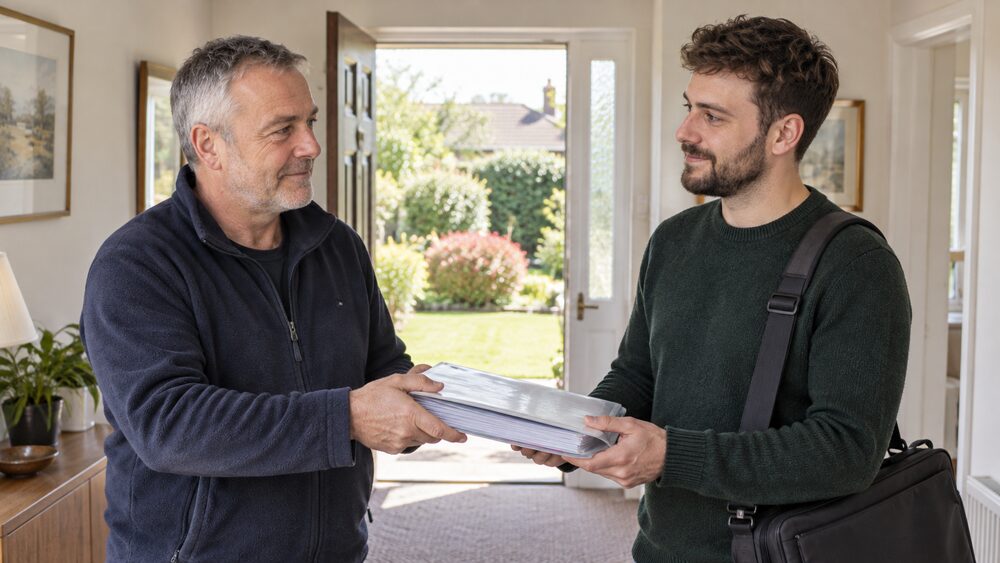
A Home Report is the document pack a seller in Scotland must have ready before their property can be marketed. It contains a survey and valuation, an energy report and Energy Performance Certificate (EPC), and a property questionnaire1. The seller arranges it and pays for it, and then gives a copy to anyone who is interested in buying2.
A Home Report is the document pack a seller in Scotland must have ready before their property can be marketed. It contains a survey and valuation, an energy report and Energy Performance Certificate (EPC), and a property questionnaire1. The seller arranges it and pays for it, and then gives a copy to anyone who is interested in buying2.
That is the key difference from the rest of the UK. In Scotland the valuation and survey are provided upfront as part of the seller's Home Report, rather than the buyer commissioning their own after an offer is accepted4. It means you can see what a surveyor thinks of the property, and what they think it is worth, before you decide whether to make an offer.
The report is required for properties in Scotland only6. If you are buying in England, Wales or Northern Ireland, there is no equivalent document and you will normally arrange and pay for your own survey and valuation.
What a Home Report is and when it is needed
The Home Report is a single pack with three parts. The survey and valuation gives the surveyor's view of the property's condition and its value. The energy report and EPC covers energy efficiency. The property questionnaire is the seller's own answers about the home, covering things such as council tax band and any alterations1.
Shelter Scotland sets out what a Home Report tells you: the value of the property, its size, layout and location, its age and building materials, its condition and any serious repair issues, any alterations, the council tax band, and its energy efficiency and accessibility9.
It is needed before marketing starts. Sellers must arrange a Home Report before they can market their property, and it is legally needed for the seller to arrange one before marketing10. Bank of Scotland puts it plainly: sellers have to provide one of these before the property can be put on the market6.
There are two exceptions. Home reports are not a requirement for private sales or new build properties8. For a new build, an energy performance certificate should still be obtained even though a Home Report is not needed9.
Sellers in Scotland must provide a Home Report
The duty sits with the seller, and it is not optional. In Scotland, sellers must provide a Home Report which includes a survey, Energy Performance Certificate and Property Questionnaire11. If you are selling in Scotland, you will need to get a Home Report12. Sellers in Scotland have to provide a report to buyers on the condition of their property13.
The seller also covers the cost. In Scotland, the seller covers the cost of the survey rather than the buyer2. The seller then provides a copy of the Home Report to any potential buyer3. Before you buy a house, the seller will give you a Home Report14.
Lenders expect to see it too. Halifax states that in Scotland sellers must send a Home Report including a survey, Energy Performance Certificate and Property Questionnaire15. Lloyds Bank says the same: in Scotland sellers must have a Home Report which includes survey, Energy Performance Certificate and Property Questionnaire16.
For a seller, the practical point is timing. The report has to be in place before the property is advertised, so the cost and the wait for a surveyor both come before any buyer sees the listing. For a buyer, it means the survey work is already done and paid for by the time you are looking.
The valuation, and which lenders accept it
The valuation is one of the three parts of a Home Report, and it gives a figure for what the property is worth8. The survey element also sets out the property's condition, the repairs required and its energy efficiency rating8.
That valuation matters beyond your own reading of it, because lenders use it. Halifax states that any loan it makes will be subject to the property valuation contained in the Home Report for properties in Scotland, or a satisfactory property valuation by a surveyor of its choice6.
Not every lender takes the same approach, and this is where buyers can be caught out. Scottish Building Society says that for property purchases in Scotland it can normally use the property valuation contained in the sellers' Home Report provided that it is no more than 3 months old17. The same rule appears on its professional mortgages and its retirement interest-only mortgage pages7.
Metro Bank takes the opposite position. It states that it cannot currently accept a home report for residential purchases in Scotland, and that the customer will need to pay for its standard valuation19.
The age of the report matters. Skipton Building Society requires customers in Scotland to have a valid home report, no older than 90 days, before making a mortgage application21. A report that has been sitting on a shelf while a property fails to sell can go stale for lending purposes.
Repairs, condition and what the survey does not cover
The Home Report sets out the condition of the property and any serious repair issues9. Official guidance for the First Homes Fund is blunt about the consequence: check the Home Report before you buy, because you will need to pay for any repairs it flags22.
That is the practical weight of the survey section. It is not a list of suggestions. It is the surveyor's view of what is wrong with the building, and once you own it, the cost of putting it right sits with you.
What the survey is not is a full structural investigation. It is a condition report, and it may not uncover everything, particularly problems that are hidden behind walls or under floors. A buyer who wants more than the Home Report gives can commission their own additional survey, at their own cost, in the same way a buyer elsewhere would.
For comparison, a marine surveyors' report is the equivalent step when buying a houseboat, to make sure the boat is in good condition and ready to live in23. The principle is the same: an independent look at condition before you commit.
Home Reports apply to Scottish properties only
A Home Report is required for properties in Scotland only6. Sellers in Scotland have to provide a report to buyers on the condition of their property13. There is no equivalent duty on sellers in England, Wales or Northern Ireland.
The wider Scottish housing framework is separate in the same way. Shelter Scotland's guidance on benefits for two homes, mortgage repossession, Housing Benefit, Discretionary Housing Payment, mortgage arrears, Local Housing Allowance, moving house and affordable homeownership schemes all state that the content applies to Scotland only24. The Warm Home Discount (Scotland) Regulations 2026 extend to Scotland only32.
If you are buying south of the border, the process is different. Guidance for household budgets notes that it covers Scotland and that you will need different advice if you live in England and Wales33. The reverse also holds: summaries covering England and Wales note that you will need different advice if you live in Scotland34.
Buying in England or Wales instead
A Home Report is a Scottish requirement, and there is no equivalent document in England or Wales. In those nations the buyer normally arranges and pays for their own survey and valuation after an offer is accepted, rather than the seller providing one upfront.
That difference is the subject of ongoing reform discussion. The system used in Scotland, where valuations and surveys are provided upfront as part of a seller's home report, has been reported as a comparison point for proposed changes to home buying and selling in the rest of the UK4.
For a buyer in England or Wales, the practical consequence is cost and timing. You pay for the survey yourself, and you usually commission it after your offer is accepted, which means you can be some way into the process before you find out what a surveyor thinks of the property. In Scotland that information is in front of you before you offer.
If you are buying in Scotland, the wider process is set out in Buying a home in Scotland. If you are buying elsewhere, see How to buy a house in England: step by step or Buying a home in Wales.
Reading the Home Report before you offer
The seller will provide a copy of the home report to any potential buyer3, and before you buy a house the seller will give you a Home Report14.
The Scottish offer process assumes you have read it. If you find a home you are interested in buying and are happy with its Home Report, you tell your solicitor, who will formally note your interest with the seller36. Being happy with the Home Report is a step in the process, not an afterthought.
Your offer itself will set out a brief description of the home, the date you want to collect the keys and move in, the price you want to pay, any items you want to buy from the seller, and any other conditions you have36. Shelter Scotland's guidance on making an offer in Scotland applies to Scotland only37.
"If you find a home you're interested in buying and are happy with its Home Report, tell your solicitor. Your solicitor w"
Who pays for the Home Report, the buyer or the seller?
The seller pays. In Scotland, the seller covers the cost of the survey rather than the buyer2. The seller then provides a copy to any potential buyer at no cost to them3.
That is worth contrasting with the costs a buyer does carry. A buyer in Scotland still pays for their own conveyancing, their mortgage costs and any property tax due. If a lender will not accept the Home Report valuation, the buyer may also have to pay for a separate valuation, as Metro Bank's position shows19.
There are other situations where a valuation report cost falls on a borrower rather than a seller. Vida Homeloans' buy-to-let terms for Scotland state that the borrower must pay the cost of a Valuation Report if one is obtained for compulsory purchase or when a Default is occurring or reasonably believed to be occurring38. Help to Buy equity loan valuations work differently again: you choose a surveyor, and arrange and pay for the report yourself39.
For the Home Owners' Support Fund, the survey report is the property of the Scottish Government and has no purpose outside the scheme40.
What protects a buyer, and where it stops
The Home Report itself is the main protection, because it puts an independent surveyor's view of condition and value in your hands before you commit. The seller's legal duty to provide it, and the requirement that it be in place before marketing, are what make that work10.
Where it stops is at the limits of the survey. It is a condition report, not a guarantee, and it will not catch everything. It also does not remove the need for your own checks: the repairs it flags become your cost if you buy22.
If something goes wrong with the buying process, Complaining when buying a home goes wrong sets out the routes. For the legal work itself, see Conveyancing: the legal work when you buy a home. If you are worried about a valuation coming in below the price you agreed, What happens if the valuation is lower than the price I agreed? covers the options.
Free, impartial help is available. Shelter Scotland provides housing advice for people in Scotland, and its pages on mortgage repossession and arrears are written for Scottish law25. If you are struggling with housing costs, Debt: a complete guide to help, solutions and your rights sets out the options.
Sources40 cited
- Application process and timeline first direct, 2026
- Survey fees Lloyds Bank, 2026-09-27
- The process of buying your first home Royal Bank of Scotland, 2026-09-25
- Home buying and selling changes: what you need to know Which?, 2026-06-18
- Homebuying reforms: what the government's plans mean for you Which?, 2025-10-06
- Mortgage FAQs Bank of Scotland, 2026-09-27
- Professional mortgages Scottish Building Society, 2026-09-26
- Applying for a mortgage: first-time buyer guide TSB, 2026
- Finding properties Shelter Scotland, 2024-07-25
- Valuing your property Skipton Building Society, 2026-09-26
- Steps to buying a house in Scotland Bank of Scotland, 2026-09-27
- The cost of selling a house Which?, 2026-01-27
- Mortgages A to Z Halifax, 2026-09-27
- Open Market Shared Equity scheme: how it works mygov.scot, 2026-03-17
- Moving home Halifax, 2026-09-27
- Moving home Lloyds Bank, 2026-09-27
- Residential mortgages Scottish Building Society, 2026-09-26
- Retirement interest-only mortgage Scottish Building Society, 2026-09-25
- Valuations Metro Bank, 2026-09-25
- Valuations for intermediaries Metro Bank, 2026-09-26
- How to apply for a residential mortgage Skipton Building Society, 2026-09-26
- First Homes Fund: eligibility Scottish Government, 2026-06-24
- Houseboats Shelter Scotland, 2024-07-24
- Benefits for two homes Shelter Scotland, 2025-12-12
- Mortgage repossession Shelter Scotland, 2025-08-13
- Apply for Housing Benefit Shelter Scotland, 2025-12-12
- Discretionary Housing Payment Shelter Scotland, 2026-03-19
- Mortgage arrears Shelter Scotland, 2025-08-13
- Economic abuse Shelter Scotland, 2026-07-31
- Local Housing Allowance Shelter Scotland, 2024-02-11
- Moving Shelter Scotland, 2024-07-25
- The Warm Home Discount (Scotland) Regulations 2026 legislation.gov.uk, 2026-04-30
- Your business and household budget Business Debtline, 2026-09-26
- Costs of living: if you can't afford your essential costs Business Debtline, 2026
- Additional measures of housing affordability QMI Office for National Statistics, 2025-09-18
- Making an offer on a home mygov.scot, 2020-08-12
- Making an offer Shelter Scotland, 2024-07-25
- Buy to let mortgage terms and conditions: Scotland Vida Homeloans, 2024
- How to get a valuation of your Help to Buy home GOV.UK, 2025-08-18
- Home Owners' Support Fund property thresholds guidance Scottish Government, 2024-10-31








 MoneyHelperFree, impartial money and pensions guidance, set up by government
 Citizens AdviceFree advice on money, consumer and legal problems in England and Wales
 ShelterFree housing advice from a charity
 GOV.UKOfficial information on tax, benefits and government services
 Financial Ombudsman ServiceFree, independent help when a complaint about a firm is not put right