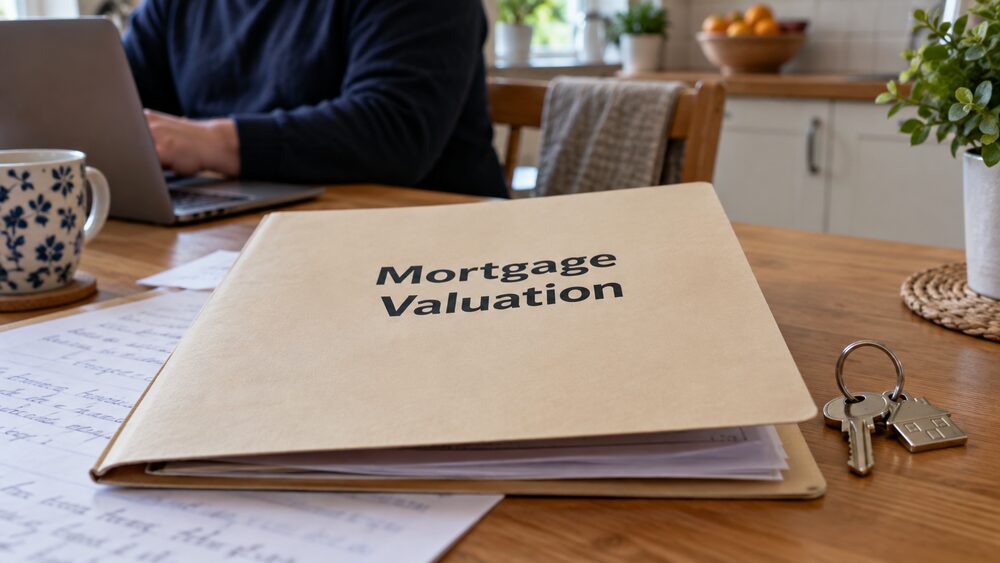
A down valuation happens when a surveyor decides a property is worth less than the agreed sale price, or less than the value proposed for a remortgage1. The lender then bases its loan on the valuation, not on the price you agreed, so the gap between the two has to be closed before the mortgage can complete.
A down valuation happens when a surveyor decides a property is worth less than the agreed sale price, or less than the value proposed for a remortgage1. The lender then bases its loan on the valuation, not on the price you agreed, so the gap between the two has to be closed before the mortgage can complete.
The valuation itself is not a survey for you. It is carried out for the lender's purposes, to make sure the property meets its criteria for lending, and the surveyor produces a report giving basic information about the property and indicating its likely value, which the lender relies on when making its lending decision2. Its scope is limited and it only provides information for the lender's benefit, to check the property will act as viable security for the loan1.
What that means in practice is arithmetic. Lenders consider the loan amount you have applied for as a percentage of the purchase price or valuation figure, whichever is lower3. If the valuation is lower, the maximum loan shrinks, and the difference comes out of your own money, a renegotiated price, or the purchase itself.
Down valuation: the lender bases its loan on the valuation, not the price
The starting point is that a mortgage valuation is not a comment on whether you got a good deal. It is the lender checking that the property would be adequate security if it ever had to sell it. The surveyor may also provide the lender with a minimum reinstatement value, the amount you would need to rebuild the property from the ground up, which is useful when getting buildings insurance cover1.
Because the loan is secured on the property, the lender's exposure is measured against what the property is worth, not what was agreed. That is why a down valuation can change the whole shape of a purchase even when nothing about the property itself has changed. The lender may reduce the amount of money it is willing to lend you, or change the interest rate available5.
A down valuation is not the same as negative equity. Negative equity is when your home is worth less than what you owe on it6. A down valuation happens before completion, between the price agreed and the figure the lender will lend against. Negative equity can follow later if values fall after you have bought.
It is also worth separating the valuation from the price. A surveyor working for a lender is not setting the market. They are applying the lender's criteria to the evidence in front of them, and their figure can be cautious. But it is the figure the lender will use, and that is what makes it consequential.
How a down valuation changes your deposit and loan-to-value
Loan-to-value is the loan amount as a percentage of the purchase price or valuation figure, whichever is lower3. Your deposit is based on the lower of the property's purchase price or valuation7. So a down valuation does two things at once: it reduces the maximum loan the lender will advance, and it increases the deposit you need to make up the difference.
The worked example is stark. Buying a £250,000 property with a £25,000 deposit needs a 90% mortgage of £225,000. If the lender's surveyor decides the property is actually worth £200,000, 90% of that is £180,000, giving £205,000 in total and a £45,000 shortfall1.
| Price agreed | After a down valuation | |
|---|---|---|
| Property figure used | £250,000 | £200,000 |
| Deposit | £25,000 | £25,000 |
| Mortgage at 90% | £225,000 | £180,000 |
| Total available | £250,000 | £205,000 |
| Shortfall | none | £45,000 |
That shortfall is the whole problem. It has to be met from somewhere: more of your own money, a lower price, or a different lender. The same principle applies to shared equity purchases. In one official example, a buyer contributing 5% of the valuation as a deposit plus £10,000 above valuation would personally contribute £15,0008. The Help to Buy equity loan allowed a prospective buyer's deposit to be reduced to 5%9, which shows how sensitive these schemes are to the relationship between price and valuation.
If you are still working out how much deposit you need, the deposit is calculated on the lower of the two figures, so a down valuation can move you into a different loan-to-value band entirely.
Will a lower valuation change the mortgage rate I was offered?
It can, and this is the part buyers often miss. The provider may reduce the amount it is willing to lend or change the interest rate available5. Generally, the lower the loan-to-value, the lower the rate10. A down valuation pushes your loan-to-value up, because the loan is measured against a smaller property figure, and that can move you into a more expensive band.
The Financial Ombudsman Service has looked at the same mechanism from the other direction. A lender can refuse a porting application on other grounds, for example if the value of the new property would take the ported balance outside the loan-to-value range for the interest rate the customer wants to port11. In other words, the loan-to-value range attached to a particular rate is a real constraint, not a formality.
So the rate you were offered at application stage is not guaranteed if the valuation changes the loan-to-value. You may be re-offered on different terms, or asked to put down a bigger deposit, borrow less, build up your credit score, or pay off outstanding debts12. If the numbers no longer work at the new rate, that is a signal to revisit the price rather than stretch.
Your options: renegotiate, add more deposit, challenge the valuation or change lender
There are four realistic routes, and they are not mutually exclusive.
Renegotiate the price. If you receive a down valuation on the property you want to buy, the first thing to do is try and renegotiate the sale price with the seller, because a down valuation is a strong bargaining tool1. The seller is not obliged to agree, but they now know that any buyer relying on a mortgage will face the same problem.
Add to your deposit. Lenders may suggest a larger deposit, another mortgage product with a higher loan-to-value, or speaking with the seller5. This works, but it means finding money you had not planned to spend, and it may leave you with less in reserve for the costs of buying a house.
Challenge the valuation. You may be able to challenge the valuation if you have robust evidence, but accepting a challenge is at the discretion of the lender1.
Change lender. Your last resort might be to try an alternative lender that uses a different independent surveyor, which may give a valuation closer to the sale price1. This costs time and money, and there is no guarantee the second figure will be higher.
Asking the lender to reconsider the valuation
A challenge is a request, not a right. The lender decides whether to accept it, and it will want evidence rather than argument. Strong evidence will be needed to challenge a down valuation, such as recent local sales data, and a revaluation following completion of remedial works may resolve the issue13.
The kind of evidence that carries weight is comparable sales. Official guidance on Help to Buy valuations, which follows a similar logic, asks for at least 6 comparable properties and sale prices from the last year if the property has increased or decreased in value14. The same guidance sets out grounds on which a valuation report may be rejected: if it does not follow the criteria, or is too high or too low compared to similar properties14.
There is a parallel in Northern Ireland's House Sales Scheme, where an independent valuer assesses the market value of your home and, if you disagree, you can ask for a redetermination by Land & Property Services, whose valuation is final and can go up or down15. That is a statutory process rather than a lender's discretion, but it shows the shape of a proper challenge: a fresh look at the evidence, with the possibility that the figure moves against you as well as for you.
If you think a lender has handled a valuation unfairly, the Financial Ombudsman Service considers complaints about mortgage valuations and surveys2. Complaining is separate from challenging: the ombudsman looks at how the lender behaved, not at whether the property is worth a particular amount.
Walking away: what you can lose and what you cannot
Before contracts are exchanged, the sale is not binding, so you can withdraw. What you cannot usually recover is money already spent: the valuation fee, legal work and searches. Many lenders offer a free basic property valuation on any new applications, so there is often no valuation fee to lose, but there is often a fee for any further advance applications4. Most lenders offer a free property valuation on any new applications, with a fee often applying to further advances16.
After exchange, the position is different. You are committed to completing, and walking away means breaking a binding contract, with the deposit at risk. If the sale price is less than what you owe, you need your lender's permission to sell6. That rule matters most in a repossession or negative equity situation, but it shows how far a lender's consent reaches once the numbers do not cover the debt.
If the purchase falls through and you are left with debts from the process, or if you are already behind on payments, free and impartial help is available. StepChange provides mortgage and debt guidance4, and its material covers options such as asking a lender to stop interest and charges for a while, or telling them you have found a better deal and seeing if they can match it17. Where a lender cannot be paid, it may agree to smaller mortgage payments until you sell your property18.
Where to get help
Free, impartial guidance on mortgages and buying a home is available from MoneyHelper, and debt advice charities such as StepChange can help if the shortfall leaves you struggling with other borrowing4. If you have a complaint about how a lender handled a valuation, the Financial Ombudsman Service is the route2. For the wider process, including what happens at each stage and what it costs, see how to buy a house in England and the costs of buying a house.
Sources18 cited
- Mortgage valuations explained Which?, 2025-12-18
- Mortgage valuations and surveys Financial Ombudsman Service, 2026-09-26
- Mortgage jargon buster Teachers Building Society, 2026-09-25
- Mortgages help StepChange, 2026-09-25
- Mortgage valuation and home surveys Nationwide, 2026
- Selling your home to avoid repossession Shelter England, 2025-09-16
- The process of buying your first home RBS, 2026-09-25
- Open Market Shared Equity Scheme: buyer information Scottish Government, 2025-09-19
- Evaluation of the Help to Buy scheme GOV.UK, 2026-09-16
- Mortgage jargon buster StepChange, 2026-09-25
- Early repayment charges Financial Ombudsman Service, 2026-09-26
- Mortgage eligibility Santander, 2026
- Equity release FAQs Equity Release Council, 2026-09-26
- How to get a valuation of your Help to Buy home GOV.UK, 2025-08-18
- House Sales Scheme nidirect, 2026-02-18
- Equity release StepChange, 2026-09-25
- Dealing with persistent debt StepChange, 2026-09-25
- Surrendering your property StepChange, 2026-09-25









 MoneyHelperFree, impartial money and pensions guidance, set up by government
 Citizens AdviceFree advice on money, consumer and legal problems in England and Wales
 ShelterFree housing advice from a charity
 GOV.UKOfficial information on tax, benefits and government services
 Financial Ombudsman ServiceFree, independent help when a complaint about a firm is not put right