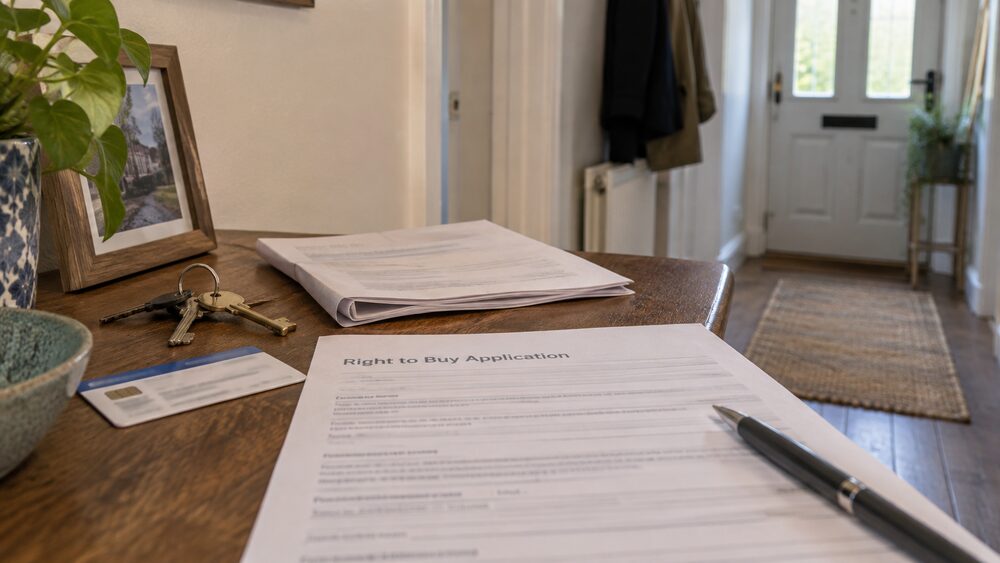
Right to Buy lets secure council tenants in England buy the home they rent at a price lower than its full market value1. The discount runs from 35% to 70% of the market value depending on how long you have been a public sector tenant and whether the home is a house or a flat, but it is capped in cash terms at between £16,000 and £38,000 depending on where you live1. The scheme was introduced in 1980 and remains open to tenants of local councils and certain other public sector landlords in England1.
The scheme only applies in England. Wales and Scotland have no Right to Buy or Right to Acquire schemes at all3, and Northern Ireland runs its own separate arrangement, the House Sales Scheme, for tenants of the Housing Executive4. Housing association tenants in England generally cannot use Right to Buy, though two related schemes, Right to Acquire and Preserved Right to Buy, cover some of them1.
What Right to Buy is and where it applies
Right to Buy is a legal right, not a discretionary scheme: if you qualify, your landlord cannot refuse to sell to you. It was introduced in 1980 and gives secure tenants of councils and certain other public bodies the right to buy their home at a discount against its open market value1. The home must be your only or main home and must be self-contained1.
The right belongs to tenants of local councils and a defined list of public bodies, including district councils, county councils, London boroughs, police and fire authorities, waste disposal authorities and registered providers such as housing associations in certain cases1. Housing association tenants are covered by the separate Right to Acquire scheme, which gives eligible tenants of registered social landlords the right to purchase the home they rent, though it only applies to a limited number of properties, for example homes built with public funds on or after 1 April 19971. If you were a secure council tenant living in your home when it was transferred from the council to another landlord such as a housing association, you may have a Preserved Right to Buy1.
When it comes to paying for the purchase, you have access to the same mortgage products available on the market as everyone else1. One rule from mortgage regulation is worth knowing: a lender cannot sell a mortgage on an execution-only basis, without advice, when the customer intends to use it to exercise a statutory right to buy their home, so you will be taken through an advised sale5.
Who can apply: secure tenants with 3 years as a public sector tenant
You probably have the Right to Buy if you are a secure council tenant and have spent at least 3 years as a public sector tenant1. Independent guidance sets out the same conditions in plainer terms: the home must be your only or main home, it must be self-contained, you must have lived in a council or housing association home for 3 years, and you must be a secure tenant3. Citizens Advice describes the qualifying test as being a secure tenant of a social housing landlord for at least 3 years, which includes a local authority or a non-charitable housing association4.
The 3 years does not have to be continuous, and you can add together any time you have spent as a public sector tenant1. The periods that count include tenancies with local authorities, community and parish councils, new town corporations, urban development corporations, housing action trusts, registered providers other than co-operative housing associations, government departments, ministers of the Crown, area electricity boards and fire and rescue bodies1. Any period spent in armed forces accommodation can count towards the qualifying period and towards the discount, but you have no Right to Buy if you currently live in armed forces accommodation1.
Eligibility also depends on your record as a tenant. The official guidance lists conditions including having no legal issues with debt, no outstanding possession orders and no history of tenancy fraud1. Up to three people can apply jointly, and family members who have lived in the home as their only or main home for at least 12 months can share the right. Family means a spouse or civil partner, parents, grandparents, children, grandchildren and siblings, plus their spouses or civil partners. Partners who are not civil partners, in-laws and cousins do not count as family members for Right to Buy purposes1.
Landlords and homes that are excluded
Not every social tenant has the right. You may not buy your home if you are the tenant of a registered provider which is a charity, a landlord which has not received public subsidy, a co-operative association, or Homes England1. The type of home matters too: the property must be self-contained and your only or main home1.
For housing association tenants, the Right to Acquire scheme is narrower than Right to Buy. It only applies to a limited number of properties, for example homes built with public funds on or after 1 April 19974. And in Wales, contract holders renting from a community landlord have no right to acquire their home at all4.
Other schemes have their own boundaries, which is worth knowing if you are weighing up alternatives. The Right to Shared Ownership scheme, which lets some housing association tenants buy a share of their home instead of all of it, excludes almshouses6. In Scotland, tenants of a local authority or registered social landlord cannot buy their existing home from their landlord through the Open Market Shared Equity Scheme, though social renters are among the priority groups for that scheme when buying on the open market7.
How the discount is worked out: 35% to 70% of market value
The discount is based on the number of years you have spent as a public sector tenant, and it differs between houses and flats1.
| Type of home | Discount after 3 years | How it builds up | Maximum |
|---|---|---|---|
| House | 35% | Stays at 35% until 5 years, then rises by 1% for each extra year | 70%, or the regional cash cap, whichever is lower1 |
| Flat | 50% | Stays at 50% until 5 years, then rises by 2% for each extra year | 70%, or the regional cash cap, whichever is lower1 |
So a tenant with 3 years gets 35% off a house or 50% off a flat, and the percentages grow with each additional year of tenancy until the 70% ceiling or the cash cap is reached1. The official guide states the position plainly:
"You get a 35% discount if you have been a public sector tenant for 3 years. The discount remains at 35% until you have 5 years as a public sector tenant, after which it will go up by 1% for every extra year, up to a maximum of 70%."
Government guidance on the scheme, 8 April 20261
One rule can pull the discount down. Under the cost floor, your discount will be reduced to reflect what your landlord has spent on building, buying, repairing or improving your home over a specific period before you apply to buy1. In practice this means a recently built or extensively repaired home may carry a smaller discount than the tenancy length alone would suggest.
Maximum discount: £16,000 to £38,000 depending on region
Whatever percentage your tenancy earns, the discount cannot exceed a cash cap that depends on where you live. Maximum cash discounts are £16,000 to £38,0001. Independent guidance confirms the same range: the maximum discount you can get is between £16,000 and £38,000, depending on where you live3, and some areas have maximum discounts set as low as £16,0004.
| Region | Maximum discount |
|---|---|
| London (except Barking and Dagenham, and Havering) | £16,0001 |
| Barking and Dagenham, and Havering | £38,0001 |
| North East | £22,0001 |
| North West | £26,0001 |
| Yorkshire and the Humber | £24,0001 |
| East Midlands and West Midlands | £24,0001 |
| Eastern (except Watford) | £34,0001 |
| Watford | £16,0001 |
| South East (except listed areas) | £38,0001 |
| South West | £30,0001 |
The caps were reduced to this range from 21 November 20241. Applications received by social landlords before that date from eligible tenants keep the discounts that applied at the time: up to £102,400 across the rest of England, or £136,400 in London boroughs1. Which? gives the same transitional figures for pre-November 2024 applications8. The practical effect of the cap is that in high-value areas, especially much of London, the percentage discount will usually hit the cash ceiling long before it reaches 70%, so the number of years as a tenant matters less than the regional limit.
Applying: the RTB1 form, the Section 125 offer and the deadlines
The process starts when you ask your landlord for the Right to Buy application form, form RTB14. Once the landlord receives it, the clock starts on a series of deadlines.
Your landlord must reply with an RTB2 form, saying whether you have the right to buy. This must reach you within 4 weeks of the date your landlord received your RTB1 form, or within 8 weeks if you have been a tenant of that particular landlord for less than 3 years1. If the landlord agrees, the next step is the Section 125 notice, which sets out the price and the terms of sale. The landlord must send this within a further 8 weeks after you received the RTB2 form if your home is a house and you are buying the freehold, or within 12 weeks if it is a flat or a leasehold house1.
You then have up to 12 weeks to accept your landlord's offer1. If you disagree with the valuation, you must tell the landlord within 3 months of receiving the Section 125 notice that you want a determination of value by the District Valuer1. At the other end of the process, your landlord cannot send you a warning notice until at least 3 months after they send your Section 125 notice; that notice will ask you either to complete the purchase within 8 weeks or to write and say you disagree with the terms1. If your landlord sends a reminder and you do not reply within 28 days, your landlord will treat it as you not wanting to buy, and your application will not be dealt with further1.
One condition sits behind all of this: your landlord is not bound to complete the sale if you have not paid all the rent, or any other payment, within 4 weeks from the date you were asked to pay it1. Rent arrears do not remove the right itself, but they can stop the sale going through until they are cleared.
Disputing the valuation with the District Valuer
Your landlord will tell you how much they think your home is worth when you apply to buy it, and there is no charge for this valuation service1. If you think the figure is wrong, you can ask for a determination of value by the District Valuer, and you must do this within 3 months of receiving the Section 125 notice1. The District Valuer's valuation then replaces the landlord's figure.
Two protections matter here. First, improvements you have made yourself are not allowed to put the price up1. The valuation reflects the property, but the value you added through your own work is disregarded, so a tenant who has fitted a new kitchen or bathroom does not pay more because of it. Second, the process is free to the tenant in the ordinary way: the landlord's valuation carries no charge1.
The equivalent process in Northern Ireland works differently and is a useful contrast. Under the House Sales Scheme, an independent valuer assesses the market value of your home, and if you disagree with the price you can ask for a redetermination by Land & Property Services, whose valuation is final and can go up as well as down9. A Right to Buy buyer in England should therefore treat the District Valuer route as a genuine check on the landlord's figure, but also be prepared for the possibility that the determination confirms or even matches the original price rather than cutting it.
When your landlord delays: the RTB6 and RTB8 notices
The deadlines in the application process are not just guidance. If your landlord misses one, there is a formal procedure that turns the delay into a reduction in the price you pay.
The first step is an initial notice of delay, Form RTB6, which you fill in and send to your landlord, giving them at least one month to take the next step1. If the delay continues, you can then send an operative notice of delay, Form RTB8. Once that operative notice is in force, the rent you pay while the delay goes on will be taken off the price you have to pay for your home1. The longer the landlord stalls, the cheaper the purchase becomes, which is the system's way of pressuring landlords to keep to the timetable.
The procedure only works if you use it. A landlord that is slow is not the same as a landlord that has refused: the RTB6 and RTB8 notices are what convert slowness into a financial consequence. Keep copies of everything you send, and note the dates, because the reduction in price depends on the notices being properly made and the delay being the landlord's.
Selling within 5 years means repaying some of the discount
The discount is not unconditional. Usually, you must pay back some or all of it if you sell the home within 5 years3. The repayment is a percentage of the resale value of the property, disregarding the value of any improvements you have made since buying1, and it steps down year by year:
- Sell within the first year: repay all the discount1
- Second year: 80% of the discount (the official guidance sets out the sliding scale; the documents give the first-year and later-year figures)1
- Fourth year: 40% of the discount1
- Fifth year: 20% of the discount1
- After 5 years: you can sell without repaying any discount1
The repayment is worked on the resale value, not on the original discount sum, so if the property has risen in value the amount repayable can be larger than the discount you received. The value of improvements you made is disregarded, which protects sellers who invested in the home after buying1.
Two further rules can affect a resale. If you purchase under Right to Buy and wish to resell or dispose of the property within 10 years, you must first offer it back to your landlord, which has the right of first refusal1. And if the property is in a National Park, an Area of Outstanding Natural Beauty or an area designated as rural by the Secretary of State, the sale may be on the condition that you may only resell to someone who has been living or working in the area for at least 3 years1. Northern Ireland's House Sales Scheme has its own, stricter version: if you sell within five years of buying you must pay back the full discount received, and if you sell within ten years you must give the Housing Executive the option to buy the property back9.
Buying a flat on a lease: service charges, major works and ground rent
Most flats bought under Right to Buy are sold on a lease, not as freehold, and that changes what ownership means. As a leaseholder you own the right to occupy for the term of the lease, while the landlord retains the building. That brings ongoing costs that a tenant buying a house does not face.
The Section 125 notice will give estimates of the service charges or improvement costs you will have to pay during the first 5 years after you buy your home1. After that period, the charges are whatever the lease provides for. Works to a building or estate which will cost any individual leaseholder more than £250 are treated as major works1, and major works can produce bills well beyond the annual service charge, for example for roof repairs, cladding or communal heating. The equivalent warning appears in Northern Ireland, where for flats or maisonettes the buyer or leaseholder must also pay an annual service charge10.
Alongside service charges, the ordinary costs of buying still apply. Buying a home is a major financial commitment involving immediate costs such as legal fees and Stamp Duty Land Tax11, and the process may also involve paying a solicitor, an independent surveyor, a mortgage arrangement fee, a Land Registry fee and the Stamp Duty charge itself12. Ground rent may also be payable under the lease terms. Before committing, read the Section 125 estimates carefully and treat the first 5 years of figures as a floor rather than a ceiling for budgeting. The dedicated page on buying a leasehold property explains the lease itself, and freehold vs leasehold sets out the difference between the two.
Paying for it: mortgages, deposits and Stamp Duty
You have access to the same mortgage products available on the market as everyone else1, so a Right to Buy purchase is financed like any other: a lender assesses your income and outgoings, and the mortgage is secured on the property. Because the purchase price is below the market value, the discount can act in place of the deposit some buyers would otherwise struggle to save, but each lender decides its own criteria and there is no rule in the scheme itself about deposits. For comparison, the Right to Shared Ownership scheme, a related option for some housing association tenants, requires a deposit usually between 5% and 10% of the share being bought6.
Stamp Duty Land Tax is charged on the purchase price, and the standard bands apply. The rates start at 0% on the first £125,000 of the purchase price, rising through the bands to 10% on the portion from £925,001 to £1.5 million13. If the property is an additional home, higher rates apply instead, starting at 5% on the first £125,000 and 7% on the portion from £125,001 to £250,00013. Because a Right to Buy price is the discounted price, many purchases fall below or near the £125,000 threshold, but this depends entirely on the price and the region. Certain reliefs and exemptions from Stamp Duty exist for particular transactions14, and the pages on Stamp Duty Land Tax and first-time buyer relief cover the detail.
Right to Buy is not the only route to ownership at a discount. The First Homes scheme, for example, offers homes to first-time buyers with at least 30% of the market value taken off the price15, and the wider options are compared in the guide to first-time buyer schemes. Which route suits a particular person depends on their tenancy, their savings and the homes available where they live.
Scotland, Wales and Northern Ireland: Right to Buy has no equivalent in Wales or Scotland
Right to Buy is an English scheme. Wales and Scotland do not have Right to Buy or Right to Acquire schemes3, so a tenant searching for either in those nations will find no application to make. In Wales there is no equivalent for contract holders renting from a community landlord either4.
That does not leave tenants elsewhere with nothing, but the alternatives work on different principles. In Scotland, social renters are among the priority groups for the Open Market Shared Equity Scheme, which helps them buy a home on the open market rather than the one they rent; tenants of a local authority or registered social landlord cannot buy their existing home through it7. Rent to Buy, a scheme that lets tenants rent at a reduced rate while saving for a deposit, is not available in Scotland16. In Wales, the Help to Buy Wales shared equity loan scheme has supported buyers since its inception on 2 January 2014, with 15,043 completions to 30 September 202517, though it applies to new build homes bought from developers rather than to a tenant's existing home, and homes split into flats are not included18.
Northern Ireland is different again. The House Sales Scheme gives Housing Executive tenants the right to buy their home, but on its own terms: you may be eligible if you have been a secure tenant with the Housing Executive for at least five years9, which is longer than the 3 years in England. If your tenancy has not run for five full years, you might still be able to buy if your partner or parent was previously the tenant9. The scheme excludes properties the Housing Executive is taking or intends to take legal possession of, and squatters cannot apply9. The full detail is on the page about the House Sales Scheme in Northern Ireland, and the general differences between the nations are covered in Money in Scotland, Wales and Northern Ireland.
Complaints and where to get help
If your landlord mishandles the application, complain through the landlord's own complaints procedure first. If that does not resolve the matter, you may wish to raise your concerns with the Local Government and Social Care Ombudsman if your landlord is a local authority, or the Housing Ombudsman if your landlord is a housing association1. The delay procedure in the RTB6 and RTB8 notices runs alongside complaints: it is a price mechanism, not a grievance process, so use both where the facts justify it.
Complaints about the mortgage side work differently. The general route is to talk to the lender or broker first, let them investigate through their formal complaints process, and after their final response contact the Financial Ombudsman Service if you are still unhappy19. The Financial Ombudsman can also usually look at complaints from leaseholders about claims for damage to a leased property, and, for policies sold or renewed after 31 December 2023, about information the insurer provided20. In Northern Ireland, Consumerline can refer a complaint to the Trading Standards Service for investigation or to the Financial Conduct Authority, which authorises lenders21.
Free, impartial help is available at each stage. Citizens Advice covers the buying process and eligibility in plain terms4, and the pages on how to buy a house, the costs of buying and complaining when buying a home goes wrong carry the detail for the steps around the purchase itself.
Sources21 cited
- Your Right to Buy your home: a guide GOV.UK, 8 April 2026
- Your Right to Buy your home (scheme summary) GOV.UK
- Right to Buy and Right to Acquire: council and housing association homes Scope, 1 April 2026
- Buying a home Citizens Advice, 25 September 2026
- MCOB 4.8A Prohibited cases FCA Handbook
- Right to Shared Ownership GOV.UK, 26 September 2026
- Open Market Shared Equity scheme buyer information Scottish Government, April 2025
- Shared ownership Which?, 26 March 2026
- House Sales Scheme nidirect, 18 February 2026
- Equity sharing nidirect, 25 February 2026
- Low cost home ownership schemes nidirect, 18 February 2026
- Buying a home: things to consider nidirect, 25 February 2026
- Cost of buying a house calculator HomeOwners Alliance, 11 June 2026
- Stamp Duty Land Tax relief for land or property transactions GOV.UK
- First Homes scheme: how the scheme works GOV.UK, 28 September 2026
- Rent to Buy GOV.UK, 26 September 2026
- Help to Buy Wales shared equity loan scheme, July to September 2025 Welsh Government, 11 December 2025
- Help to Buy Wales buyers guide, phase 3 extension Welsh Government, October 2024
- Complaints about mortgage underfunding Financial Ombudsman Service, 26 September 2026
- Multiple occupancy buildings insurance Financial Ombudsman Service, 26 September 2026
- Loans nidirect, 30 September 2025





 MoneyHelperFree, impartial money and pensions guidance, set up by government
 Citizens AdviceFree advice on money, consumer and legal problems in England and Wales
 ShelterFree housing advice from a charity
 GOV.UKOfficial information on tax, benefits and government services
 Financial Ombudsman ServiceFree, independent help when a complaint about a firm is not put right