
Children learn about money long before anyone sits them down for a lesson. Research put to Parliament suggests children form their attitude to money between the ages of 7 and 11, which means the habits, worries and assumptions they carry into adulthood are shaped in primary school, and earlier1. The practical implication is simple: everyday involvement beats formal teaching. Letting a child hand over coins at a shop, count what is in a piggy bank, or watch a parent compare prices does more than any single conversation.
MoneyHelper, the free government-backed guidance service, runs a programme called Talk Learn Do, which is free guidance to help you teach your children about money by getting them involved in everyday activities2. Alongside it there are children's savings accounts, prepaid cards, pocket money routines and free courses from charities, all of which can turn money from an adult mystery into something a child practises in small, safe amounts.
This page sets out what the evidence says about when money habits form, what lessons suit which ages, how pocket money and chores can teach budgeting, the free tools available, and how children's savings accounts work in practice: who pays in, who controls the money, what happens at 16 and 18, and how the child's savings are protected.
It's never too early to start talking about money
Because attitudes to money form between the ages of 7 and 111, waiting until the teenage years to talk about spending and saving means much of the groundwork has already been laid, for better or worse. A child who has watched adults argue about bills, or never seen money counted out, will have absorbed something either way. The aim of early money talk is not to produce a young accountant but to make money an ordinary, discussable subject rather than a source of anxiety or mystery.
MoneyHelper promotes Talk Money Week as a time to take one action towards feeling more informed, confident and in control of your money2, and the same idea works for families: pick one small thing, such as letting a child plan a small purchase or showing them the weekly food shop total, and build from there. The charity Stepchange suggests saving up for things you do as a family, like trips out, holidays and Christmas, as a fun way to plan together, alongside jam jar budgeting, researching toys and games together, and letting children pay with cash6.
Money pressure on families is real, and it shapes what children learn. The Resolution Foundation's Living Standards Outlook 2026 projects relative child poverty falling materially over the year ahead, with families with children seeing the largest gains7, but many households still have little slack. Stepchange's guidance on telling children you cannot afford something exists precisely because parents face that conversation, and its advice is to give children pocket money to save up for what they want, pay them to do chores, and help them make a plan with a budget and a timeline6. A child who saves towards a goal learns more about budgeting than one who is simply told no.
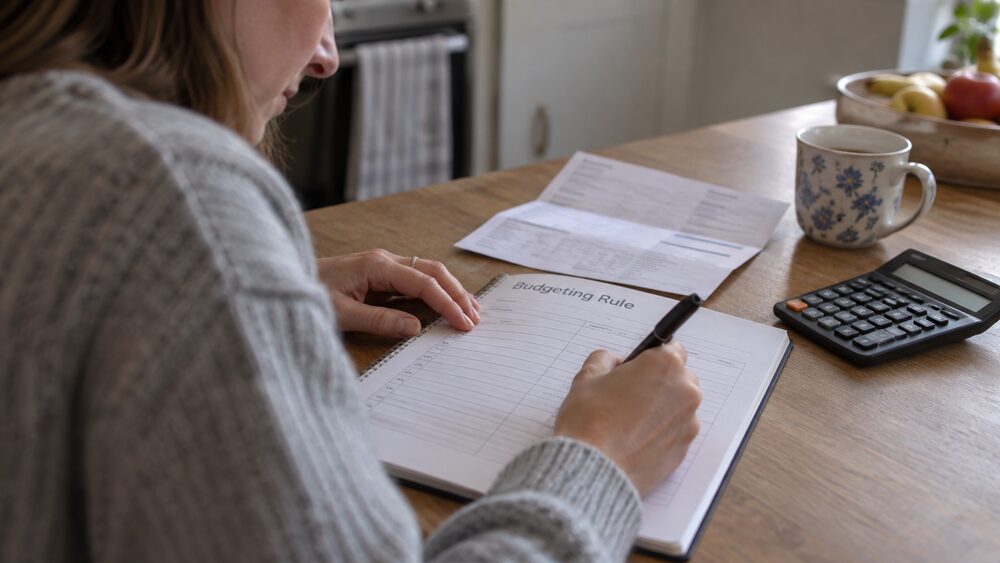
If money worries are the reason the conversation feels hard, free help exists before the teaching starts. Making a budget helps you understand money coming in each month, money going out, savings you can make, and what you can afford to pay towards debts8, and our guide to how to make a budget walks through it step by step.
Money lessons for 3 to 6 year olds
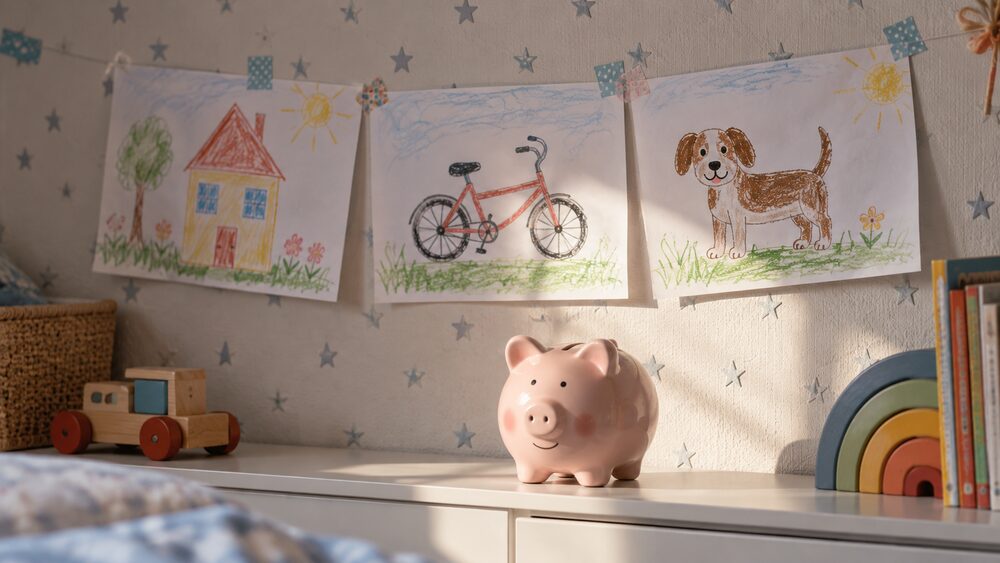
Halifax publishes a teaching guide aimed at 3 to 6 year olds, split by age, which gives a useful picture of what small children can actually grasp9. For 3 to 4 year olds it offers three lessons: understanding cash, talking about where you spend money, and spending money, plus tips on building understanding. Its suggested saving method for this age is deliberately physical: using a piggy bank or money jar is a great way to learn about saving, because a child can see the money accumulate9.
For 5 to 6 year olds the lessons move on to knowing how much money they have, needs versus wants, and starting to save9. The needs-versus-wants distinction is the seed of all budgeting: a child who can sort "food" from "a toy" at six is doing the same mental work an adult does sorting rent from subscriptions. The guide's saving method for this age is the three-jar approach: label three money jars spending, saving and giving9. Each time money arrives, the child divides it between the jars, which is a first budget in miniature.
The same principles scale up. The jar system is a child-sized version of the 50/30/20 rule for splitting income, and of the budgeting methods adults use, such as the envelope system. What matters at 3 to 6 is not the amounts but the repetition: counting, choosing, waiting and seeing the result.
Pocket money, chores and saving up for something
Pocket money is the first income most children have, and it is the natural teaching tool because it is small and the consequences of mistakes are cheap. Stepchange's guidance sets out the main options: give them pocket money to save up for what they want, ask them to complete chores to earn money towards what they want, or set academic goals6. If you prefer not to give pocket money, buttons or stickers can be swapped for a treat, and there are also apps to help kids save and spend6.
What children actually spend money on gives a sense of scale. The ONS Living Costs and Food Survey notes that some of the more common expensive items bought by children included bikes, mobile phones and personal computers, based on three years of combined spending data calibrated to the 7-to-15-year-old population10. These are exactly the purchases that suit a saving plan: too big for one week's pocket money, but reachable in weeks or months, which teaches the budget-and-timeline approach Stepchange recommends6.
Chores-for-money divides opinion, but the practical point is that earning and saving are separate lessons. A child who earns money by doing chores learns where money comes from; a child who saves it learns what it can do. Making a budget helps a child understand money coming in each month, money going out, savings they can make and what they can afford6, which is the same discipline adults use for setting financial goals.
Some families can top up a child's savings from public payments. In Scotland, the Best Start Grant includes an Early Learning Payment, a one-off payment of £319.80 when a child is between the ages of 2 and 3.5 years, to help with early living expenses11, and a School Age Payment of £319.80 to help with the costs of preparing for school12. The Early Learning Payment can be received for multiple children if you apply when each child is at the right age stage11. These are payments to parents rather than children's savings, but they are an example of money arriving at predictable moments, which is itself a budgeting lesson.
Free tools and activities for teaching children about money
Several free resources exist, and the official ones cost nothing and are impartial. MoneyHelper's Talk Learn Do is free guidance to help you teach your children about money by getting them involved in everyday activities2. MoneyHelper describes its tools as free, impartial and easy to use13, and its service as free and impartial guidance on savings and other money topics14. The Money and Pensions Service, which runs MoneyHelper, also highlights that its service can support parents and parents-to-be with free tools14.
Charities provide free courses and coaching. Christians Against Poverty describes its service as free, designed to empower you with the knowledge, budgeting skills and confidence to better manage your finances3, and its money coaching as a free service with the same aim15. In Scotland, the Money Talk Team service offers free money and debt advice16, and in Wales the Money Helper provides free and impartial money advice17. Our pages on free money guidance, money help in Scotland and money help in Wales list these in full.
| Resource | What it offers | Cost |
|---|---|---|
| Talk Learn Do (MoneyHelper) | Guidance on teaching children about money through everyday activities2 | Free |
| MoneyHelper tools | Free, impartial guidance and tools on savings and other topics14 | Free |
| CAP UK money course | Budgeting knowledge, skills and confidence3 | Free |
| CAP money coaching | One-to-one coaching to better manage finances15 | Free |
| Money Talk Team (Scotland) | Free money and debt advice16 | Free |
None of these requires any product purchase, and none gives financial advice in the regulated sense: they are guidance and education. If you want to understand that distinction, see financial advice or guidance.
Children's savings accounts: what they offer
Children's savings accounts do two jobs at once: they keep a child's money safe, and they are a teaching tool the child can watch grow. The main formal products are ordinary children's savings accounts, offered by banks, building societies and credit unions, and Junior ISAs. The Junior ISA was created by regulations in 2011 to introduce tax efficient individual investment plans for children18, and it comes in two types: an eligible child may hold only one account set up as a cash account and only one account set up as a stocks and shares account19.
NS&I, the government's savings provider, states that a young person can only have one cash Junior ISA in their name at a time, and that the annual Junior ISA investment limit is set by the Government for each tax year and published in the summary box and at nsandi.com/junior-isa20. A parent or guardian manages a Junior ISA for a child while they are under 1621. The tax wrapper means returns are not subject to income tax or capital gains tax on the child's other income, though the rules on tax are covered in our personal tax section.
Credit unions offer junior accounts too, and they work slightly differently. Credit union savings are share accounts: profit shares are distributed amongst credit union members annually and are known as a dividend22. For Junior ISA purposes, the regulations define a reference to interest as including any bonus and a dividend paid or credited in respect of a share account with a building society18, which shows how dividends and interest are treated as equivalents in the savings rules. Our guide to credit unions explains how membership works.
There is also the Child Trust Fund, the government scheme for children born between September 2002 and January 2011. No child may hold more than one Child Trust Fund account23, and the money belongs to the child and can only be taken out when they are 184. Many of these accounts were opened automatically with vouchers and remain unclaimed, so it is worth checking whether a child has one before opening a Junior ISA, since a child with a Child Trust Fund could not also hold a Junior ISA until the rules were relaxed.
Grandparents and others paying in
Grandparents can be involved in two ways: opening an account, and paying into one. On the first, the National Savings regulations allow a deposit to be made on behalf and in the name of a minor under 16 by that minor's parent, guardian or grandparent24. NS&I states that grandparents are able to open and contribute to a child's Investment Account, but will need to nominate someone to look after the child's account until they turn 16, and that person must be a parent or guardian25. So a grandparent can start the saving, but day-to-day control sits with a parent or guardian.
Money that flows between households can also end up in a child's savings. Child maintenance under a private arrangement can be paid into your bank account, or as cash if both parents agree, with written evidence of every payment kept5. Where the Child Maintenance Service collects the money, receiving parents are only charged a fee when a payment is passed on to them26. A bank account gives both parents proof of how much and how often maintenance was paid5, which matters if the payments are funding a child's savings.
Benefits paid for a child normally go to the adult who claims them. Child Benefit is payable from the day your baby is born27, and it can be paid into any account apart from a Nationwide cash builder account (sort code 070030) in someone else's name28. Parents whose child's plans change, for example leaving education or starting a paid apprenticeship, must tell HMRC straight away to avoid being overpaid29. These payments belong in the parent's budget rather than the child's account, but they are often the source of the money that gets paid in.
Paying in and taking money out
How money goes in and comes out depends on the account type. Ordinary children's savings accounts, including credit union junior accounts, work like adult savings accounts: an adult pays in on the child's behalf, and withdrawals are usually made by the adult who controls the account. Plane Saver Credit Union's Junior Saver, for example, is opened by clicking Open an Account to become a member, and the account matures at age 1630.
Junior ISAs and Child Trust Funds are locked accounts by design. NS&I's Junior ISA terms state that a parent or guardian can manage the ISA for a child while they are under 16, and once the child reaches 16 they can manage it themselves21. The money cannot simply be withdrawn by the parent: the Child Trust Fund rules state the money belongs to the child and they can only take it out when they are 184. This lock is the point of the product, since it turns the account into a genuine long-term saving lesson, but it also means money paid in is not available to the family if circumstances change.
The age at which a junior account hands over or matures varies by provider, so check the terms before opening. One credit union Junior Saver matures at 1630, while Child Trust Funds run to 184. The annual savings statistics note that young people can take control of a Child Trust Fund at 16 even though withdrawal waits until 184.
Who controls the account, and what happens at 16 or 18
Control passes in stages, and the ages are fixed by the rules rather than by the provider. For a Junior ISA, a parent or guardian manages the account while the child is under 16; once the child reaches 16, they can choose to manage their own account21. NS&I's terms add that from 16 the child can manage the account online after registering with a signed form21, and its brochure confirms the young person can apply to manage their own account when they become 1620.
For Child Trust Funds the pattern is the same at 16 and 18. The Child Trust Fund Regulations state that the appointed person ceases to have authority to manage the account where the child is 16 or over and has elected to manage the account, or where a responsible person with parental responsibility is identified and replaces them as registered contact31. The money belongs to the child and can only be taken out when they are 184.
The practical meaning is worth spelling out. At 16 the account becomes the teenager's to run, which is a good moment to hand over the statements and let them make decisions while the safety net of the lock remains. At 18 the money is legally theirs to spend, with no conditions, so the years before that are the last window for guided practice. Our page on money at 18 covers what changes for a young person's accounts, credit and contracts at that point.
FSCS protection: up to £120,000 per person
Money in a child's savings account is protected in the same way as an adult's, provided the provider is covered by the Financial Services Compensation Scheme. FSCS protects up to £120,000 in total across all accounts a person holds, either in their name or where they are listed as the beneficial owner, and where the account is an individual account held in the child's name, the child has their own protection33. The general limit is £120,000 per person or company, per authorised firm34.
Two details matter for families. First, the limit is per authorised firm, not per account or per brand: a child with two accounts at the same banking group counts them together towards one £120,000. Second, the limit is per person, so a child's protected money is separate from a parent's, which is why an account genuinely in the child's name matters. FSCS provides a tool to check whether your money is protected35.
Credit union savings are covered too. FSCS's deposit protection for credit unions protects up to £120,000 in total across all accounts held, either in the person's name or where they are listed as the beneficial owner36, and the Consumer Council for Northern Ireland confirms savings and current accounts are protected up to £120,000 per person, per institution22. One credit union Junior Saver page states the account carries up to £120,000 FSCS protection30.
Protection stops where the provider is not authorised by the Financial Conduct Authority or Prudential Regulation Authority, or where the scheme does not cover the product. Prepaid cards, for example, may hold money outside deposit protection depending on how they are structured, so check the provider's terms. If a provider fails, FSCS compensation is automatic up to the limit34; if something goes wrong short of failure, such as a disputed withdrawal, the complaint goes first to the provider and then to the Financial Ombudsman Service, as our consumer protection guide explains.
Sources36 cited
- Children's attitudes to money, evidence to the Treasury Committee UK Parliament, 2018
- Talk Money and Talk Learn Do guidance MoneyHelper, 2026
- Get help Christians Against Poverty, 2026
- Annual Savings Statistics 2025: background and methodology HM Treasury, 2025
- How child maintenance payments are made One Parent Families Scotland, 2026
- Telling kids you can't afford something StepChange Debt Charity, 2026
- Living Standards Outlook 2026 Resolution Foundation, 2026
- Pay off or reduce debt StepChange Debt Charity, 2026
- Teach your children about money: 3 to 6 Halifax, 2026
- Family spending in the UK: financial year ending 2017 Office for National Statistics, 2018
- Best Start Grant Early Learning Payment Mental Health and Money Advice, 2025
- Evaluation of the five family payments Scottish Government, 2025
- Five simple ways to boost your savings Money and Pensions Service, 2025
- One in three dads feel in control of their finances Money and Pensions Service, 2025
- Get to grips with your finances Christians Against Poverty, 2026
- Get help with money and costs if you have a child mygov.scot, 2026
- Get financial or debt advice Welsh Government, 2026
- The Individual Savings Account (Junior ISA) Regulations 2011 legislation.gov.uk, 2011
- Junior ISA Regulations 2011, regulation 19: account limits legislation.gov.uk, 2011
- Junior ISA brochure NS&I, 2024
- Junior ISA product page NS&I, 2026
- Savings accounts Consumer Council Northern Ireland, 2026
- The Child Trust Funds Regulations 2004 legislation.gov.uk, 2004
- National Savings regulations on deposits for minors legislation.gov.uk, 2015
- Looking after a child's savings NS&I, 2023
- Receiving child maintenance via the Child Maintenance Service GOV.UK, 2025
- Money when you are expecting or just had a baby One Parent Families Scotland, 2026
- How benefits and pensions are paid nidirect, 2026
- Extend Child Benefit for your teen before 31 August GOV.UK, 2026
- Junior Saver account Plane Saver Credit Union, 2026
- Child Trust Funds Regulations 2004, Part 3 legislation.gov.uk, 2026
- ISA basics NS&I, 2026-09-01
- Deposit protection: banks FSCS, 2026
- FSCS protected leaflet FSCS, 2025
- Check your money is protected FSCS, 2026
- Deposit protection: credit unions FSCS, 2026

 MoneyHelperFree, impartial money and pensions guidance, set up by government
 Citizens AdviceFree advice on money, consumer and legal problems in England and Wales
 StepChangeFree debt advice and solutions from a charity
 Turn2usFree benefits calculator and grants search from a charity
 GOV.UKOfficial information on tax, benefits and government services