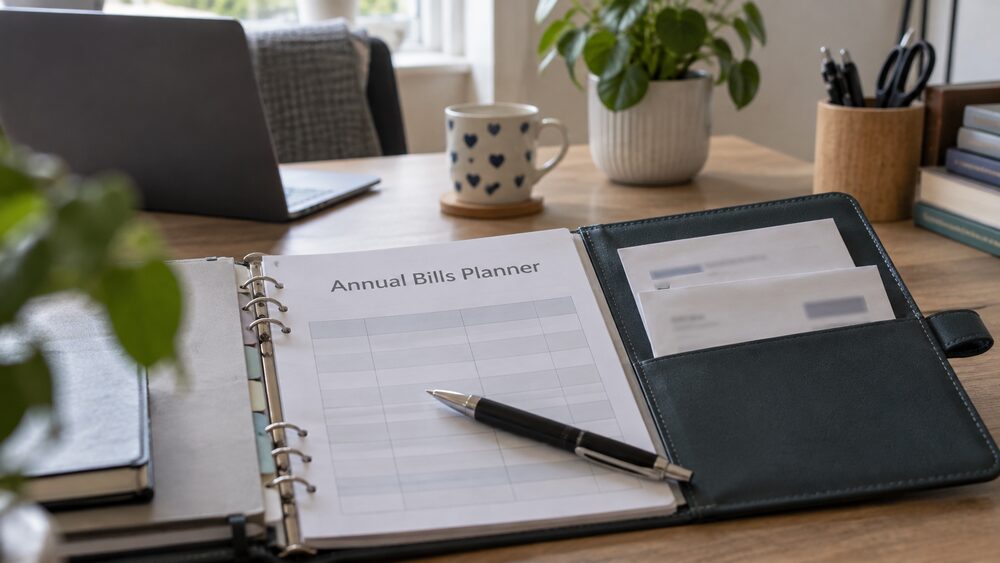
Two bills catch most households out because they are not monthly: Council Tax and the TV licence. Council Tax bills show how much you will pay over the whole year, but the cost is usually split into 10 monthly payments, so two months of the year have no Council Tax going out and the rest carry a heavier load1. A standard TV licence costs £180 per year, and it can be paid weekly, monthly, quarterly or annually3.
Two bills catch most households out because they are not monthly: Council Tax and the TV licence. Council Tax bills show how much you will pay over the whole year, but the cost is usually split into 10 monthly payments, so two months of the year have no Council Tax going out and the rest carry a heavier load1. A standard TV licence costs £180 per year, and it can be paid weekly, monthly, quarterly or annually3.
The fix for both is the same: work out the yearly cost, divide it by 12, and treat that as a monthly bill. That is the method recommended for the TV licence, and it works the same way for Council Tax, where your bill tells you how much you have to pay for the year, how that amount was worked out, and the dates you have to pay5.
There is also a formal route. You can choose to spread Council Tax payments over 12 months instead of the usual 10, which reduces the amount you are asked to pay each time6. Councils may also accept weekly or fortnightly payments5.
Council Tax is billed once a year but paid in instalments
Council Tax is an annual charge collected in instalments. The council will usually tell you to pay your bill in 10 monthly instalments, though it may accept weekly payments9. Some councils will accept payments every week or every two weeks5. In Scotland the cost is usually split into 10 monthly payments, and you may also be able to pay smaller amounts every week, every 2 weeks, or over 12 months instead of 102.
If you rent the whole property, you get a Council Tax bill for the year and can usually pay in monthly instalments11. The bill itself tells you who is registered for Council Tax in your home, how much you have to pay for the year, how that amount has been worked out, and the dates you have to pay2.
To work out what to set aside each month, you need three things: the valuation band for your home, how much your local council charges for that band, and whether you can get a discount or exemption from the full bill12. Your bill sets out the first two, and the discount rules below cover the third. Dividing the yearly figure by 12 gives a monthly amount that stays the same in every month, including the two months when no instalment leaves your account.
Spreading Council Tax over 12 months instead of 10
The default 10 instalment schedule leaves February and March free of Council Tax payments, which is why the other months feel heavier. You can choose to spread your payments over 12 months instead of the usual 10 to reduce the amount you are asked to pay on each occasion6. Councils may agree to this so that the amount of each bill is reduced13, and you can ask for it15.
The practical effect is that the same annual total is divided into 12 smaller payments rather than 10 larger ones, with no payment break in February and March16. In Scotland, the same option exists: if you pay over 10 months, you may be able to pay over 12 months instead16.
The trade-off is straightforward. Twelve instalments lower the monthly figure but remove the two-month gap, so there is no built-in breathing space at the end of the financial year. Ten instalments keep that gap but require a larger monthly amount to be budgeted for. Neither changes the annual total.
Discounts that lower the bill: 25% off if you live alone
The single person discount is the most common reduction. If you live alone, you can get a 25% discount on your Council Tax bill7. The same 25% applies if you are the only adult living in the property18, and the discount is available if you live alone or in a few other circumstances19.
The discount can be larger. If you live alone, or with people who are not counted for Council Tax purposes, you may be eligible for a 25% or even 50% discount14. People who are not counted include some students and some people with a severe mental impairment, which is why a household of several adults can still qualify.
Full-time students are treated separately. Most full-time students should not have to pay Council Tax, but there are exceptions20. One exception is where a student is the sole owner or sole tenant and lives with a non-student adult who is not their partner20. Full-time students also do not pay Council Tax unless they have other non-student adults living with them22.
If you are a carer, or you live with someone who is, there are separate Council Tax reductions worth checking, and the rules differ between England and Scotland13. Council Tax Reduction is the means-tested scheme for people on a low income, and it is claimed from the council rather than through the benefits system.
TV licence: £180 a year, paid weekly, monthly, quarterly or annually
A standard TV licence costs £180 per year3. You can pay weekly, monthly, quarterly or annually4, and the same options are described as weekly, monthly, every three months or yearly23. Dividing the annual cost by 12 and including that amount in your budget is the simplest way to absorb it5.
The licence is not only for a television set. You need a licence to watch BBC programmes using BBC iPlayer, whether you are watching live or watching a downloaded programme, on your TV, computer, tablet or smartphone3. The requirement also applies to watching TV on your phone, tablet or computer4.
There are concessions. If you are registered blind you get 50% off your TV licence5. If you are over 75, it is worth checking whether you can get a free TV licence5. People in residential care or sheltered accommodation who are aged under 75 can buy a special licence costing £7.50 a year per room, flat or bungalow24.
Why Council Tax is a priority debt if you fall behind
Council Tax is a priority debt27. It is a priority debt because the council has strong powers to make you pay28, and it counts as a priority debt whether it is your current bill or any arrears29. Council Tax bills are considered a priority payment because failing to pay on time can have serious consequences30. Council Tax arrears are a priority debt, and the council will want the ongoing Council Tax paid plus an extra amount to clear what is owed31. Priority debts are paid ahead of other debts8.
The escalation is quick. If you miss one of your monthly payments, your council should send you a reminder notice giving you seven days to pay it30. If you miss a payment, your local council could ask you to pay for the whole year at once, and if you still do not pay, they can take you to court32. Your council will send you a final notice saying you must pay the whole year's Council Tax if you miss a payment for the third time6.
If you cannot pay, contact the council before the missed payment becomes a court matter. Councils may agree to spread payments over 12 months instead of the usual 10 so the amount of each bill is reduced13. Free and impartial help is available from MoneyHelper and from debt advice charities such as StepChange and National Debtline, and the Debt section covers the full range of options.
Where the rules differ across the UK
Households in Northern Ireland pay 'rates' rather than Council Tax1. The bill is a different charge with a different name, but it plays the same role in a household budget: an annual local charge that has to be set aside month by month.
In Scotland, the payment options are set out by mygov.scot: the cost is usually split into 10 monthly payments, and you may be able to pay every week, every 2 weeks, or over 12 months instead of 102. If you cannot pay, there is separate Scottish guidance on what happens next27. Carer-related Council Tax reductions in Scotland are covered by Carers Scotland14, and the TV licence concessions are the same UK-wide25.
In England and Wales, the instalment rules, discounts and arrears process described above apply, with the council that covers the property setting the collection schedule. The Money in Scotland, Wales and Northern Ireland section covers how the rules differ in more detail.
If you rent: what your landlord can and cannot charge
Council Tax can be included in the rent where the tenancy agreement says so, but a tenant cannot be required to pay a separate additional payment for Council Tax to the landlord directly34. Your landlord cannot require you to make a separate payment to them for Council Tax35.
If you rent the whole property, you get a Council Tax bill for the year and can usually pay in monthly instalments11. If you are a business tenant, paying the rent each month may make budgeting easier, and you can ask your landlord or the agent about this5.
Sources35 cited
- Paying Council Tax bills StepChange, 2026-09-25
- Pay your Council Tax bill mygov.scot, 2026-04-01
- TV licence concessions Age UK, 2026-08-26
- TV licence fines StepChange, 2026-09-25
- Your business and household budget Business Debtline, 2026-09-26
- Council Tax arrears GOV.UK, 2026-09-26
- Help with your Council Tax Independent Age, 2026-09-26
- Council Tax arrears StepChange, 2026-09-25
- Your priority debts (England and Wales) Business Debtline, 2026-09-26
- Your priority debts (Scotland) Business Debtline, 2026-09-26
- Upfront costs of private renting Shelter England, 2026-05-01
- Council Tax GOV.UK, 2026-09-26
- Help with Council Tax Carers UK, 2026-09-26
- Help with Council Tax in Scotland Carers Scotland, 2026-09-26
- Practical and emotional advice when in debt Scope, 2026-08-05
- Cost of living if you cannot afford essential costs (Scotland) National Debtline, 2026-09-25
- Cost of living if you cannot afford essential costs (England and Wales) National Debtline, 2026-09-25
- Money for parents and babies Maternity Action, 2026-03
- How much deposit do you need for a mortgage Which?, 2026-04-02
- Student money and debt (England and Wales) National Debtline, 2026-09-25
- Student money and debt (England and Wales) Business Debtline, 2026-09-26
- Benefits you may receive while studying One Parent Families Scotland, 2026-04-06
- Budgeting, saving and borrowing Business Debtline, 2026-09-26
- Paying for your TV licence Independent Age, 2026
- Help with your TV licence in Scotland Carers Scotland, 2026-09-26
- Help with your TV licence Carers UK, 2026-09-26
- If you cannot pay your Council Tax mygov.scot, 2026-04-01
- Council Tax arrears (Scotland) Business Debtline, 2026-09-26
- Council Tax debt and IVA StepChange, 2026-09-25
- Paying Council Tax Which?, 2026-04-17
- Debts after death (England and Wales) Business Debtline, 2026-09-26
- Help with Council Tax reduction and discount Scope, 2026-08-11
- Unpaid Council Tax debt StepChange, 2026-09-25
- Fees you can charge as part of a tenancy GOV.UK, 2026-05-01
- Tenant Fees Act 2019 guidance for tenants GOV.UK, 2026-04-07




 MoneyHelperFree, impartial money and pensions guidance, set up by government
 Citizens AdviceFree advice on money, consumer and legal problems in England and Wales
 StepChangeFree debt advice and solutions from a charity
 Turn2usFree benefits calculator and grants search from a charity
 GOV.UKOfficial information on tax, benefits and government services