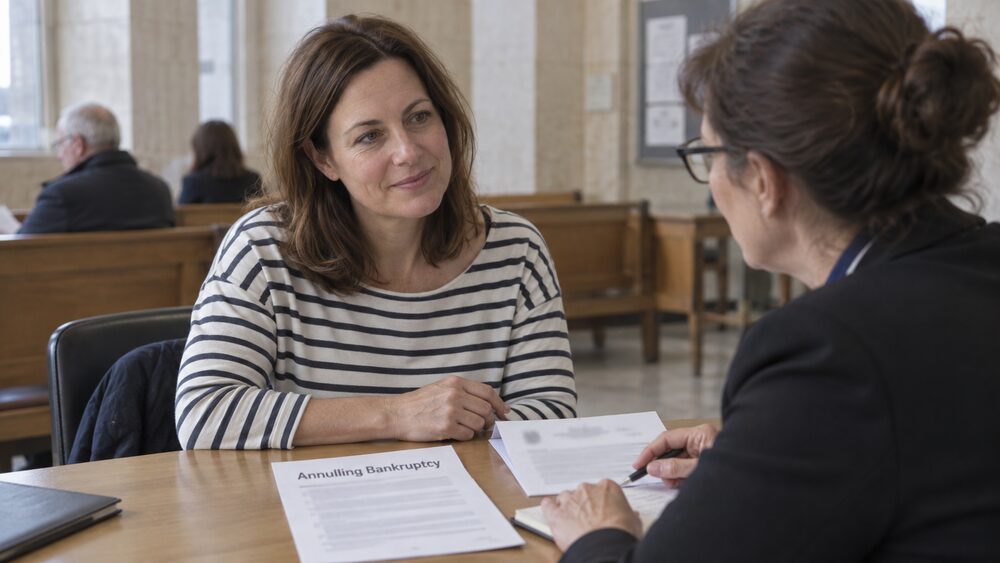
If you want to challenge a bankruptcy order, the first thing to know is that you do not have to work out how on your own, and the help does not cost anything. National Debtline has been giving free professional debt advice for over 30 years, and its advice is free, confidential and independent1. You can reach it by phone on 0808 808 4000, by webchat, or through My Money Steps4.
If you want to challenge a bankruptcy order, the first thing to know is that you do not have to work out how on your own, and the help does not cost anything. National Debtline has been giving free professional debt advice for over 30 years, and its advice is free, confidential and independent1. You can reach it by phone on 0808 808 4000, by webchat, or through My Money Steps4.
An annulment is the route back out of bankruptcy. You can apply to annul whether you made yourself bankrupt or the people you owe made you bankrupt, and you apply to the court that made you bankrupt if you can pay off your debts, secure them, or should never have been made bankrupt in the first place6. The Official Receiver can also annul your bankruptcy even if you do not draw down the money from your pension7.
The rules are not the same across the UK. The process to become bankrupt is different if you live in Scotland or Northern Ireland, and in Scotland the fees and processes differ again8. In Scotland you must speak to a money adviser before you can go bankrupt, and they must sign your bankruptcy application forms10.
Free advice if you want to challenge a bankruptcy order
The advice you need before applying to annul is the same advice you need before going bankrupt in the first place: what the order does, what it does not do, and whether another solution fits better. National Debtline provides free, impartial debt advice as a registered charity, and says it will always be available to give free advice to help people overcome the debt challenges they face1.
An adviser can talk you through the grounds for annulment and what the court will expect. You need to apply to the court that made you bankrupt if you can pay off your debts, secure debts, or should never have been made bankrupt6. If your circumstances have changed since the order, that conversation is where you find out whether annulment is realistic or whether a different route suits you better.
There is a wider point about timing. The rules around debt relief orders have changed, and for some people a DRO will now be a cheaper alternative to full bankruptcy14. A debt relief order may be a cheaper alternative to full bankruptcy for some people, and the changes could help people who are considering bankruptcy16. That matters if you are weighing up whether to challenge an order at all, or whether to ask about a different solution entirely.
Advice is also available beyond the phone line. National Debtline offers phone advice and webchat as alternatives to My Money Steps, so you can choose the channel that suits you4. If you are worried about someone else rather than yourself, there is separate guidance for that too18.
National Debtline: free, confidential debt advice for over 30 years
National Debtline is a charity that has been helping people for over 30 years, and it has been giving free professional debt advice throughout that time1. Its advice is free, confidential and independent, and as a registered charity it provides free, impartial debt advice3.
The service is free to use, always5. That is worth stating plainly, because the market around debt is not uniformly free, and the difference matters when money is already tight. Alongside advice, National Debtline offers free sample letters that you can use to contact creditors in writing20.
What the charity does not do is act as your representative. It will not speak to your creditors or the court on your behalf. What it will do is explain your position, help you understand the options, and give you the tools to write to creditors yourself.
"National Debtline has been giving free professional debt advice for over 30 years."
Phone, webchat or My Money Steps: how to get advice
There are three main ways in. You can call by phone, chat online, or use My Money Steps18. If My Money Steps is not right for you, phone advice and webchat are offered as alternatives4.
The phone number is 0808 808 4000, a freephone number15. The same number is used for free debt advice generally, and for advice on free debt management plans or negotiating reduced payments yourself16. If you have called before and been told a debt management plan is a good option, that is the number to use15.
Webchat runs Monday to Friday 9am to 8pm and Saturday 9:30am to 1pm12. The phone line runs 9am to 8pm, Monday to Friday, and 9:30am to 1pm on Saturday11. Business Debtline, which handles business debts, is open 9am to 8pm, Monday to Friday11.
If you are calling from abroad, the call is not free of charge, even though the service is12. Check what your provider charges before dialling, or use webchat during its hours instead.
Bankruptcy advice in England and Wales differs from Scotland
Where you live changes the process, the fees and who you must involve. The process to become bankrupt is different if you live in Scotland or Northern Ireland8. Bankruptcy in England, Wales and Northern Ireland works in one way, while the fees and processes are different in Scotland9.
In England and Wales, an adjudicator decides your application and can make a bankruptcy order if your centre of main interests is in England or Wales10. The one-off fee is £680 in England and Wales, and fees differ in Northern Ireland13.
In Scotland, you must speak to a money adviser before you can go bankrupt, and they must sign your bankruptcy application forms10. You apply for bankruptcy through an approved money adviser or an insolvency practitioner, and to apply for either type of bankruptcy you must live in Scotland or have an established place of business in Scotland21. For the Minimal Asset Process, you get advice from an approved money advice organisation and the application is then submitted to the Accountant in Bankruptcy23. Full administration bankruptcy can be applied for online with the help of an approved money adviser6.
There is a cross-border wrinkle worth knowing. A bankruptcy order made in England and Wales is not automatically recognised abroad10. If you have assets, work or family ties overseas, raise that with your adviser early.
What a debt adviser cannot do for you
An adviser cannot represent you with creditors or the court, and cannot make the order go away. What the law does instead is stop creditor action once you are bankrupt. The people you owe cannot take any further action against you to recover the debt once you go bankrupt24. They cannot take action to collect your debts during bankruptcy25. That protection extends to people you know: the people you owe cannot take legal action against you after bankruptcy, including people you know14.
The same pattern applies to a debt relief order. Creditors cannot contact you to ask for payment, take you to court, or send a debt collector to your home26. They cannot take action to recover the debts in your DRO, demand payments, or start court action27.
There are limits to how far this reaches. If you have an attachment of earnings order, the trustee can stop the order and discuss your options with you28. If you are on a Debt Arrangement Scheme in Scotland, the programme can be revoked in a list of circumstances, including if you make yourself bankrupt, obtain a protected trust deed, breach a condition, were untruthful, a creditor petitions for bankruptcy, there is a separation in a joint programme, or death29.
Beware of firms pretending to be National Debtline
Some companies cold call people pretending to be National Debtline, Business Debtline or the Money Advice Trust32. Criminal organisations and unlicensed debt management companies regularly pretend to be charities like the Debt Advice Foundation and make unsolicited calls to obtain personal details or sell inappropriate debt solutions33.
The pattern is familiar from other sectors. People may contact you pretending to be a bank or utility company34. Pretending to be a bailiff is a criminal offence14. Credit repair companies that claim to clear debt records should be avoided35, and firms claiming to write off credit card debt make claims that are misleading and could cost you more money, especially where they ask for upfront fees36.
The practical rule is simple: a genuine free debt charity does not cold call you, does not ask for an upfront fee, and does not need your personal details to sell you a solution. If someone rings claiming to be from a charity, hang up and call the charity's published number yourself.
Where to get help and how to complain
Free, impartial help is available from several places. National Debtline is one, on 0808 808 400015. The Insolvency Service provides information on bankruptcy, redundancy, paying off your debts, company insolvency and misconduct of trading companies and partnerships37. If you are dealing with a statutory demand, there is separate guidance on that route38.
If you believe someone is breaking the terms of their bankruptcy restrictions, you can report it. You can report someone you suspect of breaking the terms of a Bankruptcy Restrictions Order or a Bankruptcy Restrictions Undertaking, a Debt Relief Order, or a Debt Relief Restrictions Order or a Debt Relief Restrictions Undertaking39.
For a bankruptcy hearing, the form for a notice of opposition to a bankruptcy order is form Bank 638. If you are in Scotland and need to check your position, the Accountant in Bankruptcy publishes information on how to apply22.
If you are struggling with money more broadly, there are pages on free debt advice, bankruptcy in England and Wales, sequestration and the Minimal Asset Process in Scotland, debt relief orders and what debt solutions cost.
Sources39 cited
- What is the debt avalanche method and how does it work? National Debtline, 2026-09-25
- What is the debt snowball method and how does it work? National Debtline, 2026-09-25
- More help with money problems mygov.scot, 2025-06-04
- My Money Steps National Debtline, 2026
- How to do budget planning: a simple guide to managing your money National Debtline, 2026-09-25
- Cancelling bankruptcy StepChange, 2026-09-25
- Bankruptcy and my pension StepChange, 2026-09-25
- Becoming bankrupt GOV.UK, 2026-09-26
- Bankruptcy and your assets StepChange, 2026-09-25
- Bankruptcy and foreign issues (England and Wales) National Debtline, 2026-09-25
- Free debt advice contacts Which?, 2025-08-26
- How to get debt advice Advicenow, 2026-09-26
- IVA or DRO PayPlan, 2026-05-08
- Bankruptcy and family and friends loans StepChange, 2026-09-25
- Debt management plans (Scotland) National Debtline, 2026-09-25
- Can you get a mortgage with a debt management plan? National Debtline, 2026-09-25
- Emergency situations (Scotland) National Debtline, 2026-09-25
- Worried about someone National Debtline, 2026-09-25
- Debt help and advice in Scotland: your options explained National Debtline, 2026-09-25
- Can debt collectors come to your house and take your belongings? National Debtline, 2026-09-25
- Bankruptcy information document Accountant in Bankruptcy, 2026
- How do I apply for bankruptcy Accountant in Bankruptcy, 2026-07-15
- Minimal assets process StepChange, 2026-09-25
- How to go bankrupt StepChange, 2026-09-25
- Bankruptcy court hearing StepChange, 2026-09-25
- Creditor contact on a DRO StepChange, 2026-09-25
- What happens on a debt relief order StepChange, 2026-09-25
- Attachment of earnings StepChange, 2026-09-25
- Debt Arrangement Scheme (DAS) Business Debtline, 2026-09-26
- How bankruptcy affects me StepChange, 2026-09-25
- Bankruptcy and insurance StepChange, 2026-09-25
- Making sure it's us Money Advice Trust, 2026
- Debt advice fraud alert Debt Advice Foundation, 2026-02-26
- Phone calls about debt StepChange, 2026-09-25
- County court judgments and your credit rating Citizens Advice, 2026-09-25
- Writing off credit card debt StepChange, 2026-09-25
- Get help from the Insolvency Service GOV.UK, 2026-09-27
- Statutory demands (England and Wales) Business Debtline, 2026-09-26
- Complain about someone bankrupt GOV.UK, 2026-09-27





 StepChangeFree debt advice and solutions from a charity
 National DebtlineFree debt advice by phone, webchat and online
 MoneyHelperFree, impartial money and pensions guidance, set up by government
 Citizens AdviceFree advice on money, consumer and legal problems in England and Wales
 Citizens Advice ScotlandFree advice across Scotland