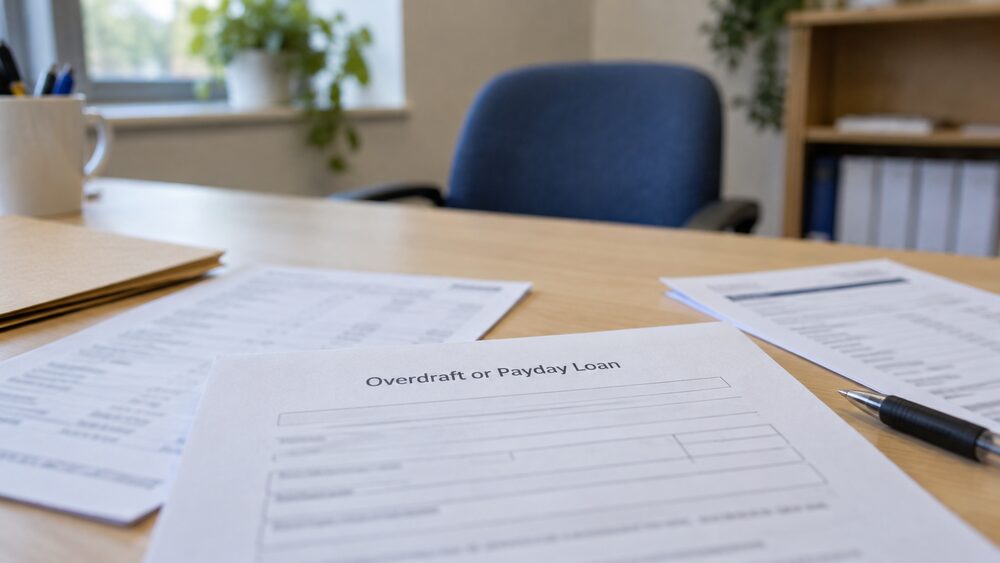
If you need a small amount of money for a short time, the two routes most people weigh up are an overdraft and a payday loan. They are not priced in the same way, and the cheaper one depends on how long you borrow and whether you stay inside an agreed limit.
A current account is the account you use to manage money day-to-day: paying bills, receiving money such as a salary or benefits, and keeping track of spending1. Opening one usually means being aged 18 or over and a UK resident, though some banks accept applications from people aged 16 and over, and many require you to be resident in the United Kingdom2. Most banks will run a credit check to see your credit history, including whether you have had problems paying money back, and will ask for a driving licence or passport to prove your identity, or a photo if you are applying online, often along with a selfie1.
The comparison that matters most is not the headline rate but what happens when something goes wrong. An unarranged overdraft, where you spend more than you have without agreeing it in advance, can trigger penalty charges, daily fees and interest at the same time, and in many cases an unauthorised overdraft costs more than a payday loan3.
Overdraft rates: often up to 40% APR until paid back
An overdraft is a borrowing facility attached to your current account. Interest on all overdrafts is charged at a single annual interest rate (APR), which makes charges easier to compare between accounts than the old system of daily and monthly fees2. Banks and building societies charge between 19% and 40% or more APR, and current accounts often charge daily interest up to 40% until the money is paid back1.
Credit union current accounts work in a similar way, with access to borrow using an overdraft normally carrying daily interest up to 42.6%6. That is a higher ceiling than the bank range, so a credit union account is not automatically the cheaper place to borrow.
The 2020 rule changes reshaped how these charges work. Rates must now be calculated as a percentage of the amount borrowed, and fixed fees and charges were banned7. The same changes brought the end of unarranged overdrafts, and banks cannot increase interest and fees once you reach your overdraft limit8. The effect is that an overdraft became cheaper if you do not use it often or use it in small amounts, and more expensive for people who stay deep in it for long periods8.
An overdraft is also repayable on demand. That means the bank can ask you to pay the whole amount back in one go if it chooses to, and your bank can withdraw or reduce your overdraft at any time, without notice9. That single feature is what separates an overdraft from a loan with a fixed term: the money is not yours for a set period, and the terms can change underneath you.
An unarranged overdraft can cost more than a payday loan
An unarranged overdraft happens when you spend more than you have in your bank account without agreeing it in advance, including going over the limit of an arranged overdraft2. The regulator defines it as a regulated credit agreement that arises when a personal current account becomes overdrawn in the absence of an arranged overdraft, or when the firm makes available funds that exceed the limit of an arranged overdraft11.
The pricing of unarranged borrowing has historically been severe. The regulator found that for unarranged overdrafts the price regularly exceeds the equivalent of an interest rate of 10% per day, and for 15% of users the effective daily rate is over 20% per day4. Banks made around 10 times more revenue from unarranged overdrafts than from arranged ones, and in some cases unarranged borrowing cost more than a payday loan4.
A worked example from 2019 shows how far this could go. TSB had the most expensive bank accounts for unarranged overdrafts, where borrowing £100 over a week would cost £76.3512. TSB charged a combination of interest, monthly fees and daily fees on unplanned overdrafts: a £6 a month usage fee, 19.84% EAR, and £5 a day on borrowing up to £25 and £10 a day on borrowing above £254.
The concentration of these costs fell on a small group. Customers using an overdraft every month borrowed 81% of all overdraft lending and paid 69% of all arranged, unarranged and refused payment fees4. People with unpredictable incomes were at least twice as likely to have used overdrafts and incurred charges on them, and five times more likely to have used high-cost credit, than those with stable incomes14.
Unpaid transaction fees when there is not enough money
When a payment cannot be covered, the charge is usually called an unpaid transaction fee1. There are usually fees or interest if you spend more than you have in your account, including if there is not enough to cover a Direct Debit or standing order15. Banks will charge a fee to cover payments where there is not enough money in your account16.
The payday loan side of this comparison is capped. Default fees, the amount you can be charged if you do not pay back the loan on time, are capped at £15.005. That cap is a hard limit set by the regulator, and it applies however large the loan was.
The bigger risk with a payday loan is not the default fee but the rollover. If you cannot repay the full amount in time, the loan rolls over, the debt escalates and you could get into financial difficulty17. The consequences of non-payment are an outstanding balance, added interest, and extra fees and charges18. A payday loan refund complaint can cover the interest the company added to your loan amount, charges added if you could not repay on time, and an extra 8% interest if you take your complaint to the Financial Ombudsman Service19.
| What triggers a charge | Overdraft | Payday loan |
|---|---|---|
| Going over an agreed limit | Interest and, historically, daily or monthly fees4 | Not applicable |
| A payment with no money to cover it | Unpaid transaction fee1 | Not applicable |
| Failing to repay on time | Interest continues; bank can demand the full amount9 | Default fee capped at £15.005 |
| The debt rolling over | Bank can withdraw the facility without notice8 | Loan rolls over and the debt escalates17 |
Overdraft or payday loan: how each affects your credit history
Overdraft usage shows up on your credit report21. The regulator expects that customers' access to, and use of, an overdraft facility will be reported on their credit file in the usual way22. Your credit rating can be affected if you often go over your overdraft limit or owe too much on your overdraft8.
Both overdrafts and payday loans sit in the group of borrowing that charges higher interest. Certain types of borrowing, such as overdrafts, revolving credit on your credit card and payday loans, charge higher interest23. That matters because a lender looking at your file sees not just whether you borrowed, but what kind of borrowing it was and whether you stayed inside the terms.
The pattern of use is what lenders read. Staying inside an agreed limit and clearing the balance is a different signal from repeatedly exceeding the limit or carrying a large balance month after month8. For payday loans, the ombudsman has looked at cases where a loan was given that the borrower could not afford, and ordered lenders to refund the interest and charges that had increased the cost of the loan24.
Clearing an overdraft before you close or switch your account
If you are using your overdraft, you have to pay it back before you can close your account, and you lose access to statements once it closes, so it is worth keeping copies if you need them1. That is the straightforward part. Switching is more flexible than many people assume.
You can switch using the Current Account Switch Service even if you are overdrawn2. If your new bank offers an overdraft that covers what you owe, the funds are sent to your old bank and you owe the overdraft balance on the new account instead. If the new limit is a lower amount, or you cannot get one, you need to arrange to pay off the remainder separately before you can switch or close your old account1.
Some providers will even let you switch if you have a large overdraft debt outstanding, though there may be a charge to do this25. Others will not, and the general position is that if you are currently overdrawn you might not be able to switch until you have paid off the overdraft26.
There is a trap worth knowing about if you open a basic bank account at the same bank where you already have an overdrawn account. The bank may use the money in the new basic account to pay off debts in the old overdrawn account, so if you receive benefits, tax credit or state pension it is worth considering opening at a different bank27. Once the overdraft is cleared, you can ask the bank to reduce or remove the overdraft, or switch to a basic bank account with no overdraft, and you can separate the overdraft from day-to-day banking by setting up a new account with no overdraft10.
When overdraft terms change and what you can do
The rules on how overdrafts can be priced changed in 2020. Rates must now be calculated as a percentage of the amount borrowed, and fixed fees and charges were banned7. The changes brought the end of unarranged overdrafts, and banks cannot increase interest and fees once you reach your overdraft limit8. The new rules brought a ban on fixed daily and monthly overdraft fees and stopped banks charging higher fees for unarranged overdrafts13.
For customers who were worse off after the April 2020 changes, there is a route to ask for help. Banks might reduce or waive interest, offer a continuation of overdraft borrowing at the current rate of interest, or agree on a repayment programme possibly including a personal loan2. For customers in temporary difficulty, the cost of the overdraft should be no higher than the customer was expected to pay, taking into account any non-contractual waivers of interest, when the revised guidance came into force28.
The underlying risk does not change with the rules, though. An overdraft is repayable on demand, so a bank can ask you to pay the whole amount back in one go if it chooses to29. Your bank can withdraw or reduce your overdraft at any time, without notice8. That is why an overdraft is described as an expensive way to borrow, and why it is worth treating the limit as something that can disappear rather than a fixed facility9.
Complaints about overdraft charges and where to get help
If you think a charge was wrong, the first step is to contact your bank. Customer services is the starting point, then a formal complaint, which the bank has eight weeks to investigate and answer with a final response. If you still do not agree, or the eight weeks pass, you can take the complaint to the free Financial Ombudsman Service1.
The volume of complaints shows this is a live issue. The ombudsman opened 5,863 complaints about overdrafts in 2025/2630. In Q4 2024/25, 50% of overdraft complaints were upheld31, and in Q1 2025/26 the ombudsman recorded 1,100 overdraft complaints32. For context, current accounts as a whole generated 8,945 complaints in Q1 2026/2733, 7,800 in Q1 2025/26 with a 28% uphold rate32, and 8,542 in Q3 2025/26 with a 27% uphold rate34.
Payday lending has its own complaint history. In a sample of payday loan complaints, 17% of non-fraud cases involved loans lasting 76 days or more35. One case involved a borrower, Rik, who wanted the lender to refund the interest and charges, which had increased the cost of his loan24. The ombudsman has also published findings on payday lending more broadly36.
If you are comparing the two routes, the wider options sit alongside each other. An overdraft is a facility on your current account, while a personal loan is a fixed sum repaid over an agreed term, and the two behave very differently when your circumstances change. If you are weighing up whether to move your banking, the Current Account Switch Service handles the mechanics, and if you are already overdrawn there is a guide to switching while overdrawn.
Sources36 cited
- How to open, switch or close your bank account MoneyHelper, 2026-09-25
- Overdrafts explained MoneyHelper, 2026-09-25
- Extortionate overdraft fees to be banned as regulator clamps down on bank borrowing Which?, 2018-12-18
- Banks banned from charging extortionate overdraft fees Which?, 2020-02-01
- Payday loans nidirect, 2026-02-25
- Credit union current accounts MoneyHelper, 2026-09-25
- Overdraft rules: research briefing House of Commons Library, 2026-07-08
- Overdrafts: things to consider StepChange, 2026-09-25
- Overdraft debt StepChange, 2026-09-25
- How can I stop living in my overdraft? StepChange, 2026-09-25
- CONC 5C.5.1R: unarranged overdraft definition FCA Handbook, 2019-05-30
- Will the base rate rise hit your credit card bill? Which?, 2019-06-07
- How to pay off your overdraft before April's rate changes Which?, 2020-02-01
- Why adults regularly use credit for food and bills University of Bristol, 2020-09
- Choosing a bank account for your Universal Credit payment MoneyHelper, 2026-09-25
- Payday loan calculator StepChange, 2026-09-25
- Loans nidirect, 2025-09-30
- Payday loan debt StepChange, 2026-09-25
- Payday loans (Scotland) Business Debtline, 2026-09-26
- Payday loans (England and Wales) Business Debtline, 2026-09-26
- What's the best way to borrow money at Christmas? Which?, 2023-12-10
- Finalised guidance: overdrafts and coronavirus FCA, 2020-07
- What do I need to know about debt? Bank of England, 2025-08-19
- Given a payday loan he couldn't afford Financial Ombudsman Service, 2026-09-27
- Graduate overdrafts StepChange, 2026-09-25
- Making the most of your bank account Independent Age, 2026-09-26
- Getting a bank account (Scotland) Citizens Advice Scotland, 2026-09-26
- Overdraft repeat use rules FCA Handbook, 2020-07
- Safe bank accounts (England and Wales) National Debtline, 2026-09-26
- Annual complaints data and insight 2025/26 Financial Ombudsman Service, 2025
- Quarterly complaints data Q4 2024/25 Financial Ombudsman Service, 2024
- Quarterly complaints data Q1 2025/26 Financial Ombudsman Service, 2025
- Quarterly complaints data Q1 2026/27 Financial Ombudsman Service, 2026
- Quarterly complaints data Q3 2025/26 Financial Ombudsman Service, 2025
- Payday lending report Financial Ombudsman Service, 2026-09-27
- Ombudsman news issue 145 Financial Ombudsman Service, 2018



 MoneyHelperFree, impartial money and pensions guidance, set up by government
 FSCSProtects your money if a bank, insurer or investment firm fails
 Financial Ombudsman ServiceFree, independent help when a complaint about a firm is not put right
 Citizens AdviceFree advice on money, consumer and legal problems in England and Wales