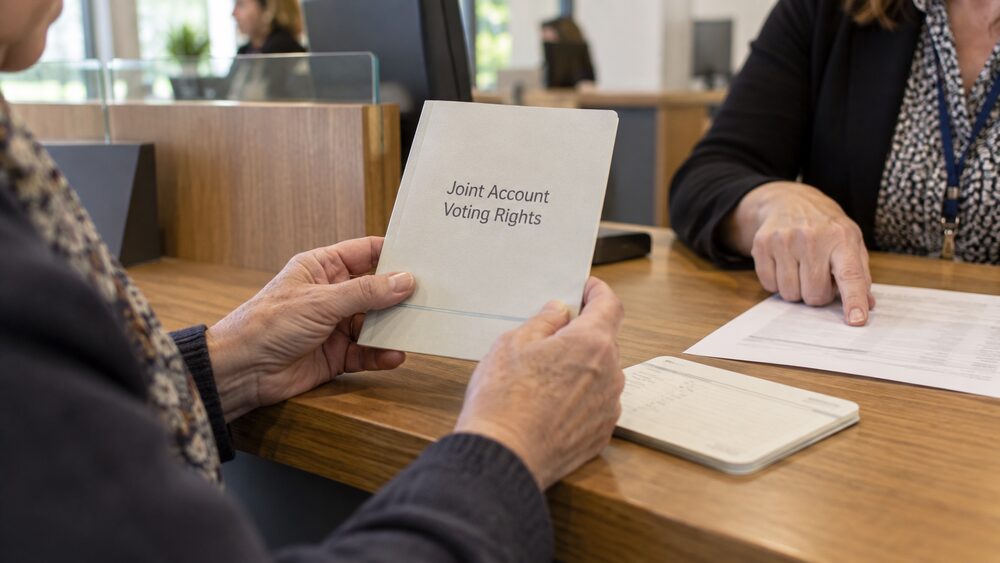
If you hold a joint savings account or mortgage with a building society, you might assume you both have the same say in how the society is run. In most cases you do not. The standard rule across the sector is that only the first named holder on a joint account gets the full set of member rights, including the right to vote at the annual general meeting. The second and later named holders are usually members too, but with fewer rights, mainly the right to receive information1.
Nationwide puts it plainly: both holders of a joint current account become members, but only the first named account holder has the right to vote on Nationwide matters3. Coventry Building Society says the same: if you have a joint account, only the first named account holder can vote4. Market Harborough Building Society's savings terms confirm that only the first named saver is entitled to membership rights, including the right to receive notices of, and to attend and vote at, meetings of the society5.
This matters because building societies are mutual organisations. When you open a savings account or take out a mortgage, you become a member, not just a customer6. That membership gives you a say in how the organisation is run, including decisions about charity partnerships and how the society is managed7. But on a joint account, that say is concentrated in one name.
What member rights on a building society account cover
Building societies are mutuals, which means most customers who have a savings account or mortgage are members and have certain rights that come with being a member2. You become a member when you open a savings account or take out a mortgage with a building society6. Holders of share accounts are members of the society and bound by its rules5.
As a member, you have rights to receive information and to voice your opinions on the way your building society is run1. Those information rights include a copy of the society's rules and memorandum on request, a copy of the annual summary financial statement, a copy of the detailed annual report and accounts, and notice of the AGM2. Shareholders can vote in elections for the board of directors, attend annual general and other meetings and, providing the correct procedures are followed, propose motions or stand for election themselves7.
Building societies operate on the principle of one member, one vote2. That means your vote counts the same whether you have £100 or £100,000 in your account. If you are both a saver and a borrower with a society, you will still normally have just one vote, except when asked to vote on a conversion or merger, when two separate votes are given2.
The AGM must be held within four months of the end of the society's financial year2. The majority of societies have a financial year ending in December, and usually hold their AGMs in the following April2.
| Right | What it covers |
|---|---|
| Information | Rules and memorandum, annual summary financial statement, annual report and accounts, AGM notice2 |
| Voting | One vote per member, regardless of balance2 |
| Meetings | Attendance at the AGM and other meetings7 |
| Standing | Proposing motions or standing for election, following the correct procedures7 |
Where the second and later joint holders stand
The Building Societies Association explains that where there are joint holders of a share account, only the first named account holder is entitled to all of the members' rights. The second or subsequent named holders are entitled to fewer rights, mainly regarding obtaining information2.
That does not mean the second named holder is not a member. Nationwide confirms that both holders of a joint account become members, but only the first named holder has the right to vote3. Yorkshire Building Society states that joint account holders are all members but only the first named person is eligible to vote at the annual general meeting8.
Some societies take a different approach. Suffolk Building Society says that if there are multiple account holders, the society will transfer voting rights to the account holder who has been a member with them for the longest period9. Monmouthshire Building Society states that where an account is held jointly, voting rights are normally exercised by the first named account holder10.
There is also a category of restricted member. Saving members with less than £100 in their account, borrowing members with a mortgage of less than £100, and members under the age of 18 have restricted rights, allowing them only to receive information on request. They cannot vote, nominate directors or speak at AGMs2.
Does the order of names on a joint account matter?
For day to day banking, the order of names usually makes no difference. Most joint accounts are set up as either-to-sign, where each account holder can give payment and withdrawal instructions independently11. Each account holder can withdraw money without asking the other person12.
The order of names also does not affect how payments are matched. Handelsbanken says that for joint accounts, you only need to provide the name of one of the account holders, and the order of names does not affect the matching response13. Leek Building Society says the same: you only need to provide one of the names registered to the account, and name order does not affect the matching response14.
But for member rights, the order is everything. The first named holder is the one whose membership carries the voting rights in most societies3. The order is set when the account is opened and appears on your statements and account paperwork.
There is one area where the order of names can matter for payments: some societies ask for the full name of both account holders as they appear on the account when setting up certain payment arrangements15. Teachers Building Society takes the opposite approach, saying that if the account is in joint names, the name of only one of the account holders should be used16.
Changing who is named first on a joint account
If you want to change which holder is named first, you will need to contact your society directly. There is no general rule on how societies handle this, so the process will depend on your society's own terms and conditions.
What is clear is that the order of names is not something you can change yourself through online banking. It is a formal change to the account record. Family Building Society notes that for joint accounts, each account holder will need to register separately if they would like online access17. That is about access, not about changing the order of names.
If you want your own member rights, one option is to open a separate sole account in your own name. Many societies allow this. Yorkshire Building Society says many of its savings accounts can be opened as joint accounts18, which implies sole accounts are also available. But some accounts cannot be held jointly at all. Bath Building Society's One Year Fixed Rate ISA can only be opened by one person and cannot be a joint account19. Its Instant ISA has the same restriction: only one account holder, no joint accounts, and only one Instant ISA per person with Bath Building Society20.
Member rights on a joint account compared with a sole account
On a sole account, you are the first named and only holder. You get the full set of member rights: the right to vote, to receive information, to attend meetings and to stand for election7. On a joint account, only the first named holder gets those rights2.
The practical difference is stark. If you hold a joint account and you are not the first named holder, you cannot vote at the AGM, you cannot nominate directors, and you cannot speak at AGMs2. You may still receive information about the society, but you do not have a say in how it is run.
| Sole account | Joint account | |
|---|---|---|
| Who is a member | You | Both holders, in many societies3 |
| Who can vote | You | First named holder only, in most societies2 |
| Information rights | Full | Full for the first named holder, limited for others2 |
| Speak at AGM | Yes | First named holder only2 |
| Nominate directors | Yes | First named holder only2 |
There is one exception worth knowing about. Holders of Permanent Interest Bearing Shares (PIBS) are members of the issuing building society and are entitled to voting rights22. PIBS are a type of investment, not a savings account, so this is unlikely to affect most joint account holders.
For tax purposes, interest earned in a joint account is usually split equally between each person, with tax only due if a share is above the annual allowance23. If you have a joint account, you only enter your share, usually 50%, of the interest received on form P53Z24.
Would a joint holder share in a windfall if a building society converted or merged?
This is one of the most common questions about building society membership, and the answer depends on the type of account and the society's rules.
Market Harborough Building Society states that holders of deposit accounts are not members of the society and have no entitlement to attend or vote at meetings, or receive windfall benefits5. For share accounts, the position can be different. The society's savings terms say that where the transfer to a successor is publicly announced within five years of the day on which you become a holder of an account, windfall benefits may be assigned to charity25.
The legislation on building society bonuses excludes any bonus, distribution of funds or the conferring of rights in relation to shares in connection with an amalgamation, transfer of engagements or transfer of business of a building society26. That means the statutory framework sets limits on what counts as a windfall in those circumstances.
If a society converts or merges, the terms set out who qualifies. The first named holder is normally the one whose membership counts. The Building Societies Association's guidance on member rights is a starting point for understanding what applies in your case1.
Where to check your society's rules and get help
The rules on joint account member rights are set out in each society's terms and conditions. These are the documents you received when you opened the account, and they are also available on the society's website.
For a general explanation of what member rights are and how they work, the Building Societies Association publishes a consumer factsheet on your rights as a building society member1 and a leaflet on the same subject2. These are independent guidance, not the rules of any one society.
If you are unsure which holder is named first on your account, contact your society directly. The order of names appears on your statements and account paperwork. If you need to change it, your society will explain the process.
For free, impartial help with money questions, MoneyHelper is the government-backed service23. If you are struggling with debt, StepChange offers free advice21. If you have a complaint about your society that you cannot resolve, the Financial Ombudsman Service can look at it.
"As a member of a building society you are more than just a customer; unlike a depositor with, or borrower from, a bank you have certain rights."
Sources27 cited
- Your rights as a building society member Building Societies Association, 2014-05-22
- Your rights leaflet Building Societies Association, 2012-02
- Get a joint current account Nationwide Building Society, 2026
- Member rights Coventry Building Society, 2026
- Savings terms and conditions Market Harborough Building Society, 2025-08-10
- What is a building society Yorkshire Building Society, 2026-09-26
- Difference between a shareholder and a depositor Building Societies Association, 2022-01-08
- Mortgage conditions 2026 Yorkshire Building Society, 2026
- When an investment account holder dies Suffolk Building Society, 2026-08-20
- FAQs Monmouthshire Building Society, 2026-09-26
- Savings A-Z jargon buster Family Building Society, 2026-09-26
- Dementia and managing money nidirect, 2026-09-03
- Confirmation of Payee Handelsbanken, 2026
- Savings FAQs Leek Building Society, 2026-09-26
- Confirmation of Payee Coventry Building Society, 2026
- Confirmation of Payee leaflet Teachers Building Society, 2024-10
- Online service FAQs Family Building Society, 2026-09-26
- Joint savings accounts explained Yorkshire Building Society, 2026-09-26
- One Year Fixed Rate ISA Bath Building Society, 2026-09-25
- Instant ISA Bath Building Society, 2026-09-25
- Debt myths true or false StepChange, 2026-09-25
- What are PIBS Building Societies Association, 2014-06-15
- Joint accounts MoneyHelper, 2026-09-25
- Form P53Z HM Revenue & Customs, 2025-04
- Mortgage and savings accounts bereavement Family Building Society, 2026-09-26
- The Building Societies (Accounts and Related Provisions) Regulations 2006 legislation.gov.uk, 2006-11-30
- FCA Handbook instrument 2008/64 Financial Conduct Authority, 2008-11-26






 MoneyHelperFree, impartial money and pensions guidance, set up by government
 FSCSProtects your money if a bank, insurer or investment firm fails
 Financial Ombudsman ServiceFree, independent help when a complaint about a firm is not put right
 Citizens AdviceFree advice on money, consumer and legal problems in England and Wales