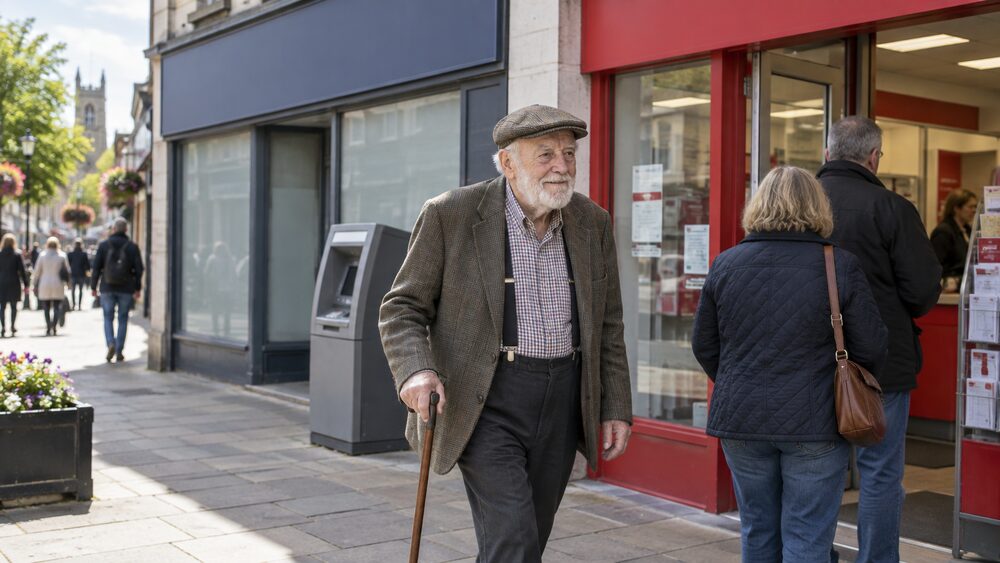
The UK still has a large cash and banking network, but it is shrinking fast. Banks and building societies have closed 6,871 branches since January 2015, at a rate of around 53 each month1. Between 2012 and 2022, the total number of bank and building society branches in the UK fell by 40%2. Already there have been 314 branches scheduled for closure in 2026, including 116 from Lloyds, 88 from Halifax and 40 from Santander3.
What replaces them is a mix of Post Office counters, shared banking hubs and cash machines. The Post Office has 11,500 branches, a figure the government requires it to maintain4. As of 19 August 2025, 178 banking hubs had been opened across the UK3. And in the second half of 2025, 99.6% of the UK urban population lived within 1 mile of a free-to-use cash access point offering withdrawals5.
This page sets out what each type of access point offers, why the numbers keep falling, how the rules protect access to cash, and what you can do if your local branch or ATM closes.
Bank branches, ATMs and Post Office counters: what each one offers
The three main ways to do your banking in person are not interchangeable. Each covers a different set of tasks.
A bank or building society branch is the fullest service. It handles everything from opening accounts to complex queries, and it is where you go for advice and problems that cannot be solved elsewhere. Building societies and mutual-owned banks operate approximately 1,300 branches, a 30% share of branches across the UK7.
A Post Office counter is narrower but far more widespread. You can pay in cash and cheques, withdraw money and check your balance over the counter8. Some branches also have free-to-use ATMs, either inside or outside9. The services available depend on who you bank with, and include withdrawing cash, paying in cheques, checking your balance or paying bills10. The Post Office network has 10,861 branches in total, of which 9,347 are standard branches and 1,514 are mobile or outreach branches5.
A cash machine is the simplest option: withdrawals, balance checks and sometimes deposits, with no staff involved. Most UK ATMs let you take cash out with cards that use any of several different payment networks, most commonly LINK, Visa and Mastercard11.
| Access point | Typical services | Coverage |
|---|---|---|
| Bank or building society branch | Full service, including account opening and advice | Around 1,300 building society branches, a 30% share of UK branches7 |
| Post Office counter | Cash and cheque deposits, withdrawals, balance checks, bill payments | 11,500 branches4 |
| Cash machine | Withdrawals, balance checks, some deposits | Around 60,000 ATMs12 |
| Banking hub | Counter services plus community bankers from individual banks | 178 opened by 19 August 20253 |
Why the number of bank branches keeps falling
The number of bank branches and cash machines has been falling over the past decade, as consumers increasingly use online banking and digital payments4. That is the single driver behind almost every closure figure on this page.
The long-run picture is stark. The number of bank branches in the UK roughly halved from 1986 to 2014, and closures are expected to continue13. More recently, banks and building societies have closed 6,871 branches since January 2015, at a rate of around 53 each month1. There were 410 closures in 2024, including 90 from Barclays, 83 from Lloyds, 76 from Halifax, 68 from NatWest and 31 from Bank of Scotland3. Closures continued into 2022, with a final count of 662 by the end of the year1. Some 792 branches closed in 20181, and 444 shut in 20191. In 2020, the lowest number of branch closures was recorded at 369, as several banks shelved plans due to the pandemic1.
The pace has not been even. The number of brick-and-mortar branches of the larger banks and building societies providing personal current accounts fell by 429 branches, a decrease of 8.6%, between 2022 Q2 and 2022 Q414. In 2023 Q1, the number of brick-and-mortar branches of the larger banks and building societies providing cash services fell by 90 branches, a decrease of 2%15. In 2023 Q2, that same measure fell by 210 branches, a decrease of 4.7%6.
For consumers, the practical effect is that the branch you use may not be the branch that stays open. The Access to Banking Standard and arrangements to provide some banking services via the Post Office are the main measures in place to reduce the impact of closures13.
Free and fee-charging ATMs: how the network is changing
The UK has around 65,000 ATMs, and almost all are connected to the LINK system16. Around 53,000 of them are free to use for consumers16. Free-to-use ATMs generate fees for their providers through per-transaction ATM interchange fees that are paid by the card issuing banks and building societies16.
The free network is shrinking. There was a 4.1% decrease in the number of free-to-use ATMs while the number of pay-to-use ATMs dropped by 6.3% between 2022 Q2 and 2022 Q4, a period of 10 months14. In the 2 years to Q1 2023, 1,391 bank and building society branches closed, as did 2,176 free-to-use ATMs17.
The Payment Systems Regulator oversees LINK, the ATM network, making sure people and businesses have access to cash across the UK18. LINK runs an ATM Community Request scheme and a Retail Centre policy, which let communities ask for cash access where provision is thin19. The regulator has also consulted on protected ATMs, which are cash machines it designates as necessary to local provision16.
Banking at the Post Office: what you can and cannot do
The Post Office is the widest in-person banking network in the country. According to UK Finance, 99% of retail banking customers can carry out basic banking at the more than 11,500 Post Offices across the UK3. The government has said that 99% of personal banking needs and 95% of business banking needs can be done through the Post Office network4.
What you can do depends on your bank. Post Offices offer simple banking facilities, such as withdrawing and depositing cash and cheques, for customers of nearly all banks20. You can access cash withdrawals at all Post Office branches21. Most banks also offer some banking services through local post offices22, and all basic bank accounts offer the facility to withdraw cash at a local Post Office23.
What you cannot do is everything. Post Office counters do not open accounts, arrange overdrafts, discuss mortgages or handle complaints in the way a branch does. The services are limited to withdrawing money, paying in cash and cheques, and checking your balance24. Some banks will let you cash a current account personal cheque or use your cash card at the Post Office, free of charge25.
"You can do your banking in a Post Office if it's nearer or easier than one of our branches."
Limits on Post Office withdrawals and deposits
Each bank sets its own limits for cash withdrawals and deposits27. The amount you can withdraw in a Post Office branch will depend on any withdrawal limits in place on the specific account you hold with your bank21.
In practice, some Post Offices will not allow you to withdraw more than £1,00028. Some Post Office branches only allow cash deposits up to a limit of £1,000, so it is worth checking at your local branch28. For cash machine withdrawals at a Post Office, standard cash machine withdrawal limits still apply29.
Some banks combine the two. Bank of Scotland customers have an £800 daily cash machine limit, and Post Office counter withdrawals count towards it: if you withdraw £300 over the Post Office counter, you can only withdraw a further £500 from a cash machine that day30.
The Post Office Travel Money Card has its own rules: a daily withdrawal limit of £300 per day over the counter in pounds sterling, and cash machine withdrawals limited to £300 per day with a maximum of 3 withdrawals31.
Banking hubs and other shared services
A banking hub is a shared face-to-face banking service for a community that has lost its branches. Banking hubs provide face-to-face banking services and are operated by the Post Office4. They are owned by Cash Access UK and run by Post Office27, and funded by Cash Access UK32.
Anyone with an account at a participating bank can use one, even if their bank has branches nearby32. Hubs provide counter services run by Post Office staff, where personal and business customers of any bank signed up to the scheme can do their everyday banking3. They also offer extra support for those who need it, including community bankers from their own bank on specific days27.
The numbers have grown quickly. As of January 2024, there were 31 banking hubs in operation across the UK33. As of 19 August 2025, 178 banking hubs had been opened across the UK3. LINK, the industry appointed body responsible for undertaking cash access assessment, has recommended 77 banking hubs30. There are now over 70 temporary hubs open, ensuring that cash access provision remains continuous while permanent hubs are being set up30.
Hubs are not the same as Post Office branches. While they are operated by Post Office, banking hubs are not regular Post Office branches8. They are opening in some areas, but not yet everywhere27.
How access to cash is protected: what the FCA's coverage rules require
Banks and building societies must protect access to cash34. The rules mean they must review how easy it is for you to get cash in your local area, including paying in and taking out cash, notes and coins, and fill significant gaps34.
Reviews are triggered by changes to services, for example if a branch, cash machine or Post Office closes or changes its opening hours, and by cash access requests from local residents, businesses and representatives34. When reviewing, firms look at a range of factors, including how long it takes and how much it costs for people to travel to get cash34. Where gaps are found, the fix could include ATMs, banking hubs or adapting Post Office branches34.
The coverage data shows how well this works in practice. In 2025 H2, 97.2% of the UK urban population were within 1 mile of a free-to-use cash access point offering deposits, and 99.6% were within 1 mile of one offering withdrawals5. In 2023 Q2, 98.6% of the UK rural population were within 3 miles of a free-to-use cash access point offering withdrawals, and 98.2% were within 3 miles of one offering deposits6.
The FCA has also set out expectations for firms when implementing branch or ATM closures, including considering the likely impact on customers, communicating changes clearly and in good time, and taking appropriate steps to ensure customers can continue to have appropriate access to banking and cash services35. Guidance says branches should not be fully or partially closed until reasonable, fit-for-purpose alternatives are in place36.
What to do if your local branch or ATM closes
The first step is to check what is still nearby. LINK's Cash Locator gives the location of ATMs, bank branches, post offices and banking hubs37. You can find out your nearest ATM by using LINK's Cash Locator11.
If your branch closes, Post Office banking is usually the quickest substitute. Post Offices offer simple banking facilities, such as withdrawing and depositing cash and cheques, for customers of nearly all banks20. Basic bank accounts in particular offer the facility to withdraw cash at a local Post Office23.
If a closure leaves a genuine gap, the rules give you a route to raise it. The FCA's rules mean banks and building societies must review how easy it is to get cash in your local area and fill significant gaps34. Reviews can be triggered by cash access requests from local residents, businesses and representatives34. LINK also runs an ATM Community Request scheme and a Retail Centre policy19.
The wider policy picture is still moving. The FCA has been given new powers to enforce cash access and could stop banks and building societies from closing cash access services if there was no suitable alternative38. The government's Cash Access Policy Statement covers access to cash deposit and withdrawal services for relevant personal and business current accounts across the UK39.
Sources39 cited
- Bank branch closures: is your local bank closing? Which?, 2026
- Bank branch and building society statistics House of Commons Library, 2026
- Bank branch closures: is your local bank closing? Which?, 2026
- Access to banking services and cash House of Commons Library, 2026
- Access to cash coverage UK 2025 H2 Financial Conduct Authority, 2025
- Access to cash coverage UK 2023 Q2 Financial Conduct Authority, 2023
- Mutual difference Building Societies Association, 2026
- Banking hubs Post Office, 2026
- Everyday banking Post Office, 2026
- Making the most of your bank account Independent Age, 2026
- Access to cash frequently asked questions Payment Systems Regulator, 2026
- Access to cash during Covid-19 Payment Systems Regulator, 2026
- Bank branch closures and access to banking House of Commons Library, 2026
- Access to cash coverage UK 2022 Q4 Financial Conduct Authority, 2022
- Access to cash coverage UK 2023 Q1 Financial Conduct Authority, 2023
- Draft specific direction 8: protected ATMs Payment Systems Regulator, 2018
- Consultation on access to cash Financial Conduct Authority, 2023
- How we help you Payment Systems Regulator, 2026
- Call for views: second annual review of Specific Direction 8 Payment Systems Regulator, 2026
- Ways to bank Consumer Council for Northern Ireland, 2026
- Everyday banking help and support Post Office, 2026
- Basic bank accounts with no credit check Shelter, 2025
- Basic bank accounts University of Bristol Personal Finance Research Centre, 2012
- Bank and building society accounts Macmillan Cancer Support, 2022
- Getting a bank account Citizens Advice Scotland, 2026
- Banking near you Lloyds Bank, 2026
- Cash deposit Post Office, 2026
- Ways to bank Santander, 2026
- At the Post Office Santander, 2026
- Post Office banking Bank of Scotland, 2026
- Travel Money Card Post Office, 2026
- What is a banking hub? Post Office, 2026
- Closure of high street banks: impact on local communities House of Lords Library, 2024
- Access to cash Financial Conduct Authority, 2024
- Our response to HMT's call for evidence for the Access to Banking Review Financial Ombudsman Service, 2026
- FG22/6: Branch and ATM closures or conversions Financial Conduct Authority, 2022
- Bank branch closures Consumer Council for Northern Ireland, 2026
- 6 things you need to know about new bill to protect cash access and scam victims Which?, 2022
- Cash access policy statement HM Treasury, 2023




 MoneyHelperFree, impartial money and pensions guidance, set up by government
 FSCSProtects your money if a bank, insurer or investment firm fails
 Financial Ombudsman ServiceFree, independent help when a complaint about a firm is not put right
 Citizens AdviceFree advice on money, consumer and legal problems in England and Wales