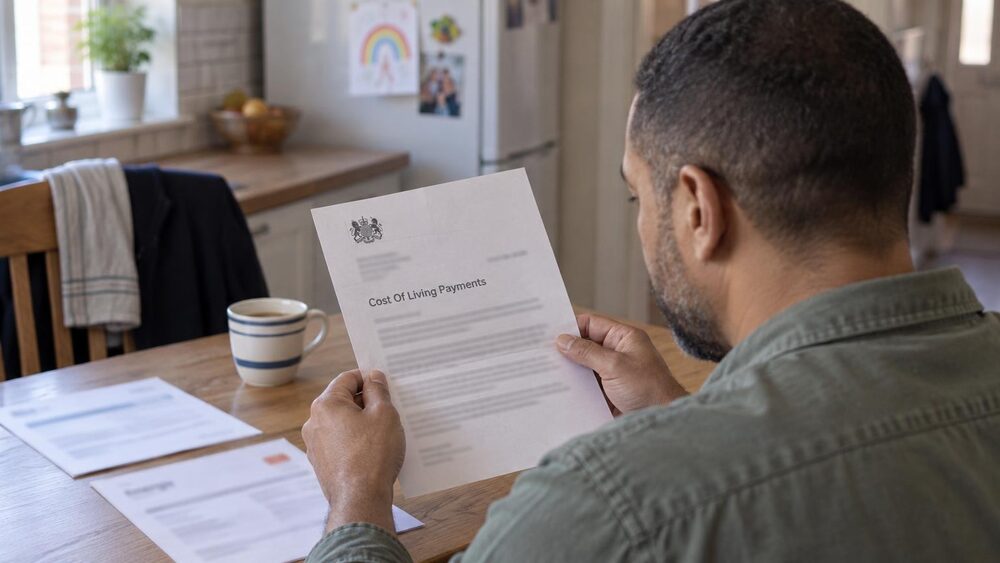
Cost of Living Payments were one-off payments the government made to help with rising prices between 2022 and 2024. There were three kinds: payments of up to £650, later up to £900, for households on means-tested benefits such as Universal Credit; a £150 payment for people on disability benefits; and a £300 payment for pensioners. The Department for Work and Pensions (DWP) has said it is not planning to make any more of them1.
The scheme has finished. The official statistics record that the low-income, disability and pensioner Cost of Living Payments were all discontinued in the 2023 to 2024 financial year2, and DWP made over 30 million separate payments for 2022/23 and a further 23 million for 2023/243. The estimated total cost was £20bn4. This page explains what was paid, who qualified, how the money arrived, and what to do if a payment never appeared or if someone contacts you claiming to be about one.
No new Cost of Living Payments are being made
DWP's guidance on the payments states plainly that it "is not planning to make any more Cost of Living Payments"1. The official income statistics confirm the ending: the Low-income benefits and tax credits Cost of Living Payment, the Disability Cost of Living Payment and the Pensioner Cost of Living Payment were all discontinued in the financial year ending 20242.
The scale of what was paid is recorded in two sets of official figures. DWP made over 30 million separate payments for 2022/23 and a further 23 million separate payments, up to the point of reporting, for 2023/243. The Scottish Government's analysis puts the estimated cost of the package at £20bn4. DWP's own fraud and error statistics show expenditure on Cost of Living Payments rose to £10.2bn in the financial year ending 2024, compared with £8.4bn in the financial year ending 20237. The two figures measure different things: the £20bn is the estimated cost of the whole support package, while the £10.2bn is DWP's measured expenditure on the payments themselves in one year.
The payments were also studied for their effect. The Scottish Government reports that over 60% of recipients reported positive impacts on essential costs, particularly energy bills and food8. Nothing in the official record suggests the scheme will return: any payment described as a "Cost of Living Payment" offered today is not part of this scheme, and the scams section below explains what to watch for.
The low-income payments: up to £900 in instalments
The main payments went to households on means-tested benefits. In 2022/23 the payment was £650, made in two instalments, for over 8 million households; this increased to £900 in 2023/244. The first round was paid as £326 in July 2022 and £324 in November 20229. The second round totalled up to £900 and was made in three payments3.
The three instalments of the 2023/24 round were fixed amounts with set payment windows. The first, of £301, was made between 25 April and 17 May 2023. The second, of £300, was made between 31 October and 19 November 2023. The third, of £299, was paid by spring 20243. The House of Commons Library, which examined the legislation behind the payments, describes them as a £900 Cost of Living Payment referred to in the Bill as "means-tested additional payments", paid in three instalments5.
The payments were made separately from your usual benefit payments9. Advice agencies in Northern Ireland describe the low-income payment as worth as much as £650 for people on means-tested benefits, with the first £326 issued to those eligible in the first round11. Turn2us records the same structure for both years: the 2022 payment came in two instalments, and the 2023/24 payment of £900 came in three instalments across the year9.
Because each instalment was a fixed amount, the total a household received depended on how many instalments they qualified for. Someone who became entitled part-way through the year, for example by starting a Universal Credit claim in the autumn, would have received only the instalments whose qualifying dates they met. The qualifying rules are covered in the section below.
Disability and pensioner payments: £150 and £300
Alongside the low-income payments there were two further one-off payments with different qualifying rules. Disabled people receiving qualifying disability benefits were given an additional £150 as part of the Cost of Living Support Package12. The Scottish Government's analysis records this as a £150 payment to around 6 million people receiving disability benefits in the winters of 2022-23 and 2023-244. The £150 went to recipients of certain non-means-tested benefits including Personal Independence Payment (PIP) and Attendance Allowance, and in Scotland also to Adult Disability Payment recipients8.
The House of Commons Library describes the £150 Disability Cost of Living Payment, referred to in the Bill as "disability additional payments", alongside a £300 payment for pensioner households5. The pensioner payment of £300 was linked to entitlement to Winter Fuel Payments in the relevant winters, which is why it is sometimes called the Pensioner Cost of Living Payment.
The qualifying date for the disability payment worked differently from the low-income payments. To be eligible for the 2023/24 disability payment, you must have received a payment, or later received a payment, for one of the qualifying disability benefits for 1 April 202313. This meant people who were awarded a disability benefit after that date, with the award backdated to cover it, could still qualify.
These payments did not require new primary legislation5, which is one reason they could be delivered quickly and through existing payment systems. As with the low-income payments, they were one-offs: the official statistics record that the disability and pensioner schemes ended with the rest of the package in the financial year ending 20242.
Who qualified and which benefits counted
The low-income payments went to recipients of certain means-tested benefits. DWP's official statistics list the qualifying benefits as Universal Credit, Pension Credit, Income-Based Jobseeker's Allowance, Income Support and Income-Related Employment and Support Allowance7. The House of Commons Library describes the qualifying group as recipients of certain means-tested benefits including Universal Credit, most of the legacy benefits and tax credits it is replacing, except Housing Benefit, and Pension Credit5. Turn2us lists the same set for the 2022 payment, adding Child Tax Credit and Working Tax Credit9.
The core rule was small but strict: a claimant must have been entitled to at least 1p of a qualifying social security benefit with respect to the qualifying period to receive a Cost of Living Payment3. For Universal Credit, that meant receiving a payment of any amount over 1p for an assessment period that ended in the qualifying window; for the first 2022 payment, that window was an assessment period ending between 26 April and 25 May, or a payment of another qualifying benefit between those dates9.
For the later rounds, the qualifying windows differed by benefit, and the official guidance itself sets out more than one period. For income-based Jobseeker's Allowance, income-related Employment and Support Allowance, Income Support and Pension Credit, the guidance gives both a period of 18 August to 17 September 2023 and a period of 13 November to 12 December 2023, depending on the instalment being assessed1. The documents do not resolve which applies to which payment, so if you are checking an old entitlement, both windows may be relevant.
Tax credits were handled by HM Revenue and Customs (HMRC) rather than DWP, and there was a rule to prevent double payment: you could not get a Cost of Living Payment from both HMRC and DWP, and you were usually paid by DWP only1. Claimants getting both Child Tax Credit and Working Tax Credit were entitled to the payment for Child Tax Credit, which was paid by HMRC1.
Some benefits that look similar did not qualify. The guidance is explicit that you would not get a payment if you were only getting New Style ESA, contributory ESA, or New Style JSA1. These are contribution-based benefits, built on your National Insurance record, rather than means-tested ones. Housing Benefit was also not a qualifying benefit in itself, unlike the legacy benefits it sits alongside5. The disability payment had its own list, and the qualifying test was receipt of a payment for one of those benefits for 1 April 202313.
Paid automatically, with no application needed
Nobody had to apply for a Cost of Living Payment. DWP's guidance states: "You do not need to apply for these payments. If you're eligible, you're paid automatically in the same way you usually get your benefit"1. Turn2us records the same for both rounds: the 2022 payment was paid automatically if you qualified, and the 2023/24 payment was made automatically and separately from your benefit payments9. Which? put it simply: you did not need to apply or contact anyone, and if you were eligible the payment was transferred automatically into your account6.
This also worked for people whose eligibility was established late. Law Centre NI's guidance notes that you did not need to apply or take any action: if you were eligible, or found to be eligible at a later date, you were paid automatically13. So someone who won a benefit appeal, or had a claim backdated, could receive a Cost of Living Payment after the main payment windows had closed.
DWP later explained how eligibility was decided: it used a computer program to identify those eligible to receive a Cost of Living Payment1. This mattered for people who thought they had missed out. Because the process was automatic, there was no claim to make and no deadline to meet for the payment itself; the question was whether the records showed entitlement to at least 1p of a qualifying benefit in the qualifying period3. If you believed the record was wrong, the route was to challenge the underlying benefit decision, which is covered by challenging a decision, rather than to claim the Cost of Living Payment separately.
Tax, the Benefit Cap and your other benefits
The payments were designed to leave your other money untouched. DWP's guidance states: "These payments are not taxable and do not affect the benefits or tax credits you get"1. The Work and Pensions Committee's report records the same point at policy level: Cost of Living Payments do not count towards the Benefit Cap, and do not have any impact on existing benefit awards3.
The Benefit Cap limits the total benefit certain households can receive. In Northern Ireland, the cap is set at £22,020 per annum for couples and households with children, and £14,753 per annum for single people without children14. For Great Britain in 2026/27, the annual level for couples, with or without children, or single claimants with a child of qualifying age, is £22,020 outside London15. Because Cost of Living Payments sat outside the cap, receiving one did not reduce anything else, and being capped did not prevent you getting one. The cap itself is explained in the Benefit Cap.
It is worth understanding what "means-tested" meant for the qualifying benefits, because it explains why some people missed out. Means-tested benefits are awarded based on your income and how much capital you have16. Your partner's income and capital may also be taken into account, and capital includes cash, stocks and shares, jointly held savings, property other than your main home, Premium Bonds and National Savings accounts16. DWP sets a limit of £16,000 in savings for eligibility for Universal Credit, and for Housing Benefit if you are under State Pension age17.
Some payments are deliberately ignored in these calculations: some types of income, such as Attendance Allowance, are ignored, and lump sums from deferring your State Pension are not counted as capital16. There are also time-limited disregards: benefits backpay held for less than one year, and personal injury compensation payments held for less than one year, are not counted as savings17. The Cost of Living Payments themselves were not taxable and did not affect benefits at the time they were paid1; once spent or saved, the money is simply yours, and unspent savings count towards your capital like any other money in your account.
Overpayments and when a payment may have to be paid back
Because the payments were generated automatically from benefit records, the question of error matters. DWP's fraud and error statistics examined the payments and reported that no underpayments were estimated on Cost of Living Payments for the financial year ending 202318, and again that no underpayments were estimated on Cost of Living Payments for the financial year ending 20247. The methodology meant the payments were not a significant source of measured underpayment in either year.
Overpayments work differently across the benefit system, and the general rules give a sense of how DWP approaches money paid in error. If an overpayment is caused because one member of a couple dies, an overpayment decision must be made according to business as usual and the overpayment will be recoverable from the surviving partner19. The same principle of recovery applies elsewhere in government payments: you will usually have to pay back a Child Benefit overpayment20, and if you receive more of any type of student finance than you are entitled to, you will have to repay the overpayment21.
For Cost of Living Payments specifically, the position was that the payment followed the benefit record. If the underlying benefit was later found to have been paid incorrectly, the associated questions were handled through the normal overpayment rules for that benefit, not through a separate Cost of Living Payment process. If you receive a letter saying a Cost of Living Payment is being recovered, the underlying benefit decision is what to look at first, and the routes for challenging it are mandatory reconsideration and, if that fails, an appeal to a tribunal.
If you believe a payment you were entitled to never arrived, the first step is the bank statement check described above6. If the payment is genuinely absent and you believe you met the qualifying rules, the route is to query the underlying benefit entitlement for the qualifying period with DWP, or HMRC for tax credits.
Scams using the Cost of Living Payment name
Because the payments were automatic, anything asking you to act to receive one was a scam. Law Centre NI's guidance was blunt: "You will not be asked for bank details by text or email and you will not be asked to follow a link in order to receive your payment"13. Which? reported the same warning, that texts, emails or calls asking people to apply or follow a link in connection with the payment were not genuine6.
Scammers have kept using the name after the scheme closed. Which? reported on a scam website offering an "annual living allowance" that instructed people to register to receive a "£900 Cost of Living payment" by entering their name, number, email address and bank details22. The same site asked for your "state" and "zip code", which are not terms typically used in the UK, a giveaway sign22. The National Audit Office has noted the wider trend: scams involving extracting personal information from the victim rose 21% in 201523, and the techniques have only spread since.
If you receive a suspicious message, forward texts for free to 7726, or send emails to report@phishing.gov.uk6. In Northern Ireland, report suspicious emails or texts asking for your bank details to Report Fraud online or by phone on 0300 123 2040, and tell your local Jobs and Benefits office24. Suspected scam letters can be reported to the Royal Mail through the scam page on its website25.
If you have already responded or paid, the steps are to contact your bank or payment provider immediately, contact the police on 101, report the scam to Report Fraud, and keep records of all contact and correspondence between you and the scammer27. The wider site guide to scams and fraud covers your rights to a refund and how complaints work.
Other help with living costs now
The Cost of Living Payments have ended, but several continuing schemes help with specific costs, and they work in different ways. The Winter Fuel Payment is an annual payment for pensioner households, with its own income rules. The Cold Weather Payment is triggered by cold weather in your area if you are on qualifying benefits, and the Warm Home Discount gives help with electricity bills through your supplier. Scotland has its own Winter Heating Payments, paid without a cold weather trigger.
For one-off crises, there are discretionary funds: the Scottish Welfare Fund offers Crisis Grants and Community Care Grants in Scotland, and the Discretionary Assistance Fund does similar work in Wales. Elsewhere, local council schemes and Discretionary Housing Payments can help with housing costs, and Council Tax Reduction reduces your bill depending on your income and circumstances. Help with food and health costs continues through Healthy Start and the NHS Low Income Scheme, and social tariffs can cut broadband, phone and water bills.
Some newer benefits have arrived since the payments ended. In Scotland, Carer Support Payment replaced Carer's Allowance, and from March 2026 the legislation renames it the Carer Support Payment component of Carer Support28. It can also be paid under Special Rules for Terminal Illness if you or the person you care for receive certain disability benefits, including DLA, PIP or Attendance Allowance29. Some payments remain outside the means test entirely: Bereavement Support Payment is not means-tested, so what you earn or how much you have in savings will not affect what you get30. For students, Access to Learning Fund payments meant to help with general living costs are counted as income, though in some circumstances all or part of the payment may be disregarded31.
If you are not sure what you are entitled to now, checking your entitlement with a free calculator or an adviser is the place to start, and the main benefits guide explains how the system fits together. If a decision on any benefit has gone against you, the routes are mandatory reconsideration and then a tribunal appeal.
Sources31 cited
- Cost of Living Payments mygov.scot, 2025
- Household income inequality, UK: financial year ending 2024 Office for National Statistics, 2024
- Cost of Living Payments: Work and Pensions Committee report UK Parliament, 2024-01-25
- Understanding the cost of living crisis in Scotland Scottish Government, 2025-02
- Cost of Living Payments briefing CBP-9722 House of Commons Library, 2026-07-08
- Cost of living payments 2023: what you need to know Which?, 2024-02-26
- Fraud and error in the benefit system: financial year ending 2024 Department for Work and Pensions, 2024
- Child poverty in the UK and Scotland Scottish Government, 2026-08-06
- Extra help for people on the lowest incomes Turn2us, 2024-02-27
- Benefit changes timetable 2022 Turn2us, 2022
- Cost of living support Advice NI, 2026-09-26
- Cost of living crisis in Scotland: analytical report Scottish Government, 2022-05
- Cost of living support session guide Law Centre NI, 2023-06
- Advice NI response to the Universal Credit Bill LCM Northern Ireland Assembly, 2026-01-26
- Benefit and pension rates 2026-2027 Department for Work and Pensions, 2026
- How your benefits are means-tested Age UK, 2026-04-30
- How savings affect means-tested benefits Scope, 2026-04-01
- Fraud and error in the benefit system: financial year ending 2023 Department for Work and Pensions, 2023
- Death and bereavement guidance Department for Work and Pensions, 2025
- Repay Child Benefit overpayments GOV.UK, 2026-09-26
- Repaying your student loan GOV.UK, 2026-09-25
- Annual living allowance text scam Which?, 2024-09-18
- Protecting consumers from scams, unfair trading and unsafe goods National Audit Office, 2016-12
- Online and text scams nidirect, 2026-07-27
- What if you're a victim of fraud? Financial Services Compensation Scheme, 2026-01-07
- FSCS podcast episode 46 transcript Financial Services Compensation Scheme, 2025
- Scams involving unauthorised payments and identity theft Financial Ombudsman Service, 2026-09-26
- The Carer Support (Modification of Subordinate Legislation) Regulations 2025 legislation.gov.uk, 2026-03-15
- Assistance under Special Rules for Terminal Illness mygov.scot, 2025-03-24
- Bereavement Support Payment nidirect, 2026-06-24
- Benefits and higher education students nidirect, 2026-06-30


 Turn2usFree benefits calculator and grants search from a charity
 Citizens AdviceFree advice on money, consumer and legal problems in England and Wales
 GOV.UKOfficial information on tax, benefits and government services
 MoneyHelperFree, impartial money and pensions guidance, set up by government