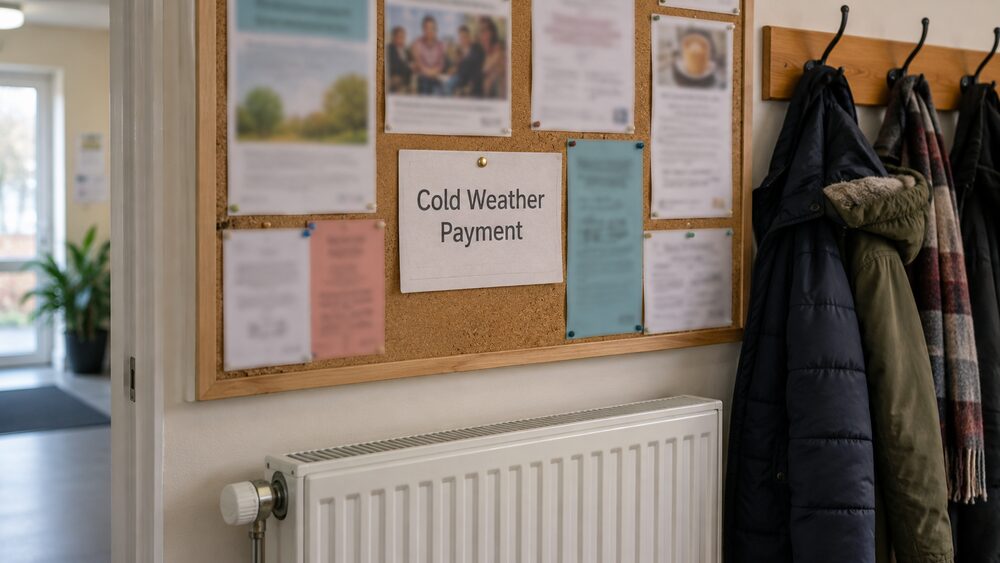
The Cold Weather Payment is £25, paid for each seven-day spell of freezing weather to people receiving certain benefits. It is available in England, Wales and Northern Ireland, and the scheme runs each winter from 1 November to 31 March1. You do not have to apply for it: if you qualify, the money is paid automatically into the same account your benefits go into3. It is a payment made by the Department for Work and Pensions (DWP) to help with heating costs when the weather is very cold4.
The payment is triggered by temperature, not by a date. When the average temperature where you live is recorded as, or forecast to be, 0°C or below for seven days in a row, a payment of £25 is triggered for everyone in that area who gets a qualifying benefit1. Because the trigger is local, two people on the same benefit can have very different winters: one may get several payments in a cold season, another none at all.
This page explains how the trigger works, which benefits qualify, the extra rules for Universal Credit claimants, who cannot get the payment, how and when the money arrives, and what to do if you believe a payment is missing.
£25 for each week of freezing weather
Each Cold Weather Payment is £25, and it is paid once for each seven-day period of very cold weather. Age UK's benefit rates guidance confirms the payment remains £25 per week when the weather has been, or is expected to be, freezing or below for seven days in a row between November and March9. The Welsh Government's cold weather resilience plan sets out the same rule in policy terms: the amount payable is £25 for each seven-day period of very cold weather occurring during the scheme period of 1 November to 31 March10.
It is worth being clear about what the £25 covers. It is £25 for the whole seven-day cold spell, not £25 per day and not £25 per calendar week. If a cold spell lasts exactly seven days, one payment follows. If the freezing weather continues, the trigger is assessed again for the next seven-day period, and a further £25 can be paid. A single winter can therefore produce several payments, and the Department for Work and Pensions publishes estimates each season of how many payments were made6.
The payment is intended to help with the extra fuel costs that a cold spell creates, and it is paid automatically with the relevant benefit rather than as a separate cheque or voucher11. There are no age rules for the payment itself: what matters is which benefit you receive, not how old you are12. Turn2us lists the payment as administered by JobCentre Plus, and it is the Department for Work and Pensions that stands behind the scheme as a whole4.
When a payment is triggered: 0°C or below for seven days in a row
A Cold Weather Payment is made when the average temperature in your area is recorded as, or forecast to be, 0°C or below for seven consecutive days1. Which? describes the same rule: payments are paid when the average temperature where you live is recorded as, or forecast to be, 0°C or below over seven days in a row3. The temperature is measured at the weather station that covers your area, so the trigger is tied to where you live, not to the national picture.
Two features of the trigger matter in practice. First, the temperature can be either recorded or forecast. That means a payment can be triggered before the cold spell has finished, because the Meteorological Office supplies a forecast of seven consecutive days of freezing weather5. Second, the seven days must run in a row. Six freezing days followed by a milder day does not trigger a payment, and the count starts again12.
The official easy-read guidance for the scheme sets out the two things every claimant needs to know: what the average temperature needs to be, and the benefits you need to be receiving to get Cold Weather Payments13. Contact's guidance for families puts the same condition in plain terms: if the average temperature recorded or forecast over seven days in a row in your local area is zero degrees Celsius, a payment can follow for those on qualifying benefits14.
Who is eligible: Pension Credit and certain other benefits
Eligibility rests on receiving a qualifying benefit when the cold spell happens. StepChange lists the benefits that open the door: Pension Credit, Income Support, income-based Jobseeker's Allowance, income-related Employment and Support Allowance and Universal Credit15. Which? adds Support for Mortgage Interest to the list of benefits that can make you eligible3. The gov.uk Pension Credit page confirms that Pension Credit recipients are linked to Cold Weather Payments, or Winter Heating Payments for people in Scotland7.
For Pension Credit claimants the position is simplest. If you currently get Pension Credit, you will usually get a Cold Weather Payment whenever the temperature trigger is met in your area4. Turn2us makes the same point: you might qualify if you are claiming Pension Credit and do not live in a care home16.
For the older income-related benefits, the legislation sets out more detailed conditions. The regulations prescribe that a payment may be made to a claimant awarded Income Support for at least one day during the cold weather period, where either their applicable amount includes one of a set of specified premiums, or their family includes a member aged under five17. The 1991 regulations describe the same two routes for Income Support claimants: a specified premium in the assessment, or a child under five in the family18. In practice this means that some people on Income Support and income-related benefits qualify automatically, while others depend on their circumstances, such as having a young child.
If you are unsure whether your benefit carries eligibility, the free benefits calculators and advisers described in checking what you are entitled to can confirm it, and the guides to Pension Credit, Universal Credit and Employment and Support Allowance explain how each benefit works.
Universal Credit claimants and the work rule
Universal Credit claimants face an extra condition that does not apply to the other qualifying benefits: work. Contact's guidance states the rule directly: Universal Credit qualifies only if you are not working14. The legislation behind it provides that there is no entitlement to a cold weather payment where a person receiving Universal Credit has been in employment or gainful self-employment for any of the days during a seven-day recorded period of cold weather, or on the day the Meteorological Office supplies the forecast for a forecasted period19.
The official guidance for Northern Ireland sets out which Universal Credit claimants qualify: those who are not employed or self-employed, and who either have a health condition or disability with limited capability for work, or have a child under five living with them20. Mental Health and Money Advice describes the same conditions: a Cold Weather Payment is payable to Universal Credit claimants who are not employed or self-employed and who have limited capability for work, or a child under five living with them4.
There is one exception written into the legislation. The rule excluding working Universal Credit claimants does not apply where the claimant receives an additional amount of Universal Credit in respect of a disabled child or qualifying young person19. So a parent who works but receives the disabled child addition in their Universal Credit can still qualify.
The practical effect is that a Universal Credit claimant's eligibility can change from one cold spell to the next. Someone who was out of work during one seven-day freeze but had started a job before the next one would qualify for the first payment and not the second. The rules on working while claiming and the Work Capability Assessment explain the underlying conditions in more detail.
Who cannot get it, including care home residents
Some groups are excluded from the payment altogether, and some exclusions depend on circumstances that can change during a winter.
- Care home residents. You will not qualify if you are living in a care home1. Turn2us frames the same condition from the other side: you might qualify if you are claiming Pension Credit and do not live in a care home16. The rules on payments when you live in a care home explain how a move into residential care affects benefits generally.
- People living in Scotland. You cannot get Cold Weather Payments if you live in Scotland21. Scotland has its own replacement payment, covered later on this page.
- People in hospital. If you are in hospital, you must tell the Pension Service or Jobcentre Plus, as this could affect your payment5. A hospital stay can affect the qualifying benefit itself, which is why the change must be reported. The guide to what happens to payments in hospital or prison covers the wider rules.
- Universal Credit claimants who are working. As above, employment or gainful self-employment during the cold period removes entitlement, with the exception for those receiving the disabled child addition19.
The exclusions matter most at the edges of a winter. Someone who moves into a care home in January, or who starts a job between two cold spells, can move in and out of eligibility. Reporting changes of circumstances promptly is what keeps the record straight, and the guide to reporting a change of circumstances explains what must be told and when.
No need to apply: how and when it is paid
You do not need to apply for Cold Weather Payment1. If you meet the criteria, you will usually get the payment automatically, as Which? puts it, with no application needed3. The money is paid into the same bank or building society account as your benefit payments1.
The timescale is short. Payments are made within 14 working days after each period of very cold weather in an area8. Carers UK gives the same timescale: the payment goes into the account that receives benefits within 14 working days after each cold period8. Independent Age states the same 14-working-day rule after each cold period1. Because the payment follows the benefit, there is no separate claim form, no phone call to make and nothing to sign.
This automatic system has one consequence worth understanding. If your benefit is paid to an account you cannot easily access, or if someone else receives your benefits for you as an appointee, the Cold Weather Payment will follow the same route. And if a payment seems to be missing, the first question is always whether the benefit itself is in payment and up to date, since the Cold Weather Payment cannot arrive without it.
It is not taxable and does not affect other benefits
The Cold Weather Payment is not taxable12. Turn2us lists the payment with "Taxable: No" in its summary of the scheme12, and the same applies in practice to how the money is treated when other entitlements are worked out.
The payment also leaves your other benefits untouched. Advice NI confirms that it will not impact on entitlement to other benefits11, and Independent Age states that getting it will not affect any of your other benefits1. The reason is straightforward: the £25 is not counted as income when your entitlement to other benefits is assessed, so it does not push you over any threshold or reduce a means-tested award.
This is one of the features that distinguishes the Cold Weather Payment from an advance or a loan. There is nothing to repay, no deduction from future benefits, and no effect on a benefit cap calculation. The money arrives, and that is the end of it. The same treatment applies to the winter heating payments in Scotland, which do not count as income when working out entitlement to other benefits22, so people who move between nations of the UK do not gain or lose protection on this point.
Cold Weather, Winter Fuel and Winter Heating: three different payments
The Cold Weather Payment is one of three winter payments with similar names, and people often confuse them. They are separate schemes with different triggers, different amounts and different administrators.
| Payment | What it is | Trigger | Where |
|---|---|---|---|
| Cold Weather Payment | £25 for each seven-day freeze | Average temperature 0°C or below for seven days in a row1 | England, Wales, Northern Ireland2 |
| Winter Fuel Payment | An annual payment to help with heating costs in the colder months23 | Not dependent on temperature; usually paid between November and December1 | Great Britain, replaced in Scotland |
| Winter Heating Payment | A one-off, yearly payment to help with fuel costs24 | Not dependent on temperature25 | Scotland only26 |
The Winter Fuel Payment is an annual payment to help with heating costs during the colder months, and most payments are made between November and December23. Unlike the Cold Weather Payment, it does not depend on how cold the weather gets. The government has also confirmed that the winter payments themselves are not being made taxable and are paid in full, though pensioners can elect to opt out27.
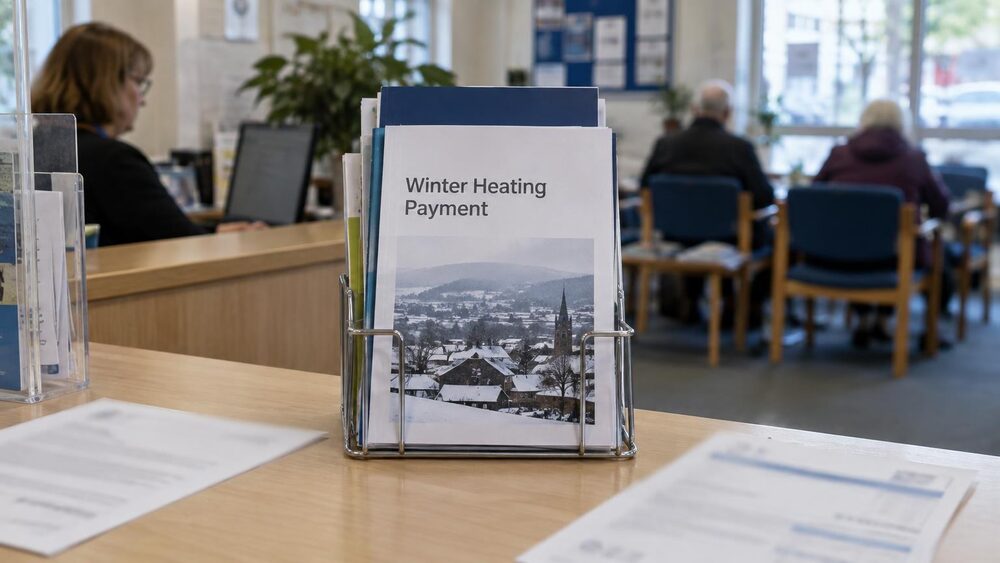
The Winter Heating Payment is Scotland's replacement for the Cold Weather Payment. It serves as a replacement for the Cold Weather Payment provided by the DWP, and unlike the Cold Weather Payment it is not dependent on temperature: it is a yearly automatic payment25. Turn2us lists it as not taxable26, and it does not count as income for other benefits22.
The practical difference is predictability. A Cold Weather Payment is uncertain: a mild winter can produce none at all. The Scottish payments are guaranteed each winter to those who qualify, but they do not rise when the weather turns harsh. The guides to the Winter Fuel Payment and to Pension Age, Child and Winter Heating Payments in Scotland cover each scheme in full.
Scotland has the Winter Heating Payment instead
The Cold Weather Payment no longer exists in Scotland. Winter Heating Payment has replaced the Cold Weather Payment in Scotland15, and the Scottish Government launched the new payment in February 2023, replacing the Cold Weather Payment with a guaranteed payment each winter28. Marie Curie's guidance gives the same date: the Winter Heating Payment replaced the Cold Weather Payment in Scotland from February 202329, and One Parent Families Scotland confirms the replacement30.
The Winter Heating Payment is administered by Social Security Scotland, not the Department for Work and Pensions26. It is a one-off payment made in Scotland during the winter to help people with heating costs22, and eligibility rests on receiving certain low-income benefits, with Pension Credit among them30. Because it is an annual automatic payment that is not dependent on temperature, a Scottish resident gets the same payment whether the winter is harsh or mild4.
Scotland has also replaced the Winter Fuel Payment. Pension Age Winter Heating Payment replaces Winter Fuel Payment from the DWP in Scotland31, and Turn2us describes it as a new benefit with the same eligibility criteria as the Winter Fuel Payment in the rest of the UK32. The Scottish Government announced that Pension Age Winter Heating Payments will be paid at a slightly higher rate than Winter Fuel Payments33. Most people are paid it automatically and do not need to apply31, and getting it does not impact any other benefits31.
For someone who moves between Scotland and the rest of the UK, the change of scheme follows the move. A person who moves from Carlisle to Gretna stops being covered by the Cold Weather Payment and becomes covered by the Winter Heating Payment instead. The guide to disability and carer payments when moving between Scotland and the rest of the UK covers the wider picture for people relocating.
The scheme dates each winter
The Cold Weather Payment scheme runs on fixed dates every year: 1 November to 31 March. Only cold spells falling inside that window can trigger a payment.
| Season | Scheme dates | Coverage |
|---|---|---|
| 2022 to 2023 | 1 November 2022 to 31 March 2023 | England and Wales21 |
| 2023 to 2024 | 1 November 2023 to 31 March 2024 | England and Wales34 |
| 2024 to 2025 | 1 November 2024 to 31 March 2025 | England and Wales35 |
| 2025 to 2026 | 1 November 2025 to 31 March 2026 | England and Wales6 |
The Department for Work and Pensions publishes official statistics for each season, giving estimates of eligible recipients and triggers. For the 2025 to 2026 season, the data tables run to 31 March 2026 and the release was last updated on 8 April 20266. The earlier releases follow the same pattern, with estimates to 31 March of each year34.
The dates matter for anyone whose circumstances change in late autumn or early spring. A cold spell at the end of October cannot trigger a payment even if you are on a qualifying benefit, and a freeze in the first week of April is equally outside the scheme. Someone whose Pension Credit award begins in mid-November is not eligible for a cold spell that ended before their award started, because eligibility is assessed against the benefit in payment during the cold period.
If a payment does not arrive: checking and challenging a decision
Because the payment is automatic, a missing payment usually means one of three things: the temperature trigger was not met in your area, your benefit did not qualify you at the time, or the payment has simply not arrived yet. The first step is to wait out the 14 working days that payments normally take8.
If the payment still has not arrived, the office that pays the benefit is the place to raise it. Age UK's guidance is to contact the pension centre or Jobcentre Plus office, and Universal Credit recipients can leave a note in their journal5. The office can check whether the trigger was met for a postcode and whether the record shows a payment.
If you are told you are not entitled and you disagree, there is a formal route:
- Ask for the decision to be looked at again. This is known as a mandatory reconsideration36.
- If you still disagree after the reconsideration, you can appeal to an independent tribunal36.
- Seek advice early, because the time limits are strict. For the comparable Winter Heating Payment in Scotland, Turn2us warns that you will usually be given one month to dispute a decision37.
The guide to challenging a decision: mandatory reconsideration and redetermination explains the process step by step, and appealing to a tribunal covers the next stage. Free, impartial help is available from sources such as Turn2us and Independent Age, and a welfare rights adviser at a local council or charity can often check whether a trigger was met in your area before any challenge is started.
Sources37 cited
- Financial help in cold weather Independent Age, 2026-09-26
- Extra help for 2025-26 Turn2us, 2026-09-08
- Cold Weather Payment, Winter Fuel Payment and Fuel Direct Which?, 2026-08-24
- Cold Weather Payment Mental Health and Money Advice, 2025-07-23
- Cold Weather Payment Age UK, 2026-09-15
- Cold Weather Payment estimates: 2025 to 2026 GOV.UK, 2026-04-08
- Pension Credit GOV.UK, 2026-09-26
- Help with energy costs Carers UK, 2026-09-26
- Benefit rates Age UK, 2026-07-21
- Cold weather resilience plan Welsh Government, 2022-02
- Extra financial support Advice NI, 2026
- Cold Weather Payment Turn2us, 2026-09-26
- Easy read: Cold Weather Payments GOV.UK, 2022-11-22
- Help with household bills Contact, 2026-08-27
- Government help with gas and electric bills StepChange, 2026-09-25
- Can I get a Cold Weather Payment? Turn2us, 2025-02-25
- The Social Fund (Cold Weather Payments) (General) Amendment Regulations 1991 legislation.gov.uk, 1991-10-25
- The Social Fund (Cold Weather Payments) (General) Regulations 1988 legislation.gov.uk, 1991-10-07
- The Universal Credit Regulations 2013 amendment legislation.gov.uk, 2013-02-07
- More financial help if you get Universal Credit nidirect, 2025-12-02
- Cold Weather Payment estimates: 2022 to 2023 GOV.UK, 2022-11-30
- Winter Heating Payment Scotland Turn2us, 2025-10-21
- Winter Fuel Payment Age UK, 2026-09-15
- Help with fuel costs One Parent Families Scotland, 2026-08-31
- Winter Heating Payment Mental Health and Money Advice, 2025-07-04
- What is a Winter Heating Payment? Turn2us, 2025-10-21
- Winter Fuel Payments charge GOV.UK, 2025-11-26
- Pension Age Winter Heating Payment: Fairer Scotland Duty assessment Scottish Government, 2023-02
- Energy bills Marie Curie, 2026-03-30
- Winter Heating Payment One Parent Families Scotland, 2026-04-06
- Pension Age Winter Heating Payment factsheet Social Security Scotland, 2026-08
- Can I get a Winter Fuel Payment? Turn2us, 2026-08-05
- Pension Credit applications and awards, February 2026 GOV.UK, 2026-02-26
- Cold Weather Payment estimates: 2023 to 2024 GOV.UK, 2023-11-29
- Cold Weather Payment estimates: 2024 to 2025 GOV.UK, 2024-11-27
- How do I challenge a Cold Weather Payment decision? Turn2us, 2025-02-25
- How do I challenge a Winter Heating Payment decision? Turn2us, 2025-10-21




 Turn2usFree benefits calculator and grants search from a charity
 Citizens AdviceFree advice on money, consumer and legal problems in England and Wales
 GOV.UKOfficial information on tax, benefits and government services
 MoneyHelperFree, impartial money and pensions guidance, set up by government