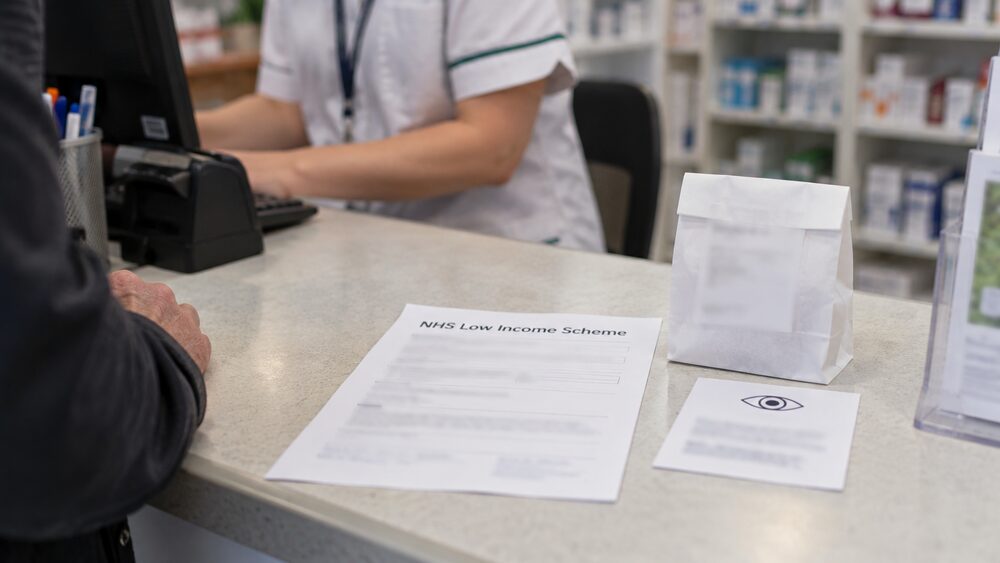
If you are on a low income, the NHS can cover or refund a surprising amount: prescriptions, dental treatment, eye tests, glasses or contact lenses, travel to hospital, and even wigs and fabric supports. Whether you get it depends on which benefit you receive, what you earn, and where in the UK you live.
If you are on a low income, the NHS can cover or refund a surprising amount: prescriptions, dental treatment, eye tests, glasses or contact lenses, travel to hospital, and even wigs and fabric supports. Whether you get it depends on which benefit you receive, what you earn, and where in the UK you live.
On Universal Credit, the test is your take-home pay in your last assessment period. You may get free prescriptions if you receive Universal Credit, depending on the total take-home pay in your last assessment period1. In practice that means no earnings, or monthly earnings of no more than £435, or no more than £935 if your award includes the child amount or limited capability for work2.
If you are not on a qualifying benefit at all, the NHS Low Income Scheme can still help. It covers prescription costs, dental costs, eye tests, glasses and contact lenses, help with the cost of travel to NHS appointments, and NHS wigs and fabric supports3. You apply on form HC14.
Free prescriptions on Universal Credit depend on your take-home pay
The single most common misunderstanding is that Universal Credit itself unlocks free prescriptions. It does not, on its own. Entitlement turns on what you earned, not on whether you work. You may get free prescriptions if you receive Universal Credit, depending on the total take-home pay in your last assessment period1.
The thresholds are specific. You qualify if you are getting Universal Credit and you have no earnings, or your (and your partner's) monthly earnings are no more than £435, or no more than £935 if your award includes the child amount or limited capability for work2. Note that the higher figure is not automatic for parents: it attaches to the award including the child amount, so a household whose Universal Credit includes that element is measured against £935 rather than £435.
Because the test is monthly, it can change from one month to the next. A month with overtime or a bonus can push you over the line and remove entitlement for that period, then restore it the following month. That is why the award notice matters: it is the document that shows what you were paid and when.
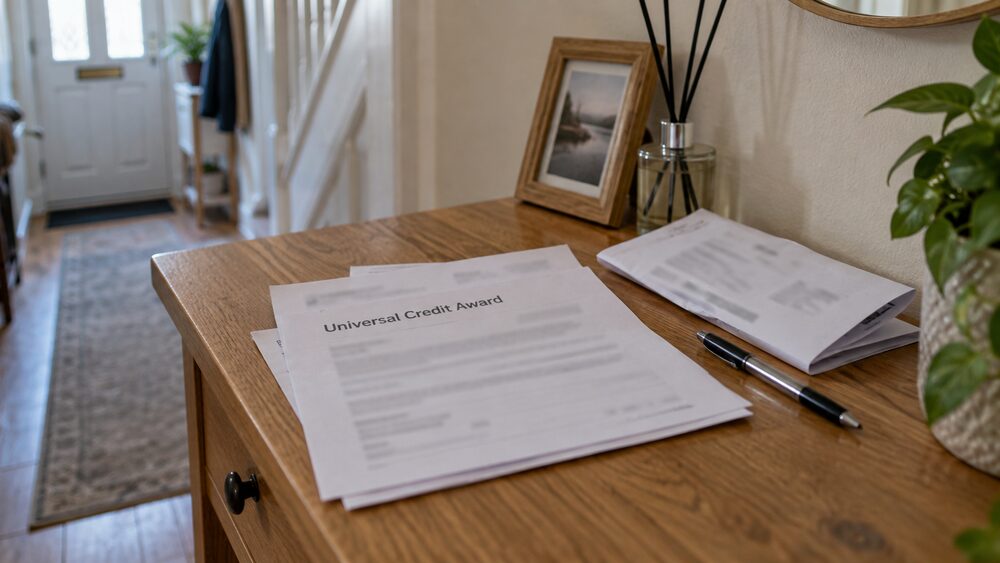
If you get Universal Credit and do not have any earned income you are automatically entitled to help with healthcare costs, with no need to apply7. Where earnings are involved, entitlement depends on the total take-home pay in your last assessment, and a Universal Credit award notice is the proof of entitlement5.
Which assessment period decides it
The period that counts is the assessment period that ended immediately before the date you claim free NHS prescriptions, and it runs for one calendar month5. An assessment period is one month8. Assessment periods are a rolling period of one month which starts each month from the day on which you made your claim9.
So if your claim began on the 12th, your assessment periods run from the 12th of one month to the 11th of the next. The figure that decides your entitlement is the earnings in the completed month immediately before the day you ask for free treatment, not your annual income and not your earnings since.
Two practical consequences follow. First, timing matters: if you are near a threshold, the month you claim in can decide the outcome. Second, keep the award notice that covers the relevant period, because that is the evidence of what you earned in it.
What help with NHS health costs covers
Help with health costs is not only about prescriptions. If you are on a low income, on certain benefits, or fit other criteria, you, your partner and children might get help with health costs3. Some people can get free or discounted prescriptions, help with travel to medical appointments, and help with the cost of dental services10.
The full list of what the NHS Low Income Scheme covers is: prescription costs, dental costs, eye tests, glasses and contact lenses, help with the cost of travel to NHS appointments, and NHS wigs and fabric supports3. Depending on your circumstances, you could also get help with the cost of glasses or contact lenses, NHS wigs and fabric supports, and travel costs to receive NHS treatment4.
| Cost | What help is available |
|---|---|
| Prescriptions | Free if you meet the earnings test on Universal Credit, or through the NHS Low Income Scheme2 |
| Dental treatment | Health Service dental treatment can be covered11 |
| Eye tests and glasses | Eye tests, plus vouchers towards glasses or contact lenses3 |
| Travel to appointments | Help with fares where you have been referred by a GP or dentist7 |
| Wigs and fabric supports | Free in England if you or your partner get Guarantee Credit Pension Credit, or Universal Credit if you meet certain criteria11 |
Who qualifies: benefits, low income and other criteria
In England, you can receive a range of free NHS health support if you receive any of the following: Income Support or Income-based Jobseeker's Allowance (not contribution based), Pension Credit Guarantee Credit, Income-based Employment and Support Allowance, or Universal Credit12. Universal Credit counts if you meet certain criteria4.
Eligibility for free prescriptions more generally takes account of age, benefits or allowances you or your partner receive, medical conditions, and your level of income13. So there are several routes in, and they are not mutually exclusive.
For pensioners, the Guarantee Credit part of Pension Credit brings help with NHS dental treatment, glasses and transport costs for hospital appointments14. If you or your partner already receive certain benefits, like Guarantee Pension Credit, you do not need to apply for the NHS Low Income Scheme7.
Universal Credit itself is calculated on your circumstances, for example your health condition or disability, income and housing costs15. The amount you get depends on your income and family circumstances16. You can claim Universal Credit and Personal Independence Payment at the same time7, and if you are both self-employed and employed, your payment is calculated on your combined earnings from self-employment and employment17.
Students are not shut out entirely. You may be able to get Universal Credit if you are available for work and studying part time18, and if you are studying part-time you may be able to get Universal Credit as long as you can meet the work-related requirements that apply to you19.
NHS Low Income Scheme: help without claiming benefits
The NHS Low Income Scheme exists precisely for people who fall outside the benefit routes. If you do not receive one of the qualifying benefits but have a low income, you may still be eligible for some help with health costs through the NHS Low Income Scheme6. If you are on a low income you may be able to get help through the scheme, which can help with prescriptions, dental, eye care and more20. If you are on a low income, you may be eligible for free healthcare such as free prescriptions and free eye tests21.
Applications should be made on form HC14. If you qualify through the NHS Low Income Scheme you will either get a HC2 certificate that entitles you to full help or a HC3 certificate for partial help with health costs6.
The dividing line between the two certificates is your income measured against your requirements. You will qualify for a full help with health costs HC2 certificate, which includes free NHS prescriptions, if your income is less than or equal to your requirements, or your income is greater than your requirements by no more than half the current English prescription charge22. Above that, an HC3 certificate gives partial help rather than full.
Glasses, dental care and travel to hospital: getting the costs back
The costs you can recover are broader than most people expect. You may be able to get help with Health Service dental treatment, eyesight tests, vouchers towards the cost of glasses or contact lens, or help with the costs of travel for treatment on referral by a doctor or dentist11.
Travel is the part most often missed. If you are receiving Guarantee Pension Credit or have an NHS Low Income Scheme certificate, you may be entitled to help with travel costs, and travel costs for a companion can be covered if there is a medical need7. The referral has to come from your GP or dentist7.
There is a separate route for travel to a Work Capability Assessment. You can request back the money you spent travelling to and from your Universal Credit assessment, keeping receipts and completing a travel expenses claim form with all tickets and receipts23. You can also claim back the fares of anyone who needs to come with you for support by letting the Health Assessment Advisory Service know24.
If a decision goes against you, there is a process. If you are appealing a Universal Credit decision, you can use your journal to ask for mandatory reconsideration25. More detail on challenging decisions is in Challenging a decision: mandatory reconsideration and redetermination.
Prescriptions are free for everyone in Scotland, Wales and Northern Ireland
The rules are not the same across the UK, and this is where the biggest difference lies. Prescriptions are free in Northern Ireland, Scotland and Wales2. People of all ages in Wales, Northern Ireland and Scotland get free NHS prescriptions22. In Scotland and Wales, prescriptions are free for everyone7. In Scotland, Wales and Northern Ireland, prescriptions are free for everyone11. Everyone receives free prescriptions whatever their age or income in Scotland, Northern Ireland and Wales26.
That means the earnings thresholds described above are an England issue. If you live in Scotland, Wales or Northern Ireland, you do not need to worry about the £435 or £935 figures for prescriptions, because there is no charge to meet in the first place.
Charges for dental treatment, eye care and travel can still apply, and the NHS Low Income Scheme operates for those costs. The scheme is described as being for people on a low income who do not receive one of the qualifying benefits, in England12, so check the equivalent arrangements where you live.
If you are going abroad or need other help
Help with health costs sits alongside a wider set of support. Universal Credit can also help with housing costs, the costs of raising a child and childcare costs, depending on your situation27. If eligible, Universal Credit can help with the costs of raising a child and childcare28, and you can claim back up to 85% of your childcare costs through Universal Credit29. Universal Credit may also help with paying for childcare30.
If you are travelling, the Global Health Insurance Card is separate from NHS help with costs. Even if the state-provided care is free, you might have to pay upfront and claim the money back once you return home, as happens in France for certain services31.
Where money problems are part of the picture, free and impartial help exists. The NHS Low Income Scheme is one route; debt advice charities and MoneyHelper are others, and the Debt: a complete guide to help, solutions and your rights sets out the options. If you are on a low income and struggling with health costs alongside other bills, Checking what you are entitled to: free calculators and advisers explains how to get a full picture of what you can claim.
Sources31 cited
- Prescription charges and health benefits Disability Rights UK, 2026-04-14
- What is help with health costs Turn2us, 2026-09-26
- Help with health costs Turn2us, 2026-09-26
- Free prescriptions for over 60s Age UK, 2026-08-26
- Exemption certificates Mental Health and Money Advice, 2025-04-10
- NHS Low Income Scheme for under 60s Entitledto, 2026-09-26
- Help with health costs Independent Age, 2026-09-26
- Universal Credit legislation legislation.gov.uk, 2026-03-18
- How to apply for Universal Credit Mental Health and Money Advice, 2025-09-09
- Cost of living Turn2us, 2026-09-26
- Help with health costs Macmillan Cancer Support, 2026-09-26
- Guide to saving on health and care costs Carers UK, 2026-09-26
- Low cost and free prescriptions Mental Health and Money Advice, 2025-03-10
- Pension Credit GOV.UK, 2026-09-26
- Health conditions and disability and Universal Credit GOV.UK, 2026-09-26
- How much Universal Credit will I get Shelter Cymru, 2026-08-25
- Self-employment and Universal Credit GOV.UK, 2026-09-26
- Claiming Universal Credit if you're a student nidirect, 2026-08-17
- Benefits for higher education students nidirect, 2026-06-30
- Making the most of your money Business Debtline, 2026-09-26
- Ways to save money at home Carers UK, 2026-09-26
- Universal Credit Gingerbread, 2026-04-16
- How to claim Universal Credit with a mental health condition Mental Health and Money Advice, 2025-09-03
- How to prepare for your Work Capability Assessment Mental Health and Money Advice, 2025-09-03
- Challenging PIP or other benefits decisions Scope, 2026-04-17
- Costs of work Entitledto, 2026-09-26
- Cost of living: other organisations that could help National Debtline, 2026-09-25
- Cost of living: other organisations that could help Business Debtline, 2026
- Extra financial help if you claim Universal Credit Shelter England, 2026-08-24
- Other help with childcare costs mygov.scot, 2026-04-01
- The EHIC explained Which?, 2026-05-21





 Turn2usFree benefits calculator and grants search from a charity
 Citizens AdviceFree advice on money, consumer and legal problems in England and Wales
 GOV.UKOfficial information on tax, benefits and government services
 MoneyHelperFree, impartial money and pensions guidance, set up by government