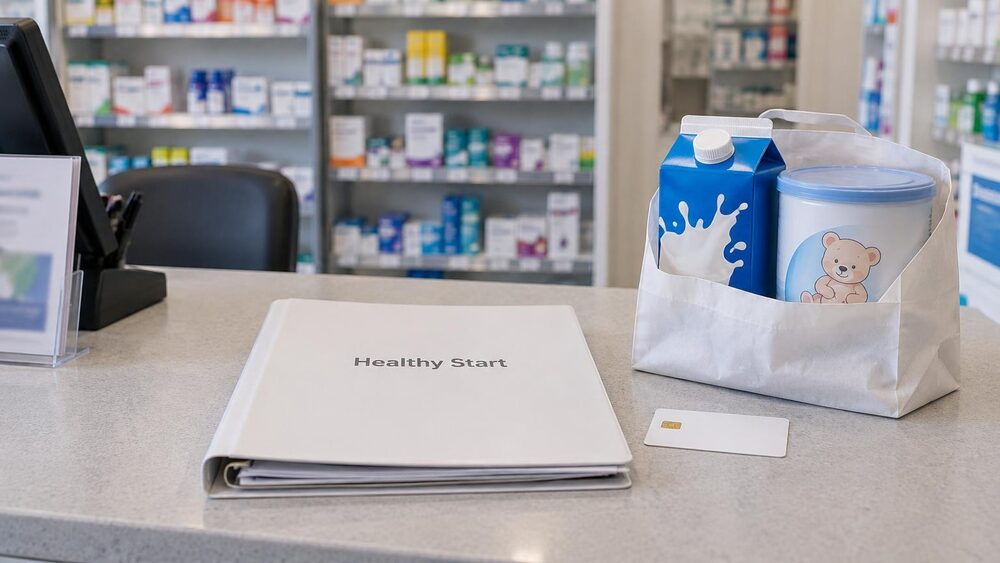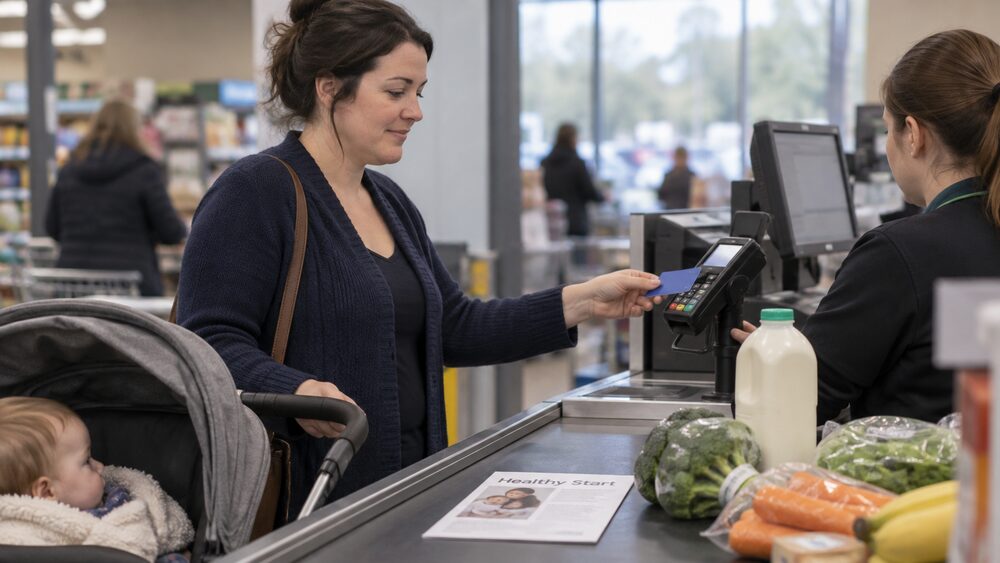
Healthy Start is a government scheme that helps pregnant people and families with young children on low incomes afford basic food. If you qualify, you are sent a prepaid card that has money added to it every four weeks, which you can spend in shops on things like milk, fruit, vegetables, pulses and infant formula1. On top of the card, the scheme provides free vitamins for pregnant women, breastfeeding mothers with a baby under one, and children under four2.
The scheme runs in England, Wales and Northern Ireland. It is for pregnant people and people responsible for children aged under four who receive a qualifying benefit, and there is a separate route in for anyone who is under 18 and pregnant3. Scotland has its own replacement scheme, called Best Start Foods, which pays more and covers children for longer4.
The amounts rose in 2026. The weekly payment is now £4.65 for each child aged between one and four, and £9.30, double that, for each child under one5. Before that rise, the scheme paid £4.25 a week for children between one and four and £8.50 for babies under one, a level that had been in place since April 20212. Because claims cannot be backdated, the date you apply matters: your entitlement begins from the date your claim is received6.
What Healthy Start gives you: a prepaid card and free vitamins
Healthy Start works in two parts. The first is the card: if you are eligible, you are given a Healthy Start card with money added onto it, and that money can be spent in participating shops1. The second part is free vitamins, which are available for pregnant women, breastfeeding women with a baby under one year, and children under four2. The scheme's purpose, as set out in the legislation that underpins it, is to improve nutrition in pregnant women, mothers and young children by helping them buy certain basic foods and vitamins10.
The card is a prepaid card rather than a bank card. It is topped up automatically, and the money stays on it until you spend it. There is no cash withdrawal involved and no need to have a bank account of your own to receive the money. The vitamins are provided separately from the card, through health services, and do not use up any of the card's balance2.
The scheme has been running since 2006, when it replaced an older voucher arrangement, and it is administered by the Department of Health11. In Northern Ireland, uptake of the scheme was just over 50% in May 2024, which means a large share of eligible families were not claiming what they were entitled to2. If you think you might qualify, it is worth checking rather than assuming you are not eligible.
How much you get: £4.65 a week, double for babies under one
The current rates, following the 2026 uprating, are £9.30 a week for each child under one and £4.65 a week for each child aged over one but under four5. A pregnant woman receives the payment for herself during pregnancy as well. The money is loaded onto the card every four weeks rather than in weekly instalments, so each top-up covers four weeks at a time7.
The rates were lower before the 2026 rise. From April 2021 the scheme paid £8.50 a week for children aged up to one and £4.25 a week for everyone else, and those figures had only been uprated twice since the scheme began in 200611. A policy analysis published in January 2025 argued that the value of the payments had fallen well behind food price inflation, and calculated that a recipient with a child aged between 0 and 1 would have needed an uplifted weekly payment of £11.16 to keep the scheme's real value11.
The payment is made for each qualifying child individually. A mother with parental responsibility for more than one qualifying child is entitled to the food benefit in respect of each such child, so a family with two children under four receives two payments13. Parents with twins and multiples are entitled to more funding for the same reason: the money follows the child, not the household14.
Who can get Healthy Start
The scheme is for pregnant people and people responsible for children aged under four1. There are two main routes in.
The first is through a qualifying benefit. You can get Healthy Start if you are pregnant or have a child under four and you receive one of the following:
- Universal Credit, if your family's take-home pay is £408 or less a month from employment8
- Child Tax Credit, if your family's annual income is £16,190 or less15
- Income Support15
- Income-based Jobseeker's Allowance8
- Pension Credit, which includes the child addition8
You do not have to be the benefit claimant yourself. You also qualify if you live with a partner who gets one of these benefits, or if you are the dependent child of someone getting one of them6. This matters for young families where one partner claims and the other does not.
The second route is age-based. Anyone who is pregnant and under 18 is entitled to Healthy Start without needing any benefit at all, provided they are at least 10 weeks pregnant14. Independent guidance confirms this route: you qualify if you are under 18 and more than ten weeks pregnant6.
There is also an extended version of the scheme for some families who cannot claim benefits because of their immigration status. This covers British children aged under four whose parent or guardian meets the financial eligibility criteria and is either subject to a no recourse to public funds condition or has no immigration status12. Applications under this extension cannot be made by individuals directly: only supporting organisations can apply on someone's behalf12.
The £408 a month earnings limit on Universal Credit
For Universal Credit claimants, Healthy Start has an earnings test of its own. Your family's monthly earned income, meaning take-home pay from employment, must be £408 or less for you to qualify6. The same £408 figure appears across independent guidance sources, including advice aimed at families with no recourse to public funds, where the household must have earnings of less than £408 a month16.
This limit is much tighter than the rules for most other Universal Credit extras. It is not the same as the earnings level at which Universal Credit itself stops. Under Universal Credit you keep 45p of each £1.00 you earn until your earnings are too high to get Universal Credit at all17, so it is entirely possible to receive Universal Credit each month and still earn too much for Healthy Start. A family can also be exempt from the benefit cap with earnings of at least £846 a month7, more than double the Healthy Start limit, and still miss out on the card.
The practical consequence is that the £408 test has to be checked month by month. If your earnings rise above £408, you stop qualifying, although you do not lose the payments immediately: you can continue to receive Healthy Start payments for eight weeks after the last assessment period in which you were eligible6. If your earnings fall again, you may requalify. The Universal Credit guide explains how monthly assessment periods work, and how earnings reduce Universal Credit explains the interaction between pay and your award.
What you can buy with a Healthy Start card
The card can be used in shops to buy a defined list of basic foods. According to the eligibility guidance, you can use your card to buy:
- plain liquid cow's milk
- fresh, frozen and tinned fruit and vegetables
- fresh, dried and tinned pulses, such as peas, beans and lentils
- infant formula milk1
The same list appears in other guidance: plain cow's milk, infant formula based on cow's milk, pulses, and fresh, frozen and tinned fruit and vegetables2. The Welsh Government's easy-read leaflet describes the scheme in the same terms, as help giving people free food, milk and vitamins3.
What the card cannot buy is anything outside that list. The restriction is the point of the scheme: the legislation describes it as enabling the purchase of certain basic foods and vitamins, chosen to improve nutrition in pregnancy and early childhood10. Infant formula is included, but only formula based on cow's milk, and follow-on milks and other products are outside the list. If an item is not on the list, the card will not pay for it.
Free Healthy Start vitamins for mothers and children
Alongside the card, the scheme provides free vitamins. These are available for pregnant women, breastfeeding women with a baby under one year, and children under four2. The vitamins come as an 8-week supply, and in Northern Ireland they are issued by the Business Services Organisation directly to the claimant via post2. If you live in Northern Ireland and are eligible, you will be sent a letter explaining how to request your free vitamins1.
The vitamin entitlement has a long history in the benefit rules. The legislation provides that a health service body has the function of providing Healthy Start vitamins for beneficiaries18, and where someone entitled to the vitamins has not received them for a period because of an act or omission by the Secretary of State or a health service body, an amount equal to the cost of purchasing the prescribed vitamins for the missing period must be paid instead18. So if the vitamins fail to arrive through no fault of your own, the scheme owes you their value in money.
The legal description of the vitamins has also been updated over time. An amendment in 2017 changed the reference to "tablets or vitamin drops containing vitamins" to "products containing vitamins, of a form and quantity" determined by the Secretary of State19. The underlying entitlement goes back much further: the 1996 regulations gave free vitamins to an expectant mother, a mother breastfeeding a child under one, or a child under five, in each case in the family of a person entitled to income support, income-based jobseeker's allowance, or child tax credit with relevant income not exceeding £14,155 and not entitled to working tax credit20. Today's scheme covers children under four rather than under five.
How to apply for Healthy Start
Applications are made online at www.healthystart.nhs.uk, including if you are not a British citizen but your child is2. The Consumer Council in Northern Ireland directs people to the Healthy Start website to find out how to apply and to check the eligibility criteria8. There is no paper claim form for the standard scheme: the legislation requires a claim to the Department that includes the specified information and declaration, and no one becomes entitled until they have made that claim21.
The steps in order are:
- Check whether you receive a qualifying benefit, or whether you qualify as under 18 and at least 10 weeks pregnant6.
- Apply online through the NHS Healthy Start website2.
- Wait for your card. If you are eligible, you will get your card by post within 5 to 10 working days9.
- Use the card in shops, with money added every four weeks7.
Two timing rules are worth knowing before you apply. First, claims cannot be backdated: your claim begins from the date the claim is received9. Second, there is a special rule for very young babies. Where a person with parental responsibility for a child under four months notifies the child's date of birth by telephone, the child may become entitled to benefit from the date of birth21. This is designed to stop families losing money in the gap between the birth and the paperwork.
After your baby is born: telling the scheme to keep payments right
Once your baby arrives, the scheme needs to be told, because the payment your family receives depends on the number and ages of your children. The telephone notification rule for babies under four months exists precisely so that entitlement can start from the date of birth rather than from whenever a written claim catches up21. The rules also require a person who is no longer entitled to benefit to inform the Secretary of State of the change in her circumstances if she continues to receive vouchers, credit or payments21. In plain terms, if your circumstances change and you keep receiving money you are no longer entitled to, you must tell the scheme.
Other parts of the maternity support system have their own evidence rules, which is worth keeping in mind if you are claiming several things at once. A Sure Start Maternity Grant requires a MAT B1 signed by a health professional, or another statement signed by a health professional, as proof of pregnancy or birth22. For Statutory Maternity Pay, you tell your employer when you want it to start and provide medical evidence of the date your baby is due23. The Sure Start Maternity Grant guide and the Statutory Maternity Pay guide cover those schemes separately.
When payments stop and what to do if your circumstances change
Money stops being added to the card when the child turns four, or if you no longer receive the qualifying benefits2. If your circumstances change, the Healthy Start Scheme asks to be informed, because payments will not continue if you do not meet the qualifying conditions9.
There is a buffer for people whose Universal Credit stops or whose earnings rise above the £408 limit. You can continue to receive Healthy Start payments for eight weeks after the last assessment period in which you qualified6. This gives a short grace period, but it is only eight weeks, so a family whose income has risen permanently should plan for the payments ending.
The legislation also deals with cards and vouchers that go unused. Where a voucher issued to a beneficiary has not been used for 16 consecutive weeks, the Secretary of State may cancel it, and the beneficiary then ceases to be entitled to benefit10. The same 16-week rule applies in the Northern Ireland regulations13. Where the issue of vouchers or credit has been suspended for 16 consecutive weeks, the person likewise ceases to be entitled10. The message is that the card is not a savings pot: money left unspent for long enough can be cancelled with the entitlement.
If a voucher or credit is lost, stolen or accidentally destroyed, the notification deadline is 16 weeks beginning with the date it was received13. And where a beneficiary cannot use a voucher within a reasonable distance of her home, the Secretary of State may pay an amount equal to the value of the voucher or credit instead21. That rule matters in rural areas or for people with limited access to participating shops.
For general changes of circumstances across your benefits, including what counts as a change and when it must be reported, see reporting a change of circumstances.
Scotland has Best Start Foods instead
Healthy Start does not run in Scotland. The Scottish Government replaced the UK Government's Healthy Start Voucher scheme with Best Start Foods on 12 August 201924, and Scottish recipients stopped receiving Healthy Start vouchers after 31 March 2020, when the UK scheme was revoked in Scotland25. If you live in Scotland, the equivalent help is Best Start Foods, paid by Social Security Scotland26.
Best Start Foods is more generous than Healthy Start and runs for longer. It provides money every four weeks on a prepaid card from pregnancy until a child is three years old27, and it covers a wider range of healthy foods than the old Healthy Start vouchers, including eggs28. The current rates are £42.40 every four weeks from birth until a child turns one, and £21.20 every four weeks from age one until the child turns three, with £21.20 every four weeks throughout pregnancy25. Expressed weekly, that is a double payment of £10.80 for families with children under one, and £5.40 for pregnant women and families with children aged one and two28.
Eligibility also differs. Best Start Foods is for pregnant women and families with children under three, rather than under four, who receive certain benefits28. People who are under 18 do not need to get any benefits to apply27, and neither do those who are 18 or 19 and dependent on someone else28. From February 2024 the Scottish Government widened eligibility to make Best Start Foods available to around 20,000 more people29. Applications can be made when you are pregnant, or any time up to your child turning three30.
Scotland also replaced the Sure Start Maternity Grant with the Best Start Grant Pregnancy and Baby Payment31. For a multiple birth, that payment gives £796.65 for the first child if you have no other children living with you, then £398.35 for the babies from a multiple birth, plus one extra payment of £398.35; if you have other children living with you, it is £398.35 per baby plus one extra payment of £398.3532. The Best Start Grant and Best Start Foods guide covers the Scottish schemes in full.
Getting help and checking entitlement
Because Healthy Start sits alongside other support for new and expectant parents, it is worth checking the whole picture rather than the card alone. Families on Universal Credit may also be able to access free vitamins and vouchers towards milk, fruit and vegetables through the scheme33. A benefits calculator can show what else you qualify for, including Maternity Allowance and the Sure Start Maternity Grant, which does not have to be repaid and does not affect other benefits7. See checking what you are entitled to for free calculators and where to get advice.
Money added to your Healthy Start card will not count as income when your entitlement to other benefits is worked out5, so claiming it carries no downside for the rest of your benefits. The main risks of missing out are practical rather than financial: claims cannot be backdated9, and uptake has historically been low, with just over half of eligible Northern Ireland families claiming in May 20242. The NHS Healthy Start website is the place to apply, and the scheme is administered by the Department of Health30.
Sources33 cited
- What is Healthy Start Scheme Turn2us, 2025-09-05
- Healthy Start scheme Advice NI, 2026
- Financial support: easy read leaflet Welsh Government, 2021-11
- Best Start Foods policy Scottish Government, 2026-09-26
- How much will I get from Healthy Start Scheme Turn2us, 2025-09-05
- Am I eligible for Healthy Start Scheme Turn2us, 2025-09-05
- Money for parents and babies Maternity Action, 2026-03
- Manage and maximise your money Consumer Council Northern Ireland, 2026
- How do I claim Healthy Start Scheme Turn2us, 2025-09-05
- The Healthy Start Scheme and Food (Amendment etc.) Regulations 2020 legislation.gov.uk, 2020-03-10
- Supporting families better with the NHS Healthy Start scheme Which?, 2025-01
- Healthy Start extension application guidance GOV.UK, 2026-09-24
- The Healthy Start Scheme Regulations (Northern Ireland) 2006 legislation.gov.uk, 2006-11-23
- Benefits and entitlements to claim when you have a baby NCT, 2026-06-26
- Healthy Start eligibility list Consumer Council Northern Ireland, 2026-09-26
- No recourse to public funds: money for parents and babies Maternity Action, 2025-09
- Universal Credit if you're employed nidirect, 2026-06-30
- The Healthy Start Scheme and Food Regulations 2006 legislation.gov.uk, 2006-10-23
- The Social Fund (Maternity and Healthy Food) Amendment Regulations 2017 legislation.gov.uk, 2017-11-27
- The Social Fund Maternity and Funeral Expenses Regulations 1996 legislation.gov.uk, 1996-06-04
- The Healthy Start Scheme and Food Regulations 2005 legislation.gov.uk, 2005-11-27
- Social Fund: Sure Start Maternity Grant nidirect, 2026-06-25
- Statutory Maternity Pay introduction nidirect, 2026-04-06
- Welfare Foods: Best Start Foods Scotland amendment regulations, Fairer Scotland duty assessment Scottish Government, 2023-12-07
- Best Start Grant and Best Start Foods statistics to 31 March 2025 Social Security Scotland, 2025-05
- Best Start Grant policy Scottish Government, 2026-09-26
- 5 family payments factsheet Social Security Scotland, 2026-03
- Evaluation of five family payments Scottish Government, 2025-09
- Changes to Best Start Foods Social Security Scotland, 2024
- Free school meals and Best Start Foods Entitledto, 2026-09-26
- Best Start Grant and Best Start Foods availability Scottish Government, 2026-03
- Best Start Grant, Best Start Foods and the baby box One Parent Families Scotland, 2026-04-06
- More financial help if you get Universal Credit nidirect, 2025-12-02

 Turn2usFree benefits calculator and grants search from a charity
 Citizens AdviceFree advice on money, consumer and legal problems in England and Wales
 GOV.UKOfficial information on tax, benefits and government services
 MoneyHelperFree, impartial money and pensions guidance, set up by government