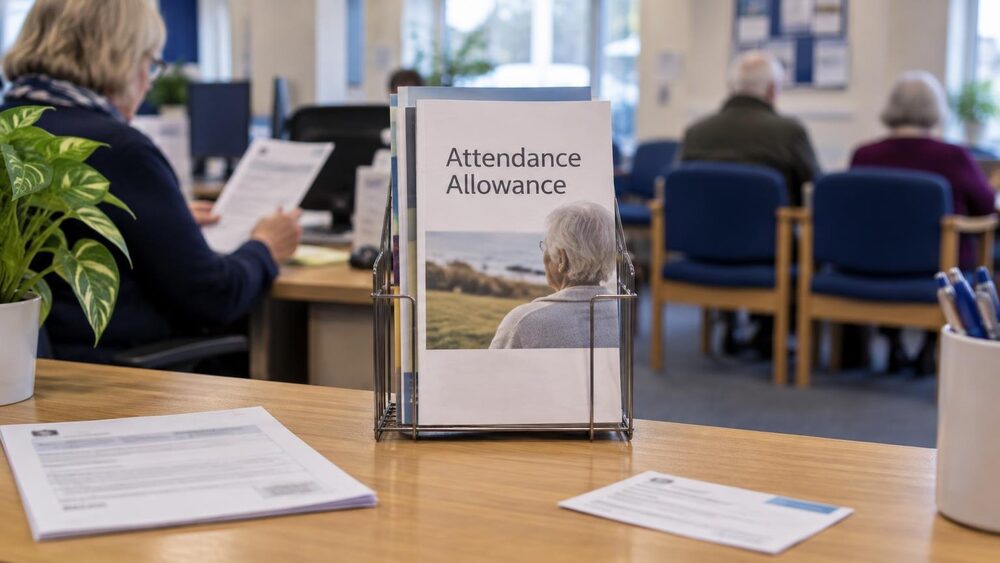
Attendance Allowance pays £72.65 a week at the lower rate and £108.55 a week at the higher rate for the period from April 2024 to March 2025, according to Mencap1. The benefit is for people who need someone to help them because of their disability, and the money is intended to help pay for care and support1.
The lower rate applies where a person needs a lot of help or looking after during the day, or needs looking after at night. The higher rate applies where help or looking after is needed during both the day and the night, or where a medical professional has said the person might have less than 12 months to live1.
To qualify, a claimant must live in the UK, have lived in Scotland, England or Wales for at least two of the past three years, be State Pension age or older, have a disability, need someone to help them, and have needed that help for at least six months1. Attendance Allowance cannot be claimed by people who receive Disability Living Allowance, Personal Independence Payment or Adult Disability Payment1. Someone living in a care home whose local authority pays for their care does not usually get Attendance Allowance, but someone who pays all their own care home costs can claim1. The benefit is not means-tested, so earnings and savings do not affect the amount paid1. Claimants do not need a paid carer1. Where someone also gets Constant Attendance Allowance, their Attendance Allowance is reduced by the amount of Constant Attendance Allowance received1.
The Department for Work and Pensions checks how a disability or health condition affects the amount of help or support needed, and may ask for an assessment if the application form does not make this clear1.
"From April 2024 - March 2025, the payments are: £72.65 per week for the lower rate, £108.55 per week for the higher rate."
Separate guidance published later gives different figures for a later year. Disability Rights UK, in a page revised and updated on 4 April 2026, lists a weekly lower rate of £76.70 and a weekly higher rate of £114.60 from 7 April 20262. Which?, in an article dated 6 April 2026, gives the same two rates for 2026-27: £114.60 a week at the higher rate and £76.70 a week at the lower rate3. Those figures relate to 2026-27 and not to the April 2024 to March 2025 period covered by the Mencap rates above.
Both later sources also describe the position in Scotland. Disability Rights UK states that pension age disability payment has replaced attendance allowance in Scotland2. Which? states that people living in Scotland need to apply for Pension Age Disability Payment instead, delivered by Social Security Scotland, with rates for 2026-27 of £114.60 a week at the higher rate and £76.70 a week at the lower rate3. Disability Rights UK lists the residence and presence tests as being present in England, Wales or Northern Ireland, having been present in Great Britain for two of the last three years before claiming, and being habitually resident in the United Kingdom, the Channel Islands, the Republic of Ireland or the Isle of Man2.
Why it matters for households
Attendance Allowance is paid to people who have reached State Pension age and need help with personal care or supervision, so the rates set the weekly amount for a group that is largely outside the labour market. At the April 2024 to March 2025 figures, the difference between the lower and higher rate is £35.90 a week1. Because the benefit is not means-tested, savings and earnings do not reduce it1, and it is paid on top of any State Pension rather than instead of it.
The rate a household receives depends on whether help is needed during the day, at night, or both, and on whether the six-month qualifying period has been met1. The six-month rule does not apply to claims made under the special rules for people who may have less than 12 months to live, who are usually paid the higher rate1. Which? states that payments are calculated weekly and usually paid every four weeks, and that a £10 Christmas Bonus is paid in December3. Which? also states that Attendance Allowance is non-taxable and is not treated as income for tax purposes3.
Where a person moves into a care home or hospital, or receives certain NHS funding, payments can stop. Which? states that payments stop after 28 days if local authority care funding is received, and that the allowance also stops if NHS Continuing Healthcare is received, though it continues where NHS-funded Nursing Care is paid with no other state financial support3. Disability Rights UK states that Attendance Allowance stops after a total of four weeks in hospital, counting either one stay or several stays where the gaps between them are no more than four weeks each time2. Which? states that in Scotland, Attendance Allowance will normally stop on moving into a care home even where the person is self-funding3.
What happens next
The April 2024 to March 2025 rates ran for that financial year1. Later rates of £76.70 a week at the lower rate and £114.60 a week at the higher rate apply from 7 April 2026, as reported by Disability Rights UK2 and Which?3. No further rate changes beyond those dates are reported in these sources.
Claims can be made on form AA1, by calling the Attendance Allowance helpline on 0800 731 0122, or online2. Disability Rights UK states that a completed form returned within six weeks is backdated to the day the form was requested2. Which? states that an application usually takes around three weeks to process, and that payment can be backdated to the date the claim form was received or the date the enquiry line was called3.
Sources3 cited
- Attendance Allowance | Mencap mencap.org.uk
- Attendance Allowance | Disability Rights UK disabilityrightsuk.org
- Attendance Allowance: eligibility and how to claim - Which? which.co.uk
 Turn2usFree benefits calculator and grants search from a charity
 Citizens AdviceFree advice on money, consumer and legal problems in England and Wales
 GOV.UKOfficial information on tax, benefits and government services
 MoneyHelperFree, impartial money and pensions guidance, set up by government