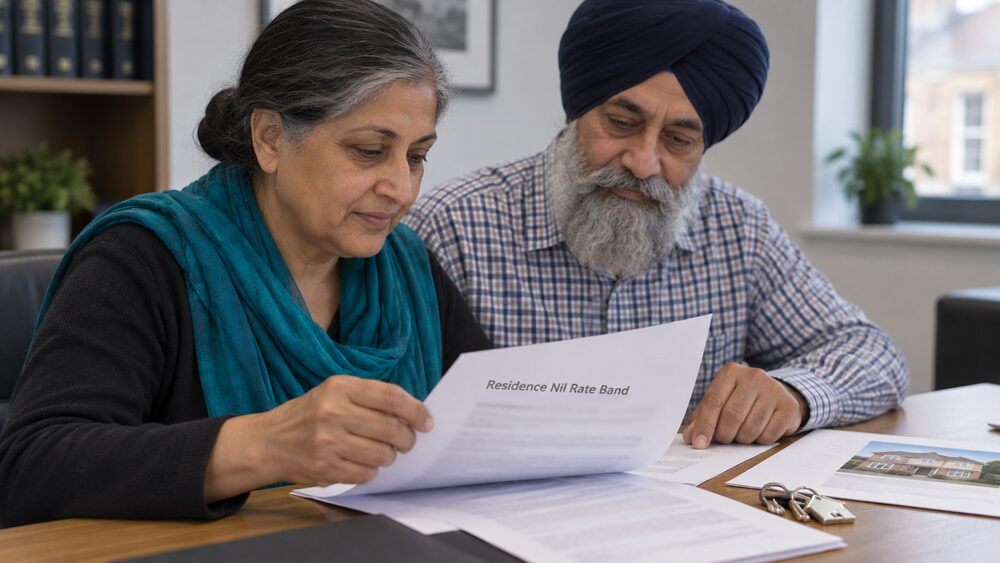
Inheritance Tax is a tax on the estate (the property, money and possessions) of someone who has died1. Most estates do not pay it, because the first slice of an estate is covered by allowances. The main one is the nil-rate band, worth £325,000 per person2. On top of that, there is an extra allowance for passing on a home to children or grandchildren: the residence nil rate band, worth up to £175,000 per person3.
Inheritance Tax is a tax on the estate (the property, money and possessions) of someone who has died1. Most estates do not pay it, because the first slice of an estate is covered by allowances. The main one is the nil-rate band, worth £325,000 per person2. On top of that, there is an extra allowance for passing on a home to children or grandchildren: the residence nil rate band, worth up to £175,000 per person3.
That extra allowance is the one that disappears for larger estates. Once an estate is worth more than £2m, the residence nil rate band is reduced by £1 for every £2 above the threshold4. Because the allowance is £175,000, it is wiped out entirely once the estate reaches £2.4m4. The £2m starting point is set by the government and is not changing5.
For a married couple leaving a home to direct descendants, the combined allowances can protect up to £1m6. But the taper is applied to each estate separately, so a couple whose combined wealth sits above £2m can still lose part of the allowance on the first death.
Residence nil rate band: £175,000 on a home left to direct descendants
The residence nil rate band is an additional allowance worth up to £175,000 if you leave your main home to direct descendants4. It sits alongside the standard nil-rate band of £325,000 per person2. Together, one person leaving a home to children or grandchildren could potentially pass on up to £500,000 tax-free7.
The allowance was introduced in April 2017 and increased gradually between April 2017 and April 20208. It is fixed at £175,000 until 5 April 20315. It applies when a home is left to a direct descendant, such as a child, stepchild or grandchild9.
To claim it, the deceased must have died on or after 6 April 2017, owned a residence, and the residence must be inherited by their direct descendants10. The allowance applies to only one home, which must be in the estate and one you have lived in at some stage. There is no minimum ownership period, the home need not be in the UK, and executors can nominate which home qualifies8.
£500,000 per person, up to £1m for a couple
For a single person leaving a home to children or grandchildren, the two allowances together can cover up to £500,0007. For a married couple or civil partners, the combined figure can reach £1m6.
That is because any unused allowance can be transferred between married couples and civil partners when one person dies11. If the first spouse or civil partner did not use all of their nil-rate band, the survivor can add the unused proportion to their own. The same applies to the residence nil rate band.
The transfer is proportional. If the first spouse had used 10% of their nil-rate band, the survivor would be able to use 90% of whatever the nil-rate band is worth when they die2. So the amount transferred depends on how much was used, not a flat figure.
Unmarried partners do not have this option. They can only benefit from the deceased's nil-rate band of £325,000, and not the £175,000 residence nil rate band, because to qualify the home must be left to direct descendants10. A partner who is not a direct descendant cannot receive the home and preserve the allowance.
What counts towards the estate's value
The taper is tested against the taxable value of the estate after allowable deductions such as debts and funeral expenses7. That means a mortgage secured on the property, credit card balances, and other liabilities can reduce the figure used to decide whether the estate is over the £2m threshold. The standard nil-rate band is applied first, not the residence nil rate band7.
Gifts made within seven years of death are also added back when working out the value of the estate. The nil-rate band is allocated to those gifts before it is used against the rest of the estate6. Gifts made more than seven years before death are generally outside the calculation, so their timing can matter12.
The residence nil rate band applies to only one home, which must be in the estate and one you have lived in at some stage8. If the value of your home at death is less than the main residence nil-rate band at that time, a downsizing addition may apply8. This is designed to help where someone has sold a larger home and moved to a smaller one, or sold up to move into care.
Unused pensions will count towards the estate
From 6 April 2027, most unused pension funds and death benefits will be included in the value of a person's estate for Inheritance Tax14. The government confirmed the change in a consultation response, stating that most unused pension funds and death benefits would be included in the value of a person's estate for Inheritance Tax from that date14.
This matters for the taper because pension wealth has historically sat outside the estate for Inheritance Tax purposes. Once included, it could push an estate over the £2m threshold and reduce or eliminate the residence nil rate band15. The change applies to deaths on or after 6 April 202716.
The rules are still being finalised. Defined contribution pensions may become subject to Inheritance Tax for people who die on or after 6 April 2027, with detail not yet known3. For now, the position is that pensions do not form part of your estate on death, but that is due to change17.
Paying the tax when the allowance is reduced
Once the residence nil rate band has been tapered away, the estate pays Inheritance Tax on the value above the available allowances. The standard nil-rate band of £325,000 per person is not tapered in the same way, so it remains available even for larger estates2.
Inheritance Tax can be paid in yearly instalments where the estate includes assets that take time to sell, such as property. The first instalment is due at the end of the sixth month after the death, with further payments due every year on that date18. You can pay off the full tax and interest at any time by writing to HMRC asking for a final assessment18.
If 10 percent or more of the net estate is given to charity, the Inheritance Tax rate drops from 40 percent to 36 percent19. However, the taper of the residence nil rate band is calculated before any gifts to charity are counted, so a charitable gift does not restore the allowance13. Lifetime charitable donations to registered UK charities are also not taken into consideration when calculating the residence nil rate band13.
Where to get help
Inheritance Tax and the residence nil rate band interact with wills, trusts, pensions and gifts, and the rules differ depending on family circumstances. Free, impartial guidance is available from MoneyHelper, and the Scottish Government provides Inheritance Tax support through mygov.scot1. For estates that may be affected by the taper, professional advice is often needed to work out the taxable value and the available allowances.
The residence nil rate band is fixed at £175,000 until 5 April 20315, and the taper threshold remains at £2m5. The pension change from April 2027 is the main development that could affect how many estates are caught by the taper14.
Sources19 cited
- Inheritance Tax mygov.scot
- How much money can I pass on without paying inheritance tax? Which?
- What happens to my pension when I die? Which?
- 5 inheritance tax planning mistakes to avoid Which?
- Budget 2025 overview of tax legislation and rates GOV.UK
- Will our gifts to our children be taxed? Which?
- More inheritance tax is being saved through charitable gifts Which?
- Inheritance tax property changes Which?
- How much could frozen tax thresholds be costing you? Which?
- Why some families will be hit harder by new inheritance tax rules for pensions Which?
- Will trusts and lifetime trusts Which?
- 5 inheritance tax rules to know when gifting money in 2026 Which?
- Could donating to charity lower my inheritance tax bill? Which?
- Inheritance Tax on pensions: liability, reporting and payment GOV.UK
- Will my pension be subject to inheritance tax? Which?
- 6 ways couples can cut taxes and maximise their savings Which?
- Inheritance tax planning and tax-free gifts Which?
- Paying Inheritance Tax: yearly instalments GOV.UK
- How can gifts in wills reduce inheritance tax? Remember A Charity








 GOV.UKOfficial information on tax, benefits and government services
 MoneyHelperFree, impartial money and pensions guidance, set up by government
 Citizens AdviceFree advice on money, consumer and legal problems in England and Wales
 Turn2usFree benefits calculator and grants search from a charity
 Citizens Advice ScotlandFree advice across Scotland