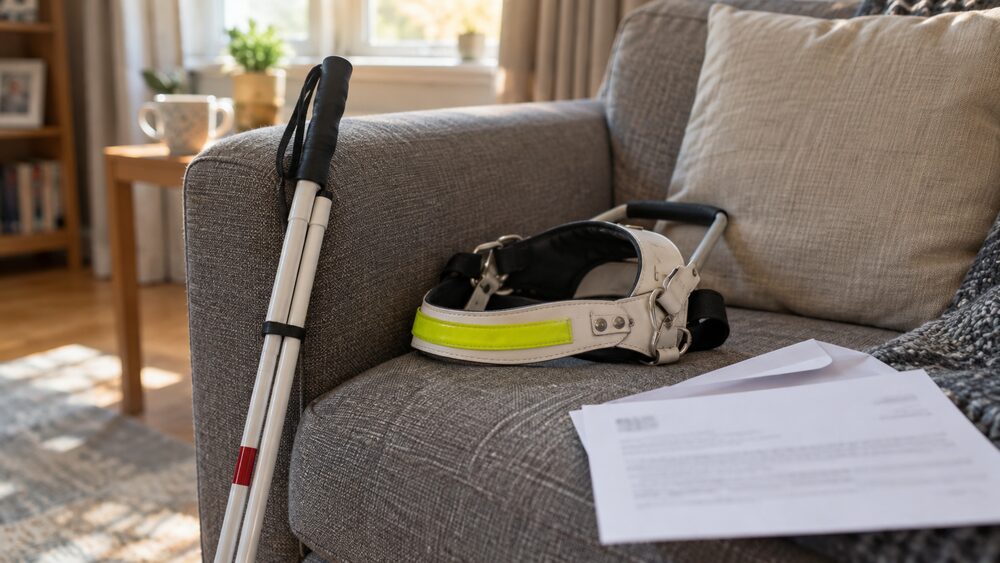
Blind Person's Allowance is an extra amount of tax-free income added on top of your Personal Allowance if you are registered blind or severely sight impaired. For the 2026 to 2027 tax year it is worth £3,250, up from £3,130 in 2025 to 20261. It is added to your tax-free Personal Allowance, so it raises the amount you can earn before you start paying Income Tax2.
Blind Person's Allowance is an extra amount of tax-free income added on top of your Personal Allowance if you are registered blind or severely sight impaired. For the 2026 to 2027 tax year it is worth £3,250, up from £3,130 in 2025 to 20261. It is added to your tax-free Personal Allowance, so it raises the amount you can earn before you start paying Income Tax2.
The allowance is not paid to you as cash and it is not automatic. You have to claim it, and if you are eligible but never claim, you do not receive it3. Once claimed, it works quietly in the background through your tax code, reducing the tax taken from your wages or pension.
This page explains who qualifies in each part of the UK, how the allowance cuts your bill, how to claim it, and what happens to any part you cannot use.
Blind Person's Allowance: £3,250 on top of your Personal Allowance
The allowance is a tax-free amount, not a payment. It is added to your tax-free Personal Allowance, which is £12,5704. For 2026 to 2027, adding the two together gives a tax-free total of £15,820. HMRC's own worked example uses the same two amounts: someone with a salary of £18,000 pays tax on £2,180, which is £18,000 less the sum of £12,570 and £3,2501.
A worked example shows how it lands in practice. Someone aged 58, registered blind, earning £18,000 a year, with a Personal Allowance of £12,570, only pays tax on £2,180, which is £18,000 less the sum of £12,570 and £3,2502. Without the Blind Person's Allowance, more of that salary would be taxable.
The allowance is not means-tested in the way some benefits are. It does not matter whether you work or have savings for the allowance itself. What can change your overall tax-free position is the separate taper on the Personal Allowance, which starts to reduce once income passes £100,0005.
Who qualifies in England and Wales, and in Scotland and Northern Ireland
The route to the allowance differs depending on where you live, because registration for blindness is handled differently across the UK.
In England and Wales, you qualify if you are registered as blind or severely sight impaired with a local authority and have a certificate, or a similar document, from your doctor to verify this2. In practice you need to be certified as blind and appear on a local authority register of blind people to claim6.
In Scotland and Northern Ireland, the test is different. The allowance is paid to people who cannot do work for which eyesight is essential and who have a certificate, or a similar document, from their doctor2. There is no requirement to appear on a local authority register in the same way, because the certification route works differently there.
| Where you live | What you need |
|---|---|
| England and Wales | Registered as blind or severely sight impaired with a local authority, plus a certificate or similar document from your doctor2 |
| Scotland and Northern Ireland | You cannot do work for which eyesight is essential, plus a certificate or similar document from your doctor2 |
There is no age limit built into the allowance. If you are registered as blind you can claim it, whether you are of working age or a pensioner7. That is different from some disability benefits, which do have age rules. Adult Disability Payment in Scotland, for example, can be applied for from age 15 years and 9 months onwards8, but that is a separate benefit and not the tax allowance.
How the allowance cuts your Income Tax bill
The allowance reduces the income on which you pay tax. It means you can earn more before you start paying Income Tax7. Because it is delivered through your tax code, most people see the benefit as lower PAYE deductions rather than a separate payment.
Income Tax is charged on income above your Personal Allowance9. The allowance raises that threshold for you. It applies to the income you pay tax on, which includes wages, benefits, money you make from working for yourself and money you make from renting out a property9.
There is one important limit. If you claim relief under the foreign income and gains (FIG) regime, you lose a list of allowances, and Blind Person's Allowance is one of them. The others include the personal allowance, the capital gains tax annual exempt amount, tax reductions for married couples and civil partners, the transferable tax allowance, and relief on certain life insurance payments10. So if you are claiming under that regime, the allowance does not apply.
The allowance also affects some tools and forms. The government's dividend and savings interest tax checker cannot be used if you get Blind Person's Allowance, along with other conditions such as filing a Self Assessment return or getting Marriage Allowance11. That is a sign the allowance changes how your tax is worked out, so it is handled outside the simple online tools.
Claiming it: the allowance is not automatic
The single most important point is that you must claim. If you are eligible for Blind Person's Allowance, you must claim it, because you do not receive it automatically3. Many people who qualify never claim, and the allowance is simply lost.
The claim is made to HMRC. Once it is in place, the allowance is built into your tax code so it reduces the tax taken from your pay or pension. If you are employed or receive a pension, that usually means your code changes and your deductions fall. If you complete a Self Assessment return, the allowance is claimed there instead.
It helps to keep your certification and any supporting document to hand, because the claim rests on being registered or certified. In England and Wales that means the local authority register and your doctor's certificate2. In Scotland and Northern Ireland it means the certificate or similar document confirming you cannot do work for which eyesight is essential2.
There is a wider point about disability and tax. Entitlement to some disability benefits, such as Personal Independence Payment, is based on how your condition affects you rather than the condition itself12. Blind Person's Allowance is different: it turns on registration or certification, not on a broader assessment of need.
Transferring unused allowance to a spouse or civil partner
If your income is low enough that you do not pay tax, or you cannot use all of the allowance, the unused part is not wasted. You can transfer any unused Blind Person's Allowance to your spouse or civil partner6. You can transfer it to your partner if you do not pay tax or cannot use it all7.
The transfer is made using form 575, "Notice of transfer of surplus Income Tax allowances"2. The same form covers other surplus allowances, so it is the standard route for passing an unused allowance across.
There is a related protection in the benefits system for couples where one partner is registered blind. If you or your partner are registered blind or claiming certain disability benefits, no non-dependant deduction or housing cost contribution is taken regardless of the non-dependant's circumstances13. Separately, if you are part of a couple and your partner is registered blind, you can still qualify for a Severe Disability Addition or Severe Disability Premium paid at the single rate even if your partner does not get a qualifying benefit14.
Other help that comes with registration
Being registered blind can open up other reductions beyond the tax allowance, and it is worth knowing they exist so you can ask about them.
You get 50% off your TV licence if you are registered blind15. There is also a Council Tax disability reduction scheme, which reduces your Council Tax by a band if you or someone you live with is permanently disabled, and it applies in England and Wales16. Backdating of that reduction may be limited to six years17.
For children, there is a further point. If you choose not to claim Disability Living Allowance despite the fact that your child is registered blind, you will still receive a disability premium when claiming means-tested benefits18. That means registration alone can carry weight in the benefits system even where a disability benefit is not claimed.
These sit alongside the tax allowance rather than replacing it. The allowance reduces your Income Tax; the TV licence discount and Council Tax reduction cut other bills. Each has its own claim route, so getting one does not automatically get you the others.
Where the allowance fits with other tax reliefs
Blind Person's Allowance is one of several allowances that can reduce your tax bill, and it is worth understanding how it interacts with the others.
Married Couple's Allowance is a separate relief for people who are married or in a civil partnership7. It works by reducing the tax bill of one spouse by 10% of the allowance they are entitled to6. You cannot get Marriage Allowance and Married Couple's Allowance at the same time19. Marriage Allowance is the relief that lets you transfer part of your Personal Allowance, and it can be backdated for up to four tax years if you were eligible during those periods20.
Blind Person's Allowance is different from both. It is not about transferring part of your Personal Allowance to a partner in the ordinary way; it is an extra allowance in its own right, and only the unused part can be passed across. If you are unsure which reliefs apply to your household, the safest step is to check with HMRC, because claiming the wrong one can mean a correction later.
There is also a wider caution about income and benefits. If your income increases, causing a benefit award to reduce to £0, that could end entitlement to that benefit21. The tax allowance itself is not a benefit and is not withdrawn on that basis, but if you receive means-tested benefits alongside it, changes in income can affect those separately.
Sources21 cited
- Annex A: rates and allowances GOV.UK, 2025-12-05
- Blind Allowance Entitledto, 2026-09-26
- Blind person's allowance Low Incomes Tax Reform Group, 2026-09-26
- Income Tax GOV.UK, 2026-09-26
- Scottish Income Tax rates and bands: 2026 to 2027 Scottish Government, 2026-01-14
- Tax-free income and allowances Which?, 2026-04-06
- Tax Independent Age, 2026-03-30
- Child Disability Payment statistics to 30 June 2026 Social Security Scotland, 2026-08
- Tax and allowances in retirement nidirect, 2026-03-30
- HS266 Foreign Income and Gains (FIG) regime GOV.UK, 2026-05-18
- Check how much tax you pay on dividends and interest from savings GOV.UK, 2025-03-03
- Personal Independence Payment (PIP) Mencap, 2026
- Non-dependants Entitledto, 2026-09-26
- Can I get a Severe Disability Premium? Turn2us, 2026-05-26
- Your business and household budget Business Debtline, 2026-09-26
- Help with Council Tax reduction and discount Scope, 2026-08-11
- Help with Council Tax Disability Rights UK, 2026-04-14
- Registered blind with no DLA Entitledto, 2026-09-26
- Marriage Allowance GOV.UK, 2026-09-26
- How to track down forgotten money Which?, 2026-07-11
- Benefits, earnings and benefits Entitledto, 2026-09-26



 GOV.UKOfficial information on tax, benefits and government services
 MoneyHelperFree, impartial money and pensions guidance, set up by government
 Citizens AdviceFree advice on money, consumer and legal problems in England and Wales
 Turn2usFree benefits calculator and grants search from a charity
 Citizens Advice ScotlandFree advice across Scotland