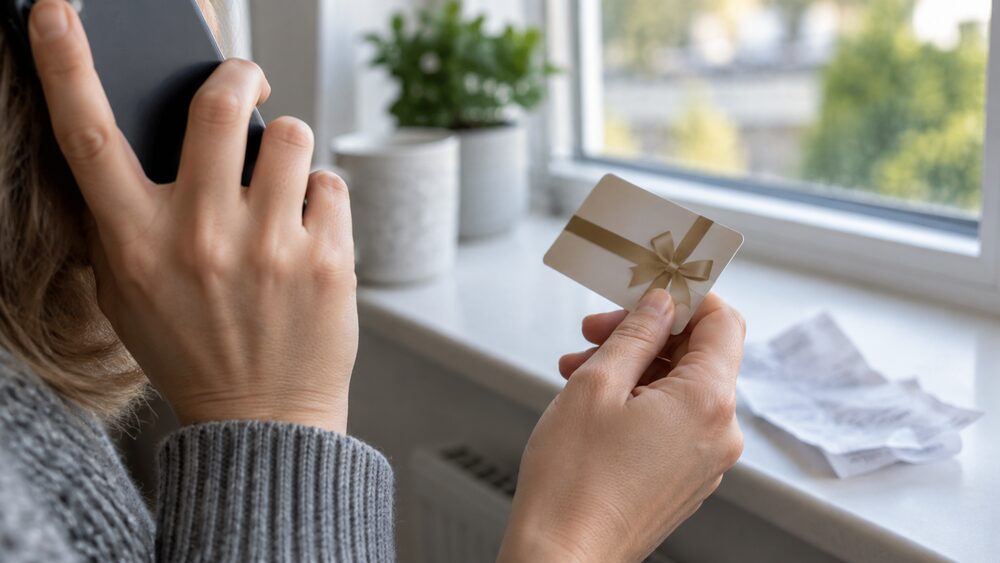
If a scammer persuaded you to buy gift cards and share the codes, the honest answer is that the money is often gone. Gift cards are easy to buy, hard to trace, spent quickly and can be sold on, which is exactly why fraudsters ask for them1. Scammers steal millions from gift cards every year1.
If a scammer persuaded you to buy gift cards and share the codes, the honest answer is that the money is often gone. Gift cards are easy to buy, hard to trace, spent quickly and can be sold on, which is exactly why fraudsters ask for them1. Scammers steal millions from gift cards every year1.
That does not mean there is nothing to do. Contact your bank and the gift card provider immediately, because the provider may be able to block the card before the balance is spent1. Report it to Report Fraud, and call the police on 101 if you are in Scotland1. Keep every message and record of contact with the scammer2.
The rest of this page explains why recovery is so difficult, how these scams work, what to say to your bank, and the warning signs that a request for a gift card code is a scam.
Act fast: contact the gift card provider and your bank
The first hours matter more than anything else on this page. Independent guidance is to contact your bank and the gift card provider immediately to try to recover your money, because sometimes the gift card provider will be able to block the card1. Once the balance has been spent, there is usually nothing left to freeze.
The Financial Ombudsman Service sets out the immediate steps for someone who has been scammed: contact your bank or payment services provider immediately, contact the police on 101, report the scam to Report Fraud, and keep records of all contact and correspondence between you and the scammer2. The Payment Systems Regulator gives the same first instruction: as soon as you realise you have fallen victim to a scam, contact your bank to report it4.
If you gave payment details as well as a gift card code, tell your bank or payment provider as soon as possible and explain what has happened5. If you handed over card details, banks ask to be told immediately so they can protect the account6. Where a card is involved, a bank may ask you to freeze it straight away while you get in touch7.
Contact the gift card provider through the details on its own website or the back of the card, not a number or link a caller gave you. If you are expecting a new card and it does not arrive, contact your bank or provider immediately8.
Why gift card payments are hard to recover
Gift cards sit outside the protections that cover most other payments. There is no Section 75 claim, because you did not buy goods or services from the scammer with a credit card. There is no chargeback in the usual sense, because the card was bought legitimately from a retailer. And there is no authorised push payment claim, because no bank transfer was made.
The reason scammers ask for them is structural. Gift cards are easy to buy, hard to trace, spent quickly and can be sold on1. Compare that with a bank transfer, where paying directly into an account is like handing over cash, which is hard to trace, and it is very hard to get your money back if the payment turns out to be fraudulent9. MoneyHelper makes the same point about bank transfers generally: it is harder to get your money back, and you have much less protection if something goes wrong10. Gift cards are worse still, because the value leaves your hands the moment the code is shared.
Banks do refund unauthorised transactions reported quickly11. The distinction that matters is authorisation. If someone uses your card without your knowledge, that is unauthorised and you will usually get a refund. If you bought a gift card yourself and read out the code, you authorised the purchase, and the loss sits with you.
There is one route that sometimes works. One4all told Which? that customers who have experienced fraudulent activities on their gift card should contact its customer service team, and it said it will reimburse their gift card1. That is one provider's stated policy, not a rule that applies across the market, but it shows why asking the provider directly is worth the call.
How gift card scams work
Most gift card scams follow the same shape: you are pressured to buy cards online or in a store, then to send the codes to the scammer13. The pressure is the point. A sense of urgency to act quickly is one of the common warning signs of a scam14.
There are several variants.
- Draining. Fraudsters take the codes from the physical cards displayed in the shop, then steal the funds once money has been loaded onto them1. You buy a card that looks untouched and the balance is already gone.
- Impersonation. Someone poses as a person or organisation you trust and asks for gift card codes. If you receive an email asking you to purchase a gift card, always contact that person using another method, such as a phone call, to double-check it is them emailing you1.
- Fake friendship. Someone builds trust with you online, then asks for gift card codes to help with a money problem, saying they will pay you back3.
- Delivery and parcel stories. Criminals impersonate legitimate delivery companies and may send a text, email or other message claiming a delivery failed, asking you to pay a fee or provide additional details to rearrange, often with a link to a fraudulent website15. A postcard version claims a parcel is waiting and asks you to call a number, then requests payment by credit card for a non-existent package16.
- Follow-up calls. Fraudsters contact previous victims requesting payment for a fake malware protection service or a new subscription fee17.
The common thread is that the payment method is the tell. If someone asks you to pay using gift cards, crypto or bank transfers, it is likely a scam, because these payment methods offer little protection18.
Your bank, the police and HMRC never ask for gift cards
This is the single rule that prevents most of these losses. Your bank, the police or HMRC will never ask you to pay or help with an investigation using gift cards3. The same wording appears in Ulster Bank's guidance to customers19.
The rule extends to anything that would let someone else take control of your money or your card. Banks or the police will never ask for your PIN or send someone to your house to pick up your bank card20. Your bank or the police will never send a courier to your home to collect your card, PIN, cash or valuables21. HMRC will never ask for your bank account details, personal information or send you notifications by email or text for claiming tax rebates, refunds, personal or payment information22.
If a caller claims to be from your bank and asks you to move money, buy gift cards or hand over a code, end the call and ring the number on the back of your card. If a message claims to be from HMRC, do not use the contact details in it.
"Remember, your bank, the police or HMRC will never ask you to pay or help with an investigation using gift cards."
Warning signs before you share a code
The clearest warning sign is the request itself. Being asked to buy a gift card and send its details to a stranger is a recognised red flag23. Do not share a gift card code or a photo of the card with someone who contacts you unexpectedly3.
Other signs sit around the request:
- Urgency. A sense of urgency to act quickly, and being told not to tell anyone14.
- Payment method. Being asked to pay a fine, tax or fee with a gift card on the promise of receiving money in return13.
- Contact details. An unfamiliar email address, or a general address such as a PO Box14.
- Presentation. Inaccurate spelling and wording14. Bad spelling and prizes that are too good to be true are common in scam post24.
- Unexpected bills. You receive bills or receipts for goods or services you have not asked for25.
If you are buying a gift card as a present, the risk is not in the card. It is in being asked to buy one and send its details to someone you do not know. If someone needs payment in the form of a gift card, it is likely to be a scam13.
What to do if you have already shared a code
Work through this in order.
- Contact the gift card provider and ask it to block the card1.
- Contact your bank or payment services provider immediately and explain what has happened2.
- If you gave card details, tell your bank immediately so it can protect the account6.
- Report it to Report Fraud, or call the police on 101 if you are in Scotland1.
- Keep records of all contact and correspondence between you and the scammer2.
- If you are worried you have given your payment details or money to a scammer, contact your bank or payment provider as soon as possible22.
Scam emails can be reported by forwarding them to report@phishing.gov.uk, and suspicious websites can be reported to the National Cyber Security Centre1. If your card has been retained by a card machine, report it to your card provider immediately26.
If you contact your bank, you may be able to recover money you have lost in unauthorised or unexpected payments27. That route depends on the payment being unauthorised, which is why the gift card purchase itself is usually outside it.
Where to get free help
You do not need to pay anyone to report a scam or to get advice. Report Fraud takes reports of fraud in England, Wales and Northern Ireland, and Police Scotland takes them on 1011. The Financial Ombudsman Service can look at complaints about how a bank handled a scam, including frozen accounts and blocked payments28.
For free, impartial money guidance, MoneyHelper covers banking and shopping safely online10. Age UK and Independent Age both publish scam guidance and support for victims12. If a scam has left you in debt, debt advice charities can help you work out what to do next.
If a bank freezes your account because it suspects fraudulent activity, it is allowed to do so while it investigates28. A card company may also freeze your card if it is suspicious about sudden unusual spending29. That is a protection, not a punishment, but it is worth knowing it can happen.
Sources29 cited
- How scammers use gift cards in their schemes Which?, 2025-09-11
- Scams involving unauthorised payments and identity theft Financial Ombudsman Service, 2026-09-26
- Gift card scams NatWest, 2026-09-25
- If you've fallen victim to a scam Payment Systems Regulator, 2026-09-25
- Scams: what to look for Financial Services Compensation Scheme, 2026-05-05
- Bitcoin Weatherbys Bank, 2026-09-22
- Still think you've been a victim of fraud or a scam Nomo, 2026-09-26
- Card fraud Take Five, 2026-09-26
- Invoice scams Halifax, 2026-09-27
- Shop safely online MoneyHelper, 2026-09-25
- How to open, switch or close your bank account MoneyHelper, 2026-09-25
- What to do if you've been a victim of a scam Independent Age, 2026-09-26
- Latest scams Tesco Bank, 2026-09-25
- Scams post nidirect, 2026
- Delivery scams Take Five, 2026-09-26
- Postal scams Consumer Council for Northern Ireland, 2026
- Computer software service fraud: follow-up calls nidirect, 2026-07-27
- Social media scams Royal Bank of Scotland, 2026-09-25
- Gift card scams Ulster Bank, 2026-09-25
- Phone scams Age UK, 2026-08-19
- Episode 46 transcript Financial Services Compensation Scheme, 2025
- How to spot HMRC phone, text and email tax scams Which?, 2026-01-19
- Fraud protection Post Office, 2026
- Scams quiz Independent Age, 2026
- Identity theft Information Commissioner's Office, 2026-09-25
- Cash machine fraud Take Five, 2026-09-26
- Support for scam victims Age UK, 2026-04-13
- Frozen accounts and blocked payments Financial Ombudsman Service, 2026-09-25
- The costs and charges of credit cards Citizens Advice Scotland, 2026-09-25



 FCA Warning ListCheck whether a firm is authorised before you deal with it
 Financial Ombudsman ServiceFree, independent help when a complaint about a firm is not put right
 Citizens AdviceFree advice on money, consumer and legal problems in England and Wales
 MoneyHelperFree, impartial money and pensions guidance, set up by government