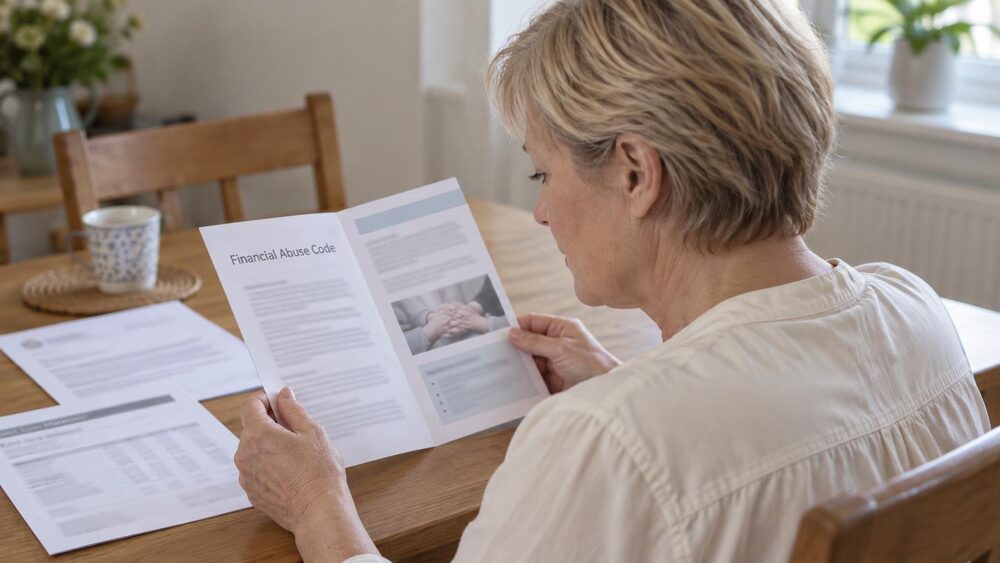
Financial abuse is when someone causes you harm by controlling or mishandling your finances or assets1. It is a crime2. The wider term used by debt charities and banks is economic abuse: when a person uses access to money or other resources to control another person3. It is a form of domestic abuse3, and it is not only about a partner. A relative, an adult child or a carer can do it too.
Financial abuse is when someone causes you harm by controlling or mishandling your finances or assets1. It is a crime2. The wider term used by debt charities and banks is economic abuse: when a person uses access to money or other resources to control another person3. It is a form of domestic abuse3, and it is not only about a partner. A relative, an adult child or a carer can do it too.
The pattern matters more than any single incident. Spending the money meant for rent and bills, taking your income from work or benefits, building up debt in your name, and threatening or harassing you are all given as examples4. Because the harm runs through bank accounts, loans and credit files, the practical route out usually starts with free debt and money advice, and with telling your bank what is happening.
Economic abuse: when money is used to control you
Economic abuse is defined as using access to money or other resources to control another person, and it is classed as a form of domestic abuse3. Financial and economic abuse are described in the same terms by lenders: a form of domestic abuse where a person's financial freedom is restricted by someone close to them8. Financial abuse specifically is when someone causes you harm by controlling or mishandling your finances or assets1.
The examples are concrete and often cumulative. They include spending the money meant for rent and bills, taking your income from work or benefits, building up debt in your name, and threatening or harassing you4. Debt taken on this way is sometimes called coerced debt, and it is the part that follows a person longest, because it sits on their credit file and in their name even after the relationship ends.
Two things follow from that. First, the money problem is not separate from the abuse, so dealing with the debt is part of getting safe. Second, the person doing it often has access to the paperwork, the post and the passwords, which is why advice services ask about who controls what rather than only about the balance owed.
Banks treat financial products used as control as a priority
Preventing financial services products from being used as a form of control and economic abuse continues to be a key priority, according to UK Finance, the trade body for the banking and finance industry5. That work sits with its Domestic, Financial and Economic Abuse Working Group and Vulnerability Committee, whose members share that priority5.
In practice this shapes what a bank is expected to do when you tell it what is happening. The Financial Ombudsman Service, which decides complaints a bank has not resolved, sees cases involving compulsive spending or gambling harm about every financial product, including loans, mortgage extensions, pensions used for gambling, high-risk investments and general banking including account support9. It also points to regulations including the Consumer Duty, which require firms to support you while you are using their product or service and to be flexible and find ways to support vulnerable customers10.
There is a limit worth knowing. Banks are legally required to close accounts when they suspect they may be used for financial crime11. That duty can collide with a victim's need for an account in their own name, and it is one reason a bank may act in ways that look unhelpful. If a bank has treated you badly, the ombudsman can look at complaints involving cost of living pressures as well as discrimination6.
"Contact your bank, they are there to help."
Citizens Advice: free, confidential help with debt and money
Citizens Advice offers free advice on debt and other money problems6, and its service includes help with gambling problems9. It describes itself as providing free, independent and confidential advice on getting out of debt and a variety of other issues13. It is not the only free option: the Debt Advice Foundation offers free, confidential support and advice on any aspect of debt14, and in Scotland there are free advice services that can help15.
Cost is the point. Approved money advisers working for Citizens Advice, independent advice centres and local councils will not charge you for debt advice16. That matters because paid debt help is where people in difficulty lose money they cannot spare. The Financial Ombudsman Service makes the same promise about its own service: you do not have to pay us to help you7.
Where a debt was built up in your name by someone else, advisers can look at what is provably yours, what can be disputed and what solutions exist. StepChange says it can refer victims to specialist organisations who are experts in coerced debt and economic abuse3. Citizens Advice has reported that the number of people it helps with debt issues has been rising every month for five months17, and it now leads a Consumer Energy Debt Advice service delivered with the Money Advice Trust and StepChange18.
How to contact Citizens Advice across the UK
The right number depends on what you need and where you live. The consumer service line for England and Wales is 0808 223 1133, with a Welsh-speaking adviser line on 0808 223 114419. The same consumer service number is given as 0808 2231133 for England and Wales in council guidance20. For Universal Credit Help to Claim, the numbers are England 0800 144 8444, Wales 0800 024 1220 and Scotland 0800 023 2581, with Advice NI on 0800 915 460422. Help to Claim in England is also given as 0800 144 8 444, with online chat23.
| Where you are | Service | Number |
|---|---|---|
| England | Help to Claim (Universal Credit) | 0800 144 844422 |
| England and Wales | Consumer service | 0808 223 113319 |
| Wales | Welsh-speaking consumer adviser | 0808 223 114419 |
| Wales | Help to Claim (Universal Credit) | 0800 024 122022 |
| Scotland | Help to Claim (Universal Credit) | 0800 023 258122 |
| Northern Ireland | Advice NI | 0800 915 460422 |
| Wales | MoneyHelper services in Welsh | 0800 756 101224 |
Citizens Advice Scotland offers independent and confidential advice on issues such as debt, money problems and welfare benefits25. In Northern Ireland, Advice NI members provide free, confidential help and advice for anyone struggling to deal with money and debt, including debt management plans, plus advice on benefits, housing, employment, tax and consumer rights26, and there is free and professional advice and assistance to help make sure a situation does not deteriorate27. The Finance Support Service supports people in need of short-term financial help28, and emergency financial assistance can be applied for through nidirect government services29.
Report financial abuse to the police
Financial abuse is a crime, and the guidance is to report it to the police2. The bank should help if you suspect financial abuse2, and the national fraud campaign's advice is to contact your bank immediately and report it to the police at reportfraud.police.uk or on 0300 123 204033. Where the person is an adult at risk, concerns can also be raised with your local council's adult social services department34. Government advice treats internet scams, postal scams and doorstep crime as forms of financial abuse, often targeted at adults who need care and support35.
If a bank or lender has handled your situation badly, the Financial Ombudsman Service is free and can be reached on 0800 023 4567 or 0300 123 9123, Monday to Friday 8.00am to 8.00pm and Saturday 9.00am to 1.00pm, or by email at complaint.info@financial-ombudsman.org.uk36. Businesses and consumer advisers can contact its Business Support Hub on 020 7964 1400 for guidance on how a complaint might be looked at38.
Where the protection stops
Free advice, the ombudsman and the banks' own commitments cover a great deal, but they do not cover everything. Debt in your name generally remains your debt until it is challenged or written off through a formal solution, and the rules on who can enter those solutions vary: an individual voluntary arrangement, for example, has eligibility conditions set out by the debt advice bodies14. Scottish solutions differ, including the Debt Arrangement Scheme16, and council tax arrears are handled under separate rules in Scotland31.
There are also limits on what a bank can do. Its legal duty to close accounts suspected of financial crime applies regardless of who is affected11, and a bank cannot simply remove a joint account holder or rewrite a credit agreement on request. Where a complaint turns on how a firm treated a vulnerable customer, the Consumer Duty is the framework the ombudsman points to10.
For anyone supporting an older person, Age UK and Independent Age both publish guidance on helping someone who may be being scammed and on managing money for someone else35. If the abuse involves a partner who is not paying rent or is leaving you with housing costs, Shelter England and Shelter Scotland have separate advice on ex-partners and rent and on money help40. For the wider picture on fraud and refunds, see Scams and fraud: a complete guide and Helping an older relative or someone else who has been targeted.
Sources40 cited
- Relationships and your money Independent Age, 2026-09-26
- Managing money for someone else Scope, 2025-11-27
- Coerced debt StepChange, 2026-09-25
- Economic abuse Shelter Scotland, 2026-07-31
- Control financial freedom report UK Finance, 2026
- Complaints involving cost of living Financial Ombudsman Service, 2026-09-26
- Consumer leaflet (easy read) Financial Ombudsman Service, 2026-09-26
- Financial and economic abuse Accord Mortgages, 2026-09-26
- Complaints that involve gambling-related harm Financial Ombudsman Service, 2026-09-26
- Complaints that involve discrimination Financial Ombudsman Service, 2026-09-26
- Bank account closures research briefing House of Commons Library, 2026-09-26
- Romance fraud Take Five, 2026-09-26
- Debt advice services Credit Services Association, 2026
- Who can enter into an IVA Debt Advice Foundation, 2026-04-21
- Debt advice Shelter Scotland, 2026-01-16
- Debt Arrangement Scheme Business Debtline, 2026-09-26
- Welsh Government paper Senedd Cymru, 2026-09-26
- Powering up support University of Bristol, 2025-10
- Making the most of your money guide National Debtline, 2026-09-25
- Problems with services Isle of Anglesey County Council, 2025-09
- Other consumer problems Isle of Anglesey County Council, 2025-10
- Adoption leave and pay rights for parents Maternity Action, 2026-02
- Where to get benefits advice Shelter England, 2025-04-22
- Money and Pensions Service toolkit Money and Pensions Service, 2026-09-14
- Time orders Business Debtline, 2026-09-26
- Help and advice on illegal lending Consumer Council for Northern Ireland, 2026
- Tips to budget and save Advice NI, 2026-09-26
- Local welfare fund Entitledto, 2026-09-26
- Support with living costs Carers UK Scotland, 2026-09-26
- Consumer protection rights GOV.UK, 2026-09-25
- Council tax: if you cannot pay mygov.scot, 2026-04-01
- Debt solutions Debt Advice Foundation, 2026-04-08
- Protect yourself Take Five, 2026-09-26
- How to help someone if you think they're being scammed Independent Age, 2026-09-26
- Support for scam victims Age UK, 2026-04-13
- Getting a bank account (Scotland) Citizens Advice Scotland, 2026-09-26
- Getting a bank account Citizens Advice, 2026-09-25
- Electronic money services Financial Ombudsman Service, 2026-09-27
- Bereavement Support Payment nidirect, 2026-06-24
- Ex-partner not paying rent Shelter England, 2026-07-01







 FCA Warning ListCheck whether a firm is authorised before you deal with it
 Financial Ombudsman ServiceFree, independent help when a complaint about a firm is not put right
 Citizens AdviceFree advice on money, consumer and legal problems in England and Wales
 MoneyHelperFree, impartial money and pensions guidance, set up by government