
Income protection insurance protects your income if you fall ill and cannot work, paying a percentage of your income each month1. But the policy does not pay simply because you are ill. It pays because your illness meets the definition of incapacity written into your policy, and that definition is the single most important piece of small print in the whole contract. Two people with the same condition, the same salary and the same insurer can get different answers, because their policies judge them against different tests.
The Financial Ombudsman Service, which settles disputes between consumers and insurers, identifies four main categories for disability in income protection insurance: "own occupation", "any suited occupation", "any occupation whatsoever", and "total disability"2. In broad terms, they run from the easiest test to satisfy to the hardest. An own occupation policy pays if you cannot do your own job. A suited occupation policy asks whether you could do your job or a similar one you are qualified or experienced for. An any occupation policy asks whether you could do some kind of work at all.
How income protection decides whether you are too ill to work
Income protection covers a wide range of conditions: essentially, any illness or disability that leaves you unable to work for a period of time, including physical conditions such as cancer or a heart attack, and mental health conditions including stress4. What counts is not the diagnosis itself but whether it stops you from working under the policy's own test. As with any claim, you will need to meet the insurer's definition of being unable to work, which may involve medical evidence4.
That is why the definition matters more than almost anything else on the page. Some policies will only pay out if you cannot do your specific job, while others may consider whether you could do a different type of work4. The difference is not academic. A surgeon with a hand injury, a delivery driver with a bad back, or an accountant with severe anxiety may all be unable to do their own job while still being physically capable of some other employment. Under an own occupation policy, that person has a valid claim. Under a stricter definition, the insurer may argue they could take other work and refuse to pay.
The Financial Ombudsman Service sets out the four main categories of disability definition used in income protection insurance2. When it looks at a complaint, it examines what the policy actually says and how the insurer applied it, which is why the wording in your own documents is the place to start. There are rules which say policy documents must be written in easy-to-read plain English, so you can understand what you are buying3. If you already have a policy, find the definition section and read it before you need it.
For a broader explanation of the product, see how income protection insurance works, and for the related short-term products see accident, sickness and unemployment cover.
Own occupation: paid if you cannot do your own job
Own occupation is the definition most people have in mind when they buy income protection. The policy pays out if you are unable to do your own job or occupation7. The insurer looks at the work you were actually doing when you became ill, not at what else you might be capable of, and not at whether vacancies exist in some other line of work.
Macmillan's guidance for people affected by cancer describes this type of cover as paying out if you cannot do "your own job or occupation"7. The test is tied to your actual role. If a condition stops you performing that role, the claim can be valid even if you could theoretically do something else entirely. For someone with years of training, a professional qualification or a specialist trade, this is the definition that protects the value of that investment.
It is also the definition that tends to matter most for mental health claims. Conditions such as stress are covered by income protection in principle4, but whether a claim succeeds depends on whether the illness stops you from doing your own job, or whether the insurer can point to some other work you could manage. An own occupation policy removes that argument.
The trade-off is cost. The price of income protection is affected by your age, your health, your job, hobbies and lifestyle, the waiting period, and whether you might be prepared to do other kinds of work than your own3. That last factor is the definition itself: an insurer that can only consider your own job is exposed to more claims, and prices accordingly. Own occupation cover is also generally more costly than mortgage payment protection insurance8, which typically uses looser tests over a shorter payout period.
Suited occupation: a job matching your skills and experience
A suited occupation definition widens the test. Under this wording, the policy pays if you cannot do your own job or a similar one that you are qualified or have the experience for7. The insurer does not have to find you a job, but it can refuse a claim if it believes you could realistically work in a related role that matches your training or background.
The practical effect depends on how transferable your skills are. A teacher who cannot cope with a classroom might, in the insurer's view, be suited to private tutoring. A bricklayer who cannot lift might be argued to be suited to site supervision. A solicitor who cannot manage court work might be suited to advisory or administrative roles. In each case the person has lost the job they actually had, but the policy may not pay, because the test looks beyond it.
Macmillan's guidance describes this cover as paying out if you cannot do "your job or a similar one you are qualified or have the experience for"7. The words "qualified" and "experience" are doing the work: the insurer will look at your education, your career history and the tasks you have performed, and will form a view about what else fits. That view can be challenged, and the Financial Ombudsman Service can examine whether the insurer applied the definition fairly2.
For a claimant, the evidence that matters under a suited occupation test is broader than under own occupation. Medical evidence still has to show you cannot do your own job4, but the insurer may also want to understand your skills and work history to assess what else you could do. Keeping records of your duties, qualifications and the physical or mental demands of your role helps both at claim time and when the policy is first priced.
Any occupation and total disability: the strictest tests
The remaining two categories are the hardest to satisfy. Under an "any occupation whatsoever" definition, the policy only pays if you cannot do any type of work at all, not just your own job or a related one2. Under "total disability", the fourth main category identified by the Financial Ombudsman Service, the policy uses its own wording for severe incapacity, and the exact test depends on what the individual document says2.
The four main disability definitions in income protection insurance, from your own job to any work at all2.
These stricter definitions are most often found in cheaper policies, in group cover arranged through an employer, and in short-term products. They are the reason a low premium can be a false economy: the policy exists, but the circumstances in which it pays are narrow. A person who cannot do their own job but could do some sedentary work may fail an any occupation test entirely.
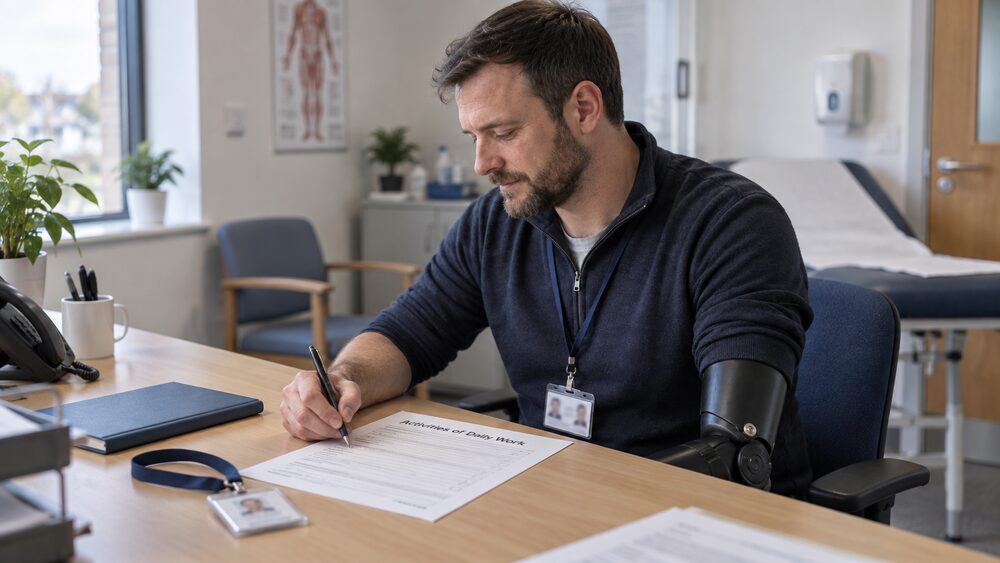
Some policies use functional tests instead of, or alongside, job-based ones. These are sometimes called activities of daily work, and they assess your ability to perform a list of physical tasks rather than your ability to hold down a specific role. The activities of daily work page explains how these tests work. Whichever wording a policy uses, the Financial Ombudsman Service will look at the definition that applies to that policy when it handles a dispute2.
Own or suited occupation: how the definition changes the cost
The definition is one of the main levers on price. Citizens Advice lists the factors that affect the cost of income protection as your age, your health, your job, hobbies and lifestyle, the waiting period, and whether you might be prepared to do other kinds of work than your own3. The last of these is the definition in plain terms: the more work the insurer can expect you to try, the less likely a claim, and the lower the premium.
The payout side also varies with the definition's strictness only indirectly, but the amount of cover is worth understanding alongside it. Policies usually provide a proportion of your income, and the insurer may reduce that by state benefits and any income from similar policies2. Citizens Advice puts the typical payout at about a half to two-thirds of your earnings before tax from your normal job3, while Which? describes typical cover of around 50% to 70% of your salary4; the two figures are close, and the exact percentage depends on the individual policy. Sometimes insurers pay a higher percentage on the first part of your salary, like the initial £50,000, and a lower percentage on the remainder8.
| Definition | What the insurer asks | What it tends to mean for price |
|---|---|---|
| Own occupation | Can you do your own job? | Highest cost, clearest claim test2 |
| Suited occupation | Can you do your job or a similar one you are qualified or experienced for? | Cheaper than own occupation7 |
| Any occupation | Can you do any type of work? | Cheaper still, hardest test to pass2 |
| Total disability | Does your condition meet the policy's own wording? | Depends on the policy's terms2 |
Income protection is generally more costly than mortgage payment protection insurance8. Part of that difference is the definition: MPPI and similar short-term products usually apply looser tests over much shorter payout periods, while income protection pays a monthly income for far longer2.
What the definition means when you make a claim
When you claim, the insurer applies the definition in your policy to your circumstances, supported by medical evidence4. Payments, once they begin, usually continue until you are able to return to work, or until the policy ends4. Which? notes that policies typically pay a percentage of your salary and continue until you return to work, retire or the policy ends, depending on the terms9.
The definition affects the claim in three ways. First, it sets the question the insurer must answer: your own job, a suited job, or any work. Second, it shapes the evidence the insurer gathers, because an any occupation or suited occupation claim invites the insurer to look at your capabilities more widely. Third, it can be the point on which the claim turns when the medical evidence is not clear-cut.
Because income protection is medically underwritten when you take it out, you know in advance what you will and will not be covered for8. That works in your favour at claim time: the argument is about your current condition, not about whether the insurer can add new exclusions. Premiums are then either set and fixed or rise each year by a specified amount5.
If a claim is refused because the insurer says you could do other work, that decision can be challenged. The Financial Ombudsman Service looks at income protection complaints and examines the definition that applies to the policy, including the deferred period and how the insurer applied its terms2. The making a claim page sets out the process step by step.
Waiting periods, claim periods and how long payments last
Every income protection policy has a waiting period, known as a deferred period, before payments start. The Financial Ombudsman Service describes the deferred period as the amount of time you have to have been off work before the policy will start paying you benefit, agreed when you took out the policy2. Citizens Advice says you usually have to wait a minimum of four weeks, but payments can start up to two years after you stop work3. Which? puts the typical default deferral period at 13 or 26 weeks, though it can be as short as four weeks, and notes the range can run from one to 12 months after you were taken ill8.
From the day you stop work to the day payments end, with the waiting period in between3.
The waiting period is there to be set against other income you may have. You may be able to claim statutory sick pay for up to 28 weeks after you stop work3, and if you can afford to rely on savings or employer sick pay for a period, opting for a longer wait before payments begin can reduce premiums4. The deferred period page explains the trade-off in detail, and statutory sick pay and state support covers what the state provides.
How long payments last depends on the policy type. Full income protection claims are typically paid until the person returns to work, retires or the policy ends5, while cheaper short-term policies may only pay for one or two years9. Options also exist for maximum claim periods of one, two or five years, which can make cover more affordable5. The how long claims pay and short-term or long-term income protection pages compare these structures.
Choosing a definition when you buy a policy
You can buy income protection insurance from an independent financial adviser, who may charge, or directly from an insurance company3. Whichever route you take, the definition is the thing to pin down before anything else, because it decides what the policy is worth when you need it.
When comparing quotes, check three things in the documents. First, the definition of incapacity: own occupation, suited occupation, any occupation, or the policy's own total disability wording2. Second, the deferred period, which is agreed when you take out the policy2. Third, the claim period: whether the policy pays until you return to work, retire or the policy ends5, or stops after one, two or five years5.
There are rules which say the policy documents must be written in easy-to-read plain English, so you can understand what you are and are not covered for3. If you take out income protection insurance, you usually have 30 days to cancel the policy and get a full refund3. If you decide to cancel after 30 days, the money you are refunded may be less than the amount you have put in3.
You must give your insurer full details of you and your family's medical history, plus dangerous hobbies or a lifestyle that includes smoking, heavy drinking or drug taking3. The answers you give feed the medical underwriting, and you are medically assessed when you take out the policy, so you know in advance what you will and will not be covered for8. The applying and underwriting and disclosure duty pages cover this in depth, and buying protection insurance explains the adviser and direct routes.
Where income protection does not pay out
The definition is the most common battleground, but it is not the only reason a policy may not pay. Basic income protection policies typically do not cover redundancy8: this is illness and injury cover, not unemployment cover, and separate redundancy insurance products exist for that risk.
A claim can also fail on the waiting period. If you return to work before the deferred period ends, the policy never starts paying, which is why the deferred period needs to be set against your savings and any employer sick pay3. And a claim can fail on disclosure: because you must give full details of your medical history and lifestyle when you apply3, an answer that turns out to be wrong or incomplete can put a later claim in question. The non-disclosure page explains what happens then.
Income protection is also not the same as loan protection or payment protection insurance (PPI), which usually only provides short term benefits2. PPI is a policy that lets you keep making loan repayments if life changes mean that is no longer possible10, protecting your payments if you have an accident, or become sick or unemployed1. The when income protection will not pay out page lists the exclusions in full.
One further point on value: some policies have an investment element, where you get a lump sum when the policy expires, called a "surrender value"2. Most modern income protection has no such element, and the cash-in value page explains what these policies are and are not worth.
Complaints and where to get help
If a claim is refused or handled badly, the first step is to complain to the insurer. If it does not resolve the matter, the Financial Ombudsman Service can look at income protection complaints, examining the definition that applies to the policy and how the insurer applied it2. Disputes about definitions are exactly the kind of case it handles.
Income protection is not a large complaints market compared with general insurance, but the numbers are not trivial: 246 new income protection complaints were opened with the Financial Ombudsman Service in Q3 2025/266. Many of those will turn on what the policy promised and whether the insurer applied its own definition fairly.
Free, impartial help is available. Citizens Advice sets out how income protection works and what it costs3, and the extra support page signposts help for people who are ill or managing someone else's policy. For anything involving the tax treatment of payouts, the tax on protection payouts page covers the position, including the fact that the income you get from the policy is tax free3.
Sources10 cited
- Personal accident insurance Financial Ombudsman Service, 2026-09-27
- Income protection insurance Financial Ombudsman Service, 2026-09-26
- Income protection insurance Citizens Advice, 2026-09-26
- The overlooked insurance that could pay if you're signed off work Which?, 2026-04-04
- Redundancy insurance Which?, 2025-11-19
- Quarterly complaints data Q3 2025/26 Financial Ombudsman Service, 2025
- Protection insurance and cancer Macmillan Cancer Support, 2023-09-01
- 9 myths about income protection busted Which?, 2025-05-27
- The most common reasons income protection pays out Which?, 2026-06-25
- Payment protection insurance (PPI) Financial Services Compensation Scheme, 2026-09-25





 MoneyHelperFree, impartial money and pensions guidance, set up by government
 Financial Ombudsman ServiceFree, independent help when a complaint about a firm is not put right
 FSCSProtects your money if a bank, insurer or investment firm fails
 Citizens AdviceFree advice on money, consumer and legal problems in England and Wales
 Turn2usFree benefits calculator and grants search from a charity