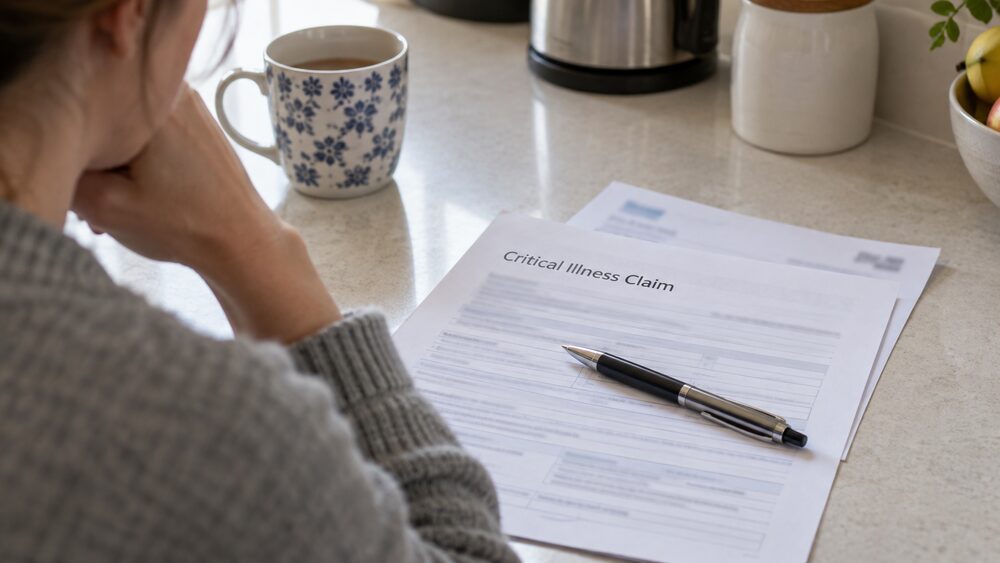
Claiming on protection insurance is not like claiming on car or home insurance. There is no damaged property to inspect and no repair to arrange. Instead, the insurer is checking whether your illness matches what the policy promised to pay for, and that check turns on medical evidence and on what you told them when you applied. Critical illness cover pays a one-off, tax-free lump sum when you are diagnosed with one of the specific conditions covered by the policy1. Income protection works differently: it pays a percentage of your income each month while you cannot work, and claims are typically paid until you return to work, retire or the policy ends2.
The two claims also run on different clocks. A critical illness claim is assessed once, against a defined list of illnesses, and processing it can take months1. An income protection claim is assessed against your ability to work, then repeated for as long as the claim lasts, with payments starting only after a waiting period known as the deferred period4. Understanding which type of policy you hold, and what exactly it promised, is the first step in any claim.
What critical illness cover and income protection pay out
Critical illness cover pays a lump-sum cash payment if you develop a critical illness like cancer, heart failure or stroke2. The payout is triggered by diagnosis, not by being unable to work: critical illness insurance gives you a lump sum if you are diagnosed with a serious illness listed in the policy, regardless of whether it stops you from working3. Policies pay out once, and the cover then ends1.
The list of conditions is long. Critical illness cover pays out if you are diagnosed with one of a list of 100 or more diseases or conditions6, though some policies might not cover all types of these illnesses, so the terms of the specific policy matter7. For cancer, payout can depend on the stage or grade of the cancer8. Cover can be added to a life insurance policy or bought separately9, and it comes in two main types, level cover or decreasing cover1.
One point catches people out with combined policies. A combined policy that pays out for critical illness may reduce the final life insurance payout when you die10. Wrapping critical illness in with life insurance often results in the payout for death being reduced if the insurer has already paid out for critical illness11.
Income protection, by contrast, protects your income if you fall ill and cannot work, paying a percentage of your income each month2. It replaces lost income if you are unable to work due to illness or injury3. Some policies include a total and permanent disability clause, which might pay out if you are unable to do the same or similar work as before, certain activities at work such as lifting, or any kind of work8.
Critical illness or income protection: how each claim works
The two claims are assessed against different tests. On critical illness cover, the ability to claim is not based on your ability to work, but on meeting the criteria set out by the provider as specified when the policy started12. The insurer checks whether your diagnosis meets its definition of a listed condition, including any severity or staging requirements.
On income protection, the test is your capacity to work. You will need to meet the insurer's definition of being unable to work, which may involve medical evidence13. Cover may be written so it pays if you cannot do your own job or occupation, or your job or a similar one you are qualified or have the experience for8. Some policies say you cannot claim if you can do other kinds of work than your own, and illness insurance policies do not always cover every type of illness14.
Both types of policy carry exclusions, and the regulator requires insurers to set these out plainly. Policy documents must show examples of exclusions or limitations, including deferred payment periods, exclusion of certain conditions, diseases or pre-existing medical conditions, moratorium periods, limits on the amounts of cover, limits on the period for which benefits will be paid, restrictions on eligibility to claim such as age, residence or employment status, and excesses15.
If you hold payment protection on a debt, such as mortgage payment protection, you may also be able to make a claim based on illness16. And if you receive sick pay or have access to group income protection through work, you may not need as much individual cover13.
What you need before you make a claim
Before contacting the insurer, gather the policy itself. The policy document tells you which conditions are listed, what the insurer's definition of incapacity is, how long the deferred period is and what is excluded. Without it, you are working from memory about what was promised.
Next, medical evidence. Many insurers will require the illness to be verified by a UK doctor or specialist1. That usually means a diagnosis in writing from a consultant, and the insurer may contact your GP or ask for a report. Evidence requirements for other kinds of financial claim give a sense of what is normal: claims for help with health costs usually need evidence of identity and of income and savings, or evidence that you are claiming certain benefits17.
For state benefits running alongside an insurance claim, the paperwork is different again. A Carer's Allowance claim needs the payslip immediately before the period you want to claim from and any received since, if you are working, or the most recent finalised accounts for your business if you are self-employed18. Terminal illness claims under the special rules for benefits need an SR1 form completed by your doctor or another health professional19.
If someone else will be involved in the claim, sort out their authority early. You can start a benefit claim for someone else if you are with them when they phone or they are terminally ill19, and a caller may have a legal right to apply for someone else, for example if they are an appointee or have power of attorney for someone who cannot manage their own affairs20.
How to make a claim, step by step
The process is broadly the same for both types of policy, with the assessment differing at the decision stage. A Financial Ombudsman Service case gives a sense of the sums involved: one claimant sought the full critical illness benefit of £30,000 under a life assurance policy21.
- Check the policy. Confirm the condition or incapacity is covered, note any exclusions, and check the deferred period on income protection.
- Tell the insurer. Contact them as soon as possible after diagnosis or after you stop work. For group cover through an employer, tell your employer too.
- Provide medical evidence. The insurer will usually ask for details of your diagnosis or incapacity, and may seek a report from your GP or specialist.
- Wait for assessment. Processing a critical illness claim can take months1. Income protection claims are assessed against the deferred period first.
- Receive the decision. A critical illness claim pays a lump sum; an income protection claim pays monthly, typically until you return to work, retire or the policy ends5.
- If refused, complain. First to the insurer, then to the Financial Ombudsman Service if you still disagree.
The deferred period: when income protection payments start
Income protection does not pay from day one. The Financial Ombudsman Service looks at the deferred period that applies to your policy, which is the amount of time you have to have been off work before the policy will start paying you benefit, agreed when you took out the policy4. Most policies include a waiting period, known as a deferral period, which can range from a few weeks to several months after you stop working13. In general, deferral periods range from one to 12 months after you were taken ill, with longer waiting periods often costing less3.
The deferred period exists because the policy is designed to replace income over the long term, not to cover the first weeks of sickness, when sick pay or savings may bridge the gap. When you chose the deferred period, you were trading cost against speed: a longer wait means cheaper premiums, a shorter one means money arrives sooner.
Payments stop on defined triggers. Income protection claims are typically paid until the person returns to work, retires or the policy ends5. Some policies cap the length of a claim instead: options exist for maximum claim periods of one, two or five years, which can make cover more affordable5.
Medical evidence and what the insurer checks
The insurer does not take your word, or even your GP's word alone, for the diagnosis. Many insurers will require the illness to be verified by a UK doctor or specialist1. For income protection, you will need to meet the insurer's definition of being unable to work, which may involve medical evidence13.
What the insurer checks depends on the policy. For critical illness, the check is clinical: does the diagnosis meet the policy's definition of the listed condition, including any requirements about severity, stage or grade8. For income protection, the check is functional: does your condition mean you cannot work as the policy defines it, whether that is your own occupation, a suited occupation or any occupation8.
The insurer may also ask about your medical history, and this is where applications matter. When you buy critical illness cover, you will be asked about your health and the health of people you are closely related to, including parents and siblings8. When applying for income protection insurance, you will need to declare any current mental illnesses you have23. The insurer then tells you whether the conditions you have declared are covered in the policy, and if they are not covered, you may be able to pay an additional premium to have them included24.
One rule protects people with genetic test results. Where treatment started after your insurance cover begins, there is no need to tell the insurance company unless it specifically requests it, but treatment must be disclosed on any new policy25.
Why claims are turned down
Claims are refused for reasons that fall into a few broad groups, and most refusals are about the policy's terms rather than the insurer's mood. The Financial Ombudsman Service sees complaints where an insurer has declined a claim because the death or injury was not caused by an accident, was not solely and directly caused by an accident, because a specific exclusion clause applies, or because the customer's injury or disability is not serious enough to meet the terms of the policy2. The same logic applies to critical illness and income protection: the condition does not meet the policy's definition, or an exclusion applies.
Exclusions are the most common reason. Illness insurance policies do not always cover every type of illness and may exclude pre-existing medical conditions14. Some policies say you cannot claim if you can do other kinds of work than your own14. Deferred periods also refuse claims by design: if you return to work before the waiting period ends, nothing is paid.
Non-disclosure is the other big reason, covered in the next section. Beyond that, some refusals are simply about what insurance can never cover. Insurers cannot cover certainties, so they are legally entitled to refuse cover where the medical prognosis is that you will die during the policy term26.
Whatever the reason, a declined claim should be explained clearly and fairly, with further options such as travel insurance or packaged bank account cover explained27. If you are struggling with debt while a claim is unresolved, it is worth checking whether any of your policies pay out for your situation, including life insurance for terminal illnesses, mortgage payment protection, critical illness cover and income protection insurance28.
Non-disclosure: when what you said at the start matters
Non-disclosure means the insurer found something you did not tell them when you applied. You must tell the truth in your application about any pre-existing conditions: if the insurer finds out later on that you were not entirely honest, it could void your entire policy1. For income protection, you must give your insurer full details of you and your family's medical history, plus dangerous hobbies or a lifestyle that includes smoking, heavy drinking or drug taking14.
The consequences can be severe precisely because the application is the foundation of the cover. A policy priced on incomplete health information was never the policy the insurer agreed to, so the insurer may treat it as if it never existed, which can mean refusing the claim and keeping the premiums paid.
There are limits on how far this goes. Where a consumer gave incorrect information in their application, the ombudsman would usually not uphold the complaint on that basis alone in certain circumstances, recognising that the consumer may not be eligible for cover but that other factors matter29. The ombudsman's approach to pre-existing conditions also recognises the disclosure process: the insurer tells you whether the conditions you have declared are covered, and if not, you may be able to pay an additional premium to have them included24.
Cover with pre-existing conditions is possible but costs more. Any cover you do find is likely to be more expensive, and it may also have more extensive exclusions than cover for people without a history of medical issues1. The dedicated pages on getting cover with a pre-existing medical condition and answering an insurer's questions honestly cover this in more depth.
If your claim is refused: complaints and the Financial Ombudsman Service
Start with the insurer. Where an application is refused, the institution must inform the consumer in writing and free of charge of the reason if lawful, and advise of the complaint procedure and the consumer's right to make a complaint to the Financial Ombudsman Service30. Insurers must also tell you, in the policy summary itself, how to complain to them and that complaints may subsequently be referred to the Financial Ombudsman Service15.
If the insurer's final answer still leaves you disagreeing, the ombudsman is free to use. Consumers can bring a complaint to the free service if the financial firm refuses and the consumer disagrees31. You send some basic information, including your name and address, what the problem is and how you want things put right, and relevant reference details32.
The ombudsman has powers to put things right in ways that matter. Where the ombudsman considers that an insurer has unfairly turned down a claim, it may recommend that the insurer reconsider the claim in line with the terms and conditions of the policy, or pay the claim and add interest to cover the period from the date of the claim until the date the settlement is paid24. More broadly, it might ask an insurer to deal with a claim they have rejected, add interest to any claim that should have been paid, or pay compensation for distress or inconvenience33.
If you used a claims management company, complaints about unjustified or unclear fees, delays in progressing claims, inappropriate or incorrect claims advice, poor communication or failure to follow instructions can be taken to the Claims Management Ombudsman36, and you can complain to the Financial Ombudsman Service if you are unhappy with the service you received from a claims company37. If you believe you were treated worse because of a protected characteristic, the ombudsman can also look at complaints that involve discrimination38.
Tax, benefits and your payout
Tax depends on who paid the premiums. Payments from a critical illness policy are not classed as income, so you will not have to pay any income tax on the money you receive from your insurer1. If you have been paying for the cover yourself, the payout is not taxable12. But if your employer pays for your critical illness cover and you make a valid claim, the payout is taxable via PAYE12. If you share the cost with your employer, the tax-free proportion of the payout mirrors the proportion of the premium you pay for: half the premium means tax on 50% of the payout12.
Income protection payouts are treated differently again, and the page on tax on protection payouts covers the detail. If a payout or the loss of income leaves you needing state support, several benefits may be relevant, and the pages on Statutory Sick Pay, ESA and state support and whether income protection affects your benefits explain how they interact.
A serious illness can also open up other help. The first step for care is to request a care needs assessment and means test from your local authority, which will establish the type of support you need and whether the council will pay towards it39. For people at end of life, claims under the special rules require you to claim the benefit and explain that you are claiming under special rules, with your doctor or cancer nurse filling out an SR1 form if you are claiming Universal Credit or ESA40.
One protection is worth knowing whatever happens to your claim. If the insurer itself fails, income protection insurance is covered by the Financial Services Compensation Scheme: 100% of the payment is covered if the firm failed on or after 3 July 2015, and 90% if before41. The page on life insurance and FSCS protection explains how this works.
Sources41 cited
- Critical illness insurance explained Which?, 2026-08-24
- Personal accident insurance Financial Ombudsman Service, 2026-09-27
- 9 myths about income protection busted Which?, 2025-05-27
- Income protection insurance Financial Ombudsman Service, 2026-09-26
- Redundancy insurance Which?, 2025-11-19
- Joint life insurance explained Which?, 2025-08-06
- Critical illness cover Financial Ombudsman Service, 2026-09-26
- Protection insurance and cancer Macmillan Cancer Support, 2023-09-01
- Family income benefit insurance explained Which?, 2026-09-07
- Over 50s life insurance Which?, 2025-12-03
- Types of life insurance policy Which?, 2025-05-16
- Critical illness cover Cavendish Online, 2026-09-26
- The overlooked insurance that could pay if you're signed off work Which?, 2026-04-04
- Income protection insurance Citizens Advice, 2026-09-26
- ICOBS 6: Helping customers make claims Financial Conduct Authority, 2026-06-26
- Your financial situation and your health StepChange Debt Charity, 2026-09-25
- How do I make a claim for help with health costs Turn2us, 2025-06-16
- How do I claim Carer's Allowance Turn2us, 2026-03-03
- Start your Personal Independence Payment claim Turn2us, 2026-08-14
- Funeral Support Payment telephone application Social Security Scotland, 2026-09-26
- Ombudsman case 25/17 Financial Ombudsman Service, 2003-02
- Shopping around for insurance Independent Age
- What insurance might I need if I have a mental health condition Mental Health and Money Advice, 2023-09-05
- Pre-existing medical conditions Financial Ombudsman Service, 2026-09-26
- Insurance and genetic conditions FAQs Genetic Alliance UK, 2026
- Life insurance with cancer explained Which?, 2026-06-25
- Chargeback rights and Section 75 UK Finance, 2026
- Debt and long-term sickness StepChange Debt Charity, 2026-09-25
- The ombudsman's approach to PPI mis-sale complaints Financial Ombudsman Service, 2026-09-26
- Payment Accounts Regulations 2015 legislation.gov.uk, 2015-12-15
- Festival refunds not guaranteed Financial Ombudsman Service, 2026-06-04
- Complain to the Financial Ombudsman Service Financial Ombudsman Service, 2024-08-20
- Accidental damage Financial Ombudsman Service, 2026-09-26
- What to expect when you complain Financial Ombudsman Service, 2026-07-24
- What to expect from the Claims Management Ombudsman Claims Management Ombudsman, 2020-03-27
- Claims Management Ombudsman leaflet Claims Management Ombudsman, 2026-09-27
- Complain about a claims company GOV.UK, 2026-09-26
- Complaints that involve discrimination Financial Ombudsman Service, 2026-09-26
- Managing money after a dementia diagnosis Which?, 2026-09-20
- Financial help at end of life Macmillan Cancer Support, 2022-09-01
- FSCS insurance cover Financial Services Compensation Scheme, 2026-09-25



 MoneyHelperFree, impartial money and pensions guidance, set up by government
 Financial Ombudsman ServiceFree, independent help when a complaint about a firm is not put right
 FSCSProtects your money if a bank, insurer or investment firm fails
 Citizens AdviceFree advice on money, consumer and legal problems in England and Wales
 Turn2usFree benefits calculator and grants search from a charity