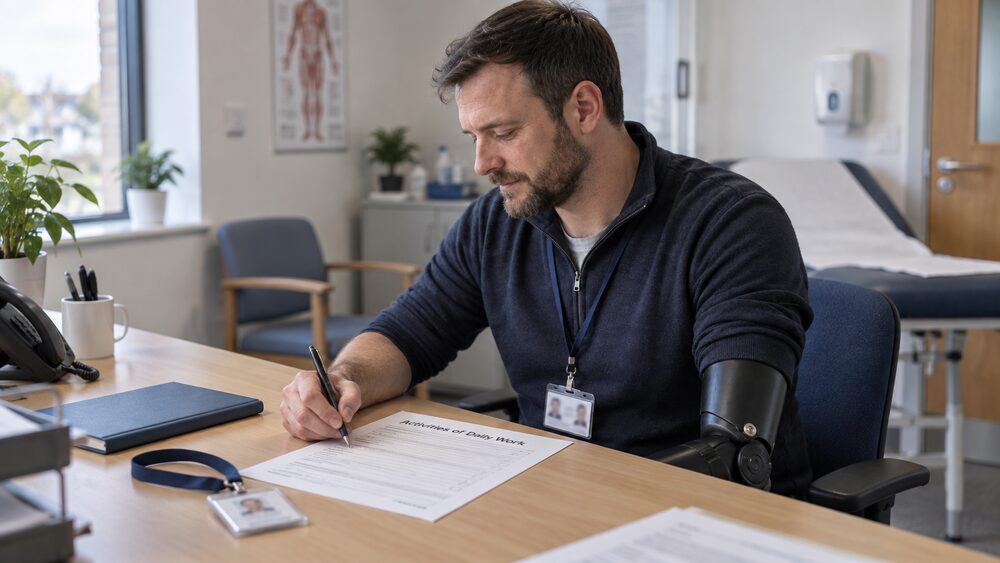
"Activities of daily work" is the phrase used in some insurance policies and benefit assessments to describe the basic tasks a person needs to carry out every day or most days. The Department for Work and Pensions refers to these as "bodily functions" in some of its guidance1. If a claim is being made on a protection policy or a benefit, the assessor may look at whether the claimant can do things like preparing food, washing, dressing, communicating and managing money.
The exact list depends on the policy or benefit. Personal Independence Payment (PIP) uses a set of 10 daily living activities, including preparing food, eating and drinking, washing and bathing, dressing, communicating verbally, reading and understanding signs, and managing money2. The Work Capability Assessment, used for Universal Credit and Employment and Support Allowance, looks at a different set of physical and mental tasks, from mobilising and standing to coping with change and social engagement3.
What matters for a claim is not the label but the definition written into the policy or the rules of the benefit being claimed. Some policies pay out if the holder cannot do a set number of listed activities. In one case the Financial Ombudsman Service looked at, a lifetime care policy would pay a monthly benefit if the policyholder was unable to do three of a list of six defined activities of daily living4. Government assessments work on a points system instead, where points are scored for each task that is difficult and enough points are needed to qualify3.
Activities of daily work: a test of whether basic tasks can be done
At its simplest, an activities of daily work test asks whether a person can carry out the everyday tasks that most people do without thinking. The independent guidance site Advicenow describes these as "anything that you reasonably need to do every day or most days", noting that the DWP also refers to them as "bodily functions"1.
This is not a test of whether someone is well enough to work. The Work Capability Assessment, for example, "doesn't really assess whether you're well enough to work. It assesses whether you can do very specific tasks which give you enough points to qualify for support"6. The same principle applies to insurance policies that use a daily work definition: the question is what a person can physically or mentally do, not whether a doctor would sign them off.
The assessment usually has two parts. For the Work Capability Assessment, that means a questionnaire to complete and a medical assessment to attend7. For PIP, most people have a face-to-face consultation with a health professional to assess their daily living needs as part of the activity test8. The assessor should have read the questionnaire beforehand and should ask questions about a typical day and any problems the claimant has9.
The tasks usually assessed: mobility, lifting, dexterity and communication
The tasks that appear in these assessments fall into a few broad groups. Physical activities include mobilising unaided, standing and sitting, reaching, picking up and moving objects, manual dexterity, making yourself understood, understanding communication, navigation and maintaining safety, continence, and consciousness during waking moments3.
Mental, cognitive and intellectual activities include learning tasks, awareness of everyday hazards, initiating and completing personal action, coping with change, getting about, coping with social engagement, and appropriateness of behaviour with other people3.
PIP's daily living activities are a separate list of 10: preparing food, taking nutrition, managing therapy or monitoring a health condition, washing and bathing, managing toilet needs or incontinence, dressing and undressing, communicating verbally, reading and understanding signs, symbols and words, engaging with other people face to face, and making budgeting decisions8. Some versions of the list use slightly different wording, such as "eating and drinking" instead of "taking nutrition" or "managing treatments" instead of "managing therapy"10.
The Work Capability Assessment questionnaire, known as the WCA50, is organised so that questions 35 to 75 cover physical activities like mobilising, standing and sitting, while questions 76 to 100 cover mental and intellectual functions a person may need in daily life12.
| Assessment | Number of activities | Examples |
|---|---|---|
| PIP daily living | 10 | Preparing food, washing, dressing, communicating, managing money8 |
| Work Capability Assessment (physical) | 10 | Mobilising, standing and sitting, reaching, manual dexterity, continence3 |
| Work Capability Assessment (mental) | 7 | Learning tasks, coping with change, social engagement, behaviour3 |
| Adult Disability Payment (Scotland) | Daily living and mobility components | Same broad daily living tasks as PIP13 |
Where activities of daily work appear in a policy
In insurance, an activities of daily work definition typically appears in policies that pay out when the holder cannot carry out a set list of everyday tasks. These are most common in lifetime care policies, some income protection policies, and older-style permanent health insurance.
The Financial Ombudsman Service has published a case study involving a lifetime care policy "which would pay a monthly benefit if she was unable to do three of a list of six defined activities of daily living"4. The policyholder in that case found she was not covered because the terms of her policy did not match her circumstances. This illustrates how much the exact wording matters: the number of activities, the specific tasks listed, and whether the holder needs to be unable to do them at all or just needs help.
Some policies use a daily work definition as a fallback. If a claim cannot be made under an own occupation definition because the claimant is not working or the occupation no longer exists, the insurer may assess against daily work tasks instead. This is sometimes called a "work tasks" or "activities of daily living" definition.
The definition can also appear in group policies provided by employers. Under tax rules, an "employment policy" is one entered into wholly or partly for the benefit of employees against a health risk14. If an employer provides income protection or permanent health insurance, the definition used will be set out in the scheme rules.
Own occupation, suited occupation or daily work: how each definition behaves
The definition in a policy determines when it pays out, and the difference between definitions can be significant.
Own occupation is the most generous for the claimant. It pays out if the holder cannot do the specific job they were doing before they became ill or disabled. A surgeon who can no longer operate would be paid under an own occupation policy even if they could retrain as a hospital administrator.
Suited occupation is narrower. It pays out only if the holder cannot do their own job or any other job they are reasonably suited to by training, experience or education. An insurer might argue that a different role is possible, and decline the claim on that basis.
Activities of daily work is narrower still. It pays out only if the holder cannot carry out basic everyday tasks. Someone might be unable to do their own job but still able to wash, dress and feed themselves, in which case a daily work policy would not pay.
The Department for Work and Pensions uses the term "capability to work" for its own assessments15. This is a different framework from insurance definitions, but the underlying question is similar: what can a person actually do?
For benefits, the assessment is points-based. The points can be scored in one or more activities3. For example, under the Work Capability Assessment, being unable to move more than 200 metres on level ground without stopping to avoid significant discomfort or exhaustion scores 6 points16. Being unable to cope with any change to the extent that day to day life cannot be managed scores 15 points16.
Why the definition matters at the point of claim
The definition matters most when a claim is made. A policy that seemed comprehensive when it was taken out may pay out on a narrower basis than expected if the definition is restrictive.
For government benefits, the points system means that the severity of a condition is graded. Under PIP, for example, points are awarded for the sentence that is true for most of the time, or more than half the time17. If a person can prepare and cook a simple meal unaided, they score 0 for that activity. If they need an aid or appliance, they score 2. If they need supervision or physical help, they score 418.
The same principle applies to mental health activities. Under the Work Capability Assessment, being unable to reliably initiate or complete at least 2 sequential personal actions due to impaired mental function scores 15 points. Being frequently unable to do so scores 6 points16.
For insurance, the definition is fixed at the point the policy was taken out. It does not change unless the policyholder agrees to a variation. However, some policies include review clauses that allow the insurer to reassess the definition at certain points, so the terms are worth checking.
The Financial Ombudsman Service considers what was, at the time of the event, the relevant law and regulations, regulator's rules, guidance and standards, and industry codes of practice19. This means that if the rules changed after the policy was taken out, the ombudsman will look at the rules that applied when the event happened.
Making a claim assessed on activities of daily work
If a claim is assessed on activities of daily work, the process usually follows a set pattern.
- Complete a questionnaire. For benefits, this might be the ESA50 or WCA50 form giving details of the health condition and how it affects everyday life20. For insurance, the insurer will send its own claim form.
- Provide medical evidence. This can include reports from a GP, specialist or consultant. Supporting evidence is important for any claim21.
- Attend a medical assessment. For the Work Capability Assessment, this is a medical assessment to attend7. For PIP, most people have a face-to-face consultation with a health professional8.
- Receive a decision. The assessor scores the activities and the decision-maker applies the rules.
- Challenge the decision if needed. If the decision is disputed, a mandatory reconsideration can be requested, or a complaint made to the insurer.
The assessor should ask about a typical day and any problems the claimant has9. Keeping a diary of how a condition affects day to day life can help, so that specific examples are available.
Where cover assessed on daily work may not pay
A daily work definition is restrictive, and there are several situations where a claim may not pay even if the claimant is unwell.
The basic tasks can still be done. If a person can wash, dress, prepare food and communicate, they may not meet the threshold, even if they cannot do their job.
The condition is variable. If ability fluctuates, the assessor will look at what is true for most of the time, or more than half the time17. Good days count against a claimant if they are frequent.
The claimant is self-employed or not working. Some policies exclude or limit cover for self-employed people, company directors with shares, temporary or fixed-term contract workers, casual workers, and sometimes consumers employed by relatives22. If a person is not working, an own occupation definition may not apply, and the insurer may fall back on daily work tasks.
Relevant information was not disclosed. Non-disclosure can lead to a claim being declined. The consumer duty to take reasonable care not to misrepresent is set out in guidance dating from 1 October 201323.
The policy terms do not match the circumstances. As the ombudsman case study shows, a policy may define activities in a way that does not cover a particular condition4.
Disclosure, disputes and where to get help
If a claim is refused, there are options.
Complain to the insurer first. The insurer should look into the complaint and reply within 8 weeks. If the response is not satisfactory, or the insurer does not get back in touch, the complaint can be taken further24.
Take it to the Financial Ombudsman Service. The ombudsman can help if a complaint has been made to the financial business and the answer is not satisfactory5. It considers the relevant law and regulations, regulator's rules, guidance and standards, and industry codes of practice at the time of the event19. The ombudsman can ask an insurer to deal with a claim they have rejected, add interest to any claim that should have been paid, or pay compensation for distress or inconvenience25.
Get free, independent help. For benefits, organisations such as Turn2us, Entitledto and Advicenow provide free guidance on assessments and appeals. For money and debt issues, MoneyHelper offers free, impartial help. For work-related support, Access to Work provides a grant to help pay for practical support with work, support with managing mental health at work, and money to pay for communication support at job interviews26.
For insolvency, the Insolvency Service provides information on bankruptcy, redundancy, paying off debts, and company insolvency27.
Sources27 cited
- Understand legal terms related to disability living allowance Advicenow, 2026
- How does the DWP decide on PIP claims? Mental Health and Money Advice, 2025-03-10
- Completing the PIP questionnaire Contact, 2026-05-18
- Consumer finds she's not covered by terms of lifetime care policy Financial Ombudsman Service, 2026-09-27
- Consumer leaflet easy read Financial Ombudsman Service, 2026-09-26
- FAQs about Work Capability Assessment mandatory reconsideration Advicenow, 2026-06
- Work Capability Assessment Turn2us, 2026-01-20
- Tips for completing PIP form Scope, 2025-10-13
- Supporting evidence for a PIP claim Mental Health and Money Advice, 2026-09-26
- Work-focused interviews Carers UK, 2026-09-26
- Adult Disability Payment Entitledto, 2026-09-26
- The questionnaire WCA50 Turn2us, 2026-09-26
- The medical assessment Turn2us, 2026-01-20
- Income Tax (Trading and Other Income) Act 2005, Section 741 Legislation.gov.uk, 2026
- Health conditions, disability and Universal Credit GOV.UK, 2026-09-26
- Limited capability for work and work-related activity element Advicenow, 2026-05
- Handle money Turn2us, 2026-08-14
- Scottish Welfare Fund statutory guidance Scottish Government, 2025-04
- Storm damage Financial Ombudsman Service, 2026-09-27
- Long-term health condition or disability and Universal Credit Entitledto, 2026-09-26
- Employment and Support Allowance case law summaries Disability Rights UK, 2026
- PPI mis-sale complaints Financial Ombudsman Service, 2026-09-26
- Tax on UK income if you live abroad GOV.UK, 2026-09-26
- Financial difficulties with mortgages Financial Ombudsman Service, 2026-09-26
- Accidental damage Financial Ombudsman Service, 2026-09-26
- Frozen accounts and blocked payments Financial Ombudsman Service, 2026-09-25
- Complain about a claims company GOV.UK, 2026-09-26





 MoneyHelperFree, impartial money and pensions guidance, set up by government
 Financial Ombudsman ServiceFree, independent help when a complaint about a firm is not put right
 FSCSProtects your money if a bank, insurer or investment firm fails
 Citizens AdviceFree advice on money, consumer and legal problems in England and Wales
 Turn2usFree benefits calculator and grants search from a charity