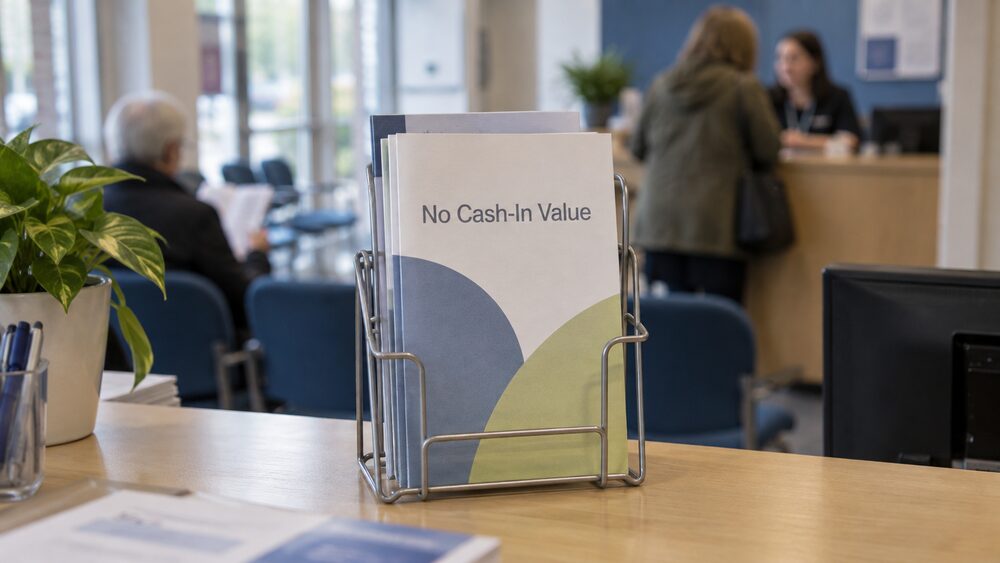
Most protection policies in the UK have no cash-in value. If you pay for life insurance and outlive the policy, you do not get your premiums back. The policy has no cash-in value, so you get nothing back1. That is true of term life insurance, decreasing term cover, increasing term cover and over 50s plans. The money you pay each month buys protection while the policy runs, not a pot of savings you can draw on later.
Most protection policies in the UK have no cash-in value. If you pay for life insurance and outlive the policy, you do not get your premiums back. The policy has no cash-in value, so you get nothing back1. That is true of term life insurance, decreasing term cover, increasing term cover and over 50s plans. The money you pay each month buys protection while the policy runs, not a pot of savings you can draw on later.
This surprises people because the word "insurance" sits alongside products that do build up a fund, such as pensions and investments. Life insurance is not one of them. As one insurer puts it, life insurance is not a savings or investment product and has no cash value unless a valid claim is made2. The only event that releases money is a valid claim, usually your death during the policy term.
The rest of this page sets out when a protection policy does pay out, what happens if you cancel or stop paying, and how putting a policy in trust changes who receives the money and how quickly.
Term life insurance has no cash-in value
Term life insurance is the most common form of protection in the UK, and it is pure protection. You choose a term, say 20 or 25 years, and a sum assured. If you die within that term, the insurer pays the lump sum to your beneficiaries. If you do not, the policy ends and nothing is returned. The policy has no cash-in value so you get nothing back1.
This is not a quirk of one provider. It is how the product is built across the market. Scottish Widows states plainly that life insurance policies have no cash-in value at any time7. Aviva says there is no cash-in value at any time with joint life insurance2. Tesco Life Insurance confirms its policy does not have a cash-in value at any time8. Legal & General describes life insurance as not a savings or investment product, with no cash value unless a valid claim is made2. Lloyds says its life insurance and critical illness cover policies have no cash in value at any time9.
The same applies to the variations on term cover. Decreasing term life insurance, often used alongside a repayment mortgage, has no cash-in value at any time, and stopping premiums ends cover with no benefit10. Increasing term cover, which rises with inflation, works the same way11. Over 50s plans, which accept everyone regardless of health, also have no cash-in value, and premiums must be paid until you die12.
The practical consequence is simple. The premiums you pay are the price of the cover you hold. If you stop paying, the cover stops. There is no fund waiting for you at the end.
When a protection policy does pay out
A protection policy pays out when the event it covers happens. For life insurance, that event is death. Most life insurance policies pay out a cash sum to your loved ones if you die while covered by the policy3. The money goes to the people you choose, your beneficiaries, if you die while the policy is in force13.
The timing matters. Life insurance usually pays out only when you die, so a cancer diagnosis on its own will not trigger a payment14. That is what critical illness cover is for. It pays a lump sum if you are diagnosed with a serious illness, including many types of cancer14. The two products do different jobs, and a life insurance policy will not pay early just because you become seriously ill.
There is one exception worth knowing. Many life insurance policies include terminal illness cover as standard, which allows a claim to be paid early if you are diagnosed with a terminal illness and have a short time to live. This is built into many policies rather than sold separately.
| Policy type | What triggers a payout | Cash-in value |
|---|---|---|
| Term life insurance | Death during the term | None1 |
| Decreasing term life insurance | Death during the term | None10 |
| Over 50s life insurance | Death, whenever it happens | None12 |
| Critical illness cover | Diagnosis of a covered serious illness | None15 |
| Income protection | Being unable to work through illness or injury | None16 |
Cancelling a policy: what you get back
If you cancel life insurance, it simply stops and you do not get any money back12. That is the general rule once you are past the cooling-off period. Typically, you will not get your money back if you cancel your life insurance4.
The exception is the cooling-off period at the start. Term life insurance usually comes with a 30 day cooling-off period, during which you would be refunded any premiums paid so far4. This is a legal right that applies to most protection products, and it exists so you can change your mind after reading the full terms. If you cancel within that window, the policy is treated as though it never started and your premiums are returned.
After the cooling-off period, cancelling is straightforward but final. Decreasing term life insurance can be cancelled at any time with no additional fees, but there is no refund of premiums paid and cover ends on cancellation10. The same pattern holds across providers: the policy stops, the cover stops, and the money already paid stays with the insurer.
If you stop paying premiums
Stopping premiums has the same effect as cancelling. Life insurance policies have no cash-in value at any time, and if you do not pay your premiums on time your cover will stop7. There is no partial refund, no reduced paid-up policy and no fund to draw on.
This applies across the market. Cavendish Online states that its insurance products have no cash-in value at any time, and if you stop paying your premiums your cover will stop10. Royal London says its life or critical illness plans do not have a cash-in value at any time and if you stop paying your premiums your cover will stop18. Cavendish Online's life assurance page adds that if premiums stop, the policy will usually end and no payout will be made19. Royal London's income protection page carries the same wording: these plans do not have a cash-in value at any time16.
For over 50s plans, the consequence is starker. You must pay the premium until you die. If you stop paying, your entire policy is cancelled and you get nothing back12. There is no surrender value and no option to take a smaller payout.
There is no cashback value to most life insurance policies, so if you have to stop paying later because you cannot afford it, that will be lost money7. That is worth weighing before you take out a policy, particularly if your income is variable.
If a policy does lapse, it may be possible to reinstate it later, but this usually depends on the insurer and may require fresh health questions. See missed premiums and lapsed cover for how that works.
Paying into trust: getting the payout to your family faster
A life insurance policy can be put into trust at any time, either when it is first written or at a later date10. Putting it in trust changes who owns the policy and who receives the payout, and it has two practical effects.
First, it keeps the payout out of your estate for inheritance tax purposes. Life insurance payments are not taxed as income, but they may be added to the value of your estate and subject to inheritance tax12. If your estate is valued at more than £325,000, inheritance tax will be charged on the insurance payout5. Writing the policy in trust ensures the payout is not added to the value of your estate and subject to inheritance tax, and may grant access to the funds faster9.
Second, it speeds up payment. The main benefit is that the payout can usually be released more quickly because it does not normally need to wait for probate6. Your family will be eligible for the payout just a few weeks after your death certificate has been issued10. Without a trust, the money forms part of your estate and can be held up while probate is granted, which can take months.
A trust does not replace a will. Writing life insurance in trust can help make sure the policy payout goes to the right people, but it does not deal with everything else you leave behind6. You still need a will for your other assets.
"Yes. Writing life insurance in trust can help make sure the policy payout goes to the right people, but it does not deal with everything else you leave behind."
For more on how trusts work and who can set one up, see writing life insurance in trust.
What happens if you have more than one policy
It is perfectly legal and fairly common for people to have more than one life insurance policy in place at the same time7. You can have more than one policy with the same company or with different providers7. You can also have a joint life insurance policy and a single life insurance policy at the same time7.
Each policy pays out separately according to its own terms. If you hold two term policies and die during both terms, both pay out. This is sometimes used to cover different needs, such as a mortgage and family income, with separate policies. It can also happen when someone changes jobs and picks up a new policy through a workplace scheme while keeping an older one running.
The cash-in value rule applies to each policy individually. None of them builds a fund, and cancelling any one of them means the cover on that policy stops with nothing returned.
Where the money goes when there is no valid claim
If you die outside the policy term, or the policy has lapsed, or the cause of death falls outside the cover, no payout is made. Life insurance policies have no cash value and the insurer will not pay out if you reach the end of the policy without a valid claim20. The policy simply ends.
The same applies if you stop paying. There is no cash-in value at any time, and at the end of your life insurance policy term you stop making payments and the cover ends21. Nothing is returned.
This is why protection policies are sometimes described as renting cover rather than buying an asset. You pay for the protection while you need it, and when the need ends, so does the policy. The value is in the cover itself, not in anything you can cash in.
Where to get help
If you are struggling to pay premiums or are considering cancelling a policy, free and impartial help is available. MoneyHelper, the government-backed money guidance service, offers free information on protection insurance and debt. Debt advice charities such as StepChange and Citizens Advice can help if affordability is the issue.
If you have a complaint about a protection policy or a claim that has been refused, you can complain to the insurer first. If you are not satisfied with the response, you can take the complaint to the Financial Ombudsman Service, which is free to use.
For more on how protection policies work and what each type covers, see the protection insurance guide.
Sources21 cited
- Term life insurance explained Which?, 3 December 2025
- Life insurance glossary Aviva, 19 June 2026
- What is life insurance? Legal & General, 25 March 2026
- Term life insurance Cavendish Online, 26 September 2026
- Critical illness insurance explained Which?, 24 August 2026
- Is your life insurance set up to pay the right person? Which?, 11 July 2026
- Life insurance Scottish Widows, 25 September 2026
- What is life insurance? Tesco Insurance, 20 August 2025
- Life insurance help and guidance Lloyds Bank, 27 September 2026
- Decreasing term life insurance Cavendish Online, 26 September 2026
- Increasing term life insurance Cavendish Online, 26 September 2026
- Over 50s life insurance Which?, 3 December 2025
- Types of life insurance policy Which?, 16 May 2025
- Life insurance with cancer explained Which?, 25 June 2026
- Critical illness cover Scottish Widows, 25 September 2026
- Income protection Royal London, 26 September 2026
- Family and lifestyle protection Santander, 2026
- Life or critical illness cover Royal London, 26 September 2026
- Life assurance Cavendish Online, 26 September 2026
- Barclays life insurance for mortgage holders Barclays, 2026
- My cover Quotemehappy.com, 20 August 2026











 MoneyHelperFree, impartial money and pensions guidance, set up by government
 Financial Ombudsman ServiceFree, independent help when a complaint about a firm is not put right
 FSCSProtects your money if a bank, insurer or investment firm fails
 Citizens AdviceFree advice on money, consumer and legal problems in England and Wales
 Turn2usFree benefits calculator and grants search from a charity