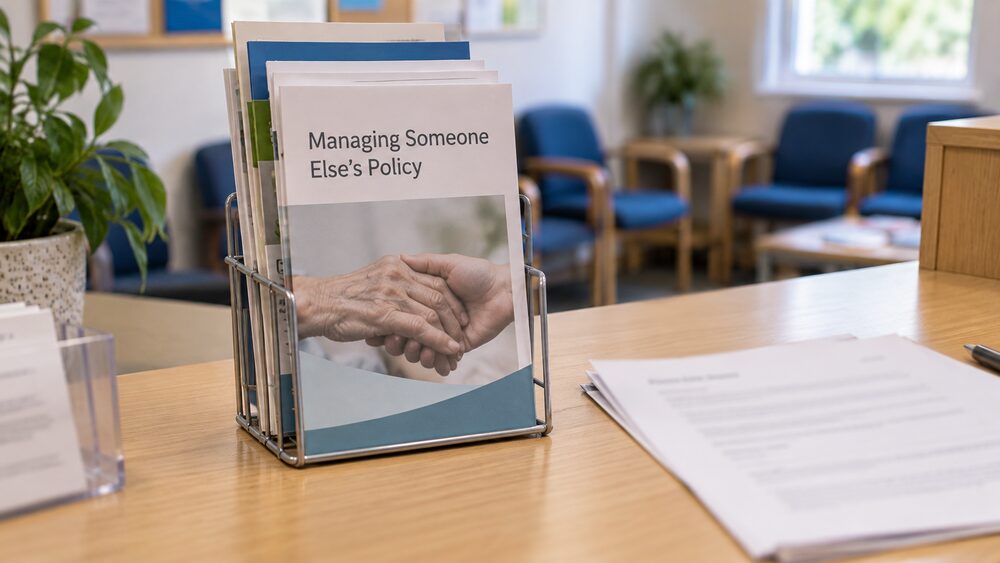
If someone in your family becomes ill, loses the ability to manage their own money, or simply wants help running an insurance policy, the law gives you ways to step in, but only if you have the right paperwork. A bank or insurer will not discuss a policy, take payments from an account or change cover just because you are a spouse, adult child or carer. They need legal authority, and the most common form of that authority in England and Wales is a lasting power of attorney, known as an LPA.
An LPA is a legal document in which someone (called the donor) appoints one or more people (called attorneys) to make decisions on their behalf. A power of attorney enables you to choose a person or more than one person to deal with your property and affairs1. Registering one costs £92 per LPA2, and registration normally takes around 8 to 10 weeks, although one provider reports the whole process can take up to 20 weeks3. The LPA cannot be used with a bank or insurer until registration is complete.
This page explains what you can and cannot do without authority, how an LPA works, what it costs, how to set one up, and where to get help if you are ill, struggling with money worries or facing economic abuse.
Managing a family member's insurance without authority
Without legal authority, your options for dealing with someone else's insurance are limited. You can contact the person's life insurance company to find out about their policy and how to make a claim, but the insurer will decide what it can tell you and what it needs from the policyholder themselves7. Insurers are bound by data protection rules and their own terms, so a phone call from a relative does not unlock a policy.
There are some things that do not require authority at all. If someone holds you responsible for a car accident, they have the right to request your insurance details, and that request can be made later rather than at the scene8. If you are helping someone think through a claim, it is worth knowing that a policyholder can cancel their policy and set up a new one with a different insurer whenever they want, even if a claim is ongoing, although the claim will affect their no-claims bonus9. Some insurers state this in their policy documents, but if it cannot be found, the policyholder could call their insurer and ask10.
A broker can also help. Brokers have permissions and legal authority to act on behalf of their customers11, and they are experts who help you decide what type of insurance and level of cover you need and recommend a suitable policy at a price you can afford12. If the person you are helping already uses a broker, the broker may be able to explain the policy's position, though it still cannot make changes without the policyholder's authority.
The line to hold on to is simple: talking, checking and gathering information is usually possible; making decisions, changing cover, cancelling a policy or taking money from an account is not, unless you hold a power of attorney or the policyholder is present and giving consent.
Two types of LPA, and the one that covers insurance and banking
There are two types of LPA: one for making financial decisions and another for making health and care decisions13. For insurance, banking and anything else to do with money, it is the financial one that matters.
A property and financial affairs LPA gives an attorney the power to make decisions about money and property, including managing bank or building society accounts, paying bills, collecting a pension or benefits, and if necessary selling the home4. It can cover decisions about selling the home, paying the mortgage and bills, and arranging repairs2. The government confirms you can appoint one or more people to make decisions about money and property, including collecting a State Pension6.
A health and welfare LPA is different: it gives an attorney power over matters such as daily routine, washing, dressing and eating, medical care, moving into care and life-sustaining treatment14. When setting it up, the donor must decide whether to give the attorney authority over life-sustaining treatment decisions2. It has no role in running an insurance policy.
The two types also behave differently while the donor still has capacity. A financial LPA can be used, with the donor's permission, while they still have mental capacity, if that option is chosen when setting it up2. The donor decides when this type of LPA starts2. A health and welfare LPA only comes into effect when the donor can no longer make those decisions themselves.
Most banks and insurers will want to see the registered financial LPA before they will let an attorney act, and some will keep their own record of it. If you are setting one up with insurance and banking in mind, the financial LPA is the one to prioritise.
Who can make an LPA and who can be an attorney
To make an LPA, you must be over 18 and able to make your own decisions, which the law calls having mental capacity6. The document must be set up while the donor still has capacity: an LPA remains valid after capacity is lost, but it cannot be created once it has gone15.
A diagnosis of dementia does not automatically rule out making one. The Alzheimer's Society explains that you can still set one up provided you have the mental capacity to understand the document, your choice of attorneys and the consequences of the decision16. Capacity is assessed at the moment the decision is made, so someone who has good days and bad days can make an LPA on a good day, with support if needed.
Attorneys can be relatives, friends or professionals. You can formally appoint a friend, relative or professional to hold a power of attorney that allows them to act on your behalf1. If more than one attorney is appointed, the power of attorney will state whether they must make decisions together (jointly) or whether each can act independently (jointly and severally)17. A joint appointment means nothing can be done unless all attorneys agree, which can cause delays if one is ill or abroad; joint and several appointments let one attorney act alone.
Attorneys appointed under an LPA must act in the best interests of the individual14. On payment, an attorney usually cannot claim for time spent carrying out their duties unless they are a professional attorney, such as a solicitor, although a non-professional attorney can be paid if this is specified in the instructions part of the LPA form2.
Registration fee: £92 per LPA, with reductions and exemptions
Registering an LPA costs £922. Because many people register both types at the same time, one financial and one health and care, the total for two is £1842.
The fee is not the same across the UK. In England and Wales it is £92 per LPA, in Scotland £99, and in Northern Ireland £1894.
Help with the fee exists. If you are on a low annual income (under £12,000), you might be eligible for a 50% discount, and if you are receiving certain income-related benefits you will not have to pay anything at all2. The reduced fee for those who qualify is currently £41 and will go up to £46 on 17 November18.
The registration fee is separate from any help you pay for. You can choose to use a solicitor to complete the application for you, which typically costs between £500 and £8004. Completing the forms yourself using the official service costs only the registration fee, and charities such as Age UK publish guidance to help.
| Cost | Amount | Notes |
|---|---|---|
| Registration, England and Wales | £92 per LPA | £184 for both types together2 |
| Registration, Scotland | £99 | 4 |
| Registration, Northern Ireland | £189 | 4 |
| Reduced fee | £41, rising to £46 on 17 November | For those who qualify18 |
| Low income (under £12,000) | 50% discount | 2 |
| Certain income-related benefits | No fee | 2 |
| Solicitor-prepared application | typically £500 to £800 | 4 |
How to set up and register an LPA
The process is straightforward but must be followed in order. Get LPA forms and an information pack from the Office of the Public Guardian: download them online, order them by calling 0300 456 0300, or use the online service on GOV.UK2. Registration is done through the Office of the Public Guardian19.
Before an attorney can use their authority, the LPA must be registered with the Office of the Public Guardian20. This is the step people most often underestimate: a signed but unregistered LPA is not usable with a bank or insurer.
When completing the forms, the donor chooses the attorneys, decides whether they act jointly or jointly and severally17, and, for a financial LPA, decides when it should start2. The donor can also include instructions and preferences, such as how the attorney should be paid or what they should prioritise2.
The donor must have capacity when signing, and the document must be witnessed as the forms set out. Once the Office of the Public Guardian has registered the LPA, it can be used with providers. If the donor later loses capacity, nothing further is needed for an LPA that is already registered, which is the key difference from the older enduring power of attorney described later on this page.
Registration takes weeks, and the LPA cannot be used until it is done
It normally takes around 8 to 10 weeks to register an LPA, as long as there are no errors with the application4. Errors, missing signatures or unanswered questions will add delay, because the Office of the Public Guardian will return the form for correction.
Some providers give a longer picture. NS&I states that an LPA must be registered with the Office of the Public Guardian before it can be used with it, and that it can take up to 20 weeks to set up21. The gap between the two figures reflects the difference between the registration process itself and the whole journey, including gathering documents, correcting errors and sharing the registered LPA with each provider.
The practical lesson is to plan ahead. Someone who wants an attorney ready to act if they become ill cannot wait until the illness arrives: the LPA must be made while they have capacity15 and registered before it can be used20. Families dealing with a dementia diagnosis often find the window for setting one up is shorter than they expected, which is why the Alzheimer's Society guidance on making one after a diagnosis matters16.
While waiting for registration, the donor continues to manage their own affairs, and anyone helping them can only do what the donor authorises informally, such as being present on calls or helping with paperwork.
Sharing an LPA with a provider: access codes and paper copies
Once registered, the LPA has to reach each bank, insurer or other organisation before the attorney can act. In England and Wales, you can share an LPA with organisations electronically if it was registered on or after 1 January 2016, generating an access code via the government website17. The donor or attorney gives the code to the organisation, which uses it to view the registered LPA online.
The unique code lasts for 30 days21. If it expires before the organisation has retrieved the LPA, a new code can be generated. NS&I, for example, asks customers sending a code to include specific identifying information alongside it21.
Not every provider uses codes, and not every LPA can be shared this way. Older LPAs, and the enduring powers of attorney described in the next section, exist on paper. For an enduring power of attorney, you or your attorney will need to show signed copies of the EPA to banks and financial providers so the attorney can manage the accounts22. Many organisations keep a copy on file once they have seen the original, so the work of sharing it is done once per provider.
Expect each provider to have its own process. Some register the attorney on the account immediately; others require the attorney to call, visit a branch or complete their own form before they will discuss the policy or account. The attorney may be asked for identification as well as the LPA.
Changing or cancelling an LPA, and older enduring powers
While a donor still has mental capacity, they keep control: they can continue to manage their own affairs and change or cancel their power of attorney23. An LPA can be cancelled at any time while the donor has mental capacity, by sending the original LPA document and a deed of revocation to the Office of the Public Guardian2.
An LPA does not expire on its own. It remains in place until the donor passes away or revokes the authority4. So a document made at 50 is still valid at 80 unless the donor cancels it, which is worth remembering if family circumstances change, for example after a divorce or the death of an attorney.
Many older people hold the predecessor document, an enduring power of attorney or EPA. An EPA is a document that appoints someone, an attorney, to help manage property, money and financial affairs22. It is the older form of power of attorney, which has now been replaced by the lasting power of attorney, and it is no longer possible to make a new EPA24. EPAs signed and witnessed before October 2007 can still be used: the donor can either continue to use it, or cancel it and set up a property and financial affairs LPA instead22.
The crucial difference is what happens when capacity is lost. If you lose mental capacity, your attorney must register the EPA with the Office of the Public Guardian before they can make any decisions on your behalf2. Registration is triggered when the attorney thinks the donor is beginning to become unwell or already lacks capacity to manage their own finances19. To register an EPA you need to fill in form EP2PG online or call the Office of the Public Guardian on 0300 456 0300 and ask them to post a copy19. The registration fee for an EPA is £9224.
An existing EPA cannot be changed; the official guidance is to cancel it and set up an LPA instead22. If you have the capacity to make decisions, you can cancel the old EPA and register a new LPA19. When cancelling an unregistered EPA, you must let your attorney or attorneys and any relevant banks and financial providers know22.
Where an LPA does not apply: Scotland and Northern Ireland
The LPA is an England and Wales document. Scotland and Northern Ireland have their own systems, and the fees differ too: £92 per LPA in England and Wales, £99 in Scotland and £189 in Northern Ireland4.
In Northern Ireland, the equivalent document is still called an enduring power of attorney. It must be set up while you have capacity and registered with the Office of Care and Protection if you become incapable25. If or when you lose capacity, your attorney must register the form with the Office of Care and Protection25.
Northern Ireland also has a fallback for people who have no EPA and have lost capacity. The family may need to apply to the Office of Care and Protection to become a controller, which gives similar powers to those of an attorney but is time-consuming and expensive25. Controllership gives the right to manage someone's property and financial affairs, with supervision from the Office of Care and Protection17. The lesson is the same as in England and Wales: arranging authority in advance is far easier than applying to a court after capacity is lost.
Scotland has its own continuing and welfare powers of attorney, administered separately, and the registration fee there is £994. An ordinary power of attorney made in any part of the UK has a further limit: while a power of attorney ceases if you become mentally incapable of managing your affairs, an enduring power of attorney will continue1.
Joint accounts and other alternatives
Some families consider a joint account instead of an LPA, so a relative can pay bills directly. This works, but it carries risks that an LPA does not.
Opening a joint account adds a financial link to the other person, so companies look at both credit histories, and a poor history might lower the chances of acceptance26. Only consider opening a joint bank account with someone you trust, as it could damage your credit score if they have poor credit, and you could be responsible if they run up debt27. Some savings accounts can be held jointly, for example NS&I's Direct Saver can be opened in your own name or jointly with one other person28, but the same linking of finances applies.
There is a specific danger when illness is the reason for the arrangement. If a partner loses mental capacity, the joint account could be frozen unless there is a power of attorney in place; the bank might freeze it completely or only allow essential payments26. So a joint account set up precisely for the situation where capacity is lost can stop working at the moment it is most needed.
Joint accounts also change deposit protection. The FSCS protection tool assumes a joint account with two account holders, each with an equal share29, so money in a joint account is split between the holders for protection purposes rather than all counting to one person.
For most families, an LPA is the more flexible route: it gives the attorney authority without transferring ownership of the money, it survives loss of capacity, and it can be cancelled by the donor while they still have capacity2.
Help if you are ill, struggling with money worries or facing economic abuse
If illness is the reason money has become difficult, check what cover already exists. Mortgage payment protection insurance is an insurance policy that covers your repayments if you become ill or lose your job28. If you have lost your job or are too ill to work, check whether you have mortgage protection insurance to cover your payments29. Some people also hold payment protection of other kinds; in one ombudsman case study, a monthly-premium PPI policy cost 79p for each £100 of the statement balance30, a reminder that small monthly premiums can add up over a long policy.
If you are managing someone else's policy and disagree with how an insurer or bank has treated you as an attorney, the Financial Ombudsman Service can consider complaints about powers of attorney, including how a firm has dealt with an attorney acting for a donor23.
Money worries and mental health often go together, and free help exists. FSCS points people struggling with money worries towards resources for mental health support25. Mind provides confidential advice and support to anyone experiencing a mental health problem, on 0300 123 339326. Rethink Mental Illness runs a national helpline on 0300 5000 927 and support groups for people living with mental illness, their carers and relatives26.
Economic abuse, where a partner or ex-partner controls someone's money, is widespread. In the past 12 months, over 5 million women have experienced economic abuse, 2.1 million had restricted access to their bank accounts, and 60% of those experiencing economic abuse have accumulated debts as a result of the controlling, coercive actions of the perpetrator, with victim-survivors accruing debts of £27k split across five creditors on average27. If this is your situation, or the situation of the person you are helping, specialist support services exist, and debts built under coercion may be challengeable: the Financial Ombudsman Service looks at complaints where a lender did not treat a vulnerable customer fairly.
For wider reading, the guides to protection insurance, claiming on a life insurance policy after someone dies, missed premiums and lapsed cover and what you get if you cannot work cover the insurance side of illness and bereavement, and the debt guide covers where to get free help with money problems.
Sources30 cited
- Help to collect your benefits or pension nidirect, 2026-06-26
- Claiming on life insurance Marie Curie, 2026-04-14
- Fault claims and no-claims bonuses Financial Ombudsman Service, 2026-09-16
- When to use an insurance broker MoneyHelper, 2026-09-25
- Who is involved in the claims process FSCS, 2026-09-25
- Power of attorney Age UK, 2026-01-09
- Ordinary power of attorney Age UK, 2026-03-23
- Nominate someone to collect your State Pension GOV.UK, 2026-09-26
- Managing money after a dementia diagnosis Which?, 2026-09-20
- What is a lasting power of attorney (LPA)? Equity Release Council, 2022-09-02
- Setting up power of attorney Which?, 2026-02-26
- What is power of attorney Which?, 2026-02-26
- Power of attorney fees rise this month Which?, 2025-11-05
- What is lasting power of attorney Mental Health and Money Advice, 2025-03-10
- Manage a bank account for someone else GOV.UK, 2023-05-02
- Manage savings for an adult NS&I, 2026-04-02
- Use or cancel an enduring power of attorney GOV.UK, 2026-09-26
- Enduring power of attorney Age UK, 2026-01-09
- Complaints about power of attorney Financial Ombudsman Service, 2026-09-26
- Dementia and managing money nidirect, 2026-09-03
- Joint accounts MoneyHelper, 2026-09-25
- Choosing a bank account for your Universal Credit payment MoneyHelper, 2026-09-25
- Check your money is protected FSCS, 2026-09-25
- NS&I Direct Saver NS&I, 2026-09-04
- Cost of living crisis: mental health support FSCS, 2026-09-25
- Debt and mental health Advice NI, 2026
- From Control to Financial Freedom report UK Finance, 2024-05
- Advice to avoid losing your home nidirect, 2025-12-03
- Mortgage arrears or payment difficulties nidirect, 2025-11-07
- Payment protection insurance (PPI) case studies Financial Ombudsman Service






 MoneyHelperFree, impartial money and pensions guidance, set up by government
 Financial Ombudsman ServiceFree, independent help when a complaint about a firm is not put right
 FSCSProtects your money if a bank, insurer or investment firm fails
 Citizens AdviceFree advice on money, consumer and legal problems in England and Wales
 Turn2usFree benefits calculator and grants search from a charity